How a public-private partnership advisor turned client-cleared transaction summaries, development-finance press, multilateral-institution engagement letters, conference addresses, policy-journal authorship, and compensation evidence into a USCIS-approved EB-1A case.
Key facts at a glance
| Petition outcome | Form I-140 approved under EB-1A on May 6, 2026. |
| Professional profile | Nigerian advisor who structured public-private partnerships for power and transport projects across West Africa. |
| Field niche | PPP structuring for frontier-market infrastructure. |
| Starting weakness | Government confidentiality and public deal announcements often hid the advisor’s name and specific contribution. |
| Profile-building focus | Client-cleared transaction summaries, development-finance press, multilateral-institution engagement letters, conference addresses, policy-journal authorship, and compensation benchmarking. |
| EB-1A criteria supported | Leading role, original contributions, published material, high remuneration, and membership. |
| Central issue | Proving the petitioner’s own advisory authority without disclosing confidential government or transaction information. |
| Approval lesson | In infrastructure PPP cases, independent institutional validation can turn hidden advisory work into evidence USCIS can evaluate. |
The approval
On May 6, 2026, USCIS approved the Form I-140 petition of an EB-1A Infrastructure PPP Consultant whose work helped structure power and transport projects across West Africa, but whose strongest achievements were mostly hidden behind government confidentiality, development-finance protocols, and deal announcements that did not name the advisors behind the work.
Inside the infrastructure and development-finance community, the value of his work was clear. Projects moved from policy concept to bankable structure. Public agencies, private investors, and institutional stakeholders relied on his judgment to make complicated power and transport initiatives more feasible in frontier markets. Yet the public record did not fully show his role.
For EB-1A, the petition had to prove more than participation in important projects. It had to show extraordinary ability in PPP structuring for frontier-market infrastructure and document why his individual expertise mattered to the field.
That became the center of the case: turning confidential transaction work, unnamed advisory influence, and institutional trust into evidence USCIS could read and evaluate.
The evidence problem in infrastructure PPP consulting
Infrastructure PPP work can be difficult to document because the best evidence is often private, politically sensitive, or protected by client confidentiality. Government agencies may announce projects without identifying the advisors who structured the transaction. Development-finance institutions may describe the project but not the professional judgment behind it. Private sponsors may value the consultant’s work while still limiting what can be disclosed.
The petitioner’s starting weakness was not lack of achievement. It was lack of visible attribution. He had advised on serious power and transport matters, but much of the public record attached the success to ministries, agencies, investors, or project companies rather than to the professional who helped shape the PPP structure.
This required a focused field definition. The case was not presented as general business consulting, general finance, or broad project management. It was framed as PPP structuring for frontier-market infrastructure, with emphasis on the specialized work required to make public-interest infrastructure attractive, legally workable, and financially credible for multiple stakeholders.
That field definition gave the petition a credible measuring stick. The question was not whether the petitioner was a public celebrity or a famous banker. The question was whether his PPP structuring work was recognized as serious, specialized, and significant within the infrastructure-development field.
Why transaction announcements were only the beginning
It would have been tempting to rely on project announcements alone. That would have been risky. USCIS could reasonably ask whether a public transport or power project succeeded because of government policy, investor capital, engineering contractors, political momentum, or the petitioner’s own advisory work.
The record therefore treated transaction announcements as a starting point, not the conclusion. The petition had to show what the petitioner actually did inside those transactions: how he contributed to structure, risk allocation, stakeholder alignment, financeability, and implementation readiness.
The strongest evidence came from client-cleared transaction summaries, institutional letters, conference records, development-finance visibility, and policy-focused authorship that explained his role without exposing confidential government or commercial information.
That distinction changed the case. Instead of asking USCIS to infer significance from unnamed infrastructure deals, the petition translated transaction work into specific, attribution-based evidence of professional authority.
Client-cleared transaction summaries became the backbone of the case
In some EB-1A fields, strong evidence appears in patents, citations, awards, or public product launches. In infrastructure PPP consulting, the most persuasive evidence may be carefully drafted transaction summaries that disclose enough to prove the petitioner’s role while respecting client confidentiality.
The petition used that evidence carefully. The goal was not to reveal confidential project terms, government negotiations, procurement details, or financial models. The goal was to document the nature of the petitioner’s advisory contribution in safe terms: project type, sector, geography, stakeholder environment, scope of responsibility, and the practical significance of his structuring work.
Good evidence did not say only that he “advised on infrastructure projects.” It explained what he did: helped clarify PPP models, supported risk allocation, prepared stakeholder-facing materials, contributed to financing strategy, advised on procurement or concession structure, and helped align public objectives with investor expectations.
Those materials gave USCIS a way to understand high-level transaction impact without asking a government client or development institution to disclose sensitive information. They also helped separate the petitioner’s individual contribution from the broader project ecosystem.
Leading-role evidence had to show advisory authority, not project association
A consultant can be connected to an impressive project without being central to it. That is why leading-role evidence had to be handled carefully. The petition could not merely list power projects, transport initiatives, agencies, or development partners. It had to show that the petitioner held meaningful advisory responsibility within those matters.
The record documented his authority over transaction structuring, stakeholder coordination, project-positioning strategy, and advisory outputs used by public and private decision-makers. It showed that organizations relied on his expertise at points where projects needed practical judgment, not just administrative support.
That evidence helped separate true PPP leadership from ordinary consulting participation. The case showed that his work influenced how projects were framed, evaluated, and advanced toward implementation.
For infrastructure consultants, this distinction matters. A résumé may list sectors, governments, or deal names. An EB-1A petition must prove what the professional actually carried and why that responsibility was important.
Original contribution in a PPP structuring case
Original contribution can be difficult in advisory work because the output is often a structure, framework, transaction pathway, or decision memo rather than a public invention. The contribution may be highly valuable but invisible to people outside the transaction.
For this petitioner, the original-contribution evidence was built around his approach to PPP structuring in frontier-market infrastructure. The petition showed how his work helped convert complex public needs into transaction models that could be understood by governments, investors, development-finance stakeholders, and implementation partners.
That mattered because USCIS looks for contributions of significance, not routine job performance. The evidence had to show that his work was not just internal consulting labor, but a meaningful contribution to how infrastructure projects could be structured in difficult market conditions.
The petition did not claim that he invented PPPs or infrastructure finance. It made a narrower and more defensible point: within frontier-market power and transport infrastructure, his structuring work helped move difficult projects toward bankable, stakeholder-supported models.
Published material and development-finance visibility
The original profile had limited public visibility because finance and infrastructure press often focus on project sponsors, government announcements, and institutional lenders rather than individual advisors. That is especially true in West African infrastructure, where the most important professional work may happen behind the scenes.
Development-finance press, policy commentary, infrastructure articles, conference coverage, and sector-focused authorship helped make the petitioner’s expertise visible without overstating his role. These materials positioned him as a professional voice in PPP structuring and frontier-market infrastructure, not just a name attached to private advisory work.
The petition treated published material as supporting evidence, not decoration. The most useful public evidence connected his name to infrastructure policy, PPP strategy, investment readiness, or development-finance themes that matched the field niche of the case.
High remuneration and compensation benchmarking
The high-remuneration criterion can be useful for infrastructure advisors, but it must be compared against the right peer group. A PPP consultant working across frontier markets should not be compared casually to all consultants, general project managers, or local administrative professionals.
In this case, remuneration evidence was organized around relevant comparators: infrastructure PPP advisors, development-finance consultants, transaction-structuring specialists, and senior professionals working on power, transport, and public-private investment matters in comparable markets.
That benchmarking helped show that the petitioner’s compensation reflected market recognition for specialized advisory expertise. It also supported the broader argument that his judgment was valued in a field where reliable structuring expertise is scarce and commercially important.
Membership and institutional recognition
Membership evidence can be weak when it reflects ordinary enrollment. In this case, it became useful when tied to professional infrastructure, finance, or PPP bodies that reflected serious participation in the field.
The petition used industry-body membership and institutional engagement carefully. These records helped show that the petitioner operated within a recognized professional ecosystem and that his expertise was not limited to one employer or one client relationship.
The strongest institutional validation came from multilateral-institution engagement letters. In frontier-market infrastructure, such letters can carry unusual weight because they come from organizations that understand project finance, public-sector constraints, procurement realities, and the quality of advisory work required to advance difficult transactions.
How the EB-1A criteria worked together
The petition did not depend on one perfect document. It worked because multiple forms of evidence pointed in the same direction and supported the same field theory:
- Leading role: Client-cleared records and institutional letters showed responsibility for PPP structuring, stakeholder coordination, and transaction-facing advisory work in power and transport projects.
- High remuneration: Compensation evidence was benchmarked against relevant infrastructure, PPP, and development-finance advisory peer groups.
- Published material: Development-finance press, policy-journal authorship, conference visibility, and sector commentary made his expertise legible beyond confidential transaction files.
- Membership: Industry-body involvement and institutional engagement helped show recognized participation in the infrastructure and PPP ecosystem.
- Original contributions: Transaction summaries and institutional letters showed that his structuring work helped advance infrastructure projects in complex frontier-market conditions.
The strongest part of the record was coherence. The case did not drift into generic claims about business consulting, public policy, or project management. It stayed focused on PPP structuring for frontier-market infrastructure and showed why the petitioner was recognized within that field.
The final-merits argument
At the final-merits stage, the petition had to show more than satisfaction of individual criteria. It had to demonstrate that, taken together, the evidence established sustained acclaim and extraordinary ability in the petitioner’s field.
The argument centered on independent validation rather than confidential deal value alone. The petitioner was not presented as someone who simply worked on important projects. He was presented as a PPP structuring professional whose expertise had been trusted by clients, recognized by institutions, discussed in the development-finance space, and valued at a high level in the market.
The final record showed that his expertise had been recognized through advisory responsibility, disclosure-safe transaction documentation, multilateral engagement letters, policy and conference visibility, membership evidence, and compensation benchmarking.
That is why the case was stronger than a file built around infrastructure deals alone. It told USCIS who the petitioner was within the field, what he contributed, and why independent professionals treated his work as significant.
Why the approval mattered
The approval mattered because it showed how an infrastructure PPP consultant can qualify when confidential advisory work is converted into safe, specific, and independently validated evidence.
For this Nigerian consultant, the petition did not try to present him as a government official, celebrity dealmaker, or general finance executive. It documented him as a specialized PPP structuring advisor whose work helped make power and transport projects more feasible in frontier-market conditions.
The approval confirmed the central lesson of the case: government confidentiality does not make a strong case impossible, but it does require careful evidence design. When transaction summaries, institutional letters, public visibility, and compensation data are aligned, confidential infrastructure work can become a credible EB-1A record.
Lessons for PPP consultants and infrastructure advisors
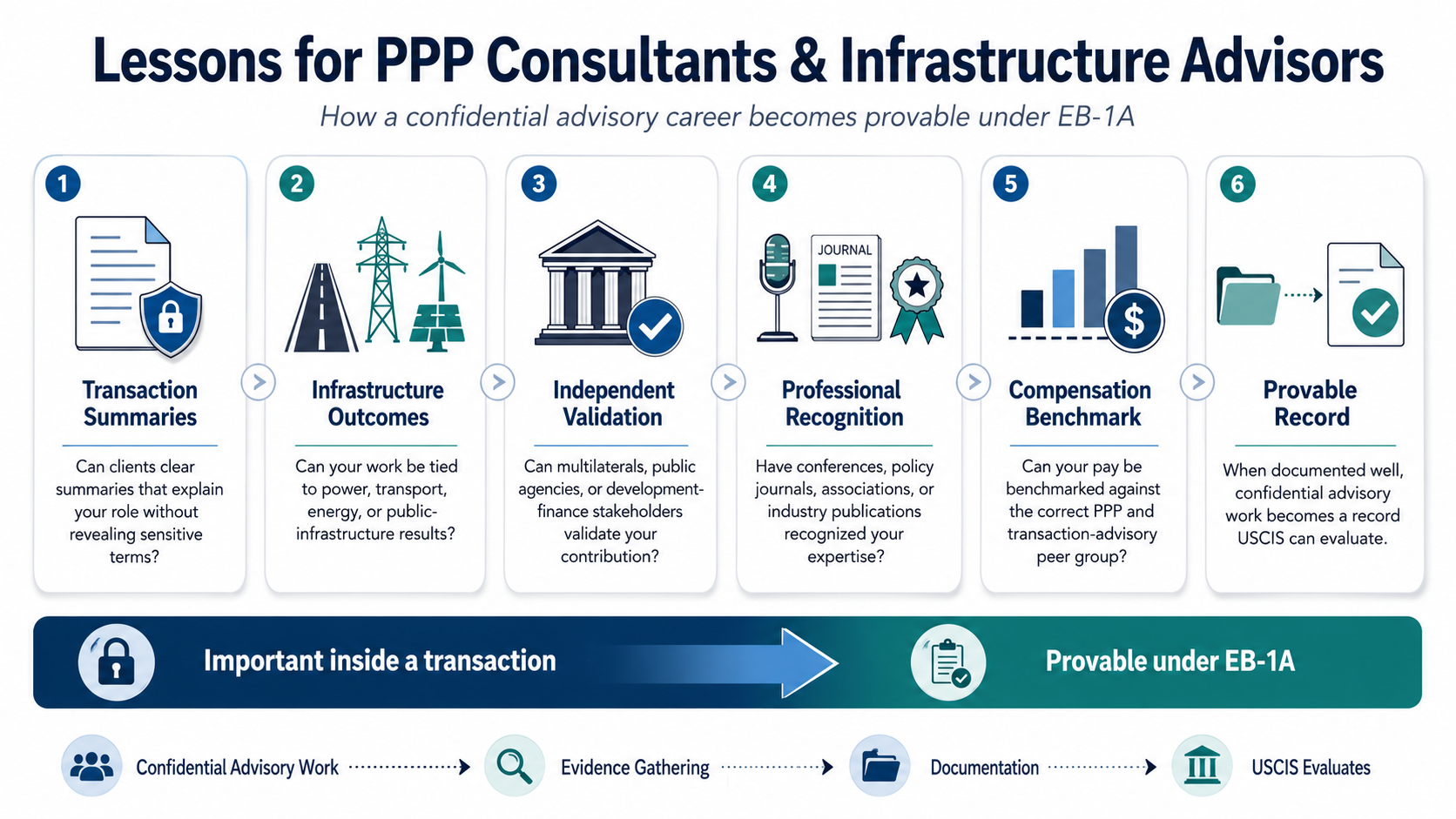
This case is useful for infrastructure advisors, PPP consultants, project-finance professionals, development-finance specialists, and public-sector transaction advisors whose strongest accomplishments are serious but not fully public.
A strong record usually begins with the following questions:
- Can your clients clear transaction summaries that explain your role without disclosing sensitive terms?
- Can your advisory work be connected to specific power, transport, energy, or public-infrastructure outcomes?
- Do multilateral institutions, development-finance stakeholders, or public agencies have a basis to validate your contribution?
- Have conferences, policy journals, industry associations, or development-finance publications recognized your expertise?
- Can your compensation be benchmarked against the correct PPP, infrastructure, and transaction-advisory peer group?
When those questions are answered with documents, a confidential advisory career can become a record USCIS can evaluate. That is the difference between being important inside a transaction and being provable under EB-1A.
Frequently asked questions
Can an infrastructure PPP consultant qualify for EB-1A?
Yes. An infrastructure PPP consultant may qualify for EB-1A if the evidence shows sustained acclaim and extraordinary ability in a clearly defined field, such as PPP structuring for frontier-market infrastructure. The petition must document the consultant’s own recognized expertise, not just the importance of the projects involved.
Can confidential government or transaction work support an EB-1A petition?
It can support the petition when documented safely. Useful evidence may include client-cleared transaction summaries, institutional letters, non-confidential project descriptions, policy publications, conference records, and expert letters that explain the petitioner’s role without exposing sensitive details.
Is PPP structuring a strong EB-1A field niche?
It can be strong when defined carefully. PPP structuring for frontier-market infrastructure is more specific than general consulting because it involves public-sector objectives, investor requirements, financeability, risk allocation, procurement realities, and implementation strategy.
How can multilateral-institution letters help a PPP consultant’s EB-1A case?
Multilateral-institution letters can be powerful because they come from organizations familiar with infrastructure transactions, development finance, public-sector constraints, and the quality of advisory work required to move difficult projects forward.
Can policy-journal authorship support an EB-1A infrastructure case?
Yes. Policy-journal authorship may support published-material or original-contribution arguments when the writing is connected to the petitioner’s field niche and shows recognized expertise in infrastructure, PPP strategy, development finance, or frontier-market project structuring.
Can Immignis and Advance My Profile help PPP consultants build EB-1A evidence?
Immignis and Advance My Profile help PPP consultants, infrastructure advisors, development-finance professionals, and transaction specialists define a defensible field niche, organize confidential evidence safely, build independent validation, and present a clear EB-1A record.
Build an EB-1A record around infrastructure expertise and independent validation
Many infrastructure consultants and PPP advisors help shape major public projects while remaining invisible in public announcements. Client-cleared summaries, multilateral letters, development-finance visibility, conference addresses, policy authorship, and compensation benchmarking can turn that hidden work into petition-ready evidence.