How an EB-1A Ophthalmologist from Sudan secured approval by turning trachoma elimination campaign leadership into a petition ready immigration profile built on surgical volume attribution, elimination program leadership letters, tropical medicine publications, WHO partner documentation, training program records, and ethical profile building.
Key facts at a glance
| Petition outcome | Form I-140 approved under EB-1A on August 21, 2024. |
| Professional profile | Sudanese eye surgeon central to trachoma elimination campaigns across affected regions. |
| Field niche | Neglected tropical eye disease surgical programs. |
| Starting weakness | Campaign metrics belonged to programs, ministries, NGOs, and donors, while the petitioner’s own surgical volume, leadership, training role, and field contribution were not clearly attributed to him as an individual. |
| Profile-building focus | Surgical volume attribution, elimination-program leadership letters, tropical medicine publication, WHO partner documentation, training program records, membership evidence, judging or case-review service, independent expert letters, and immigration-specific profile building. |
| EB-1A criteria supported | Original contributions, leading role, scholarly articles, membership, and judging. |
| Central issue | Showing that the petitioner was not merely one doctor inside a public health campaign, but a field-level ophthalmologist whose surgical output, leadership, training work, and program involvement helped advance trachoma-elimination efforts in affected regions. |
| Approval lesson | In neglected disease and public health medicine, EB-1A evidence must convert campaign level success into person centered proof. Elimination campaign leadership can become top of field evidence when attribution, surgical volume, training roles, and partner validation are documented clearly. |
The approval
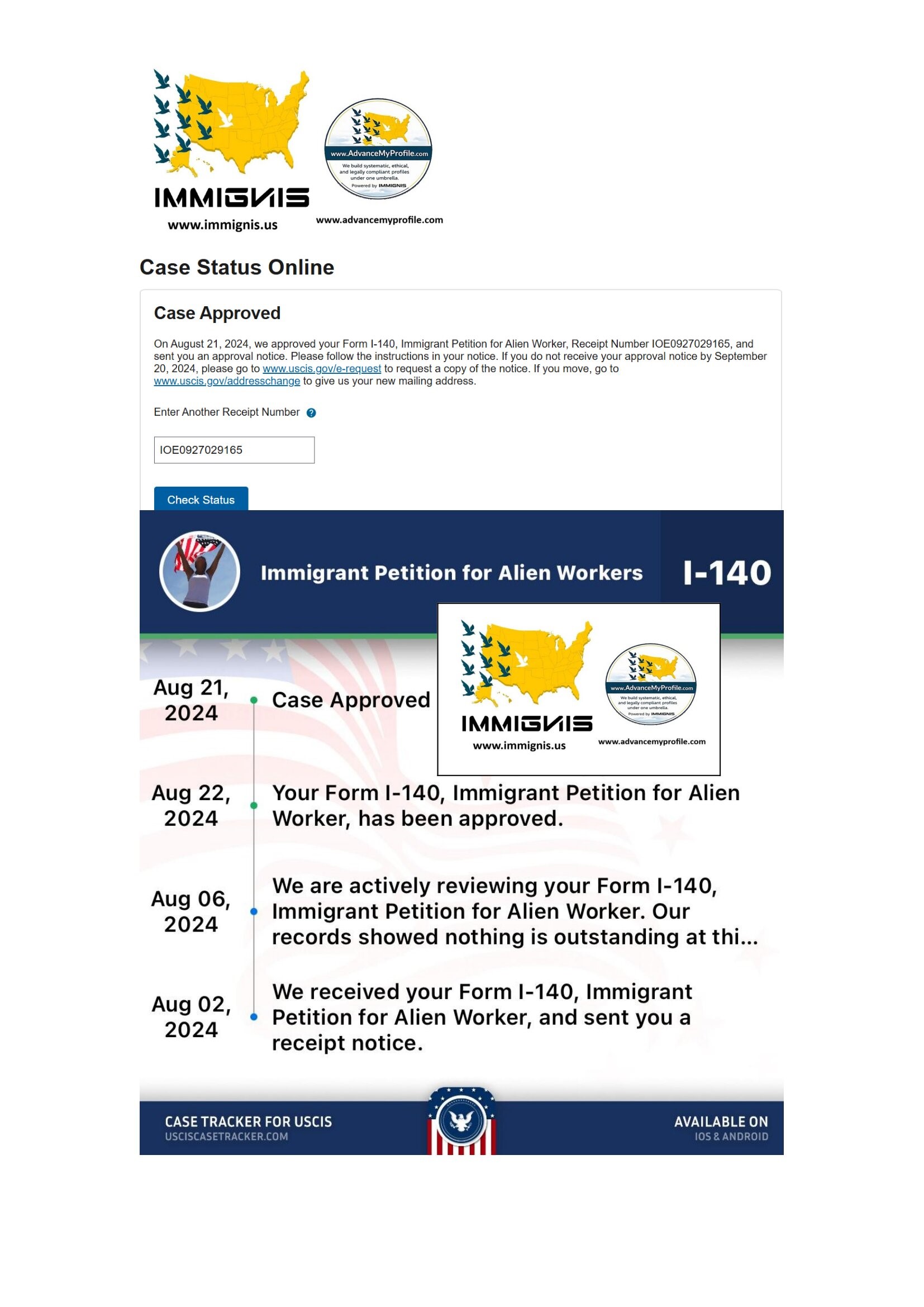
On August 21, 2024, USCIS approved the Form I-140 petition of a Sudanese trachoma ophthalmologist whose work focused on neglected tropical eye-disease surgical programs and trachoma-elimination campaigns in affected regions.
The approval was important because this was not a conventional medical prestige case. The petitioner was not presented as a celebrity physician or a hospital executive with a simple public profile. His strongest work existed in mass public-health campaigns, surgical outreach programs, field training, and elimination initiatives where the public scoreboard usually belongs to ministries, international agencies, NGOs, and donor-funded programs.
That created the core evidence problem. The campaigns could show impressive numbers, but USCIS still needed to know what this surgeon personally did. How many surgeries could be connected to him? What leadership roles did he hold? Who relied on his expertise? How did his work matter in the field of trachoma surgery and neglected tropical eye disease control?
Immignis and Advance My Profile helped turn that under attributed medical record into a petition ready EB-1A profile. The immigration specific profile building strategy centered on surgical-volume attribution, elimination-program leadership letters, tropical medicine publication, WHO partner documentation, training-program records, and field validation from people and organizations familiar with the petitioner’s work.
The evidence problem in trachoma elimination cases
Trachoma-elimination work creates a special kind of EB-1A evidence problem. The work can be lifesaving and field-changing, but it is often documented at the program level rather than the individual level. Reports may show how many patients were treated, how many districts were reached, or how a campaign advanced toward elimination goals, but they may not name the ophthalmologist who performed, supervised, trained, or led the surgical work.
That was the petitioner’s starting weakness. The campaign metrics were strong, but the personal attribution was thin. Surgical counts belonged to programs. Training outcomes belonged to implementing partners. Success belonged to a broader elimination campaign. For USCIS, that was not enough unless the petition could separate the petitioner’s contribution from the collective program record.
The case therefore defined the field carefully as neglected tropical eye disease surgical programs, with a focus on trachoma and related surgical prevention of blindness. This precise niche helped USCIS understand that the petitioner’s work was not ordinary ophthalmology. It involved a specialized public health surgical role in a disease area that many officers may never have encountered before.
This field definition was essential for EB-1A profile building. It allowed the petition to explain what excellence looks like in trachoma elimination work: high volume surgery, leadership in elimination programs, training of other eye care providers, participation in partner programs, technical publication, and trusted roles in case review or surgical quality assessment.
Why campaign success had to become person centered evidence
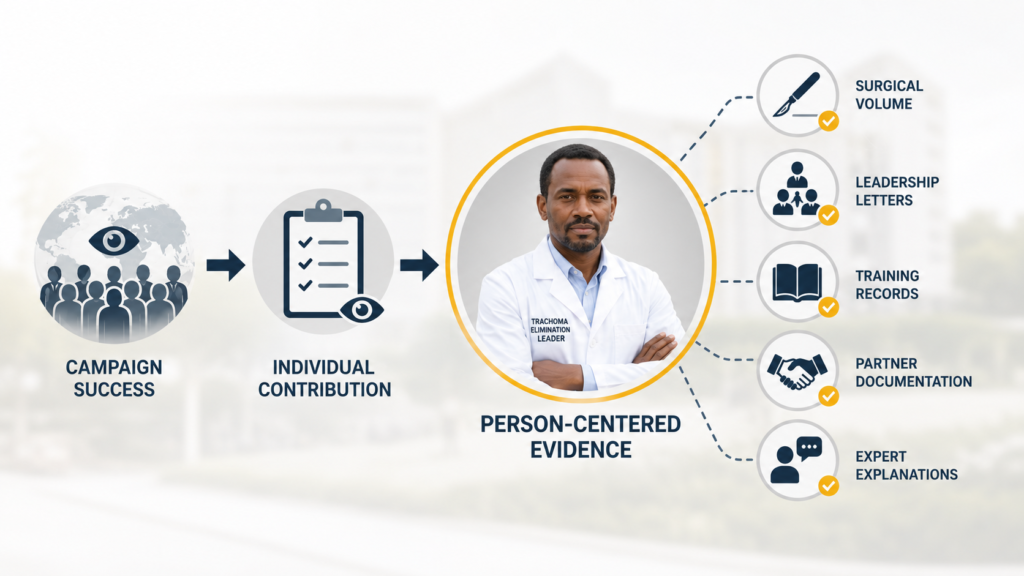
A public health campaign may achieve major results, but EB-1A does not approve campaigns. It evaluates individual professionals. That meant the petition had to move from program level success to person centered evidence.
The petition did not simply say that trachoma programs were successful. It documented how the petitioner personally contributed to those programs. That included surgical volume evidence, leadership letters, training records, partner documentation, and expert explanations showing why his work mattered inside the field.
This is a common challenge in medical profile building and public health profile building. When a professional works inside a large campaign, the strongest evidence is often buried in logs, partner records, supervisory letters, training materials, and program reports. Immigration profile building helps identify those records and organize them around USCIS criteria.
In this case, that organization changed the record. The petitioner no longer appeared as one unnamed doctor inside a large initiative. He appeared as a specialized ophthalmologist whose leadership and surgical work helped move elimination goals forward.
Surgical volume attribution proved practical expertise at scale
Surgical volume attribution was one of the strongest evidence categories because trachoma surgery is a field where high volume, high quality clinical output matters. A surgeon who performs or supervises large numbers of corrective procedures in affected regions is not merely delivering routine care. He is contributing directly to blindness prevention and elimination campaign success.
The petition documented the petitioner’s surgical volume through available logs, program records, partner confirmations, and expert letters. The goal was not to inflate numbers or rely on broad campaign totals. The goal was to identify the petitioner’s specific role within those totals and make that work visible to USCIS.
This evidence supported original contributions and leading role because it showed practical field impact. In neglected tropical eye-disease programs, numbers are not just statistics. They are the field’s proof of reach, technical capacity, and public-health contribution.
For professionals searching for EB-1A profile building, EB-2 NIW profile building, or USCIS evidence building in medicine, this case shows why raw experience must be converted into attributable evidence. Surgical volume becomes powerful only when the record shows who performed the work, under what conditions, and why the work mattered.
Elimination program leadership letters showed top of field trust
Elimination-program leadership letters helped explain the petitioner’s role in a way USCIS could understand. These letters were important because they came from people and organizations involved in trachoma control work and could describe the petitioner’s technical contribution, leadership, and reliability in field conditions.
The best letters did not use empty praise. They connected the petitioner to specific programs, surgical responsibilities, training roles, quality control work, and outcomes. They explained why his participation mattered and how his work supported elimination efforts across affected regions.
This evidence helped separate the petitioner from the campaign as a whole. USCIS could see that outside stakeholders did not view him as interchangeable. They recognized him as a surgeon and program leader whose expertise was trusted in a specialized and underserved field.
That is exactly what professional profile building for immigration should do. It should not create a false story. It should collect credible voices who can explain the real professional significance of the person’s work.
Tropical medicine publication gave the case scholarly structure
Tropical-medicine publication strengthened the petition because it showed that the petitioner’s experience was not only operational, but also connected to field facing knowledge. In medical EB-1A cases, publication helps USCIS see that a clinician’s work contributes to a professional knowledge base, not only to direct service delivery.
The petition used publication evidence to support the scholarly-articles criterion and to reinforce the original-contributions argument. The publication connected the petitioner’s experience in trachoma surgery and neglected tropical eye disease to broader issues of surgical quality, access, elimination strategy, training, or public health implementation.
This mattered because the petitioner’s work could otherwise be misunderstood as only humanitarian service. Humanitarian service is valuable, but EB-1A requires evidence of extraordinary ability. Publication helped show that the petitioner’s field experience had been translated into knowledge others could learn from and evaluate.
As part of publication profile building and medical profile building, this evidence made a difficult field more legible to USCIS. It helped explain the standards, methods, and significance of trachoma-elimination surgery to an officer who may have never handled this kind of case before.
WHO partner documentation made the field significance clear
WHO-partner documentation was especially important because trachoma elimination operates through international public health frameworks, technical partners, implementing agencies, and disease control programs. Evidence connected to WHO partners helped place the petitioner’s work within a recognized global health ecosystem.
The petition used this documentation carefully. It did not claim that every global campaign result belonged to the petitioner. Instead, it showed that his work was connected to respected programs and that his surgical and leadership contributions were part of recognized trachoma-elimination efforts.
This kind of evidence helped USCIS understand why the field mattered. Trachoma may be unfamiliar to many adjudicators, but documentation from recognized international partners helped show that this was not a small local practice area. It was part of a global effort to prevent blindness and eliminate a neglected tropical disease.
For immigration-specific profile building, this was a major advantage. Strong partner documentation can translate a specialized medical niche into a credible field of national or international importance without overstating the petitioner’s role.
Training program records supported leadership and judgingtype evidence
Training program records helped show that the petitioner was trusted not only to perform surgery, but also to train others. In elimination campaigns, building local surgical capacity is often as important as completing individual procedures. A surgeon who trains other providers multiplies impact across regions and strengthens the sustainability of the campaign.
The petition documented the petitioner’s work in training programs, workshops, surgical mentoring, and technical instruction for eye-care teams. This supported the leading role criterion because it showed that the petitioner helped build capacity within the field.
Training records also supported judging type evidence when the petitioner evaluated surgical technique, reviewed cases, assessed trainees, or helped determine whether other providers met program standards. In medical and surgical fields, judging often appears through case review, quality assessment, credentialing input, training evaluation, or technical supervision rather than formal award panels.
This was an important part of EB-1A profile building because it converted clinical leadership into USCIS readable evidence. The petitioner was not only doing the work. He was helping define and assess how others should do the work.
Membership evidence placed the petitioner inside specialized professional networks
Membership evidence strengthened the record when it showed affiliation with selective or professionally meaningful ophthalmology, tropical medicine, or disease control bodies. In neglected disease fields, membership can help show that the petitioner belongs to professional networks where expertise, training, or field contribution is recognized.
The petition did not treat membership as a standalone shortcut. Instead, it connected membership evidence to the broader record of surgical leadership, program participation, training, and field recognition. This made the criterion more persuasive because the membership was part of a coherent professional profile rather than an isolated credential.
For profile improvement, this is an important lesson. Membership is strongest when it fits the petitioner’s field niche and reinforces the story already established by contributions, publications, judging, and leading roles.
The approval hook: elimination campaign leadership as top of field proof
The approval hook was that elimination campaign leadership can serve as top of field proof in a field most officers have never heard of. The petition had to teach USCIS what trachoma elimination work is, why it matters, and how professionals in that space earn recognition.
In this field, prestige may not look like mainstream medical fame. It may look like trusted surgical leadership in affected regions, training other surgeons, producing high-volume attributable surgical work, supporting WHO-partner programs, contributing to tropical medicine knowledge, and helping campaigns move toward elimination targets.
Once the petition explained that field specific hierarchy, the evidence became much stronger. The petitioner’s achievements were not evaluated by the wrong standard. They were evaluated according to the realities of neglected tropical eye-disease surgical programs.
That is why the approval mattered. It showed that a highly specialized medical professional can succeed in EB-1A when the petition builds the right framework and documents the person’s real contribution clearly.
How profile building changed the case
This case shows how profile building can change the outcome of an under documented but high impact professional record. The petitioner already had extraordinary field experience. What was missing was a structured immigration profile that could translate trachoma elimination work into USCIS evidence categories.
Immignis and Advance My Profile helped organize the case around surgical volume attribution, leadership letters, tropical medicine publication, WHO partner documentation, training program records, membership evidence, and judging type activity. These elements turned a campaign based medical record into a person centered EB-1A profile.
This kind of profile improvement is especially important for doctors, surgeons, public health specialists, humanitarian medical professionals, and neglected disease experts whose impact is real but hidden inside institutional reports. Ethical profile building does not invent achievements. It identifies, documents, and explains the achievements that already exist.
For professionals searching for profile building, immigration profile building, EB-1A profile building, EB-2 NIW profile building, medical profile building, physician profile development, or USCIS evidence building, this case shows how specialized public health medicine can be presented in a stronger, clearer, and more searchable way.
Why this case worked
The case worked because the petition did not ask USCIS to accept campaign statistics without attribution. It converted broad public-health success into specific evidence of the petitioner’s role.
Surgical volume attribution showed practical expertise. Leadership letters showed trust. Tropical medicine publication showed scholarly contribution. WHO partner documentation showed field significance. Training records showed capacity building. Judging type evidence showed evaluation authority. Membership evidence placed the petitioner inside the specialized professional ecosystem.
Together, those categories showed that the petitioner was not merely participating in trachoma-elimination campaigns. He was helping lead, perform, teach, evaluate, and document work central to neglected tropical eye disease surgery.
Most importantly, the petition made an unfamiliar field understandable without reducing its seriousness. USCIS could see both the human importance of preventing blindness and the professional significance of the petitioner’s role within that mission.
Conclusion
The Sudanese trachoma ophthalmologist’s EB-1A approval shows that extraordinary ability can be proven in highly specialized public-health fields, even when most records initially belong to programs rather than individuals.
The petition succeeded because it used ethical profile building to document surgical volume attribution, elimination-program leadership, tropical medicine publication, WHO partner documentation, training records, membership, and judging-type evidence in one coherent record.
The broader lesson is clear: in neglected tropical disease work, the most persuasive evidence often comes from the field’s own validation system. When elimination campaign leadership is documented properly, it can become powerful proof of top of field expertise.
Frequently asked questions
Can a trachoma ophthalmologist qualify for EB-1A?
Yes. A trachoma ophthalmologist may qualify for EB-1A when the evidence shows extraordinary ability through original contributions, leading roles, scholarly articles, membership, judging, training leadership, and independent field validation.
Can surgical-volume evidence support an EB-1A petition?
Yes. Surgical-volume evidence can be valuable when it is clearly attributed to the petitioner and connected to field significance, case complexity, public health impact, or specialized expertise.
Do elimination program letters help a medical EB-1A case?
Yes. Letters from elimination program leaders, implementing partners, NGOs, ministries, or international health partners can help prove the petitioner’s individual role inside a broader campaign.
Can WHO partner documentation support EB-1A evidence?
Yes. WHO partner documentation can help show that the petitioner’s work was connected to recognized global health programs and that the field itself has international significance.
Can training other surgeons count as leadership or judging?
Yes. Surgical training can support leading role evidence, and evaluation of trainees, case review, or quality assessment can help support judging type evidence in medical and surgical fields.
Can Immignis and Advance My Profile help neglected disease specialists build EB-1A evidence?
Yes. Immignis and Advance My Profile help doctors, ophthalmologists, surgeons, public health experts, and neglected disease specialists define a precise niche, document achievements, improve visibility, and build a petition ready EB-1A profile through ethical profile building and immigration specific evidence development.
Build an EB-1A record around surgical impact, public-health leadership, and field validation
Many public health doctors and neglected disease specialists have exceptional impact, but the evidence is often scattered across campaign reports, surgical logs, training records, NGO letters, partner documentation, publications, and internal program files.