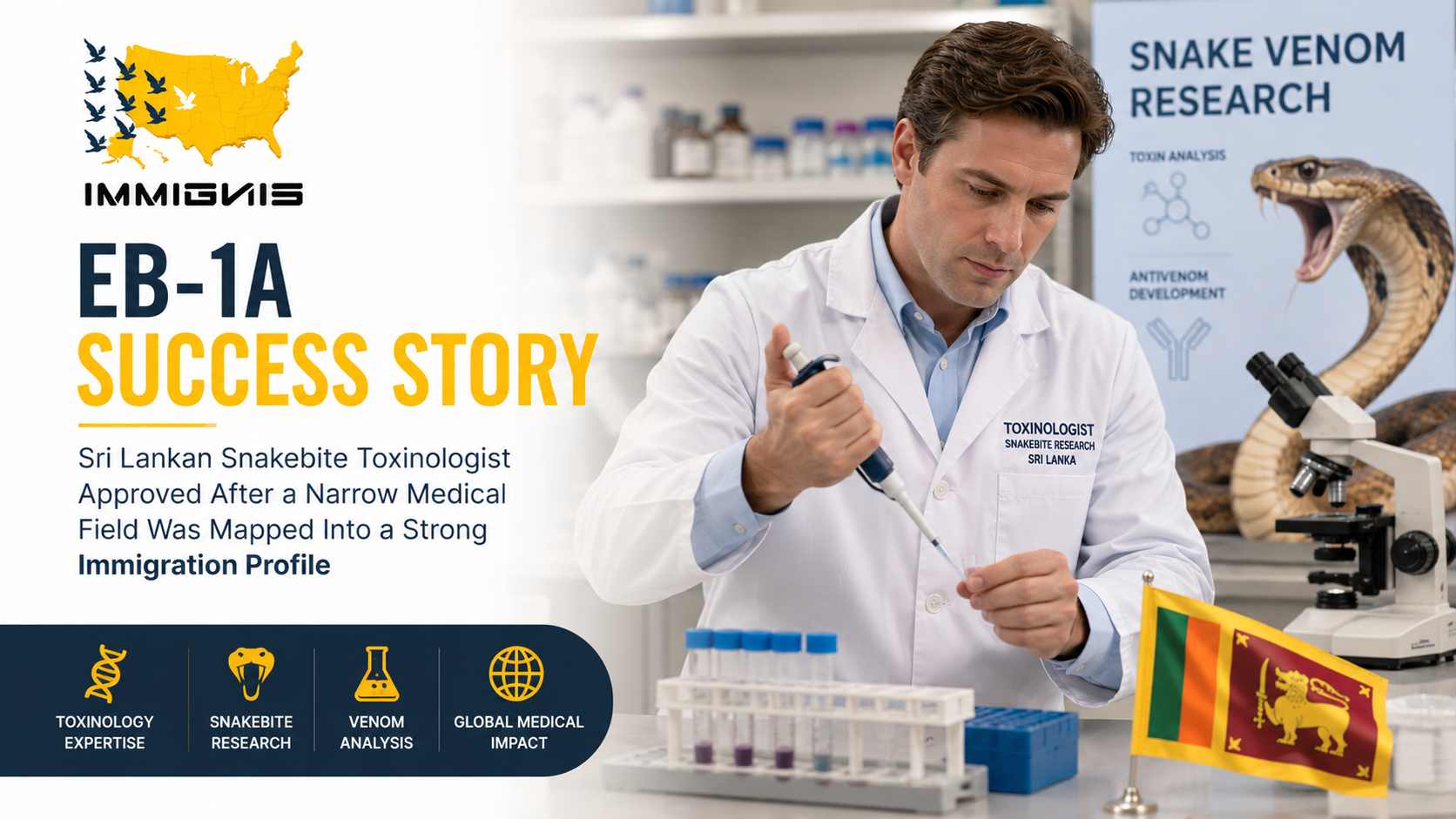
EB-1A Clinical Toxicologist: How a Sri Lankan clinician-researcher in clinical toxicology and antivenom protocols secured EB-1A approval by turning a small but high-burden medical specialty into a petition-ready immigration profile built on protocol adoption documentation, publication record, WHO snakebite initiative roles, international toxicology-society leadership, expert letters, and ethical profile building.
Key facts at a glance
| Petition outcome | Form I-140 approved under EB-1A on February 11, 2026. |
| Professional profile | Sri Lankan clinician researcher focused on envenomation treatment in one of the world’s highest burden snakebite regions. |
| Field niche | Clinical toxinology and antivenom protocols. |
| Starting weakness | The field was tiny, with few journals, few peers, and few easy reference points, making the petitioner’s high level expertise harder for USCIS to measure through ordinary prestige signals. |
| Profile building focus | Protocol-adoption documentation, publication record, WHO snakebite initiative roles, international toxinology society leadership, judging and review service, and expert letters explaining the field’s small size as a concentration of expertise. |
| EB-1A criteria supported | Original contributions, scholarly articles, membership, judging, and leading role. |
| Central issue | Showing that a narrow global field is not a weak field, and that being near the top of a small, life saving medical specialty can still support EB-1A extraordinary ability. |
| Approval lesson | Small field does not mean small achievement. With the right immigration specific profile building, USCIS can understand that top of field recognition may look different in a rare but globally important medical specialty. |
The approval
On February 11, 2026, USCIS approved the Form I-140 petition of a Sri Lankan clinician-researcher whose work focused on clinical toxinology, envenomation treatment, and antivenom protocols in one of the world’s highest-burden snakebite regions.
The approval was important because this was not a broad medical specialty with hundreds of famous journals, large professional societies, or obvious global rankings. Snakebite toxinology is a small and highly specialized field. It carries serious public-health importance, but it does not always produce the same public prestige signals that USCIS officers may expect in more visible areas of medicine.
That made the case a strong example of EB-1A profile building and immigration-specific profile building. The petitioner already had meaningful expertise, but the record needed to explain why a narrow field still has a hierarchy of experts and why the petitioner’s work sat near the top of that hierarchy.
Immignis and Advance My Profile helped convert the petitioner’s technical and clinical record into a petition-ready EB-1A profile. The strategy focused on protocol-adoption documentation, publication record, WHO snakebite-initiative roles, international toxinology-society leadership, expert letters, judging activity, and clear field mapping that helped USCIS understand the real scale of the achievement.
The evidence problem in clinical toxinology cases
Clinical toxinology is a field where the medical stakes are high but the evidentiary ecosystem is small. In regions where snakebite is a major cause of disability and death, strong clinicians and researchers may influence treatment protocols, antivenom use, triage pathways, and regional practice standards. Yet the field has fewer journals, fewer large conferences, and fewer easily recognized public markers than fields such as cardiology, oncology, or artificial intelligence in medicine.
That was the petitioner’s starting weakness. The work mattered deeply in places where envenomation was a serious public-health burden, but the number of peers and publication venues was limited. A shallow review could make the record look modest simply because the field itself was narrow.
The petition therefore had to educate USCIS before arguing the criteria. It had to explain what clinical toxinology is, why snakebite treatment and antivenom protocols require specialized expertise, and why recognition inside a small expert community can be more meaningful than surface level visibility in a broader field.
This field definition was central to the profile building strategy. The case was not presented as general emergency medicine or ordinary rural clinical care. It was framed as a specialized medical niche involving venom toxicology, antivenom protocol development, clinical management of envenomation, public-health implementation, and expert leadership in a narrow but globally important field.
Why a small field can still support extraordinary ability
The key approval hook was simple but powerful: small field does not mean small achievement. EB-1A does not require the petitioner’s field to be large. It requires the petitioner to show extraordinary ability in the field where the person works. A professional can be near the top of a narrow field when the evidence proves that the field has real importance and that the petitioner is recognized by its serious experts.
This point had to be made carefully. The petition did not argue that the petitioner deserved approval merely because the field was rare. It argued that the field was medically important, technically demanding, and populated by a limited number of qualified specialists, and that the petitioner’s contributions were recognized within that expert community.
Expert letters played a major role in this framing. They mapped the field’s small size as a concentration of expertise rather than as a weakness. They explained that in clinical toxinology, a small number of credible specialists may guide practice, develop protocols, advise public-health initiatives, and train others. In such a field, recognition from the right experts can carry significant weight.
For professionals searching for profile building, immigration profile building, EB-1A profile building, EB-2 NIW profile building, medical profile building, or USCIS evidence building, this case shows why field definition is not a technical detail. It can decide whether an officer understands the record at all.
Protocol adoption documentation made the contribution practical and verifiable
Protocol-adoption documentation became one of the strongest parts of the petition. In clinical toxinology, protocols are not ordinary paperwork. They can determine how quickly a patient is assessed, which antivenom is used, when referral is required, how complications are monitored, and how limited resources are allocated in high-burden settings.
The petition documented where the petitioner’s antivenom or envenomation-management protocols were adopted, referenced, implemented, taught, or relied upon. It also explained why those protocols mattered in a resource-sensitive medical environment where incorrect or delayed treatment can have severe consequences.
This evidence supported original contributions because it showed that the petitioner’s work had practical value beyond personal clinical performance. The record did not merely say the petitioner treated many patients. It showed that the petitioner helped shape methods that other clinicians could use.
As part of professional profile building for immigration, the protocol evidence made the petitioner’s contribution concrete. It gave USCIS a clear way to see how clinical insight became field practice.
Publication record supported scholarly articles and field education
The petitioner’s publication record helped satisfy the scholarly-articles criterion and strengthened the original-contributions argument. In a small specialty, each credible publication can matter because there are fewer venues and fewer experts producing field specific knowledge.
The petition presented the publications not as isolated academic items, but as part of a broader evidence record. The articles helped explain envenomation treatment, antivenom use, clinical patterns, protocol development, or regional disease burden in a way that other professionals could evaluate and apply.
This was important because USCIS may compare publication volume across fields unfairly if the petition does not provide context. A narrow field cannot be measured by the same publication expectations as a huge biomedical specialty. The petition therefore explained the field’s publication environment and connected the petitioner’s articles to real clinical and public-health relevance.
That is a key profile improvement lesson for rare medical specialists: publication evidence becomes strongest when it is linked to field scarcity, expert reliance, clinical application, and the petitioner’s precise niche.
WHO snakebite initiative roles showed global relevance
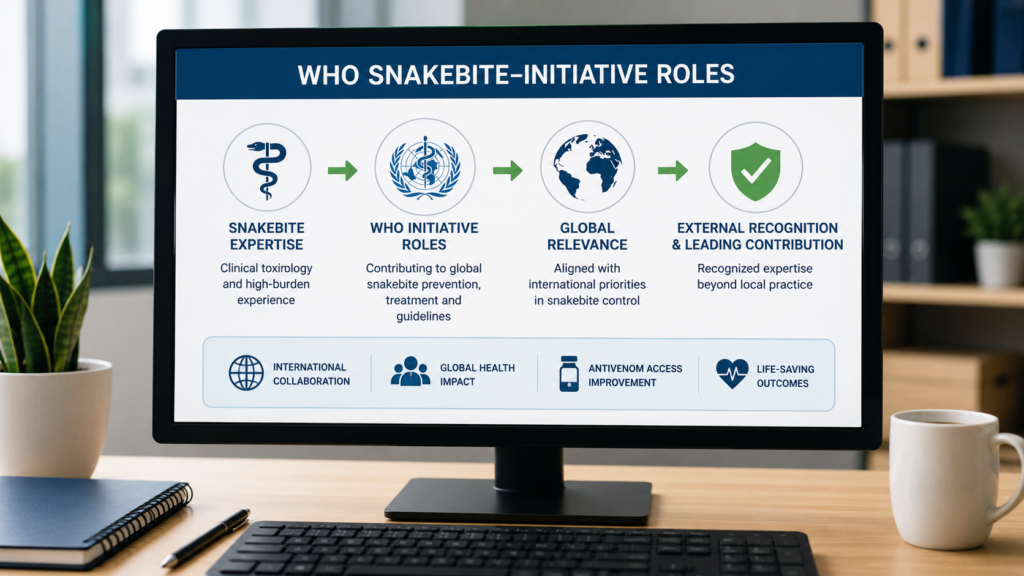
WHO snakebite-initiative roles helped show that the petitioner’s expertise was relevant beyond local practice. Snakebite is often treated as a neglected public-health problem, and participation in WHO-linked or WHO-relevant initiatives can show that the petitioner’s knowledge connects to international priorities.
The petition used these roles to demonstrate external recognition and leading contribution. The evidence showed that the petitioner was not simply working in a high-burden region, but was connected to broader efforts to improve snakebite prevention, treatment, antivenom access, or clinical guidance.
This evidence was especially useful because it gave the narrow specialty an international frame. USCIS could see that clinical toxinology may be small, but it matters to global health, neglected disease control, and life-saving treatment systems.
In immigration-specific profile building, this kind of evidence helps transform a local or regional medical record into an internationally legible extraordinary ability profile.
International toxinology society leadership supported membership and leading role
International toxinology society leadership helped support both membership and leading role evidence. In a small field, professional societies can serve as key markers of recognition because they gather the limited number of experts who actually understand the specialty.
The petition did not treat society involvement as a simple membership line. It explained why the society mattered, what level of selectivity or professional standing was involved, and how the petitioner’s role showed leadership or trusted expertise within the toxinology community.
This evidence also helped address the field-size problem. Because the field is narrow, leadership in a credible international toxinology organization may be more meaningful than a generic membership in a large medical association. The petition made that distinction clear.
For EB-1A profile building, this is an important strategy: a membership or leadership role becomes stronger when the petition explains the organization’s relevance to the niche and the petitioner’s specific role inside it.
Judging and expert review showed trust in the petitioner’s expertise
Judging evidence was built through roles where the petitioner reviewed, evaluated, or assessed work by other professionals in clinical toxinology, tropical medicine, venom research, antivenom practice, or related medical settings.
In rare fields, judging may not look like a large award jury. It may appear as peer review, case review, guideline review, abstract review, protocol evaluation, training assessment, or technical expert review. The petition explained these activities in field-specific terms so USCIS could understand how the petitioner was trusted to evaluate the work of others.
This evidence was important because it showed that the petitioner was not merely producing work. Other professionals trusted the petitioner’s judgment. That is one of the clearest indicators of expert standing in a small specialty.
The judging evidence also reinforced the expert letter narrative: in a narrow field, the people asked to evaluate others are often the same people recognized as true specialists.
Expert letters mapped the field and explained the petitioner’s standing
Expert letters were unusually important in this case because the field itself required explanation. The strongest letters did not simply say that the petitioner was excellent. They taught USCIS how the field works, why the field is small, why the medical stakes are high, and how the petitioner’s work compared to others in the specialty.
The letters explained that clinical toxinology is not weak because it is narrow. Rather, it is specialized, medically urgent, and concentrated among a small number of experts who have the experience to guide antivenom protocols and envenomation treatment.
They also helped separate the petitioner from ordinary clinical practice. The letters identified the petitioner’s protocol work, publication record, WHO related involvement, society leadership, and review activity as evidence of recognized expertise rather than routine service.
This is exactly where ethical profile building matters. The petition did not inflate the field or exaggerate the petitioner’s record. It translated a niche medical career into a clear evidentiary framework that a non-specialist officer could evaluate.
How profile building changed the case
This case shows how profile building can change the presentation of a rare medical specialty. Before the evidence was organized, the petitioner’s record could have looked too narrow, too technical, or too dependent on a small professional community. After immigration specific profile building, the same record showed a clinician-researcher recognized in a high impact field with limited but meaningful reference points.
Immignis and Advance My Profile helped organize the record around the EB-1A criteria most suited to the petitioner: original contributions, scholarly articles, membership, judging, and leading role. Each evidence category reinforced the same message: the petitioner was operating at a high level in the specialized field of clinical toxinology and antivenom protocols.
The profile improvement process also strengthened the search visibility and public clarity of the case. Keywords such as EB-1A profile building, immigration profile building, medical profile building, physician profile development, and USCIS evidence building were used naturally because they accurately describe what the case required.
For professionals in rare fields, this is the central lesson. The problem is not always that the achievements are weak. Often, the achievements are simply hard for outsiders to measure until the field is defined, the evidence is attributed, and expert recognition is placed in the right context.
Why this case worked
The case worked because it turned the field’s small size from a weakness into a context for understanding expertise. Protocol-adoption documentation showed practical influence. Publications showed scholarly contribution. WHO snakebite-initiative roles showed international relevance. Toxinology society leadership showed standing in the expert community. Judging evidence showed trusted evaluation. Expert letters explained the field’s narrow structure and high public health importance.
Together, the evidence showed that the petitioner was not simply a clinician treating snakebite cases in a high burden region. The petitioner was a toxinology specialist whose protocols, scholarship, leadership, and expert roles helped shape how the field understands and treats envenomation.
Most importantly, the petition did not ask USCIS to lower the standard because the field was small. It showed that the petitioner met the standard within a field that required specialized knowledge, urgent clinical judgment, and recognized expertise.
Conclusion
The Sri Lankan snakebite toxinologist’s EB-1A approval shows that professionals in narrow medical fields can succeed when the petition clearly explains the field, documents the petitioner’s role, and connects the evidence to recognized USCIS criteria.
The case succeeded by using ethical profile building to present protocol adoption, publication, WHO linked work, international society leadership, judging, and expert validation as one coherent immigration profile.
The broader lesson is clear: a small field is not a small achievement. When a clinician-researcher stands near the top of a rare, life-saving specialty, the petition must make that field legible and the person’s role unmistakable.
Frequently asked questions
Can a clinician researcher in clinical toxinology qualify for EB-1A?
Yes. A clinician researcher in clinical toxinology may qualify for EB-1A when the evidence shows original contributions, scholarly articles, leading roles, membership, judging, and recognition from credible experts in the field.
Can a small medical field support an EB-1A petition?
Yes. EB-1A does not require the field to be large. It requires strong evidence that the petitioner is among the top professionals in the defined field. A narrow specialty can support EB-1A when its importance and hierarchy are explained clearly.
Do antivenom protocols help prove original contributions?
Yes. Antivenom or envenomation management protocols can support original contributions when the evidence shows that they were adopted, referenced, implemented, or relied upon by other clinicians, organizations, or public health stakeholders.
Can WHO related roles help an EB-1A case?
Yes. WHO related or WHO linked initiative roles can help show external recognition, global relevance, and leadership when they are clearly connected to the petitioner’s field and expertise.
Can international society leadership support EB-1A membership or leading role?
Yes. Leadership or meaningful membership in a credible international toxinology society can support membership and leading role evidence when the petition explains the society’s importance and the petitioner’s role.
Can Immignis and Advance My Profile help rare medical specialists build EB-1A evidence?
Yes. Immignis and Advance My Profile help rare medical specialists, clinicians, physician researchers, and public-health experts define a precise niche, document achievements, improve visibility, and build a petition-ready EB-1A profile through ethical profile building and immigration specific evidence development.
Build an EB-1A record around rare medical expertise, protocol influence, and expert recognition. Many rare field clinicians and researchers already have strong impact, but their evidence is often scattered across protocols, publications, expert networks, society roles, consultation records, and peer review activity.
Find out whether your clinical, medical, public health, toxicology, infectious disease, or rare specialty record can be developed into a stronger immigration profile through ethical profile building, profile improvement, and USCIS evidence building.