A public-art case built around municipal commissions, mural festivals, critical coverage, and evidence that large-scale social murals can qualify as recognized artistic work.
Key facts at a glance
| Outcome | EB-1A approval for a Brazilian public muralist whose work centered on large-format murals with social themes. |
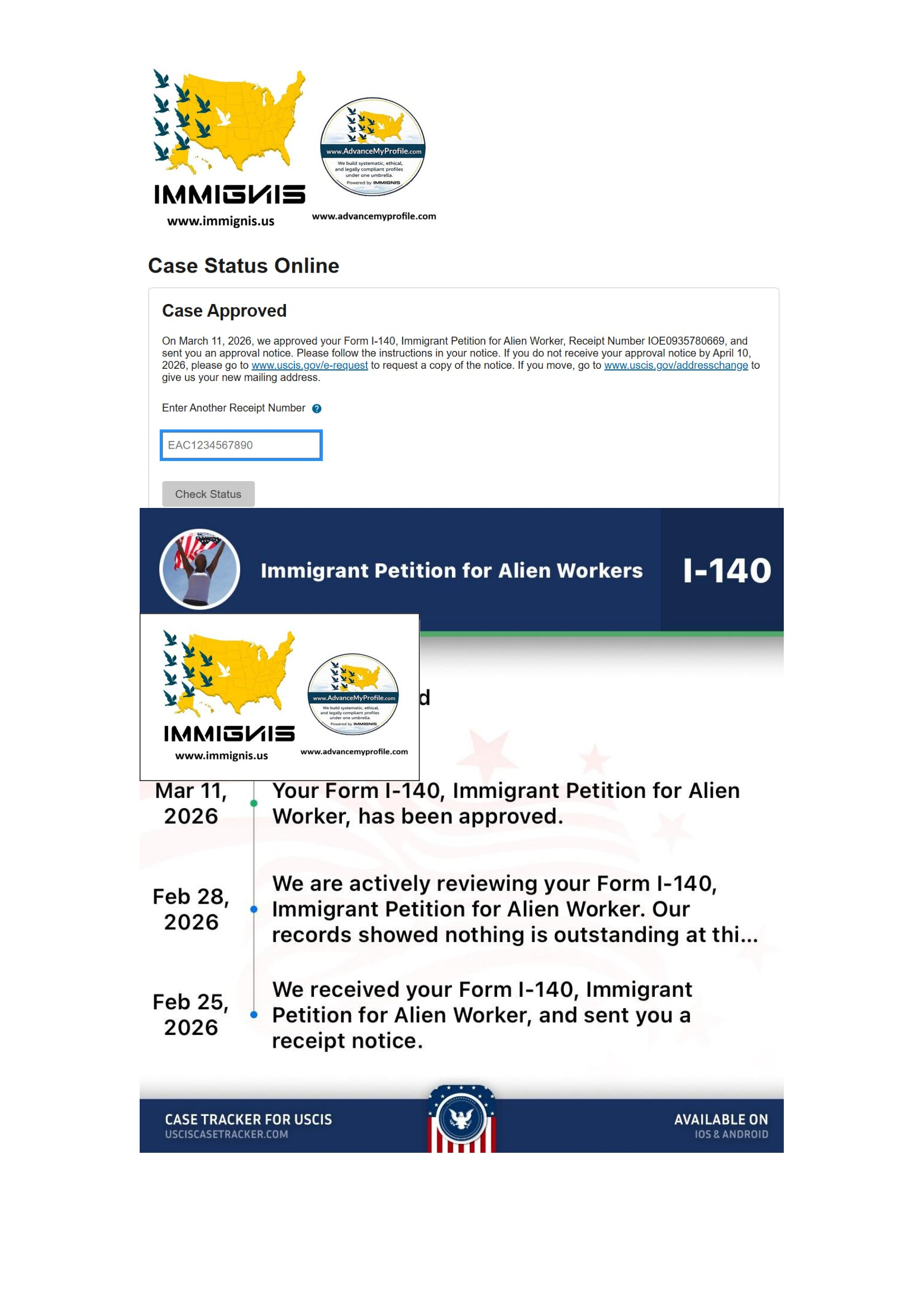
| Approval date | Approved on March 11, 2026. |
| Field niche | Large-format public murals with social themes, including community-facing public art, international mural-festival work, and municipal commissions. |
| Starting problem | The artist had visible public work, but the usual art-world paper trail was thin. His strongest evidence was not gallery catalogs, private sales, or museum acquisition records. It was murals on walls, commission records, festival invitations, and local public recognition that had to be converted into EB-1A evidence. |
| Evidence developed | Municipal commission contracts, international mural-festival invitations, art-press coverage, documented public-art budgets, curator and public-art official letters, and records showing the artist as the lead creator of major public murals. |
| EB-1A criteria supported | Display of work at artistic exhibitions or showcases, original artistic contributions, published material, awards or professional recognition where supported, judging, and leading or critical role evidence tied to public-art commissions. |
On March 11, 2026, USCIS approved the Form I-140 petition of an EB-1A Muralist whose most important work did not hang on white gallery walls. It covered public walls, neighborhood corridors, transit-facing buildings, and civic spaces where people saw the art without buying a ticket or reading a catalog.
That was the challenge and the opportunity in the case.
For many visual artists, EB-1A evidence begins with solo exhibitions, museum shows, auction records, gallery representation, reviews, sales, and prizes. This artist did not fit that pattern neatly. His career had grown in public view, but not always in ways that immigration evidence immediately understands. A mural can define a street and still leave the artist with fewer documents than a painter who sold ten small canvases through a gallery.
The petition had to make a straightforward point with disciplined evidence: in public art, the street can be the gallery, but the record still must prove selection, authorship, recognition, and artistic significance.
The problem was not visibility. It was proof.
The artist was not unknown in the ordinary sense. His murals were visible. Local residents recognized them. Public-art organizers invited him to paint. Municipal and cultural programs had commissioned or hosted his work. Some of his pieces had become markers of place, appearing in city photography, neighborhood media, and festival materials.
But EB-1A does not approve visibility by assumption. USCIS needed documents that showed how the work was selected, who credited him, what distinguished the projects, and why the record showed more than local enthusiasm.
That distinction mattered. A wall with a celebrated mural is not enough if the petition cannot prove who created it, who selected the artist, whether the event was juried or curated, whether the project carried cultural or artistic weight, and whether independent voices recognized the work.
Immignis and Advance My Profile reviewed the record with the central art-world issue in mind. The case could not force the muralist into a gallery-painter mold. It had to document the hierarchy of public art on its own terms: commissions, festivals, curatorial selection, public budgets, cultural programming, press, and expert interpretation.
Why public artists often look weaker on paper than they are
Public art has its own evidence problem. The finished work may be impossible to miss, but the artist behind it can be under-documented. A mural may not come with a catalog essay. A neighborhood commission may not produce a formal review. A festival may promote the event more than the individual artist. A city may photograph the wall without naming the painter in every caption.
That can create a misleading EB-1A record. The artist appears active, but the file does not show sustained acclaim. It may show photographs, social media, and community reactions, while leaving out the harder evidence USCIS needs: selection process, public budget, scope of commission, media coverage, expert recognition, and the artist’s individual role.
For this muralist, the answer was not to exaggerate the evidence. The answer was to rebuild it around the professional systems that actually govern public art.
What USCIS needed to see in a muralist EB-1A case
The EB-1A classification is for individuals who can show extraordinary ability through sustained national or international acclaim and recognized achievements in their field. For artists, the evidence can look different from science, engineering, or business cases. The petition must still satisfy applicable criteria and then pass the final merits review, where USCIS examines whether the total record shows the level of recognition required for EB-1A.
In this case, the petition needed to answer several practical questions.
- Were the murals displayed in settings that could be treated as artistic exhibitions or showcases, even though they were outdoors or site-specific?
- Were the commissions selective, curated, juried, or otherwise professionally meaningful?
- Could the artist be identified as the creator or lead artist rather than one member of an anonymous wall-painting crew?
- Did independent media, critics, curators, municipalities, or festival organizers discuss the work and the artist?
- Was there evidence that the murals made an original artistic contribution within large-format public art or socially engaged mural practice?
- Did awards, invitations, judging, public-art budgets, or expert letters show recognition beyond ordinary local activity?
The legal strategy stayed close to those questions. It did not claim that every public wall was equivalent to a museum exhibition. It showed which public-art settings carried curatorial or professional significance and why those settings mattered in the mural field.
The field was defined as public mural art, not generic visual art
One of the most important decisions was field definition. The case did not present him as a general painter, a street decorator, or a broad contemporary artist. The profile was narrowed to large-format public murals with social themes.
That field definition helped the record make sense. His strongest work involved site scale, public access, community context, visual storytelling, and the ability to turn an exterior wall into a civic or cultural encounter. Those are not minor differences from studio painting. They affect how the work is commissioned, viewed, reviewed, preserved, and credited.
The petition described his murals as public-facing artistic works selected for places where the audience was not limited to collectors or gallery visitors. The evidence showed that his work operated within mural festivals, municipal programs, cultural commissions, and curated public-art settings.
Municipal commissions became more than project records
Municipal commission records were among the most important evidence streams. A city or public entity does not commission a mural in the same way a private person paints a wall at home. A meaningful public-art commission can involve proposal review, location approval, budget allocation, community or cultural objectives, and public presentation.
The petition organized the commission evidence around selection and responsibility. It documented who commissioned the work, how the artist was chosen, what role he held, the scale and location of the mural, the budget or funding framework where available, and the final public-facing result.
This made the evidence useful for more than one EB-1A criterion. It supported display or showcase evidence by showing where the work was publicly exhibited. It supported leading role evidence by showing that the artist was responsible for the visual outcome of a civic or cultural project. It also helped original-contribution arguments where the commission involved a distinctive artistic method, social theme, or public intervention.
The exhibition argument had to respect how murals are shown
The display criterion is especially important in artistic EB-1A cases because it recognizes that artists may show their work through exhibitions or showcases. For muralists, the question is whether a public wall, mural festival, city arts program, or curated outdoor project can be documented as a professional display of artistic work.
The petition did not rely on photographs alone. It collected event pages, festival materials, program records, municipal announcements, curator statements, maps, invitations, and press references that placed the murals within recognized public-art settings.
International mural festivals were particularly useful. A festival can operate as a public exhibition when artists are selected, promoted, scheduled, and presented to audiences. The petition documented the organizer, selection process where available, participating artists, location, audience or public reach, and the artist’s own work within the event.
That approach avoided a weak argument that every painted wall equals an exhibition. Instead, it showed which public-art contexts had exhibition-like professional value.
Art-press coverage gave the work an independent voice
Published material cannot be built from captions, reposts, or promotional blurbs alone. The record needed independent coverage that discussed the artist, his murals, or his role within public art.
Art-press and culture-media coverage helped move the story beyond local appreciation. The stronger articles described his visual language, subject matter, public setting, festival work, or place within mural practice. Where coverage came from municipal or event sources, it was used carefully and not overstated as independent critical review unless the content supported that use.
The best coverage did not merely say a mural existed. It explained why the mural mattered in the public environment: what subject it addressed, how the artist handled scale and composition, and why the piece became part of the neighborhood or cultural program.
Original contribution evidence came from method, scale, and social meaning
For artists, original contribution evidence must do more than say the work is beautiful or unique. The petition identified the features that made his public murals distinct within his niche: large-format composition, social themes, integration with urban surfaces, community-facing symbolism, and the ability to make public space carry narrative meaning.
Curators, mural-festival directors, public-art officials, and experienced artists explained the contribution in field-specific terms. Their letters discussed his work as public art, not merely as decoration. They addressed artistic choices, public setting, technique, thematic continuity, and the way his murals engaged viewers outside the commercial gallery system.
This was important because USCIS can discount letters that rely on praise without explanation. The expert letters had to explain what the artist did, how they knew it, why it was significant in public mural practice, and how the work compared with ordinary mural commissions.
The leading-role evidence came from contracts, programs, and responsibility
The leading or critical role criterion can be difficult for artists who work in collectives, festivals, studios, or public spaces. It is not enough to say the artist was important. The record must show the nature of the organization or project and why the person’s role mattered.
For this muralist, the evidence included commission contracts, program materials, project descriptions, public-art budgets, and letters confirming that he was selected to create the visual work, develop the concept, lead execution, or represent the artistic identity of the project.
That evidence solved a common public-art problem. A large mural may involve assistants, organizers, property owners, funders, and city officials. The petition separated logistical support from artistic authorship. It showed who conceived the visual direction, who was credited, and who bore creative responsibility for the final work.
Judging and awards were used only where the record supported them
The profile also developed recognition through judging and awards where the evidence was real and documentable. Jury invitations for emerging-artist prizes, mural competitions, or public-art selections can support the judging criterion if the artist actually evaluated the work of others.
Awards and selections were handled with similar care. A paid listing, a generic participation certificate, or a noncompetitive festival appearance should not be inflated into an award. Where an invitation, prize, finalist status, commission selection, or festival selection had a genuine competitive or curated basis, the petition documented the standard and the artist’s result.
This restraint strengthened the petition. In arts cases, overclaiming can make strong evidence look weak. The better strategy is to let the record show which recognitions are competitive, which are curated, which are commissioned, and which are simply useful background.
The case did not try to make public art look like gallery art
The strongest part of the strategy was its refusal to apologize for the field. Public art does not need to imitate gallery practice to be serious. It has its own pathways of recognition: municipal selection, festival curation, public budgets, cultural programming, press, community visibility, and expert evaluation by curators and public-art professionals.
The petition translated those pathways into evidence USCIS could evaluate. It showed not only that the artist had painted murals, but that the work had been selected, displayed, discussed, funded, credited, and interpreted within a professional public-art context.
That translation mattered because the officer was not being asked to rely on taste. The petition built an evidentiary record.
How the EB-1A criteria came together
| Criterion | How the record supported it |
| Display of artistic work | Municipal commissions, mural festivals, curated outdoor showcases, public-art programs, and documentation of completed murals showed where his work was displayed to public audiences in professionally meaningful settings. |
| Original artistic contributions | Curator and public-art expert letters connected his large-format mural practice, social themes, public-space integration, and visual method to a recognizable contribution within public mural art. |
| Published material | Art-media, culture-media, and public-art coverage discussed the artist, his murals, his role, or the significance of the work, rather than merely listing an event. |
| Awards and professional recognition | Where supported, competitive selections, mural-festival recognition, commission awards, or prize-related evidence were documented by selection standards and scope. |
| Judging | Invitations to evaluate public-art, mural, or emerging-artist competitions supported judging where the artist actually reviewed or selected the work of others. |
| Leading or critical role | Contracts, programs, public-art records, budgets, and letters showed that significant public-art projects depended on his creative authorship and execution. |
Why the approval mattered
USCIS approved the petition on March 11, 2026. The approval showed that a public artist does not need to abandon the reality of his field to fit EB-1A. He needs a record that teaches the field accurately.
The case did not turn murals into museum paintings. It proved that murals can be displayed artistic works, that public commissions can show leading creative responsibility, that art press and curator letters can explain significance, and that the street can function as a serious site of artistic recognition when the record is documented correctly.
For the artist, the approval also solved a deeper problem. His work had always been public. The EB-1A petition made his authorship public as well.
What public artists can learn from this case
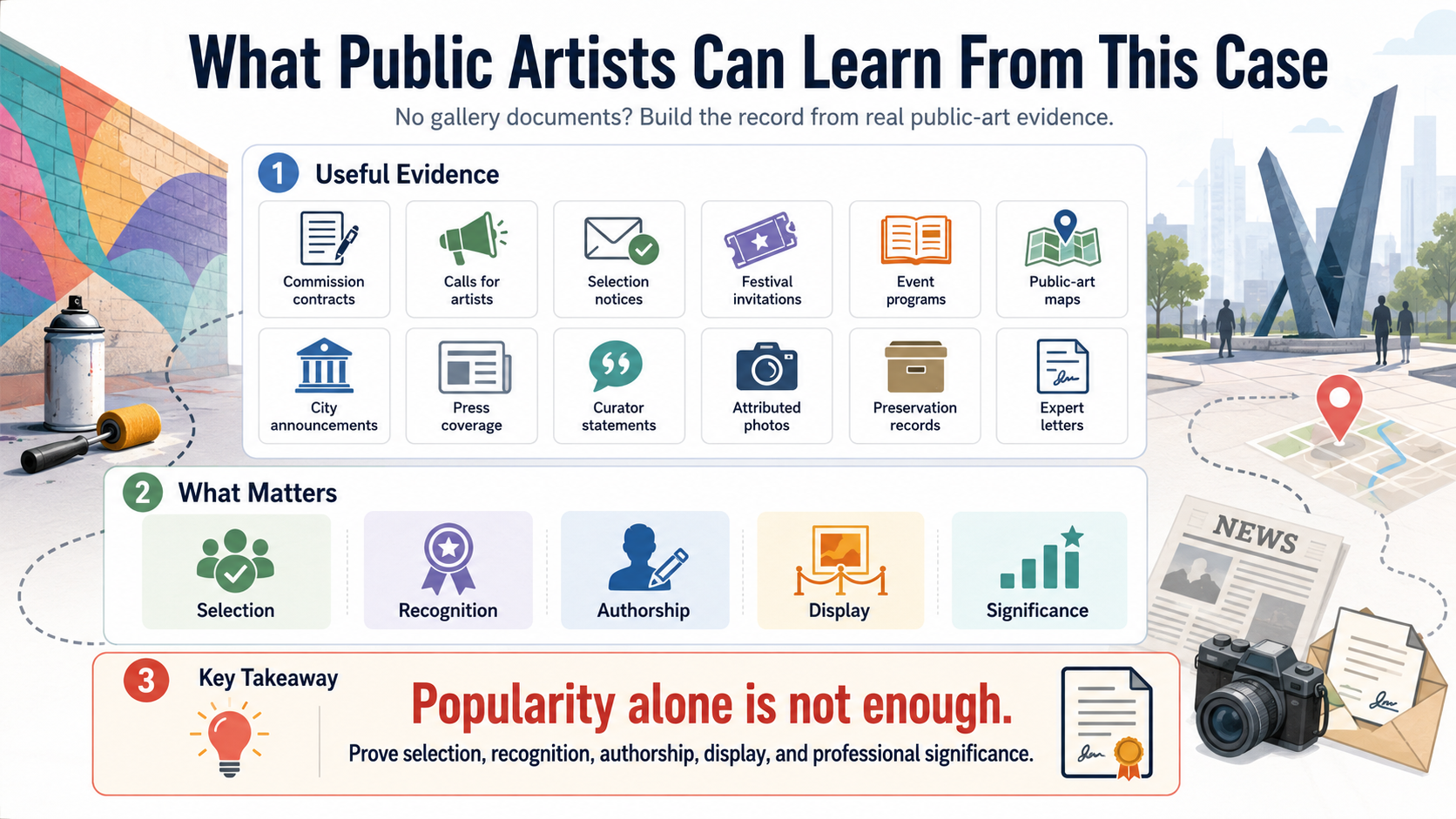
Many muralists, street artists, installation artists, and community-based artists underestimate their evidence because they do not have the usual gallery documents. That does not mean there is no case. It means the record must be built from the evidence that the field actually produces.
Useful public-art evidence may include commission contracts, calls for artists, selection notices, mural-festival invitations, event programs, public-art maps, city announcements, press coverage, budget records, curator statements, photographs with attribution, preservation records, and letters from professionals who can explain the work in artistic terms.
The key is not to claim that public popularity alone proves extraordinary ability. The key is to document selection, recognition, authorship, display, and professional significance.
Frequently asked questions
Can a mural count as an artistic exhibition or showcase for EB-1A?
It can, depending on the facts. A mural is stronger when it is part of a curated public-art program, municipal commission, mural festival, cultural exhibition, or professionally organized public showcase. Photographs alone are usually not enough; the petition should document the organizer, selection process, location, audience, attribution, and professional context.
Do street artists need gallery exhibitions for EB-1A?
Not always. Gallery exhibitions can help, but public artists may rely on field-appropriate evidence such as commissions, festivals, public-art programs, critical coverage, curator letters, and documented public installations. The petition should explain how recognition works in that artistic niche.
Can municipal commissions support EB-1A?
Yes, if the record shows that the commission was selective, professionally meaningful, and tied to the artist’s individual role. Contracts, city records, public-art budgets, program descriptions, and letters from officials or curators can help prove that the work was more than routine decoration.
What is the biggest mistake muralists make in EB-1A cases?
A common mistake is submitting images of murals without proving selection, authorship, press recognition, artistic significance, or the professional standing of the commissioning body. USCIS needs evidence, not just a portfolio.
Can public popularity help an EB-1A artist case?
Public visibility can support the narrative, but it should be tied to verifiable evidence: media coverage, public attendance or reach where available, commissioned locations, professional selection, critical reviews, cultural recognition, or expert interpretation.
Build an EB-1A record around the way your art is actually recognized
Public artists often work outside the systems that produce clean immigration evidence. Their art may be visible, but their authorship, selection, and recognition may be scattered across city records, festival pages, press mentions, contracts, photographs, and curator memory.
Immignis and Advance My Profile help artists identify a defensible field niche, collect attribution evidence, document public displays and commissions, develop independent recognition, and prepare an EB-1A record that reflects how the artist is actually known in the field.
If your strongest work lives in public spaces, the question is not whether it belongs in a gallery. The question is whether the record can prove why the work matters and why you are recognized as the artist behind it.