Key facts at a glance
| Outcome | EB-1A approval for a Ukrainian documentary photographer whose work focused on wartime civilian life, displacement, and long-form conflict photography. |
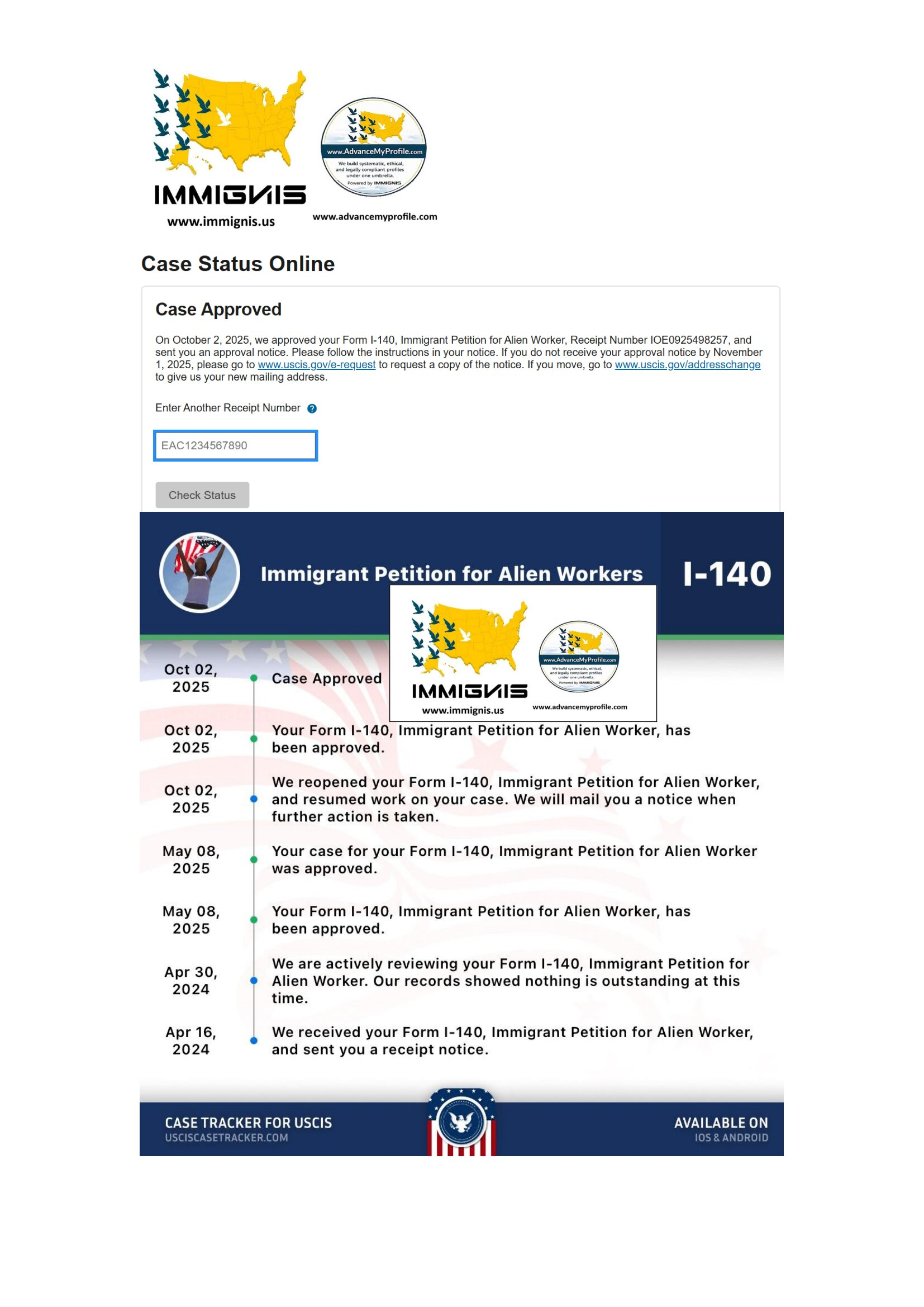
| Approval date | USCIS case status reflected approval on October 2, 2025. |
| Profile / base | Ukrainian photographer with a scattered international publication record and U.S.-relevant humanitarian and media recognition potential. |
| Field niche | Long-form conflict and displacement photography, with an emphasis on civilian life, forced movement, memory, and visual documentation during wartime. |
| Starting weakness | Her images had traveled widely, but bylines were inconsistent, wire-service records were scattered, and the public record did not yet show sustained acclaim tied clearly to her name. |
| Profile-building path | Immignis and Advance My Profile organized credited publication evidence, reclaimed attribution, developed a photo-award and exhibition record, secured photojournalism press features, built jury-service evidence, and obtained editor, curator, and photojournalism expert letters. |
| EB-1A evidence presented | Published material, display of work at exhibitions or showcases, original artistic contributions, awards, judging, and a final-merits narrative showing why her authorship mattered in the field. |
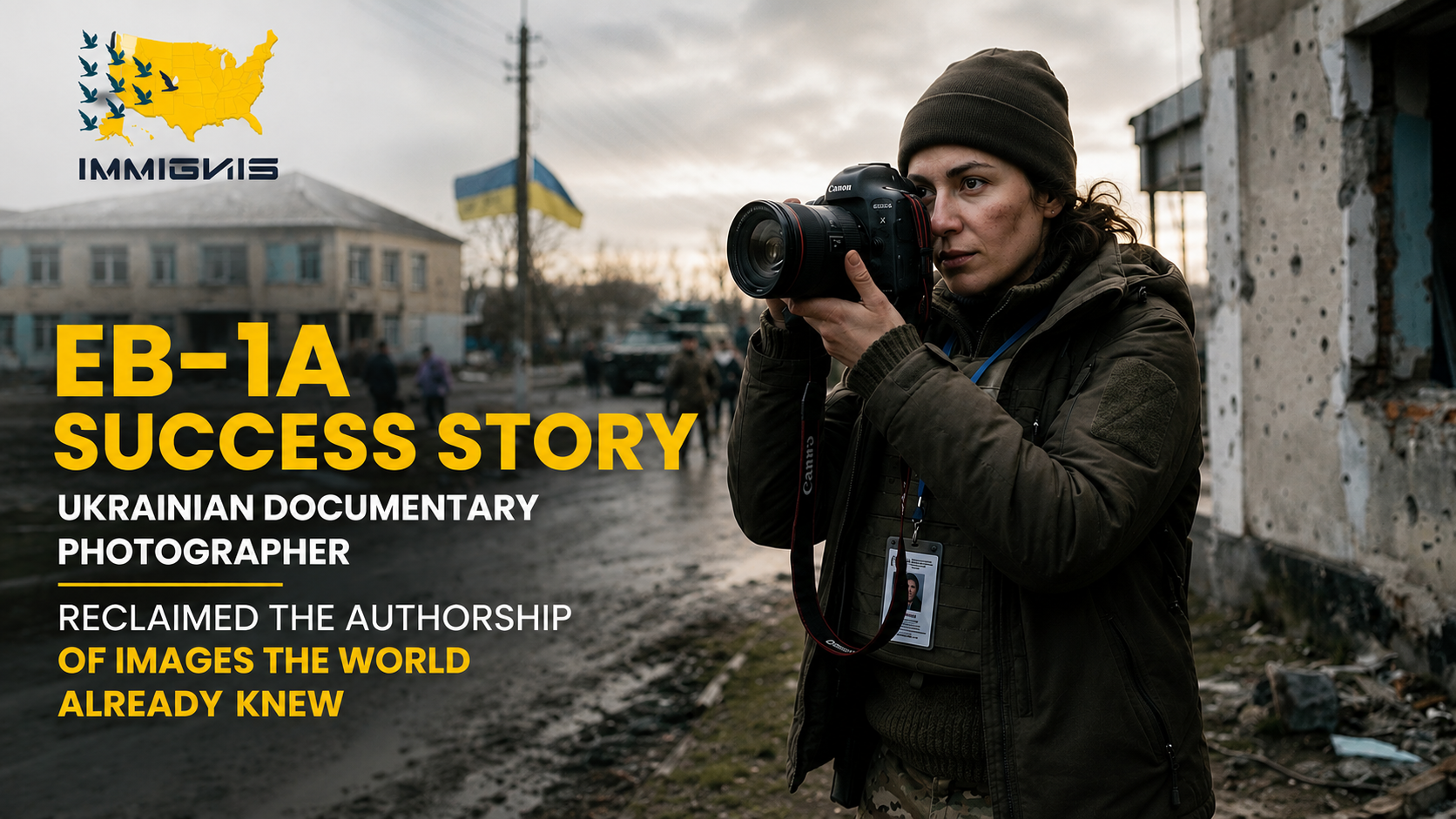
On October 2, 2025, USCIS approved the Form I-140 petition of an EB-1A Documentary Photographer whose strongest work had already moved through newsrooms, archives, exhibitions, and humanitarian conversations before her immigration record could clearly prove one essential point: she was the author behind the images.
This was not a case about making an unknown photographer look important. It was a case about organizing a record that had become fragmented because of the way conflict photography is published, syndicated, archived, and credited.
Her photographs documented wartime civilian life and displacement. Some appeared through wire services, nonprofit communications, documentary outlets, and editorial packages. Some were credited cleanly. Others carried shortened credits, agency labels, incomplete captions, or later references that separated the image from the person who made it.
For EB-1A, that created a serious problem. The world may recognize an image, but USCIS still needs to understand whose work it is, why it matters, and how the field recognizes the photographer herself.
The images were visible. The author was not always visible.
A documentary photographer can spend years building a body of work in unstable environments. The resulting images may enter newspapers, magazines, reports, exhibitions, advocacy archives, and public memory. Yet the evidence often remains scattered across captions, editorial databases, agency records, publication screenshots, curator notes, and informal acknowledgments.
That was the starting weakness in this case. The photographs were not the problem. The attribution trail was.
The client had a serious body of conflict and displacement work. She had captured civilian experiences with the patience and restraint that long-form documentary photography requires. But her EB-1A profile initially looked weaker than her real career because too much of the proof sat in disconnected places.
An officer reviewing only a basic portfolio might see powerful photographs, but EB-1A asks a different question. Has the petitioner shown sustained national or international acclaim and a record of recognized achievement in the field? For a photographer, that usually requires more than a folder of images.
Why conflict photography creates a difficult EB-1A evidence problem
Conflict and displacement photography does not always behave like gallery-centered art. Work may be published quickly. Editors may crop, caption, syndicate, or repackage images. Wire services may distribute a photograph under agency systems. Humanitarian organizations may use images for urgent reporting. Later, the photograph may be remembered more than the photographer.
That creates a gap between real-world impact and immigration evidence.
Immignis and Advance My Profile treated the case as an authorship and recognition problem. The goal was not to overstate the photographs or turn trauma into marketing. The goal was to prove, with a careful paper trail, that the client had produced original documentary work and that recognized editors, curators, journalists, and photography professionals understood the value of that work.
The field niche was narrowed to long-form conflict and displacement photography. That focus mattered. It kept the story away from a generic claim of being a “photographer” and allowed the petition to explain the specific professional problem she addressed: documenting civilian life and forced movement with continuity, context, and visual authorship.
What USCIS needed to see in this documentary photography EB-1A case
For a documentary photographer, EB-1A evidence must do more than show publication. It must connect the publication record to the individual artist or photojournalist.
Published material had to include reliable coverage about her or her body of work, not merely pages where an image appeared. Display evidence had to show that her work was selected for exhibitions, showcases, documentary photography programs, or curated presentations. Awards evidence had to separate true recognition from simple submissions or participation. Judging evidence had to show that she evaluated the work of other photographers, not merely attended festivals or gave talks.
Original artistic contribution was the most delicate issue. The petition could not simply say that war photography is important. It had to identify what was original about her body of work, why editors or curators valued it, and how her photographs contributed to a wider understanding of conflict, displacement, civilian memory, or humanitarian documentation.
The final merits analysis then had to make the evidence read as one career, not a collection of isolated items. The approved petition presented a photographer whose authorship, exhibitions, critical attention, judging work, and expert letters pointed to the same professional identity.
The first task was to rebuild the attribution trail
Before the public-facing profile could be strengthened, the existing record had to be cleaned. Credits were gathered from published pages, archives, agency records, editor correspondence, captions, exhibition materials, and portfolio documentation.
Where an image was credited to an agency or publication but could be traced to her authorship, the evidence explained the connection. Where credits were incomplete, the record relied on supporting documentation rather than assumption. Where an image could not be reliably attributed, it was not treated as a major part of the case.
That discipline helped the petition avoid a common weakness in creative EB-1A filings: presenting famous work without proving the petitioner’s personal connection to it.
The attribution record also allowed later evidence to make sense. A curator letter became stronger because it could discuss identified works. A press feature became more useful because it was tied to a defined series. Exhibition evidence became clearer because the petition could show which photographs were selected and why.
The exhibition record gave the photographs a curated home
For visual artists and photographers, display of work can be a powerful EB-1A criterion when the record shows serious selection, curatorial context, and professional presentation.
The case developed an exhibition record around documentary photography and conflict-related visual storytelling. The focus was not on quantity alone. A list of local showings would not have solved the problem. The stronger evidence came from curated programs, thematic exhibitions, photojournalism showcases, or documentary venues where selection itself indicated professional recognition.
Each exhibition record was organized with the same questions in mind: Who selected the work? What was the theme? Which photographs or series appeared? What was the venue’s role in the photography or documentary field? Was the exhibition documented through catalogs, programs, curator statements, press, or institutional pages?
This helped USCIS see that the photographs were not only published as illustrations. They were being presented as authored documentary work.
Published material had to be about the photographer, not only about the crisis
Many photographers confuse publication with published material under EB-1A. A photograph printed in a newspaper can be valuable evidence, but the published-material criterion usually requires coverage about the person or their work.
That distinction shaped the case. The petition separated ordinary image publication from articles, interviews, profiles, reviews, or photography-focused features that discussed the client, her series, her method, or the importance of her visual record.
Photojournalism press features were especially useful because they could explain the work as photography rather than simply using it as an illustration for a news event. A strong feature could discuss her field approach, long-form subject matter, ethical choices, exhibition history, or how editors understood her images.
The result was a cleaner record. Published photographs supported the broader story, while published material about the photographer helped satisfy the criterion and strengthened final merits.
Awards evidence was handled carefully
The profile-building work included photo-award submissions and recognition evidence, but the record did not treat every submission as an award. That distinction matters.
For EB-1A, an award is stronger when the evidence shows the name of the prize, the awarding body, selection criteria, level of competition, number or quality of entrants where available, and the reason the work was recognized. A shortlist, finalist placement, honorable mention, or nomination can still help, but it must be described accurately.
In this case, award evidence was used to show peer recognition in documentary photography and photojournalism where the record supported it. It was not used to inflate the case with vague claims of being “award-winning” unless the documentation could carry that language.
That approach made the petition more credible. It also protected the final merits argument because USCIS could see that recognition was being presented with precision.
Jury service showed that the field trusted her eye
Judging evidence can be particularly useful for photographers because it shows that other institutions or organizers trusted the petitioner to evaluate creative work by others.
Immignis and Advance My Profile helped document jury service, review roles, or adjudication invitations tied to photography contests, emerging-photojournalist programs, documentary festivals, or visual storytelling awards. The evidence needed to show actual evaluation, not honorary attendance.
The strongest records identified the event, the selection process, the type of work reviewed, the petitioner’s role, and proof that she judged or evaluated submissions. That allowed the petition to show more than public exposure. It showed professional reliance on her judgment.
For a photographer whose own byline had sometimes been inconsistent, judging evidence also served a second function. It showed that the field knew her as a photographer, not merely as the hidden author of widely circulated images.
Editor and curator letters did what screenshots could not
Screenshots can prove that an image appeared somewhere. They cannot always explain why the image mattered, what the photographer contributed, or how the work fits within a field.
Independent letters from editors, curators, photojournalism leaders, and documentary photography professionals helped fill that gap. The best letters did not rely on praise alone. They identified specific series, explained why the photographs were difficult or important, and addressed the client’s role in producing visual evidence of civilian experience and displacement.
A strong editor letter could explain how her photographs were selected and used. A curator letter could explain why the work belonged in a documentary exhibition. A photojournalism expert could compare her approach to common practices in conflict documentation and explain why sustained authorship over time mattered.
Those letters helped convert a scattered archive into a professionally understood body of work.
How the EB-1A evidence came together
The final petition did not depend on one dramatic claim. It worked because several evidence streams supported the same identity: a Ukrainian documentary photographer whose long-form work on conflict and displacement had been published, exhibited, recognized, and professionally evaluated.
Display evidence showed that her photographs were selected and presented in curated settings. Published material explained her work to photography and public audiences. Awards and award-related documentation showed peer recognition where supported. Judging evidence showed that institutions trusted her to evaluate the work of others. Original contribution evidence explained the significance of her visual record and the way her photographs contributed to documentary understanding of civilian life during conflict.
Most importantly, the petition solved the authorship problem. The record no longer asked USCIS to infer that she stood behind the images. It documented the connection.
The approval and what this case teaches photographers
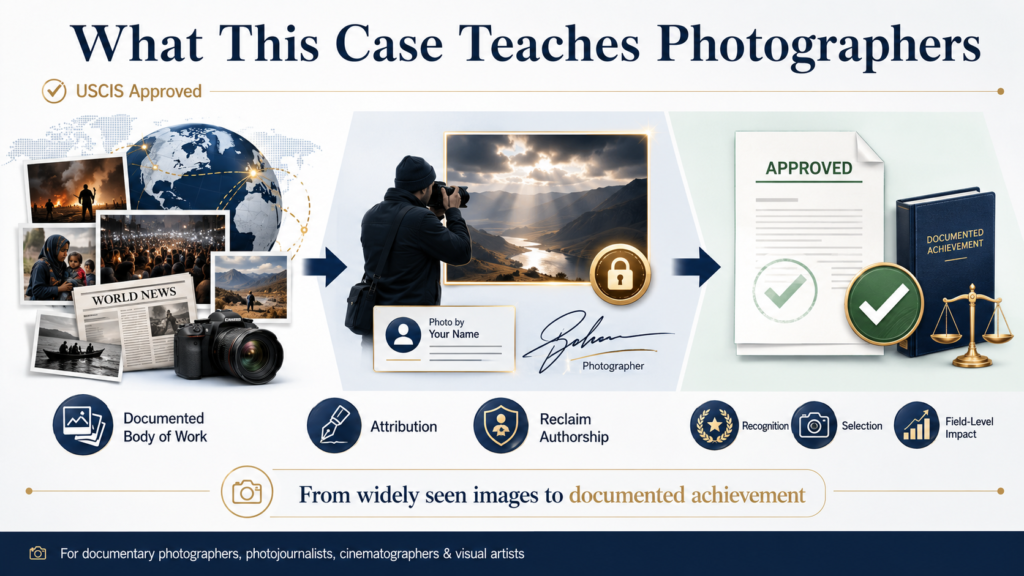
USCIS approved the petition after the record presented her photography as a documented body of professional achievement, not as a scattered collection of images.
The lesson is important for documentary photographers, photojournalists, cinematographers, and visual artists whose work travels through institutions larger than themselves. A powerful image may move the public, but an EB-1A petition still needs attribution, recognition, selection, and field-level explanation.
For this client, the case turned on a simple but difficult task: reclaiming authorship of images the world had already seen. Once that authorship was documented, the rest of the record could finally speak clearly.
FAQ for documentary photographers considering EB-1A
Can conflict photographers qualify for EB-1A?
Yes, but the record must show more than difficult subject matter. A strong petition should document authorship, published material, exhibitions or showcases, awards, judging, and expert recognition in the photography or documentary field.
Do published photographs alone satisfy the EB-1A published-material criterion?
Not always. Published images can support the overall record, but the published-material criterion generally requires coverage about the photographer or the photographer’s work. Articles, reviews, interviews, profiles, and photography features are usually more useful for that criterion.
What if my photos were published without consistent bylines?
The attribution trail must be rebuilt. Useful evidence may include editor letters, agency records, original files, caption records, contracts, publication archives, curator statements, and other documentation tying the images to the photographer.
Can exhibitions help a documentary photographer’s EB-1A case?
Yes. Curated exhibitions, documentary showcases, photo festivals, museum programs, and institutional presentations can support the display criterion when the evidence shows selection, venue significance, and the photographer’s credited work.
Why are expert letters important in photography EB-1A cases?
Expert letters can explain why a body of work matters, how it is understood within the field, and why the petitioner’s contribution is original or significant. The most useful letters discuss specific works and evidence, not general praise.
Build an EB-1A record around the authorship your images deserve
Documentary photographers often carry years of serious work in archives, captions, agency systems, festival files, and editor inboxes. The work may be known before the photographer’s immigration record is clear.
Immignis and Advance My Profile help photographers and creative professionals identify a defensible field niche, organize attribution evidence, build recognition, and prepare an EB-1A record around proof that can be verified and explained professionally.