
Key facts at a glance
| Outcome | EB-1A approval for an Indonesian composer whose work merged Javanese gamelan with electronic production and festival-based contemporary music practice. |
| Approval date | Approved on March 9, 2026. |
| Field niche | Gamelan-electronic hybrid composition, with a focus on commissioned works, festival premieres, intercultural sound design, and contemporary performance contexts. |
| Starting problem | The music was distinctive, but the field was unusual. USCIS first needed to understand what the specialty was before it could evaluate recognition inside that specialty. |
| Profile-building path | Immignis and Advance My Profile built the record through commission contracts, ethnomusicology and music-press coverage, academic collaboration papers, festival premieres, streaming and commercial-use data, judging evidence, and independent expert letters defining the field. |
| EB-1A evidence presented | Original contributions, published material, commercial success in the performing arts, leading or critical role, judging, festival showcase evidence, and expert explanations of field significance. |
| Approval hook | The petition defined the field itself so USCIS had a measuring stick for the achievement. |
EB-1A Composer: USCIS approved the Form I-140 petition on March 9, 2026.
The approval did not come from calling the work innovative in general terms. The petition had to do something more basic first: it had to teach the officer what field the composer belonged to.
He was an Indonesian composer creating music between Javanese gamelan tradition and electronic production. Festivals had commissioned his work. Academic collaborators understood the research value. Listeners were finding the recordings online. Yet the first version of the record had a problem that many artists in new or hybrid fields face: the achievement had no obvious category.
Was he a traditional musician? An electronic producer? A contemporary composer? A cultural researcher? Each label explained part of the work, but none of them gave USCIS a fair way to measure the full record.
The music was not the problem. The category was.
A conventional music case may begin with a familiar frame: orchestral performance, film scoring, classical interpretation, commercial music production, or a major award record. This case began somewhere less comfortable. The composer worked in a space where a centuries-old ensemble tradition met digital sound design, sampling, sequencing, synthesis, and contemporary festival presentation.
That made the case interesting, but also risky. If the petition described him only as a composer, the record looked scattered. If it described him only as a traditional artist, the electronic production work appeared secondary. If it described him only as an electronic producer, the cultural and compositional discipline behind the gamelan work disappeared.
For EB-1A, the field matters because the field supplies the standard of comparison. USCIS is not simply asking whether the person is talented. The petition must show extraordinary ability through sustained acclaim and recognized achievements in a field of endeavor. If the field is unclear, the evidence has no stable measuring stick.
The profile-building strategy therefore began by narrowing the case to gamelan-electronic hybrid composition. That phrase did not make the field bigger. It made the record more honest and more usable.
Why the petition had to define gamelan-electronic composition
Gamelan is not just an aesthetic reference. It involves ensemble practice, layered rhythmic structures, tuned instruments, performance relationships, and cultural memory. Electronic production is not just a modern coating. It involves sound design, editing, spatial treatment, sampling choices, synthesis, and the way recorded or programmed sound changes the listener’s experience.
The composer’s work lived in the tension between those systems. The petition described how his compositions used gamelan materials and electronic methods without reducing either side to decoration. The focus was on composition, structure, collaboration, and performance context.
That distinction mattered. A superficial fusion claim would have been weak. USCIS did not need marketing language about blending old and new. It needed evidence that this was a real artistic specialty, that knowledgeable people could evaluate it, and that the petitioner had produced recognized work inside it.
Independent expert letters helped define the field. Ethnomusicologists, festival programmers, contemporary composers, and music-technology specialists could explain why the work was not simply a local performance style or an experimental hobby. They could identify the technical and artistic questions the work raised: tuning, translation between acoustic and electronic sound worlds, ensemble identity, live performance, recording, and audience reception.
What USCIS needed to see in this composer’s EB-1A case
The case could not rely on a generic artist biography. It needed evidence that matched the reality of a hybrid music field.
For original contributions, the petition identified the composer’s specific approach to gamelan-electronic composition and explained why it mattered to contemporary music, ethnomusicology, festival programming, and intercultural performance. For published material, the record needed music press, ethnomusicology press, or arts-and-technology coverage about his work or expertise, not just event listings.
For commercial success, the petition used evidence that made sense for the field: streaming data, performance fees, commission records, licensing, ticketed presentations, and available comparisons. The goal was not to pretend a niche contemporary composer should be measured against global pop stars. It was to show commercial and audience response within the relevant artistic market.
For leading or critical role, the petition documented commissions, premieres, academic collaborations, and festival roles that depended on his compositional authorship. For judging, it documented roles in which he evaluated other composers, submissions, performances, or experimental music projects.
At final merits, USCIS could still ask whether the full record showed sustained acclaim. The petition therefore had to connect the same person across every evidence stream: the commissioned composer, the published subject, the collaborator, the performer whose work reached audiences, and the professional asked to judge the work of others.
Commission contracts turned informal recognition into evidence
Many composers are recognized first through commissions rather than press. A festival, ensemble, academic program, or cultural institution asks for a new work because it trusts the composer’s artistic voice. That is recognition, but it has to be documented.
Immignis and Advance My Profile organized commission contracts, engagement letters, program descriptions, premiere records, and correspondence showing that institutions had selected him to create original gamelan-electronic works. The record identified who commissioned the work, what was commissioned, where it premiered, and why the commissioning body mattered in the field.
The strongest commission evidence did not simply say that he was paid. It showed artistic reliance. A festival or institution was not hiring a background technician. It was presenting his composition as part of a curated program or cultural platform.
This helped the leading-role and original-contribution arguments. It also showed that his career was not based only on self-published work or private experimentation. Organizations in the field were giving his compositions a public stage.
Festival premieres showed the work in its natural environment
For this case, festival premieres were more than performances. They were the public places where the field became visible. A gamelan-electronic work may not fit neatly inside a gallery exhibition, a classical recital, a club set, or an academic lecture. Contemporary music festivals and interdisciplinary arts programs often provide the right context.
The petition documented festival programs, premiere materials, curator statements, performance listings, and audience or press response where available. These records helped show that the work had been displayed or presented in recognized artistic settings.
The record also explained the role of the premiere. In contemporary composition, a premiere can be an important marker because it shows that a new work was selected, produced, rehearsed, and presented to an audience under the judgment of programmers or curators.
This evidence gave USCIS a concrete picture. The composer was not merely claiming a style. His works had been commissioned, premiered, and placed before audiences in settings where contemporary music professionals could assess them.
Ethnomusicology and music-press coverage gave the field a language
The initial problem was not only lack of publicity. It was lack of vocabulary. An officer unfamiliar with gamelan-electronic composition may not know what questions to ask or why the work deserves evaluation on its own terms.
Published material helped solve that problem when it did more than announce performances. Coverage in ethnomusicology, contemporary music, arts-and-technology, or cultural press could explain the work’s artistic context, the composer’s method, and the relevance of the hybrid form.
The petition favored coverage that discussed the composer or his expertise directly. General articles about gamelan, electronic music, or festival culture were not enough unless they connected clearly to his work. The best material gave USCIS independent evidence that knowledgeable writers and editors saw his compositions as part of a meaningful artistic conversation.
This also strengthened final merits. Published material made the field legible and helped move the record beyond self-description. Other people were naming the work, interpreting it, and explaining why it mattered.
Academic collaboration papers made the artistic method examinable
The profile also included academic collaboration papers. In a hybrid music field, these can be valuable because they allow the composer’s method to be discussed with more precision than a concert announcement can provide.
The papers and collaborations examined questions such as musical structure, performance practice, cultural translation, sound technology, and the relationship between traditional ensemble resources and electronic production. Where the composer’s contribution was identifiable, the petition used these records to show authorship, expertise, and field engagement.
This evidence had to be framed carefully. Academic collaboration did not automatically make the petitioner a scholar of extraordinary ability. Its value was that it documented a serious artistic method and showed that researchers or institutions considered the work worthy of analysis.
The papers also supported the original-contribution narrative. They showed that the work could be discussed, taught, studied, and evaluated by others, which is especially important when the field itself is unfamiliar.
Streaming data and commercial evidence were compared to the right market
Commercial success in a niche music field must be presented honestly. Streaming numbers can be useful, but only if they are documented, contextualized, and tied to the beneficiary’s work.
The petition used platform analytics, streaming reports, royalty or licensing records where available, commission fees, ticketed performance evidence, and audience data. It did not compare the composer to mainstream pop acts or treat every play as proof of extraordinary ability.
Instead, the evidence asked a more useful question: did his work reach audiences, generate measurable engagement, and show commercial or public response that was meaningful for contemporary experimental composition?
That framing made the commercial-success evidence credible. It recognized the scale of the field while still showing that the work had moved beyond private artistic production.
Expert letters defined the measuring stick
The most important letters did not merely praise the composer’s talent. They explained the field.
Strong letters came from people who could describe the place of gamelan-electronic composition within contemporary music, festival programming, ethnomusicology, intercultural composition, or music technology. They explained what counts as recognition in the specialty and why the petitioner’s commissions, premieres, publications, collaborations, and audience data mattered.
That was essential because USCIS officers are not expected to be specialists in every artistic niche. A strong petition does not ask the officer to know the field already. It gives the officer a reliable way to understand the field through credible independent voices.
The letters also avoided vague admiration. They identified works, explained methods, discussed selection by respected institutions, and described how the petitioner’s work contributed to the development or visibility of the hybrid form.
Judging evidence showed recognition by peers
Judging was developed through roles in which the composer evaluated other musicians, compositions, festival submissions, experimental music projects, or interdisciplinary works. This evidence mattered because it showed that the field treated him not only as a participant, but as someone qualified to assess others.
The petition documented the organization, event, category, selection process, and nature of the evaluation. It also separated genuine judging from ordinary panel participation or performance invitations.
For artists in newer fields, judging evidence can be especially useful. It shows that peers and institutions recognize the person’s judgment even when the field does not have a long list of traditional awards or rankings.
In this case, judging helped balance the commercial and performance evidence. It showed professional trust, not only audience response.
The field itself became part of the petition strategy
The case’s central challenge was not whether the composer had done serious work. The challenge was whether the record could make that seriousness visible to a legal decision-maker.
The petition therefore built the field before it argued the acclaim. It explained what gamelan-electronic hybrid composition is, who evaluates it, where it is presented, how it is commissioned, what kinds of press cover it, what kinds of collaborations study it, and what commercial evidence can fairly measure audience response.
Only then did the evidence become easy to understand. Commission contracts showed selection. Festival premieres showed presentation. Published material explained context. Academic collaborations made the method examinable. Streaming and licensing data showed reach. Expert letters supplied standards. Judging evidence showed peer trust.
That is why the approval hook was so strong: the petition defined the field itself so the achievement had a measuring stick.
How the EB-1A evidence came together
The approved petition did not depend on one impressive fact. It worked because several types of evidence pointed to the same narrow professional identity: an Indonesian composer recognized for gamelan-electronic hybrid composition.
– Original contributions: The record identified his compositional approach, commissioned works, interdisciplinary method, and expert explanations of why the work contributed to a defined contemporary music specialty.
– Published material: Ethnomusicology, contemporary music, arts-and-technology, and music-press coverage explained the composer, the work, and the field context.
– Commercial success: Streaming data, commission records, licensing evidence, ticketed presentations, or related metrics were documented and compared within the appropriate niche market.
– Leading or critical role: Commission contracts, festival premieres, and academic collaborations showed institutions relying on his authorship and expertise.
– Judging: Festival, competition, or selection-panel roles documented his evaluation of other artists’ work.
– Final merits: The record showed sustained recognition inside a narrow and well-defined artistic specialty, rather than scattered activity across unrelated music categories.
The strongest part of the record was its coherence. USCIS did not have to decide whether he was a traditional musician, a producer, a composer, or a researcher. The petition showed why those pieces formed one field.
Why this approval matters for artists in hybrid fields
This approval is useful for composers, sound artists, interdisciplinary performers, digital artists, experimental filmmakers, multimedia designers, and culturally rooted creators whose work does not fit traditional institutional categories.
A niche field can qualify for EB-1A, but the petition must define the field with care. The more unusual the specialty, the more important it becomes to explain who recognizes excellence, where the work is presented, how audiences encounter it, and what evidence proves that the petitioner is recognized within it.
Hybrid artists often have real recognition scattered across festivals, residencies, commissions, academic programs, streaming platforms, press, and community institutions. The problem is not always lack of achievement. The problem is that the evidence has not been organized into an adjudicator-readable field.
This case showed that a petition can respect the complexity of an artistic tradition while still making the legal record clear.
The result
USCIS approved the Form I-140 on March 9, 2026.
The final record presented an Indonesian composer whose gamelan-electronic compositions had been commissioned, premiered, discussed, studied, streamed, and evaluated by others in the field. The petition did not flatten the work into a generic music profile. It taught the field, then proved the standing.
For the composer, that made the difference between being an unusual artist with scattered evidence and an EB-1A-approved professional with a defined record of extraordinary ability.
Lessons for composers and interdisciplinary artists considering EB-1A
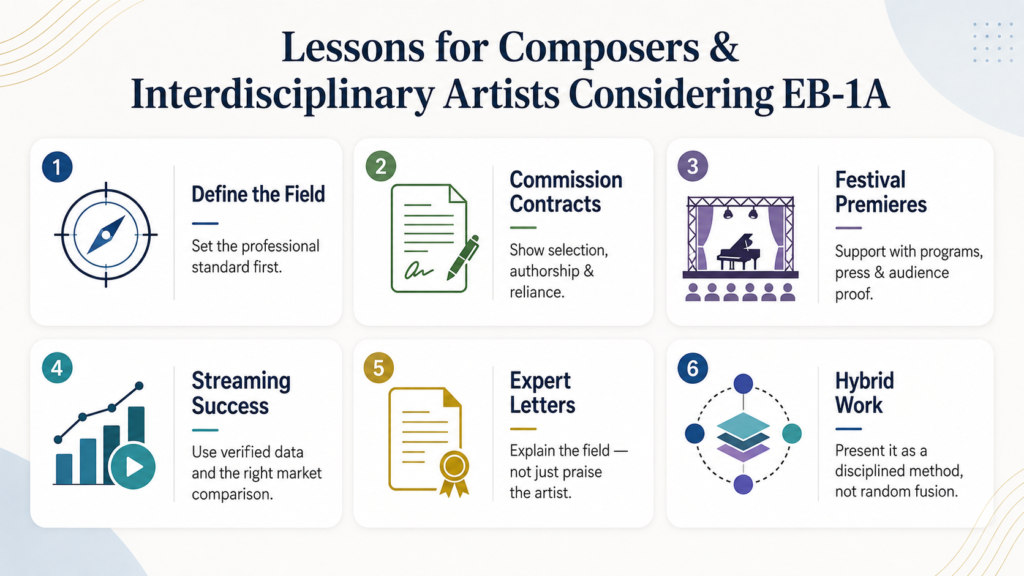
– Define the field before arguing acclaim. USCIS needs to know the professional standard being used.
– Commission contracts can be strong evidence when they show selection, authorship, and institutional reliance.
– Festival premieres are most useful when supported by programs, curator statements, press, or audience evidence.
– Streaming data can support commercial success when it is verified and compared to the right artistic market.
– Expert letters should explain the field, not only praise the artist.
– Hybrid work should not be described as random fusion. The petition must show a disciplined method and recognized context.
Frequently asked questions
Can experimental composers qualify for EB-1A?
Yes. Experimental composers can qualify for EB-1A when the petition documents a defined field, recognized achievements, independent evidence, and sustained acclaim. The key is showing how the field evaluates excellence and how the composer has been recognized within that field.
Can commission contracts help an EB-1A music case?
Yes. Commission contracts can support original-contribution, leading-role, or recognition arguments when they show that a respected institution selected the composer to create original work and presented that work publicly.
Does streaming data count as commercial success for EB-1A?
Streaming data may help when it is verified, tied directly to the petitioner’s work, and contextualized within the relevant market. For niche or experimental music, the comparison should be fair to the field rather than based on mainstream pop metrics.
What if USCIS does not understand the artistic field?
The petition should define the field through expert letters, published material, program records, academic collaborations, and explanations of field hierarchy. A strong petition does not assume the officer already knows the specialty.
Can hybrid cultural work support EB-1A?
Yes. Hybrid cultural work can support EB-1A when the evidence shows a disciplined artistic method, public presentation, independent recognition, and field significance. The record should avoid vague claims and show how the work is evaluated by knowledgeable professionals.