How an EB-1A Master Watchmaker from Switzerland secured approval after confidential complication development, maison-cleared attribution, patent records, horological press, industry recognition, judging, teaching, collector-market evidence, and remuneration benchmarking were organized into a personal record of extraordinary ability.
Key facts at a glance
| Petition outcome | Form I-140 approved under EB-1A on February 6, 2024. |
| Professional profile | Swiss master watchmaker and complications specialist whose technical work appeared in high-value mechanical watches sold under prestigious maisons rather than under the individual maker’s name. |
| Field niche | Haute horlogerie complications development. |
| Starting weakness | The industry protected the identity of the specialist behind the movement. Public attention went to the maison, reference, and finished watch, while the petitioner’s technical authorship remained inside confidential development files. |
| Profile-building focus | Maison-cleared attribution letters, patent documentation, horological-press coverage, industry-award records, watchmaking-school masterclasses, judging service, remuneration benchmarking, and carefully framed collector-market evidence. |
| Principal EB-1A evidence areas developed | Original contributions, high salary or other significantly high remuneration, published material about the petitioner, nationally or internationally recognized awards where personally attributable, and judging the work of others. |
| Central issue | Showing that the petitioner was not simply a skilled employee assembling luxury watches, but a complications specialist whose technical decisions shaped movements, performance, reliability, and products recognized at the highest level of mechanical watchmaking. |
| Approval lesson | In confidential craft and luxury industries, attribution must be earned document by document. The brand can provide context, but the petition must still identify the person behind the protected technical work. |
The watch carried the maison name. The movement carried his decisions.
A finished haute horlogerie watch is designed to look complete and inevitable. The dial presents a name. The case has a reference number. The movement may be decorated, photographed, awarded, reviewed, and sold for a price that attracts collectors around the world. What the public rarely sees is the chain of technical decisions required to make a complex mechanical function fit, perform, survive testing, and remain serviceable over time.
That invisibility was the starting problem in this case. The petitioner had worked on sophisticated complications for respected Swiss maisons, but the strongest proof was protected by employment agreements, supplier relationships, intellectual-property rules, and a culture that placed the house above the individual craftsperson. The watches were visible. The maker was not.
USCIS approved the Form I-140 petition on February 6, 2024. Immignis and Advance My Profile built the record around lawful attribution: what the petitioner personally designed or solved, which documents could be cleared for use, how patents and independent coverage supported the technical narrative, and why the compensation, judging, and teaching record reflected standing beyond ordinary watchmaking work.
Why elite watchmaking can make exceptional work look like routine employment
A watchmaker may spend years inside a manufacture without appearing publicly as the author of a product. Teams divide responsibility among movement constructors, prototypists, complications specialists, finishers, industrialization engineers, quality teams, case and dial specialists, and after-sales experts. A successful watch then enters the market under the maison name. Even detailed reviews may describe the caliber without naming the people who made its most difficult functions possible.
This structure can produce a misleading immigration record. A person may have solved a serious mechanical problem, developed a protected component, guided a complication from concept to production, or corrected a reliability failure, yet the resume may still read like a series of staff positions. The prestige of the employer does not automatically establish the extraordinary ability of every employee.
The petition therefore had to do more than display expensive watches and famous brands. It needed person-specific evidence. Each claimed achievement had to answer four questions: What was the technical problem? What did the petitioner do? How can that contribution be verified without breaching confidentiality? Why did the result matter beyond an ordinary assignment?
The field was defined as haute horlogerie complications development
The case did not use the broad label watchmaker. That term could describe repair work, restoration, assembly, regulation, production, retail service, or many other occupations with different standards of achievement. The petitioner’s actual expertise was narrower: the development of mechanical complications in high-end watchmaking.
A complication is any function beyond the basic display of hours, minutes, and seconds. The technical demands vary widely, but complications may involve additional indications, calendar logic, chronograph control, acoustic mechanisms, striking sequences, astronomical information, power management, or other mechanical functions. Their development requires accuracy, miniaturization, energy control, manufacturability, durability, finishing awareness, and careful interaction among components.
This field definition gave the evidence a common center. Patents, prototype records, technical letters, awards, press features, compensation, judging, and masterclasses were not separate achievements collected for volume. They described how the field recognized a specialist trusted with difficult mechanical work that few watchmakers are equipped to perform.
Maison-cleared attribution letters made confidential authorship usable
The most important evidence did not come from public marketing. It came from carefully limited letters and technical summaries cleared by the maisons or other authorized parties. These documents identified the petitioner’s responsibilities without disclosing protected drawings, tolerances, unreleased references, proprietary processes, or trade secrets.
A useful attribution letter explained more than job title and dates. It described the type of complication or subsystem involved, the stage of development, the petitioner’s decision-making authority, the technical difficulty, and the difference between the petitioner’s work and routine execution. Where possible, it also explained whether the solution reached prototype, validation, production, award consideration, or continued use.
The letters were strongest when they separated individual work from team work. They did not claim that one watchmaker created an entire watch. They identified a discrete contribution and placed it within the larger manufacture. That restraint made the evidence more believable and allowed the petition to respect both collaboration and personal authorship.
Patent records supplied a public trail where publicity did not
Patent documentation provided another route to technical attribution. In luxury watchmaking, an invention may be assigned to a company even when the named inventor is an individual specialist. The petition used relevant records to establish inventorship, filing dates, technical subject matter, and the relationship between the protected mechanism and the petitioner’s field.
A patent alone did not end the analysis. The record still had to explain what problem the invention addressed and why it mattered. Some patents never reach production. Others protect narrow variations. The case therefore connected patent evidence to development history, technical use, internal validation, later products, or independent professional discussion where the available record allowed it.
This distinction helped support the original-contributions argument. The evidence did not treat every patent as proof of major significance. It showed which protected ideas reflected meaningful mechanical authorship and how those ideas affected complication design, performance, reliability, production, or future development.
Awards were persuasive only when the personal connection was proved
Watch-industry awards can give an officer an understandable measure of recognition, but they require careful attribution. A prize may belong to the watch, the maison, a design team, or a named individual. The petition did not convert a product award into a personal award merely because the petitioner worked on the movement.
For each relevant distinction, the record identified the awarding organization, the category, the selection process, the recognized watch or mechanism, and the petitioner’s documented role. If the award formally belonged to the maison, it was used as context for the importance of the product and paired with separate evidence showing the petitioner’s contribution. Only personally received or properly attributable recognition was presented under the awards criterion.
This approach protected the credibility of the entire case. In a field where prestigious names can easily overwhelm the individual record, precision mattered more than a long list of trophies.
Horological press had to discuss the maker, not merely the watch
Independent horological journalism helped move the profile beyond employer-controlled material. Reviews of a watch were useful for explaining the technical and market context, but they did not automatically satisfy published material about the petitioner. The relevant question was whether qualifying coverage actually discussed the watchmaker, the person’s work, or the person’s recognized expertise.
Profiles, interviews, technical features, event coverage, and specialist articles were organized separately from authored pieces and maison publicity. The petition examined the publication, the independence of the source, the depth of the discussion, the audience, and whether the material focused substantially on the petitioner rather than mentioning a name in passing.
That separation also made the story more readable. Independent coverage helped explain why a complications specialist matters, while technical and employer records proved what this particular specialist had done.
High remuneration required a Swiss watchmaking comparison, not a luxury-price assumption
The price of a watch says almost nothing by itself about the salary of the person who developed it. A six-figure retail price cannot substitute for evidence that the petitioner earned significantly high remuneration compared with others in the field. The case therefore treated compensation as its own evidentiary question.
The record considered base salary, bonuses, specialist allowances, consulting fees, royalties where applicable, and other compensation supported by reliable documents. Benchmarks were selected carefully so that the comparison reflected Switzerland, the relevant period, seniority, technical specialization, employment type, and the difference between general watchmaking roles and high-level complications development.
This like-for-like approach was important. A comparison to entry-level technicians would have overstated the evidence. A comparison to unrelated luxury executives would have been equally weak. The petition showed how the petitioner’s remuneration compared with professionals performing genuinely similar work.
Judging and masterclasses showed that the field trusted his eye and judgment
Judging evidence came from completed service evaluating the work of other watchmakers, students, designers, or competitors. Invitations alone were not enough. The record documented the organizer, the petitioner’s selection, the work evaluated, the role performed, and completion of the service.
Watchmaking-school masterclasses and advanced teaching added another form of professional reliance. Teaching does not automatically satisfy the judging criterion, but repeated invitations to instruct serious practitioners can strengthen the overall record. They show that institutions trusted the petitioner to explain difficult mechanisms, diagnose errors, and transmit knowledge that is not widely available.
Together, judging and teaching gave the case a dimension that patents and compensation could not. They showed the petitioner acting as an evaluator and source of expertise for other professionals, not only as an employee producing work inside one maison.
Collector-market evidence explained significance without turning price into acclaim
Collector response, auction commentary, demand, specialist dealer analysis, and secondary-market behavior can help explain why a particular watch or complication attracted attention. The case used this material cautiously. Market enthusiasm was not presented as a stand-alone EB-1A criterion, and the value of the finished watch was not treated as the petitioner’s personal commercial success.
Instead, collector-market evidence supplied context. It showed that the products connected to the petitioner’s work were examined, discussed, and valued by a knowledgeable audience. When paired with independent attribution, patents, awards, and technical records, that context helped explain why a mechanical contribution was not merely an internal exercise.
This was especially useful for final-merits analysis. The petition could show a chain from technical authorship to recognized product, professional evaluation, and market attention without claiming that every part of the product’s reputation belonged to one person.
Why this case worked
The case succeeded because it did not ask the officer to confuse brand prestige with personal acclaim. It acknowledged the realities of team production and confidentiality, then built a record that consistently returned to the petitioner’s own work.
The evidence operated in layers. Cleared letters established role and authority. Patents supplied public technical authorship. Independent coverage created person-focused visibility. Awards were used with accurate ownership. Compensation was benchmarked against comparable professionals. Judging and teaching showed reliance by the field. Collector evidence explained the importance of the products without becoming a substitute for proof.
Most importantly, the petition educated before it argued. It explained how elite mechanical watchmaking recognizes technical achievement and why anonymity can be part of the industry structure rather than evidence that the work lacked significance.
What watchmakers and confidential-industry specialists can learn
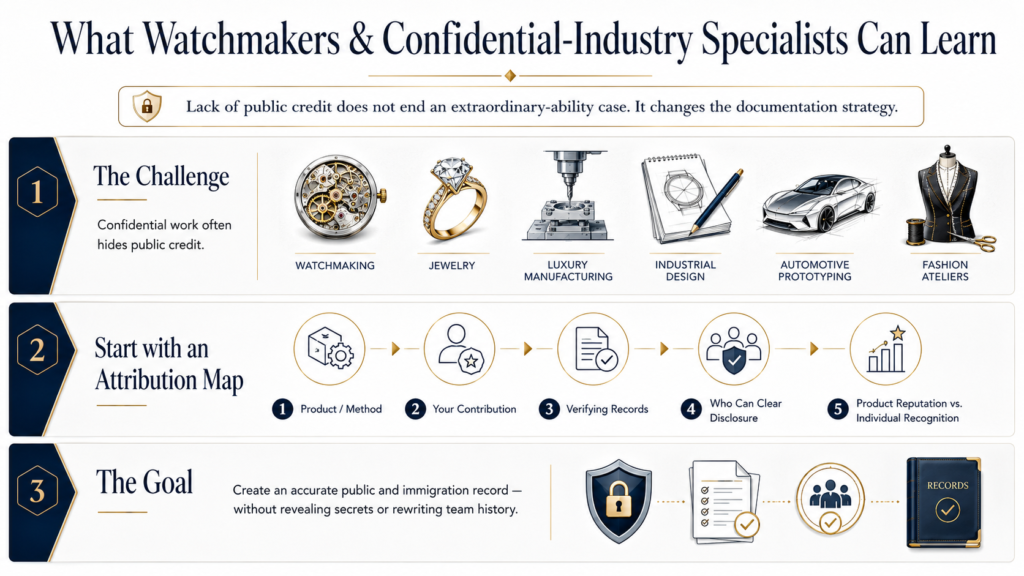
Professionals in watchmaking, jewelry, luxury manufacturing, industrial design, automotive prototyping, fashion ateliers, and other confidential creative-technical fields often assume that a lack of public credit ends an extraordinary-ability case. It does not. It changes the documentation strategy.
The strongest starting point is an attribution map. List each major product or method, identify the personal contribution, locate records that can verify it, determine who has authority to clear information, and separate product reputation from individual recognition. Publicity can then be developed ethically around information that the relevant organizations permit to be disclosed.
The goal is not to reveal secrets or rewrite team history. It is to create an accurate public and immigration record for work that the industry already knows was exceptional.
Frequently asked questions
Can a master watchmaker qualify for EB-1A?
Potentially. The petition must show sustained national or international acclaim and satisfy the required evidentiary framework. A respected job title, famous employer, or expensive product is not enough by itself. The record must establish the individual watchmaker’s achievements and standing.
Can confidential watch-development work be used in an EB-1A petition?
Yes, when it can be documented lawfully and credibly. Cleared letters, redacted technical summaries, patent records, role descriptions, validation records, and authorized evidence may explain the work without exposing trade secrets or restricted product information.
Does working for a prestigious Swiss maison prove extraordinary ability?
No. The reputation of the maison provides context, but USCIS still needs person-specific evidence showing what the petitioner did, why the role was important, and how the field recognized the individual.
Can a patent support the original-contributions criterion?
It can contribute to the record, especially when the petitioner is a named inventor and the patent relates directly to the field. The petition should also explain technical significance, use, adoption, influence, or other evidence showing that the contribution was important rather than merely novel on paper.
Can a watch award be claimed by a movement specialist?
Only with accurate attribution. If the award was given to the watch or maison, it should not automatically be described as the petitioner’s personal award. It may still provide useful context when separate evidence proves the petitioner’s important role in the recognized product.
What counts as published material about a watchmaker?
Qualifying material may include independent profiles, interviews, features, or substantial articles discussing the person and the person’s work. Product reviews that never identify or discuss the watchmaker generally do not become published material about that individual.
How can high remuneration be proved in Swiss watchmaking?
The evidence should document actual compensation and compare it with reliable data for similar professionals in the same geographic and occupational market. Role, seniority, specialization, bonuses, consulting arrangements, and the relevant year all matter.
Can judging watchmaking competitions satisfy the judging criterion?
It may when the petitioner actually evaluates the work of others in the same or an allied field. The record should document selection, the organizer, the work evaluated, the petitioner’s responsibilities, and completed service.
Do watchmaking masterclasses satisfy an EB-1A criterion?
Teaching is not automatically a separate regulatory criterion, but repeated and selective invitations can strengthen the overall record by showing professional reliance, transfer of specialized knowledge, and standing in the field. Teaching that includes formal evaluation may also support judging when properly documented.
Can collector prices prove extraordinary ability?
Not by themselves. Collector demand and auction or secondary-market evidence may explain the importance of a product, but the petition still needs a reliable connection between that product and the petitioner’s personal work. Retail or resale price is not a substitute for individual acclaim.
How does profile building help watchmakers?
Ethical profile building identifies achievements that lack public attribution, develops authorized documentation, organizes patent and award evidence, strengthens independent visibility, records judging and teaching, and creates a coherent professional identity without disclosing confidential material or overstating team achievements.
Start with the movement, not the logo
Master watchmakers, complications specialists, movement constructors, prototypists, restoration experts, independent watchmakers, horological engineers, and luxury-product specialists may already have strong EB-1A evidence hidden inside patents, confidential projects, product awards, compensation records, judging, teaching, and specialist press. The first step is to identify what can be attributed personally and what still needs independent documentation.