EB-1A Sports Event Operations Executive: How a Qatari sports-event operations executive secured EB-1A approval by turning function-level leadership inside global sporting events, operating playbooks, later-host consulting, federation and stakeholder letters, conference keynotes, event-industry coverage, professional roles, and remuneration evidence into a personal record of extraordinary ability.
Key facts at a glance
| Petition outcome | Form I-140 approved under EB-1A on February 8, 2024. |
| Professional profile | Qatari sports-event operations executive who directed major operational functions for global mega-sporting events and later advised organizations preparing subsequent events. |
| Field niche | Mega-event operations and legacy planning. |
| Starting weakness | The events were internationally visible, but individual authorship disappeared inside organizing committees, cross-functional teams, vendors, federations, public agencies, and temporary delivery structures. |
| Profile-building focus | Function-attribution documentation, operating-method and legacy records, later-host consulting evidence, event-industry press, international federation and stakeholder letters, conference keynotes, professional-body roles, and remuneration benchmarking. |
| Principal EB-1A evidence areas developed | Leading or critical role, original contributions, published material about the petitioner, significantly high remuneration, and selective membership where the admission requirements were supported. |
| Central issue | Showing that the petitioner did not merely work at famous events, but personally directed difficult operations functions and developed knowledge that later event hosts and industry stakeholders sought to use. |
| Approval lesson | A mega-event can establish context, but the strongest evidence follows the expertise after the closing ceremony. Later consulting demand can show that the field values the person, not only the event brand. |
The tournament ended. His operating system did not.
Mega-sporting events are remembered through host cities, venues, ceremonies, records, broadcast moments, and the final medal table. Operations executives rarely appear in that public memory. Their work is most visible when something fails and almost invisible when transport, accreditation, workforce, venue readiness, logistics, spectator services, command centers, and incident escalation all work as intended.
That was the evidence problem in this case. The petitioner had directed important operations functions inside internationally recognized events, but the record initially looked like a list of committees and event names. Thousands of professionals had contributed. The organizing body received the public credit. The individual executive was present in internal charts, manuals, readiness meetings, decision logs, and after-action work, but not in the way an immigration officer could readily evaluate.
USCIS approved the Form I-140 petition on February 8, 2024. Immignis and Advance My Profile organized the case around a simple question: what expertise remained valuable after the event itself ended? The answer came from function-level attribution, operational methods that could be documented, later consulting for other event hosts, professional recognition, industry visibility, and evidence that the petitioner was trusted with responsibilities beyond ordinary event employment.
Why mega-events erase individual authorship
A global sporting event is delivered through an unusually dense temporary organization. The host committee may work with international federations, public authorities, venue owners, security agencies, transport providers, technology contractors, broadcasters, sponsors, volunteers, hospitality operators, and hundreds of specialist suppliers. Even senior executives operate inside a system built for collective delivery.
That structure makes personal attribution difficult. A successful event does not prove that every manager performed at an extraordinary level. A large budget does not establish individual acclaim. A senior title can also be misleading if the record does not show actual authority, the importance of the function, or the decisions the person controlled.
The petition therefore did not try to claim the whole event as the petitioner’s achievement. It identified the defined operational functions he directed, the problems those functions had to solve, the authority attached to his role, the scale and consequences of the work, and the records that could verify his contribution. This narrower approach made the story both stronger and more credible.
The field was defined as mega-event operations and legacy planning
The case did not use the broad label event management. That phrase can cover weddings, conferences, concerts, exhibitions, corporate meetings, community festivals, and many other activities. The petitioner’s work involved a different level of coordination: time-limited, multi-venue sporting events with international requirements, intense public scrutiny, large workforces, layered stakeholder authority, and little tolerance for operational failure.
Mega-event operations includes the systems that allow competition and public-facing services to function together. Depending on the assignment, the work may involve venue readiness, command and control, accreditation, workforce deployment, logistics, mobility interfaces, service standards, rehearsals, contingency planning, issue escalation, and integration among delivery partners. Legacy planning addresses what remains afterward, including transferable methods, trained personnel, venue capability, institutional knowledge, and support for future hosts.
This field definition gave the petition a coherent center. Operating manuals, organizational records, later consulting, conference invitations, federation letters, professional roles, and remuneration evidence were not disconnected achievements. They described a specialist whose value lay in making complex temporary systems work and in transferring that knowledge to the next host environment.
Function-attribution documentation turned committee work into personal evidence
The strongest early task was to separate the petitioner from the committee structure without misrepresenting team delivery. The record used authorized organizational charts, role descriptions, delegated authorities, meeting and readiness records, operating plans, implementation documents, performance summaries, and letters from people who had direct knowledge of the petitioner’s work.
Useful documents did more than repeat an executive title. They identified the specific function, the stage of the event lifecycle, the decisions the petitioner could make, the teams or contractors he directed, the operational risks involved, and the consequences if the function failed. Where disclosure was permitted, the evidence also described scale through venues, operational days, service areas, staff groups, or stakeholder interfaces without publishing protected security or commercial information.
This documentation supported the leading-role analysis because it showed why the function was important to a distinguished event organization. It also prevented the petition from relying on prestige by association. The event’s reputation established context; the function records established the petitioner’s personal responsibility.
Operating playbooks became evidence of original contribution
Major events generate manuals, matrices, dashboards, checklists, readiness frameworks, escalation routes, rehearsal protocols, and after-action reports. Many are routine adaptations of established practice. Others reflect original solutions to a host city’s particular constraints. The petition had to distinguish between ordinary operating paperwork and methods that materially improved delivery or became useful beyond one assignment.
The record focused on methods that could be attributed to the petitioner and traced through use. Examples included operating models, readiness measures, coordination procedures, command-center workflows, handover systems, or legacy tools that were adopted, reused, requested, or relied upon by other stakeholders. The case did not argue that authorship of a manual alone proved major significance. It connected authorship to implementation and professional demand.
That distinction was central to the original-contributions argument. The value of an operating method is not the number of pages it contains. It is whether knowledgeable organizations use it to solve a recurring problem, reduce uncertainty, coordinate multiple actors, or prepare another event more effectively.
Later host-city consulting showed that the expertise traveled
The most persuasive approval hook was the petitioner’s subsequent consulting record. After the original event structure had dissolved, later host cities and event organizations sought his advice. That demand helped answer the question the petition had been building toward: did the field value the event name, or did it value the executive’s knowledge?
Consulting evidence was documented through engagement letters, scopes of work, invitations, advisory records, contracts, deliverables, and testimony from clients or stakeholders. The strongest records explained why the petitioner was selected, what problem the new host faced, what part of his prior experience was relevant, and how his advice affected planning or delivery.
This evidence did not need to suggest that every later event copied one complete model. Host cities differ in governance, infrastructure, regulation, climate, culture, workforce, and institutional capacity. The significance came from adaptation. Other organizers considered the petitioner’s judgment transferable enough to bring into their own planning environment.
Federation and stakeholder letters explained the importance of the role
Independent and well-grounded letters helped explain work that public sources could not fully show. Event operations often involves restricted plans, sensitive stakeholder arrangements, commercial contracts, or security-adjacent information. A credible letter can describe responsibility and significance without disclosing protected details.
The most useful letters came from people positioned to evaluate the work, such as federation representatives, senior organizing officials, venue or government stakeholders, delivery partners, or later consulting clients. They explained how they knew the petitioner, what they observed, why the function mattered, and how his decisions differed from ordinary management work.
The petition avoided vague praise. Statements that the petitioner was excellent, hardworking, or important carried limited weight unless tied to specific facts. The strongest testimony identified a problem, the petitioner’s role in resolving it, the operational result, and the reason another organization relied on the same expertise later.
Event-industry coverage had to identify the executive, not only the spectacle
A famous tournament may generate enormous media attention, but coverage of the event is not automatically published material about one executive. The petition separated general event publicity from articles, profiles, interviews, and professional features that actually discussed the petitioner and his work.
Relevant coverage could address operational leadership, planning methods, host-city preparation, event legacy, lessons transferred to later organizers, or the petitioner’s recognized expertise. The record considered the publication, the independence of the source, the depth of discussion, the intended audience, and whether the article focused substantially on the person rather than mentioning a name in a long list.
This distinction protected the case from a common error. Global attention to a sporting event establishes that the undertaking was distinguished. It does not, by itself, establish that a particular operations executive received national or international recognition.
Conference keynotes and professional roles made the expertise visible between events
Conference invitations gave the petitioner a public platform separate from the organizing committee. Keynotes, panels, workshops, and specialist sessions allowed him to explain operational lessons, readiness models, stakeholder coordination, legacy planning, and knowledge transfer to an audience of event professionals.
The evidence documented the organizer, selection process where available, topic, audience, speaker role, and completed participation. Repeated invitations were especially useful when they showed that industry groups sought the petitioner’s judgment after the original event had ended.
Professional-body roles required careful treatment. Ordinary paid membership in an event association is generally not enough to establish the EB-1A membership criterion. Where membership was presented under that criterion, the petition documented selective admission standards based on achievement. Committee, advisory, or leadership roles that did not satisfy the membership criterion could still support leading role, professional recognition, or the final merits analysis.
High remuneration required an executive-to-executive comparison
Mega-event budgets, television rights, ticket revenue, and sponsorship values do not prove that an individual executive received high remuneration. The petition addressed compensation separately through actual employment records, consulting agreements, bonuses, allowances, and other supported components of the petitioner’s remuneration.
The comparison had to account for the unusual structure of event work. Senior appointments may be fixed-term, project-based, regional, expatriate, consulting, or tied to event completion. Reliable benchmarking therefore required attention to geography, period, function, executive level, contract type, package structure, and the difference between general event management and leadership in mega-sporting operations.
A like-for-like comparison was more persuasive than a dramatic but weak one. The case did not compare a senior international operations executive with junior event coordinators. It used the closest available professional market and explained any limitations in the data.
Legacy planning proved that operations work can outlive the closing ceremony
Event legacy is sometimes reduced to stadium use or tourism promotion. For operations professionals, legacy can also mean institutional capacity. It may include trained teams, operating systems, venue procedures, supplier knowledge, readiness methods, public-agency coordination, and a body of lessons that later hosts can use.
The petitioner’s record connected event-time delivery with post-event transfer. The evidence showed how operational knowledge was captured, communicated, adapted, or requested after the event. That helped explain why later consulting was not a separate career accident. It was the continuation of a recognized field contribution.
This legacy framing also made the case educational. The petitioner was not presented as someone who managed crowds for a short period. He was presented as a specialist in temporary systems whose methods could improve how future hosts prepare, operate, and retain capability.
Why this case worked
The case worked because it resisted the temptation to rely on the event’s fame. Every major section returned to person-specific evidence. Function records established authority. Operating methods showed identifiable technical and managerial contribution. Later consulting demonstrated continued demand. Federation and stakeholder letters supplied informed validation. Industry coverage, keynotes, professional roles, and remuneration evidence showed recognition beyond one employer or committee.
The pieces also reinforced one another. A consulting contract was stronger because the client explained why the petitioner was selected. A keynote was stronger because it addressed methods documented in the case. A letter was stronger because internal records confirmed the role. Press coverage was stronger because it focused on the executive rather than repeating event publicity.
Most importantly, the petition followed the expertise after the final whistle. The strongest proof of distinction was not merely that the petitioner had been inside a famous event. It was that other organizations wanted the knowledge he had developed there.
What mega-event professionals can learn
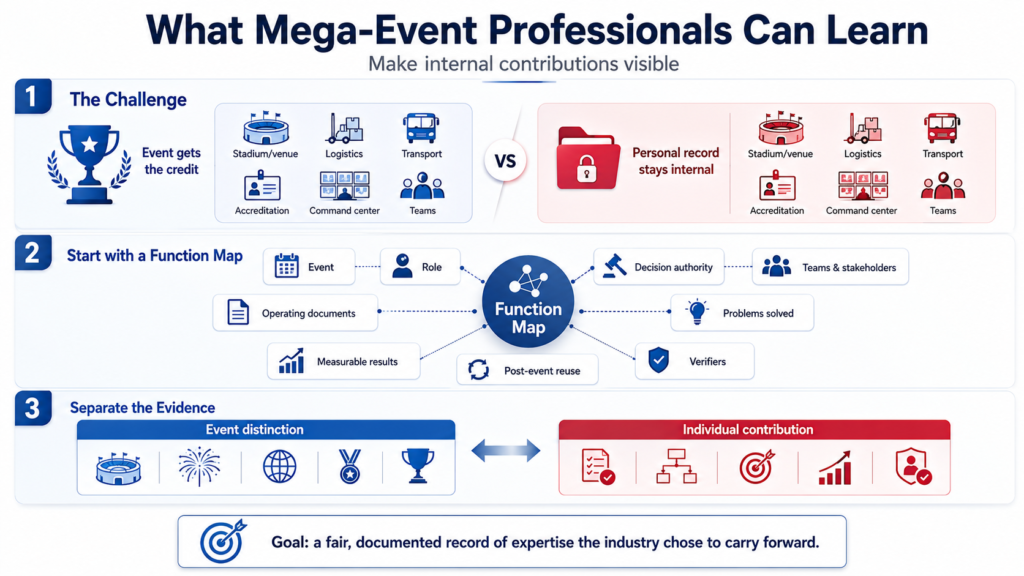
Sports-event executives, venue directors, operations planners, accreditation leaders, workforce specialists, transport coordinators, command-center leaders, logistics executives, and legacy advisers often have the same problem: their results belong publicly to the event, while their personal record remains internal.
A useful starting point is a function map. Identify each event, the exact responsibility, decision authority, teams and stakeholders involved, operating documents created, problems solved, measurable results, post-event reuse, and people able to verify the work. Then separate evidence of the event’s distinction from evidence of the individual’s contribution.
The goal is not to turn one executive into the sole author of a collective event. It is to make a fair, documented record of the expertise that the industry already chose to carry forward.
Frequently asked questions
Can a sports-event operations executive qualify for EB-1A?
Potentially. The record must establish extraordinary ability under the applicable evidentiary framework and show sustained national or international acclaim. Working at a famous event or holding a senior title is not enough by itself. The petition needs person-specific evidence of responsibility, contribution, recognition, and standing in the field.
Does working on a globally known sporting event prove extraordinary ability?
No. The reputation of the event can help establish that the organization or undertaking was distinguished, but USCIS still needs evidence showing what the petitioner personally did, why the function was leading or critical, and how the field recognized the individual.
How can an executive prove personal work inside a large organizing committee?
Useful evidence may include organizational charts, delegated-authority records, role descriptions, operating plans, readiness documents, decision logs, performance reports, contracts, and detailed letters from knowledgeable officials or stakeholders. The documents should distinguish the petitioner’s work from the collective effort.
Can operating manuals or event playbooks support an original-contributions claim?
They can contribute when authorship is documented and the method had meaningful use, adoption, influence, or demand beyond routine internal paperwork. The petition should explain what problem the method solved and how qualified organizations relied on it.
Why is later host-city consulting important?
It can show that the petitioner’s expertise retained value after the original event ended. Contracts, scopes of work, invitations, client letters, and deliverables can help establish why another host or event organization selected the petitioner and what knowledge it sought.
What evidence supports a leading or critical role in mega-event operations?
The petition should establish both sides of the criterion: the distinguished reputation of the organization or event and the importance of the petitioner’s actual role. Title alone is insufficient. Authority, function, scale, decision-making, consequences, and informed testimony matter.
What counts as published material about an event executive?
Qualifying material may include independent profiles, interviews, features, or substantial industry articles that discuss the executive and the executive’s work. General coverage of the event, a staff list, or a passing name mention usually does not establish published material about the person.
How can high remuneration be proved for a fixed-term event executive?
The record should document actual compensation and compare it with reliable data for genuinely similar professionals. The analysis may need to address base pay, project bonuses, allowances, consulting fees, geography, executive level, contract duration, and the temporary nature of mega-event employment.
Can membership in an event-management association satisfy the membership criterion?
Only when the organization requires outstanding achievements for admission and those requirements are judged by recognized experts. Ordinary open or fee-based membership generally does not satisfy the criterion. Leadership or committee service may still support other parts of the case.
Can conference keynotes help an EB-1A petition?
Yes, as part of the overall record. Selective invitations to teach or speak can show professional demand and recognition, especially when the topics connect directly to documented methods or leadership. Speaking alone is not a separate regulatory criterion, so the evidence must be placed carefully.
Does event legacy planning matter in an extraordinary-ability case?
It can. Legacy evidence may show that the petitioner’s contribution continued through transferred systems, trained personnel, venue capability, future-host guidance, or institutional knowledge. The petition should document the petitioner’s role and avoid broad claims based only on general host-city benefits.
How does profile building help mega-event professionals?
Ethical profile building identifies hidden attribution, organizes operational records, develops authorized evidence, strengthens person-focused visibility, documents later consulting and speaking, benchmarks compensation, and turns temporary committee work into a coherent professional record without overstating team achievements.
Make the operating record visible
Mega-event operations executives, venue leaders, host-city advisers, tournament directors, readiness specialists, command-center executives, logistics leaders, and legacy planners may already have substantial EB-1A evidence. The main difficulty is often attribution: the event is famous, while the person who built part of its operating system remains buried inside the committee structure.