EB-1A Climate Adaptation Planner: How a Fijian climate-adaptation planner secured EB-1A approval by documenting authorship of a planned-relocation framework, community-level use, UNFCCC-process participation, publication, international adaptation-network roles, judging activity, media coverage, and immigration-specific profile building.
Key facts at a glance
| Petition outcome | Form I-140 approved under EB-1A on August 29, 2024. |
| Professional profile | Fijian climate-adaptation planner who designed community-relocation frameworks for coastal villages facing climate-related risk. |
| Field niche | Planned relocation and climate-adaptation governance. |
| Starting weakness | The framework was cited and discussed in international adaptation settings, but the public record often credited the government process or country rather than the planner who authored and organized much of the practical guidance. |
| Profile-building focus | Framework-authorship documentation, community and agency use, UNFCCC-process participation records, publication development, international adaptation-network roles, judging evidence, media coverage, expert letters, and immigration-specific evidence organization. |
| Principal EB-1A evidence areas developed | Original contributions, leading role, published material, membership based on professional distinction, and judging the work of others. |
| Central issue | Showing that the petitioner did more than participate in a public-sector initiative: he created a usable relocation playbook that agencies, communities, and adaptation professionals relied upon. |
| Approval lesson | A policy framework can become persuasive EB-1A evidence when the record identifies its author, documents real use, separates personal contribution from institutional ownership, and shows recognition beyond the original government setting. |
The approval
On August 29, 2024, USCIS approved the Form I-140 petition of a Fijian climate-adaptation planner whose work focused on planned relocation and climate-adaptation governance for coastal communities.
The framework at the center of the case had already traveled. It appeared in international discussions, adaptation meetings, policy references, and requests for practical guidance. The unusual problem was that the document often traveled farther than its author’s name. Readers saw Fiji, a ministry, a working group, or a climate program. They did not always see the planner who had turned a politically difficult subject into a sequence that communities and public agencies could actually follow.
Immignis and Advance My Profile built the case around attribution. The goal was not to claim that one person owned a national policy process. It was to identify which parts the petitioner drafted, coordinated, refined, and carried into practice, then connect that work to independent use and professional recognition.
The playbook was known before its author was
The strongest idea in the case was simple: the relocation framework already carried the names of villages, agencies, consultation stages, land questions, livelihood concerns, and implementation steps. The petition needed to make sure the author’s name was attached to the professional record as well.
Public-sector documents often blur individual authorship. Final versions may appear under a ministry logo. Meeting notes may name a committee. International presentations may refer to a country experience. This can make a major personal contribution look like routine government participation, even when one planner shaped the structure, wrote key sections, resolved conflicting inputs, and created the practical method used by others.
The petition therefore did not begin with broad statements about climate change. It began with the document trail: drafts, assignments, revision histories, consultation records, meeting materials, acknowledgments, technical correspondence, and letters from people who knew who did the work.
Planned relocation is not simply moving houses
A village relocation can look straightforward from a distance: identify a safer site, construct homes, and move residents. In practice, physical relocation is only one part of the problem. A workable framework must address land tenure, community consent, customary authority, livelihoods, schools, health access, water, roads, cultural sites, host-community relations, funding, grievance procedures, and what happens after the move.
That is why the petition defined the field as planned relocation and climate-adaptation governance. The petitioner was not presented as a general urban planner or an administrator assigned to a climate project. He worked in the governance layer where climate risk, public institutions, community participation, and long-term social continuity meet.
The narrow field definition made the evidence easier to evaluate. It explained why drafting a relocation sequence, creating consultation safeguards, and coordinating implementation responsibilities could carry professional significance well beyond one village or one ministry.
Framework-authorship documentation gave the contribution an owner
Authorship was the first major evidence task. A final policy document alone could not show which person created the underlying approach. The petition reconstructed the development history and identified the petitioner’s role at each important stage.
The evidence included working drafts, tracked revisions, assigned sections, technical notes, meeting records, consultation summaries, presentation files, email correspondence, and letters from officials or specialists who had direct knowledge of the drafting process. Where several people contributed, the record described the petitioner’s part precisely rather than presenting a collaborative product as the work of one person.
This made the original-contribution argument more credible. USCIS could see the difference between attending a policy meeting and authoring the operational logic that allowed a relocation process to move from general principle to practical use.
Use by villages and agencies turned a policy document into a working method
The case did not stop at authorship. A framework may be original, but EB-1A evidence becomes stronger when the record shows that others used it and relied on it. The petition therefore documented how the approach informed consultations, relocation planning, agency coordination, implementation steps, or later adaptation work.
Community-level use mattered because it tested whether the framework could function outside a conference room. A relocation method has little value if it cannot guide difficult conversations about land, livelihoods, identity, and public responsibility. Records showing that agencies and communities relied on the process helped demonstrate practical significance.
Requests from outside the petitioner’s immediate program were also important. When adaptation professionals, visiting delegations, regional networks, or other governments sought the framework or asked for the petitioner’s input, the evidence showed that the work had become a reference point rather than a one-time internal document.
UNFCCC-process participation had to show substance, not attendance
The petitioner had participated in climate-adaptation discussions connected to international processes. That helped the case only after the record explained what he actually did. A conference badge, delegate list, or photograph would not have been enough.
The petition used agendas, speaker records, technical submissions, workshop materials, panel roles, drafting contributions, and correspondence to show when the petitioner supplied expertise on relocation, human mobility, adaptation planning, or community governance. The distinction was important: presence at an international forum is not the same as being relied upon for professional knowledge.
These records helped move the case beyond a purely domestic frame. They showed that the petitioner’s experience was relevant to a wider climate-policy conversation and that his role involved explaining or shaping practice, not merely observing it.
Publication gave the framework a citable professional record
Publication development addressed another weakness. Policy work often circulates through reports, presentations, and government documents, while the individual specialist remains difficult to identify in academic or professional searches.
The profile-building strategy organized publishable themes around planned relocation governance, community consultation, implementation sequencing, climate mobility, and lessons from coastal-village experience. The aim was not to turn a public official into an academic overnight. It was to give practice-based knowledge a clear author and a permanent professional home.
Authored articles, policy papers, conference proceedings, or technical publications helped support the formal record. They also allowed later users of the framework to cite the petitioner directly rather than referring only to a country or agency.
International adaptation-network roles showed recognition beyond one institution
International adaptation-network roles helped demonstrate that the petitioner was not known only inside his employer. The petition examined whether each role involved selection, responsibility, technical contribution, or reliance on prior achievement.
This distinction mattered for membership evidence. Open enrollment in a broad professional group would not carry the same value as an appointment, expert roster, committee role, or network position granted because of demonstrated experience. The petition described the admission or selection basis wherever the evidence supported it.
The roles also created independent documentation: invitations, appointment notices, committee records, requests for technical input, and letters from professionals who had no employment relationship with the petitioner.
Judging appeared through review of plans, proposals, and adaptation work
In climate-adaptation planning, judging does not always take the form of a prize panel. It may involve reviewing relocation proposals, assessing community plans, evaluating adaptation projects, selecting technical submissions, reviewing publications, or advising whether another professional’s work meets program standards.
The petition used assignments where the petitioner actually evaluated the work of others. It documented what was reviewed, who requested the evaluation, the criteria used, and why his expertise was considered relevant. Participation in a committee was not treated as judging unless the record showed real assessment responsibility.
This evidence added a different kind of recognition. Other professionals were not only reading his framework; they trusted him to decide whether other plans and proposals were workable.
Media coverage had to identify the planner behind the relocation story
Climate-related village relocation attracts press attention, but much of that coverage focuses on residents, visible damage, or government announcements. Those stories may explain the issue without discussing the professional who designed the process.
The profile-building strategy sought coverage that named the petitioner and described his technical role. Interviews and features were most useful when they addressed consultation design, governance choices, implementation problems, or lessons that other coastal communities could use.
This turned media visibility into more than general publicity about climate risk. It created published material about the applicant and gave readers a clearer understanding of why planned relocation requires specialized professional judgment.
A leading role was proved through function, not a government title
Government titles can be difficult to compare across countries. A modest title may carry major responsibility, while a senior title may not establish a critical function. The petition therefore focused on what depended on the petitioner.
The evidence showed where he controlled important drafting work, coordinated agencies, translated community concerns into procedures, represented the technical approach, or solved problems that affected whether the framework could be implemented. Letters explained the consequences of his role rather than simply praising his position.
This helped support the leading-role analysis without exaggerating the institutional setting. The argument was not that the petitioner ran the entire government response. It was that he performed a central professional function in a nationally and internationally relevant adaptation initiative.
How Immignis and Advance My Profile rebuilt the record
Before profile building, the petitioner’s career could be summarized too vaguely: a Fijian planner worked on climate relocation. That description hid the strongest fact in the case. He had helped write the playbook that others were beginning to request.
Immignis and Advance My Profile reorganized the evidence around a clear chain: authorship, community use, agency reliance, international presentation, publication, network selection, judging, media coverage, and expert validation. Each item had to answer the same question: what did this professional personally contribute?
The process did not remove the government, communities, or collaborators from the story. It placed the petitioner accurately inside that story and prevented institutional branding from erasing individual achievement.
Why this case held together
The case worked because the evidence categories reinforced one another. Drafting records established authorship. Community and agency use showed practical significance. International participation and network roles demonstrated recognition outside the original institution. Publication gave the work a citable identity. Judging showed peer trust, and media coverage made the petitioner visible to the public.
The field niche also kept the argument disciplined. The petition did not rely on the broad importance of climate change. It showed distinction in planned relocation and climate-adaptation governance, then explained how professionals in that field create and demonstrate influence.
The approval hook remained concrete throughout: the petitioner was the author of a playbook that other communities and countries wanted to understand. The evidence finally attached his name to it.
What policy professionals can learn from this case
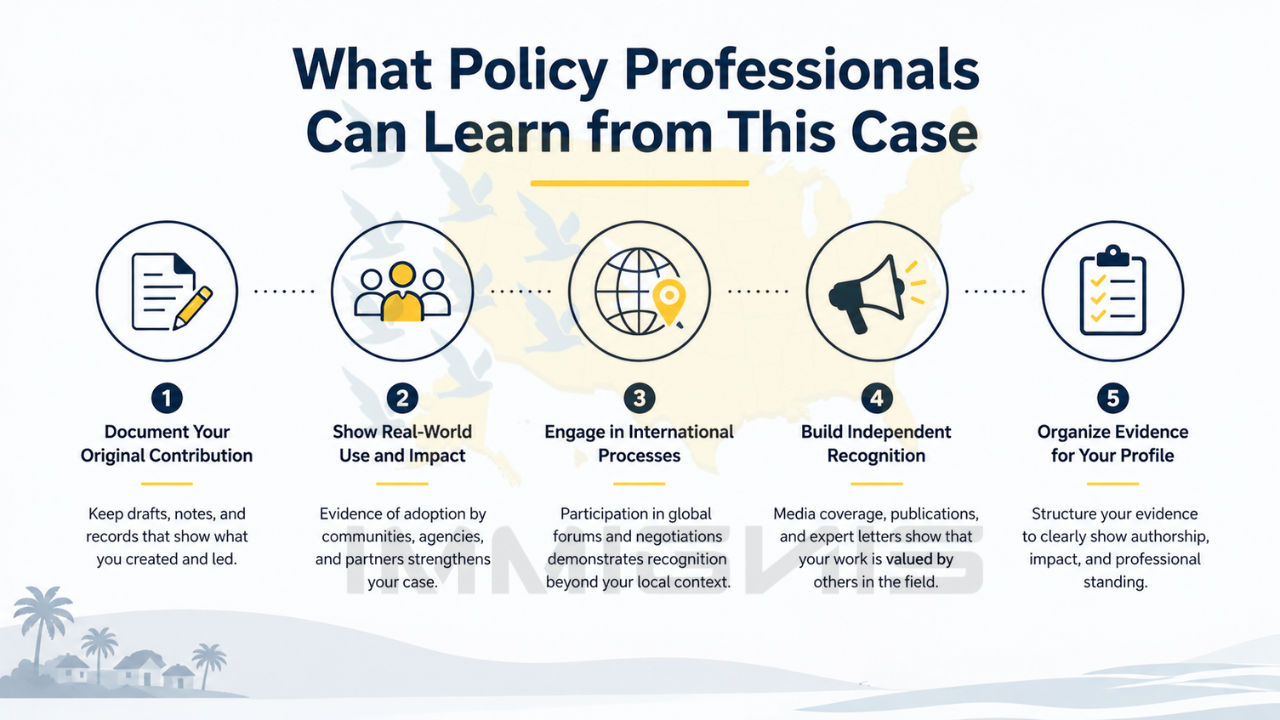
Public-sector specialists often assume that institutional documents cannot become personal immigration evidence. They can, but only when the record separates public ownership from individual contribution. A government may own the final policy. The professional record can still show who designed the method, wrote key sections, solved implementation problems, and became the person others consulted.
A useful evidence review should look beyond the final PDF. Draft history, assignments, acknowledgments, correspondence, consultation records, implementation documents, speaking requests, review work, and independent letters may reveal the real professional story.
No single document guarantees EB-1A eligibility, and USCIS evaluates the full record under the applicable legal standard. Still, accurate attribution can change a case that initially looks like ordinary public service into one that shows identifiable, field-level contribution.
Conclusion
The Fijian climate-adaptation planner’s approval shows how a widely discussed framework can remain weak immigration evidence until its authorship is documented. The work was already useful. The missing part was a record connecting that usefulness to the person who created much of the practical method.
Once the evidence traced the playbook back to its author, the case became easier to understand. The villages remained at the center of the relocation process, as they should. The immigration record finally showed the planner whose work helped make that process possible.
The client’s name and identifying details are omitted to protect privacy. The professional field, approval date, and evidence strategy reflect the underlying case record.
Frequently asked questions
Can a climate-adaptation planner qualify for EB-1A?
Yes. A planning or policy career can support EB-1A when the evidence addresses the regulatory requirements and the complete record shows the required level of sustained professional recognition. The field does not have to be laboratory science.
Can a government relocation framework count as an original contribution?
It can help when the applicant’s authorship is documented and the framework has significance beyond routine job duties. Evidence of implementation, agency reliance, requests from other jurisdictions, or professional adoption can be especially useful.
How can someone prove authorship when a ministry is named on the final document?
Drafts, tracked revisions, assigned sections, meeting records, correspondence, acknowledgments, presentation files, and detailed letters from people with direct knowledge can establish the applicant’s specific role without claiming sole ownership of collaborative work.
Does participation in a UNFCCC event automatically satisfy an EB-1A criterion?
No. Attendance alone is generally weak. The record should show a substantive role such as speaking, drafting, technical contribution, expert consultation, panel participation, or documented reliance on the applicant’s knowledge.
What can count as judging for a climate-adaptation professional?
Examples may include reviewing relocation plans, grant proposals, technical submissions, conference abstracts, publications, adaptation projects, or the work of other professionals. The evidence must show actual evaluation responsibility.
Can work affecting a small number of villages have international significance?
Yes, depending on the evidence. A local framework may have wider value when it addresses a problem faced by other countries, is requested or adopted elsewhere, informs international discussion, or becomes a practical model for comparable communities.
Turn public-sector work into attributable professional evidence
Many climate, policy, and development professionals influence important programs while their names remain hidden inside government documents, working groups, and collaborative frameworks.
Start with a free EB-1A profile assessment to review your policy authorship, implementation record, international roles, publications, judging work, media coverage, and professional influence.