
How an EB-1A Earthquake Early Warning Engineer from Chile secured approval by documenting algorithm development, sensor-network implementation, public-system contribution, earthquake-engineering publications, agency validation, international seismic roles, conference recognition, judging service, and ethical immigration-specific profile building.
Key facts at a glance
| Petition outcome | Form I-140 approved under EB-1A on March 21, 2025. |
| Professional profile | Chilean seismic engineer developing rapid-alert and structural-response systems for earthquake-prone cities, public infrastructure, and operational networks. |
| Field niche | Earthquake early warning and real-time seismic risk reduction. |
| Starting weakness | The alerts and public systems carried institutional names, while the petitioner’s algorithmic, sensor-network, testing, and implementation contributions were dispersed across larger programs and difficult to identify as an individual record. |
| Profile-building focus | System-contribution mapping, algorithm and deployment documentation, earthquake-engineering publications, public-agency letters, international seismic-network roles, conference platforms, judging evidence, expert letters, and careful attribution of technical responsibility. |
| Principal EB-1A evidence areas developed | Original contributions of major significance, leading or critical role, authorship of scholarly articles, qualifying published material, and judging the work of others. |
| Central issue | Showing that the petitioner was not simply employed by a visible warning program, but personally shaped the technical chain that allowed detection, analysis, communication, and protective action to occur within seconds. |
| Approval lesson | Mega-system and public-infrastructure cases become stronger when the petition separates the engineer from the institution and traces a specific technical contribution from design and testing through deployment, professional reliance, and independent recognition. |
The public saw the alert, not the engineering history behind it
Earthquake early-warning systems are remembered through their most visible moment: an alert arrives before the strongest shaking reaches a location. To the public, that moment may appear almost instantaneous. The technical record behind it is anything but instant. It can involve years of sensor placement, signal processing, threshold design, network latency testing, false-alert analysis, software integration, field calibration, agency coordination, and repeated review after actual seismic events.
The petitioner’s difficulty was that the visible system belonged to an institution. Public notices, agency websites, control rooms, and national or regional warning platforms carried organizational names. The engineer’s role appeared in technical records, development decisions, internal reviews, publications, implementation files, and the knowledge of specialists who had worked with the system. Those materials did not automatically form a personal EB-1A record.
USCIS approved the Form I-140 petition on March 21, 2025. Immignis and Advance My Profile organized the case around a simple but demanding evidentiary task: identify which parts of the warning chain the petitioner personally influenced, then document why those contributions mattered beyond ordinary engineering support.
Why earthquake early warning is an attribution problem
An early-warning platform is not one device or one algorithm. It is a connected system. Seismic stations detect motion. Communications infrastructure transmits data. Algorithms estimate event characteristics. Decision rules determine whether and where an alert should be issued. Interfaces deliver warnings to agencies, operators, infrastructure systems, or the public. Each component must work under severe time pressure.
That structure creates an immigration challenge. A successful platform may be widely known while hundreds of professionals contribute to it. An officer can easily understand that an earthquake-warning program is important, but program importance does not establish that one participant possesses extraordinary ability.
The petition therefore defined the petitioner’s field as earthquake early warning and real-time seismic risk reduction. This was narrower than general civil engineering or geophysics and broad enough to include algorithms, sensor networks, deployment, structural-response integration, and operational decision systems. The field definition gave each document a clear purpose.
The case did not argue that one engineer controlled an entire public warning system. It showed a more credible record: identifiable technical responsibility within critical parts of a complex system, followed by evidence that agencies, collaborators, researchers, and professional networks relied on the petitioner’s expertise.
System-contribution mapping turned a public program into personal evidence
The strongest organizational step was a contribution map. The record separated the warning system into technical functions and matched the petitioner’s documented role to each relevant function. These could include algorithm design, sensor-network architecture, calibration, latency reduction, event classification, alert thresholds, structural-response integration, operational testing, or post-event analysis.
This prevented the petition from relying on vague statements such as “worked on the national warning system.” Instead, each claimed contribution was tied to project records, cleared technical summaries, authorship evidence, implementation timelines, agency letters, or testimony from specialists with direct knowledge of the work.
Contribution mapping also identified boundaries. It showed what belonged to the petitioner, what belonged to a team, and what belonged to the institution as a whole. That distinction made the evidence more credible because it did not convert collective achievement into personal ownership.
Algorithm documentation explained what changed and why it mattered
Algorithmic work can be difficult to present because source code, operational thresholds, and performance logs may be confidential or security-sensitive. The petition used disclosure-safe documentation to explain the technical problem, the petitioner’s approach, the testing process, and the verified result without exposing restricted system details.
The emphasis was not on calling an algorithm “advanced.” It was on evidence. The record addressed questions such as whether the method improved event characterization, reduced processing time, handled noisy signals, supported more stable alert decisions, or performed reliably across different seismic conditions.
Where performance claims were used, the evidence identified the testing environment and avoided unsupported comparisons. A laboratory result, a simulated test, an operational trial, and a deployed system were treated as different stages rather than blended into one claim of success.
This documentation supported the original-contributions argument because it connected an identifiable technical method to the functioning or improvement of a real warning process. The significance came from professional reliance and system use, not from technical vocabulary alone.
Deployment evidence showed that the work survived contact with reality
A warning method becomes more persuasive when it moves beyond a paper or prototype. Deployment evidence documented how the petitioner’s work entered field operations, sensor networks, agency procedures, infrastructure interfaces, or testing programs.
The case used implementation records, authorized project descriptions, validation reports, deployment timelines, and letters from people responsible for operating or evaluating the system. These materials showed whether the petitioner participated in design decisions, troubleshooting, commissioning, testing, or continued technical oversight.
Deployment also helped explain major significance. A method considered for implementation is not the same as a method used in operations. The petition distinguished proposal, pilot, integration, and actual operational reliance. That precision made the strongest examples more believable.
Public-agency letters established technical responsibility without overstating it
Letters from public agencies or institutional partners were important because they could connect visible systems to less visible technical leadership. The strongest letters identified the writer’s position, basis of knowledge, the petitioner’s specific responsibility, and why the work was important to the organization’s warning or risk-reduction function.
The letters did not simply state that the petitioner was talented or that earthquakes are dangerous. They described a technical problem, the petitioner’s role in addressing it, and the effect of the contribution on system performance, operational readiness, or professional practice.
Independent experts added field context, while agency and project witnesses supplied attribution. The petition used both types of letters for different purposes and supported them with underlying records wherever possible.
Publications created a durable scientific record
Scholarly articles helped move the case beyond confidential implementation files. The publication record addressed earthquake early warning, seismic sensing, rapid source estimation, structural-response systems, network performance, operational evaluation, or related areas within the defined field.
The petition documented authorship, the standing of the publication venue, citation context where useful, and the petitioner’s contribution in multidisciplinary work. It did not rely only on total citation counts. It examined how later researchers used the methods, results, datasets, or findings.
Publications also made the petitioner’s technical identity coherent. Instead of appearing as a general engineer attached to several projects, the record showed a sustained body of work around rapid seismic information and real-time risk reduction.
Conference platforms and international network roles showed recognition outside one employer
Conference presentations, invited technical sessions, panel roles, and participation in international seismic networks helped establish professional visibility. The petition explained the relevance of each platform and the petitioner’s actual role rather than treating attendance as recognition.
International network or committee positions were assessed carefully. Open membership or routine participation was not presented as achievement-based membership. Roles involving selection, appointment, technical responsibility, standards input, or demonstrated expertise were documented through appointment records, selection criteria, and evidence of actual service.
These activities supported the broader record because they showed that the petitioner’s expertise was sought across institutions and national boundaries, not confined to one internal project.
Judging evidence converted professional trust into a regulatory criterion
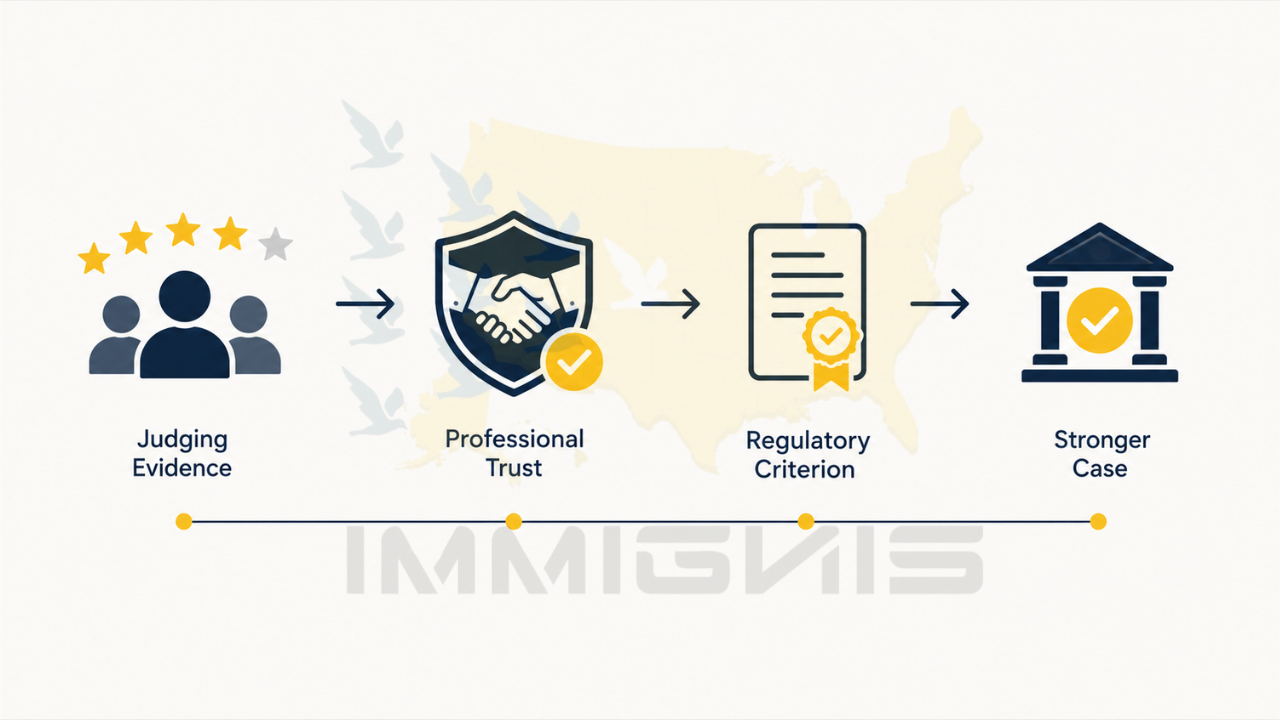
The judging criterion was supported through completed evaluation of the work of others. Relevant evidence could include journal peer review, conference-paper assessment, technical proposal evaluation, grant review, standards review, or formal assessment of engineering submissions.
The petition preserved invitations, completed-review confirmations, editorial records, committee correspondence, and other evidence showing actual service. Invitations alone were not treated as completed judging.
This evidence mattered beyond the criterion itself. It showed that professional organizations trusted the petitioner to evaluate methods and conclusions in a field where reliability and technical judgment have serious consequences.
Published material required coverage about the engineer
Published material was kept separate from scholarly authorship. Articles written by the petitioner supported the scholarly-articles criterion. Qualifying published material required coverage about the petitioner and the petitioner’s work.
Where engineering media, science outlets, public-agency publications, or other independent sources discussed the petitioner’s contribution, the record documented the outlet, author, audience, and substance of the coverage. Articles focused only on the institution or warning program were not automatically treated as coverage of the individual.
This distinction was especially important in a public-infrastructure case. The petition had to avoid borrowing institutional publicity and instead identify material that genuinely discussed the engineer’s role.
Leading-role evidence focused on authority, not title
A senior title alone does not prove a leading or critical role. The petition showed how the petitioner’s decisions affected technical direction, system design, testing, implementation, or operational readiness within a distinguished organization or project.
Evidence included organizational descriptions, responsibility records, technical approvals, work-package leadership, agency letters, project outputs, and examples of decisions that depended on the petitioner’s expertise. The distinguished reputation of the organization or project was documented separately from the petitioner’s role within it.
This approach helped USCIS understand that the petitioner’s contribution was not routine participation in a famous system. The role mattered because specific technical functions depended on the petitioner’s judgment and work.
The final merits analysis followed the entire warning chain
Meeting at least three evidentiary criteria is only the first stage of EB-1A analysis. USCIS then evaluates the evidence together to determine whether the petitioner has sustained national or international acclaim and belongs among the small percentage at the top of the field.
The final presentation therefore followed the technical chain from research and design through testing, deployment, professional reliance, publication, judging, and external recognition. No single document was expected to carry the case. The strength came from consistency across different evidence types.
The record also showed continuity. The petitioner was not associated with one isolated alert or one short project. Publications, implementation responsibility, international roles, conference recognition, and peer evaluation demonstrated a sustained professional identity in real-time seismic risk reduction.
Why this case worked
The approval hook was accurate because it reflected the central evidence problem: the warning arrived in seconds, but the record needed to show whose years of work made those seconds possible.
The petition did not rely on the national importance of earthquakes as a substitute for personal acclaim. It traced identifiable technical contributions to deployment and professional reliance, while preserving the distinction between the petitioner, the engineering team, and the public institution.
By the time USCIS reviewed the full record, the engineer was no longer hidden inside a system diagram. The evidence showed a sustained pattern of technical authorship, operational responsibility, peer trust, and recognition in a defined field.
What other seismic and infrastructure professionals can learn
Engineers working in public infrastructure, emergency systems, sensor networks, transportation, utilities, structural monitoring, safety technology, and other large programs often face the same problem. The institution is visible; the technical contributor is not.
A useful evidence-building process begins with attribution. Preserve project responsibility records, approved technical summaries, algorithm documentation, deployment logs, performance validation, publications, review service, committee appointments, conference invitations, and letters from people who directly evaluated or relied on the work.
The goal is not to claim ownership of a public system. It is to document the part of the system that genuinely depended on the professional’s expertise and explain why that contribution mattered within the field.
Frequently asked questions
What is EB-1A?
EB-1A is an employment-based immigrant classification for a person of extraordinary ability in the sciences, arts, education, business, or athletics. The petitioner must satisfy the applicable evidentiary framework and demonstrate sustained national or international acclaim in the final assessment.
Can an earthquake early-warning engineer qualify for EB-1A?
Potentially. Eligibility depends on the individual evidence. Original contributions, leading or critical roles, scholarly articles, judging, qualifying published material, selective membership, awards, and high remuneration may be relevant.
Does working on a national warning system automatically prove extraordinary ability?
No. The reputation or importance of the system does not automatically transfer to every participant. The petition must document the individual’s responsibility, contribution, recognition, and sustained standing in the field.
How can confidential algorithms be used in an EB-1A petition?
Authorized summaries, redacted technical records, performance descriptions, cleared diagrams, patent documents, and detailed letters can explain the contribution without disclosing restricted code, thresholds, security details, or proprietary methods.
Can deployment evidence support original contributions of major significance?
Yes. Deployment can show practical reliance, but the record should distinguish testing, pilot integration, operational use, and broad adoption. The petitioner’s personal role must also be documented.
Can a public-agency letter prove a leading role?
It can help when the writer has direct knowledge and explains the petitioner’s technical authority, responsibility, and effect on a distinguished project or organization. Strong letters are supported by project records and specific examples.
Can publications and citations strengthen a seismic-engineering case?
Yes. The petition should document authorship and explain how later researchers or practitioners used the petitioner’s methods, data, findings, or technical conclusions rather than relying only on citation totals.
Can journal peer review satisfy the judging criterion?
Yes, when completed review of the work of others is documented. Conference, grant, proposal, technical, or standards evaluation may also be relevant when the service is formal and verified.
Does ordinary professional-society membership satisfy the membership criterion?
Not automatically. The criterion requires evidence that admission demanded outstanding achievements judged by recognized experts. Open or paid membership may provide context but generally does not meet that standard by itself.
What is the difference between scholarly articles and published material?
Scholarly articles are works authored by the petitioner. Published material generally means qualifying coverage written about the petitioner and the petitioner’s work. The two categories should be presented separately.
Can conference presentations support an EB-1A petition?
They can support professional recognition and final merits, especially when the petitioner was invited, selected, or entrusted with a substantive technical role. Mere attendance is usually less persuasive.
How can an engineer prove a leading or critical role in a team-based program?
The record should show the distinguished reputation of the project or organization and identify decisions, work packages, approvals, technical functions, or responsibilities that depended on the engineer’s expertise.
Does EB-1A require a permanent U.S. job offer or labor certification?
EB-1A does not require a permanent job offer or labor certification, and an eligible person may self-petition. The record must still show that the person intends to continue working in the area of extraordinary ability in the United States.
How does EB-1A differ from EB-2 NIW for a seismic engineer?
EB-1A focuses on extraordinary ability and sustained acclaim under its own criteria. EB-2 NIW requires EB-2 qualification and a showing that waiving the job-offer and labor-certification requirements is in the national interest. The appropriate pathway depends on the person’s evidence and proposed U.S. work.
How can ethical profile building help an infrastructure engineer?
It can organize existing evidence, improve lawful attribution, develop legitimate publications and judging service, preserve deployment records, and build professional visibility without inventing adoption, purchasing recognition, or overstating team achievements.
Make the engineering behind the alert visible
A strong seismic-engineering record may already exist across project files, algorithms, deployment reports, agency records, publications, review platforms, conference programs, committee appointments, and the testimony of specialists who relied on the work.
Start with a free EB-1A profile assessment to identify which achievements can be documented now, which contributions require clearer attribution, and which ethical profile-building steps may strengthen an earthquake early-warning or seismic-risk-reduction case.