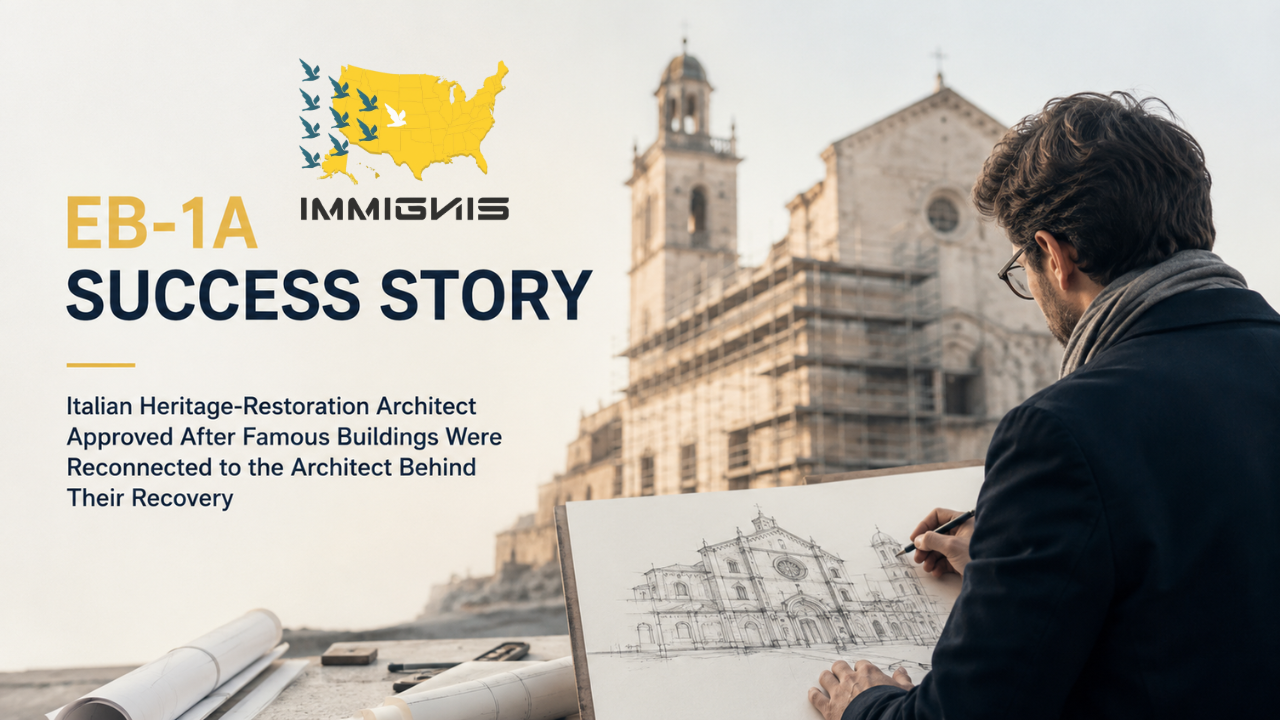
An EB-1A Heritage Restoration Architect from Italy secured approval after earthquake-damaged heritage projects, reversible-intervention methods, project-attribution records, restoration-journal authorship, professional heritage roles, architecture-press coverage, jury service, teaching appointments, and immigration-specific profile building made an otherwise invisible specialist personally identifiable.
Key facts at a glance
| Petition outcome | Form I-140 approved under EB-1A on March 27, 2025. |
| Professional profile | Italian architect restoring earthquake-damaged historic structures through seismic-conscious conservation and reversible-intervention methods. |
| Field niche | Seismic-conscious heritage restoration. |
| Starting weakness | The monuments and restoration projects were visible, but public credit usually stayed with the building, public authority, firm, or multidisciplinary team rather than the architect responsible for crucial conservation decisions. |
| Profile-building focus | Project-attribution documentation, restoration-journal publication, selective heritage-body roles, architecture-press features, competition and award-jury service, teaching appointments, expert letters, and ethical immigration-specific profile building. |
| Principal EB-1A evidence areas developed | Original contributions, leading or critical role, published material about the petitioner, judging the work of others, and qualifying membership where the admission standards supported it. |
| Central issue | Showing that the petitioner was not merely assigned to famous buildings, but personally shaped how damaged heritage structures could be stabilized, repaired, and returned to use without erasing historic fabric. |
| Approval lesson | A heritage-restoration case becomes stronger when the record separates the architect from the landmark and documents authorship, technical authority, peer trust, public recognition, and adoption of the architect’s conservation methods. |
The building had a name. The architect did not.
Historic buildings arrive in the public record with names, dates, photographs, guidebook entries, and memories attached to them. After an earthquake, the same building may receive extensive coverage as engineers, architects, conservators, public authorities, and contractors work to keep it standing. The specialist who decides how to intervene without sacrificing the building’s character can remain almost invisible.
That was the central problem in this case. The petitioner had worked on damaged historic structures and had helped shape technically careful restoration decisions. Yet the most searchable record belonged to the monuments. Project announcements emphasized reopening dates, public funding, or the institution responsible for the site. Drawings and technical files showed the work, but they did not automatically give a U.S. immigration officer a clear account of personal distinction.
USCIS approved the architect’s Form I-140 petition on March 27, 2025. The record succeeded after Immignis and Advance My Profile followed the technical decisions back to the person who made them and built a public professional profile around attribution, authorship, peer trust, and responsibility.
Why heritage restoration hides individual achievement
Heritage restoration is collective by design. A serious project may involve structural engineers, conservation architects, art historians, archaeologists, materials specialists, public agencies, contractors, craftspeople, owners, and community representatives. The finished work must respect both safety and cultural value, which means no single professional should claim credit for everything.
That necessary collaboration creates an immigration-evidence problem. A project can be nationally known while an individual participant still appears to have performed an ordinary staff function. A building may survive, reopen, or receive an award, but none of those facts alone proves who diagnosed the structural problem, selected the intervention strategy, defended a conservation choice, or coordinated the work that protected historic fabric.
The profile-building strategy therefore avoided a simple list of famous projects. Each project was examined for personal authorship, decision authority, technical responsibility, independent validation, and evidence showing that the petitioner’s role affected the outcome.
The field was defined as seismic-conscious heritage restoration
The case was not presented as general architecture. The field niche was defined as seismic-conscious heritage restoration: the practice of stabilizing and repairing historic structures after earthquake damage while protecting the materials, form, cultural meaning, and future study of the building.
This definition mattered because the work sits between modern safety demands and conservation restraint. An architect may need to improve structural behavior without replacing more historic material than necessary. New elements must be compatible with the old structure, clearly justified, and capable of being monitored or reconsidered as knowledge develops. Reversible or retreatable intervention is valuable because it preserves future options rather than treating the present solution as beyond question.
Once the field was defined precisely, project attribution, technical publication, heritage-body service, jury work, teaching, and press coverage stopped looking like unrelated accomplishments. They became different ways of measuring standing inside the same specialized practice.
Project-attribution records separated the architect from the monument
Project attribution became the first major evidence task. The record identified which damaged structures the petitioner worked on, the phase of work involved, the exact responsibilities held, and the decisions that required the petitioner’s judgment.
Useful evidence included appointment records, project scopes, signed drawings, technical reports, meeting minutes, design submissions, conservation plans, correspondence, authorship histories, public-agency confirmations, consultant records, and letters from professionals with direct knowledge. The strongest documents did not simply say that the petitioner participated. They explained what changed because of that participation.
This approach also prevented overclaiming. A multidisciplinary project remained a team achievement. The petition focused only on work that could be attributed reliably, such as developing an intervention concept, resolving a structural-conservation conflict, directing a restoration package, coordinating specialist input, or taking responsibility for a critical part of implementation.
Reversible-intervention methods supported original-contribution arguments
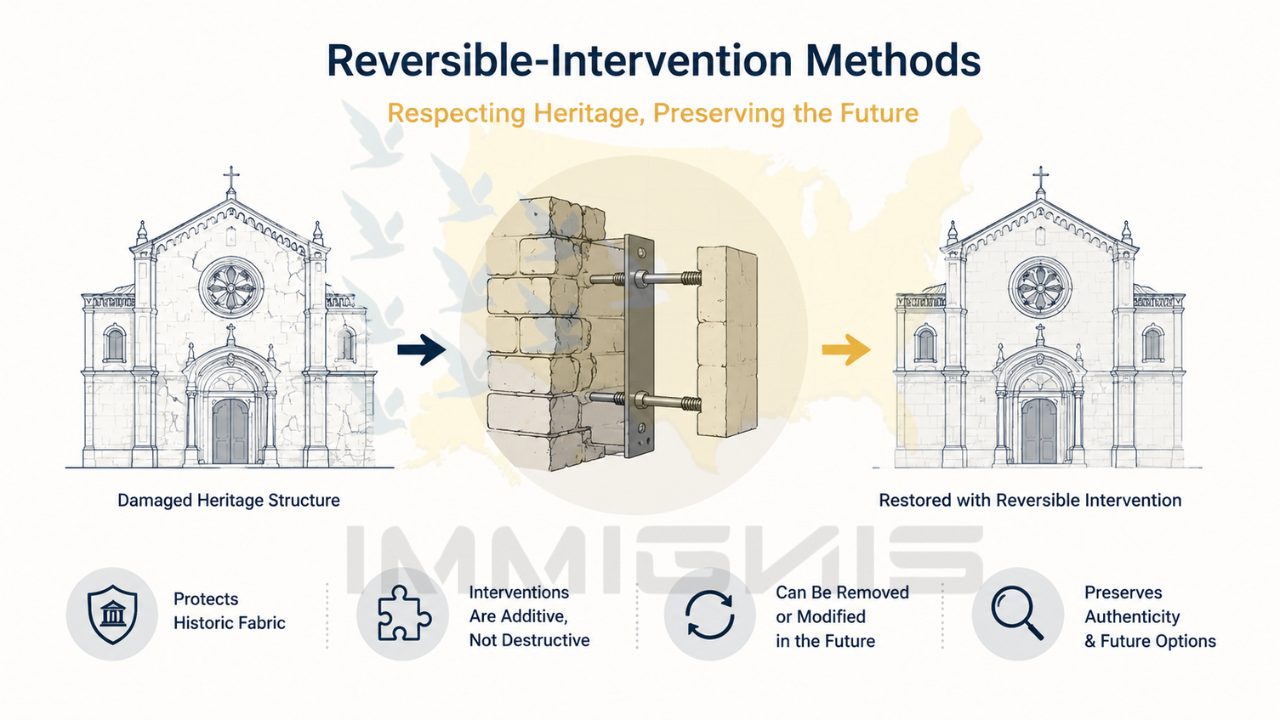
The petitioner’s technical identity centered on methods designed to stabilize damaged heritage while limiting irreversible loss. In this field, originality does not always mean inventing an entirely new material or structural system. It can appear in how an architect adapts known conservation principles to a difficult building, combines diagnostic information with intervention design, or creates a method that others can study and reuse.
The petition documented the problem each method addressed, the reasoning behind the chosen intervention, how the method protected historic material, and whether the approach was later repeated, discussed, taught, cited, or relied upon by other professionals. This moved the argument beyond personal preference. It showed a contribution capable of influencing practice.
Independent expert letters were important here, but they were not asked to use praise as a substitute for evidence. The best letters identified the method, explained why the choice was difficult, compared it with ordinary practice, and described its professional significance.
Restoration-journal publication gave the methods a life beyond one project
Many conservation decisions first exist in drawings, site notes, internal reports, or presentations delivered to a project team. A publication record made the petitioner’s reasoning available outside those files.
Articles could address seismic assessment of historic masonry, compatibility of reinforcement, reversible connections, repair sequencing, monitoring, material conservation, or lessons from a completed intervention. The purpose was not to rewrite confidential project documents for publicity. It was to convert non-confidential knowledge into work that other architects and conservation professionals could examine.
Publication also clarified authorship. On a large restoration project, institutional credit can be broad. A signed journal article or technical paper provides a direct record of who organized the analysis and contributed the professional argument.
Architecture coverage had to discuss the architect, not only the building
Heritage projects often receive substantial media coverage, but an article about a monument is not automatically published material about every professional who worked on it. The case distinguished project publicity from coverage that actually discussed the petitioner and the petitioner’s work.
Architecture and conservation press became useful when it identified the architect, described a restoration decision, examined the method, quoted the petitioner as a subject-matter authority, or connected the person to a recognizable body of work. A passing name in a long project list carried much less value.
This distinction improved both legal accuracy and reader trust. The petition did not inflate the fame of the building into fame of the architect. It used only coverage that made the personal connection clear.
Jury service documented peer trust
Competition and award-jury service provided one of the cleanest forms of professional evaluation. When an architect is asked to assess design proposals, conservation schemes, student work, awards, or restoration concepts, the record can show that others trust the person to judge quality in the field.
The petition documented the appointing organization, the subject of the evaluation, the level of the candidates or entries, the selection of the petitioner, and evidence that the judging was actually completed. Invitations alone were not treated as enough.
For a heritage specialist, jury work also showed that the petitioner’s expertise was useful outside the person’s own projects. The architect was not only producing work but helping decide what good work looked like.
Teaching appointments and heritage-body roles widened the record
Teaching appointments helped show that the petitioner’s knowledge was being transferred to developing architects and conservation professionals. Courses, studios, workshops, guest teaching, and technical training were most useful when they concerned the defined niche and when the institution selected the petitioner because of professional expertise.
Heritage-body roles served a different purpose. Committee work, technical groups, professional panels, and selective memberships could demonstrate that the field relied on the petitioner in standards, conservation discussion, project review, or professional development. For the membership criterion, the petition examined the actual admission requirements rather than assuming that every professional association membership qualified.
Together, teaching and professional service helped establish continuity. The petitioner’s influence did not end when a construction site closed. It continued through the people, institutions, and professional decisions informed by the architect’s knowledge.
Leading role was proved through responsibility, not the fame of the site
A famous monument can make a project sound impressive while saying little about an individual’s role. The leading or critical-role argument therefore focused on decision authority and consequence.
The record showed where the petitioner led a defined workstream, directed conservation design, coordinated technical specialists, represented the restoration approach before responsible authorities, supervised implementation, or resolved issues that affected safety and heritage value. Letters and project records explained why those duties mattered to the distinguished organization or project involved.
This was more persuasive than simply attaching photographs of celebrated buildings. USCIS needed to understand the petitioner’s function inside the project, not only recognize the landmark.
Why this case worked
The case gave each evidence type a specific job. Project records established attribution. Technical methods explained originality. Publications created identifiable authorship. Architecture coverage showed public professional recognition. Jury service demonstrated trust in the petitioner’s judgment. Teaching and heritage-body roles showed that the expertise traveled beyond individual sites. Responsibility records supported the leading-role argument.
The approval hook was simple without being simplistic: the buildings were already famous, but the petition had to make the hands and judgment behind their recovery visible. It did so without claiming sole credit for collaborative work.
What architects and conservation professionals can learn
Attribution should be preserved while a project is active. Signed reports, role descriptions, drawing records, meeting minutes, public presentations, design approvals, publication agreements, and letters written close to the work are far easier to verify than memories reconstructed years later.
Professionals should also separate a project’s reputation from their own contribution. The fame of a cathedral, palace, museum, or historic town does not establish extraordinary ability. The petition must show what the person decided, authored, led, or changed.
Finally, a restoration portfolio is stronger when it explains the method. Before-and-after photographs can be useful, but they rarely show why an intervention was difficult, what alternatives were rejected, or how the work respected both structural safety and heritage value.
Conclusion
The Italian heritage-restoration architect’s EB-1A approval came from turning quiet, collaborative conservation work into an attributable professional record. The monuments did not need more publicity. The architect needed evidence connecting personal judgment to the work people could already see.
Project attribution, reversible-intervention methods, restoration-journal authorship, architecture coverage, jury service, heritage-body roles, teaching appointments, and responsibility records showed a specialist whose influence extended beyond a single building or employer.
The client’s name and identifying project details are omitted to protect privacy and confidentiality. The professional field, approval date, starting challenge, and evidence strategy reflect the case information provided for this success story.
Frequently asked questions
Can a heritage-restoration architect qualify for EB-1A?
Yes. An architect may qualify when the petition addresses the regulatory criteria and the record as a whole shows the required level of sustained recognition. Working on famous buildings alone is not enough; the evidence must identify the architect’s own distinction.
Do famous restoration projects automatically prove extraordinary ability?
No. Project reputation provides context, but the petition must document the applicant’s role, technical responsibility, contribution, and recognition. A landmark’s fame cannot be transferred automatically to every team member.
How can an architect prove personal credit on a multidisciplinary project?
Useful evidence may include signed drawings, reports, appointment records, project scopes, meeting minutes, authorship histories, approvals, public-agency records, and detailed letters from professionals with first-hand knowledge.
Can a restoration method count as an original contribution?
It may when the applicant can be identified as an author or developer and the record shows professional significance through adoption, reuse, publication, citation, teaching, independent analysis, or measurable project value.
What does reversible intervention mean in heritage restoration?
It generally refers to an approach that limits unnecessary permanent change and preserves the possibility of later adjustment, removal, or improved treatment. The exact meaning depends on the building, materials, and conservation context.
Can architecture-media coverage support the published-material criterion?
Yes, when qualifying media discusses the applicant and the applicant’s work. An article devoted only to the building, with a passing name in a project list, may be insufficient.
Can serving on an architecture competition jury satisfy the judging criterion?
It may. The record should show that the applicant evaluated the work of other professionals or comparable participants and should include proof of appointment and completed judging activity.
Does teaching architecture count as an EB-1A criterion?
Teaching is not a separate EB-1A criterion, but a selective appointment may strengthen leading-role, recognition, and final-merits arguments. It can also show that an institution relied on the applicant’s specialized expertise.
Can membership in a heritage organization satisfy the membership criterion?
Only when the evidence shows that admission required outstanding achievement judged by recognized experts or comparable qualifying standards. Ordinary paid membership is generally not enough.
How can a confidential restoration project be documented?
The case can use cleared role summaries, non-confidential technical descriptions, redacted records, authorized letters, public project materials, and evidence that explains responsibility without exposing protected details.
Can project awards be used when the award went to the building or firm?
They can provide context, but the petition must avoid treating an organizational or project award as the applicant’s personal award unless the rules and records support that attribution. Separate evidence should connect the applicant to the recognized work.
How can profile building help a conservation architect?
Profile building can recover project attribution, organize technical authorship, develop non-confidential publications, document jury and teaching service, secure independent validation, and create a coherent public record without inventing achievements.
Make the architect visible without taking credit from the team
Professionals in conservation architecture, structural restoration, seismic rehabilitation, historic masonry, archaeology, cultural-heritage management, materials conservation, and adaptive reuse may already have strong EB-1A evidence hidden in project files, drawings, technical reports, jury appointments, teaching records, committee work, publications, and specialist correspondence.
Start with a free EB-1A profile assessment to identify which projects are already attributable, where independent documentation is available, and which ethical profile-building activities could make the professional record clearer.