Why the EB-2 NIW Visa Has Become the Preferred Path for Skilled Workers and Entrepreneurs
Last Updated on March 24, 2026 by Amelia
You’re a talented professional with a master’s degree, or maybe you’re building the next breakthrough startup. You’ve heard whispers about a “self-sponsored green card” that doesn’t chain you to an employer. But is the EB-2 NIW visa really as accessible as people claim, or is it just immigration marketing hype?
After helping hundreds of professionals navigate this pathway and analyzing the latest USCIS adjudication data through Q3 FY2025, I can tell you definitively: the EB-2 National Interest Waiver (NIW) has fundamentally transformed skilled immigration, but not in the way most applicants expect. The landscape shifted dramatically from the 95% approval rates of 2022 to the current ~61% year-to-date average, yet filings have nearly tripled. Why? Because despite tighter scrutiny, this remains one of the few immigration categories where you control your destiny.
This guide cuts through the noise. You’ll understand exactly why skilled workers and entrepreneurs are flocking to EB-2 NIW, what separates successful petitions from denials in 2026, and how to position yourself strategically, whether you’re a AI researcher in Berlin, a healthcare innovator in Mumbai, or a fintech founder in São Paulo.
What Makes EB-2 NIW Different from Traditional Employment-Based Green Cards
The Self-Petitioning Revolution
Most employment-based green cards require a U.S. employer to sponsor you through the PERM labor certification process—a bureaucratic marathon involving recruitment advertising, prevailing wage determinations, and Department of Labor backlogs that now stretch to two years in many cases. The EB-2 NIW eliminates this entirely.
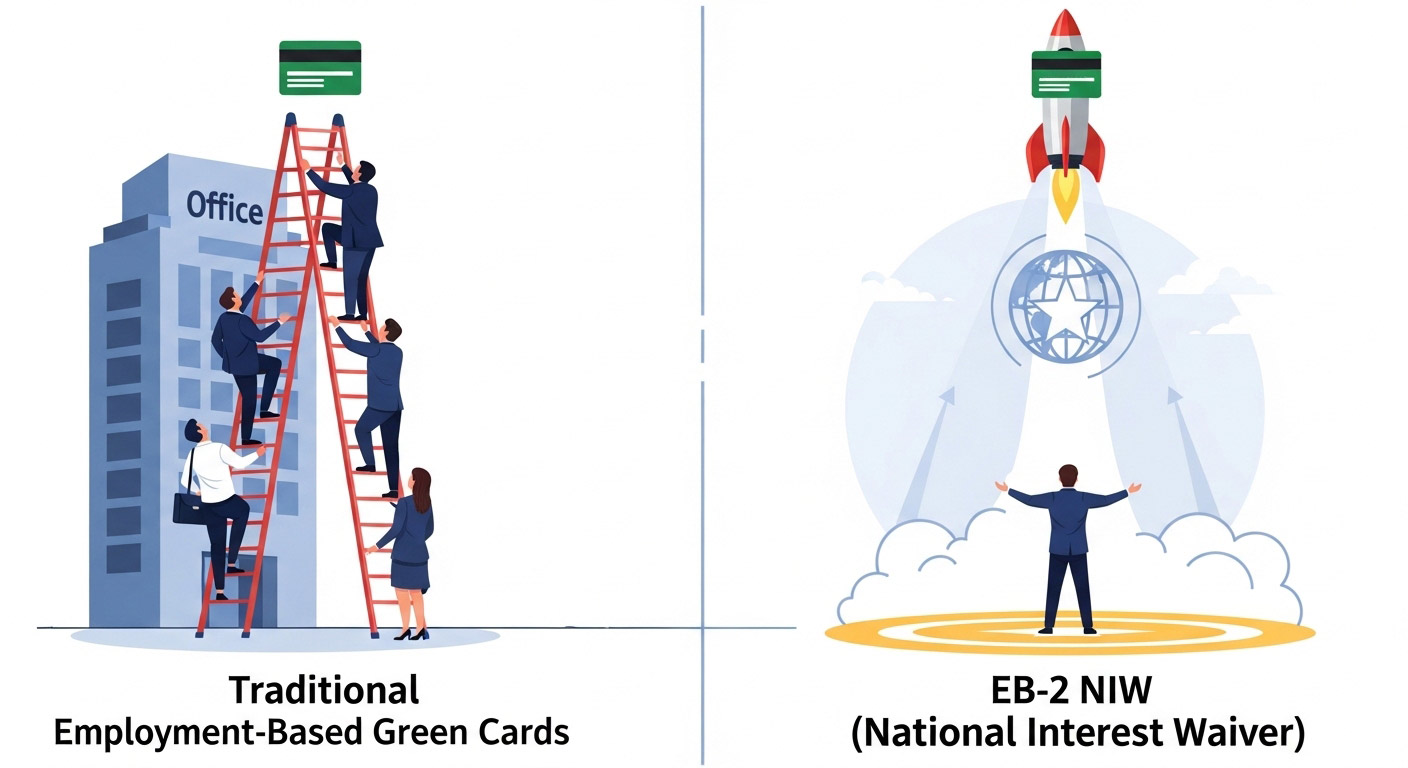
You file Form I-140 yourself. No employer. No job offer. No labor market test.
This distinction matters profoundly for entrepreneurs who haven’t incorporated in the U.S. yet, researchers between academic positions, and professionals whose “employer” is a global remote-work arrangement. In January 2022, USCIS policy guidance explicitly expanded NIW eligibility for entrepreneurs and STEM professionals, triggering a surge from 21,990 petitions in FY2022 to 63,549 in FY2024—a 190% increase.
The Strategic Advantage of Priority Date Control
When you self-petition, you establish your “place in line” (priority date) immediately upon filing I-140. This matters because EB-2 visas for India and China face significant retrogression, meaning even approved petitions wait years for final green card availability. For professionals from countries without backlogs (most of Europe, the Americas, Africa), concurrent filing of I-140 and I-485 adjustment of status means you can receive work authorization and advance parole within months, long before final approval.
Expert Insight: “Filing now locks in your priority date amid growing visa retrogression,” notes Nicole Gunara, Principal Attorney at Manifest Law. “Policies and standards could change at any moment. The eligibility window is shrinking”.
The Three-Prong Dhanasar Framework: How USCIS Actually Evaluates Your Case
Since 2016, all EB-2 NIW adjudications follow the Matter of Dhanasar framework, a three-prong test that replaced the rigid NYSDOT standard. Understanding these prongs practically, not just theoretically, determines success.
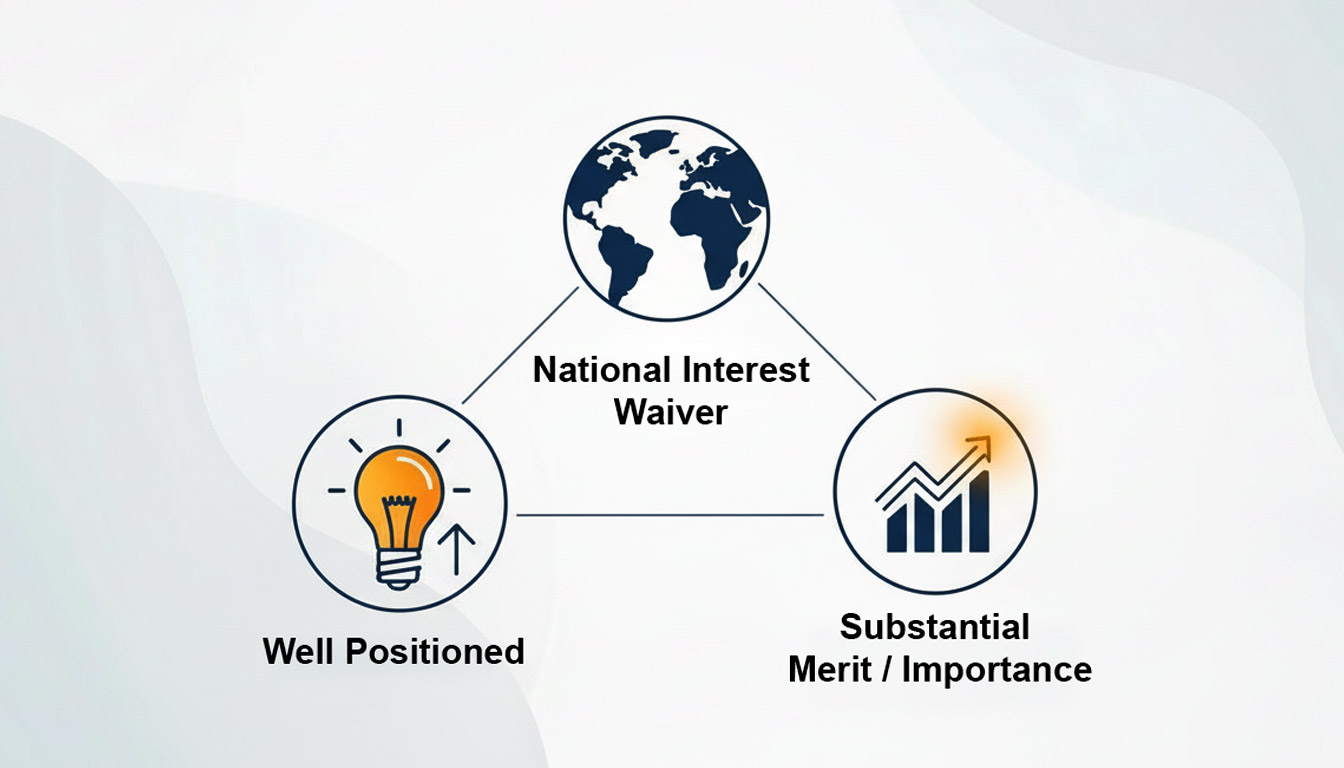
Prong 1: Substantial Merit and National Importance
The Mistake: Most applicants confuse “national importance” with “personal importance.” They describe why their work matters to their career. USCIS wants to know why it matters to America.
The Reality: Your proposed endeavor must demonstrate impact beyond your immediate employer or client base. In 2025, USCIS clarified that “demonstrating a national shortage in a particular occupation is not sufficient”—you must show your specific endeavor has national-level impact.
Winning Examples:
- AI Safety Researcher: Developing algorithmic bias detection tools for federal agencies addressing national security screening
- Renewable Energy Engineer: Creating grid-scale battery storage solutions aligned with Department of Energy decarbonization targets
- Public Health Data Scientist: Building predictive models for CDC infectious disease surveillance
Evidence Strategy: Government policy papers (White House Critical and Emerging Technologies list, NIH research priorities), industry reports showing national economic impact, and letters from quasi-governmental agencies carry disproportionate weight.
Prong 2: Well-Positioned to Advance the Endeavor
USCIS evaluates your “track record of related success” and “progress toward achieving the endeavor”.
This isn’t just about degrees—it’s about demonstrated execution capability.
Credential Patterns by Approval Rate (Well-Prepared Cases):
- PhD + 5+ years post-graduation + strong publications: 80-85% approval
- Master’s + 8+ years progressive experience: 70-80% approval
- Recent PhD (0-1 years): 55-70% approval
Critical Insight: For entrepreneurs, “well-positioned” often means showing existing traction—letters of intent from U.S. customers, pilot program results, or funding commitments. For researchers, it means active grants, collaborations with U.S. institutions, and a clear publication pipeline.
Prong 3: On Balance, Beneficial to the United States
This prong requires demonstrating that waiving labor certification serves national interest better than protecting U.S. workers through the traditional process. The post-Dhanasar standard removed the requirement to show “harm to national interest” if denied; instead, it’s a balancing test.
Successful Arguments:
- Time-Sensitive National Needs: Work addressing immediate public health emergencies or critical infrastructure vulnerabilities
- Scarcity of Specialized Expertise: Demonstrating your specific skill combination is not available in the U.S. labor market
- Innovation Acceleration: Showing that labor certification delays would impede technological breakthroughs with broad economic benefits
Why Entrepreneurs Specifically Choose EB-2 NIW
The Startup Founder Dilemma
Traditional EB-2 NIW requires a job offer, but if you’re founding a company, you’re the employer, not the employee. The NIW solves this paradox by evaluating your endeavor’s national benefit rather than your employment status.

2025 Policy Clarification: USCIS updated guidance emphasizing that “broad assertions regarding general benefits to the economy and the potential to create jobs are insufficient.” Instead, entrepreneurs must demonstrate how their work benefits society—not just commercial success.
Winning Entrepreneur Profiles:
- Fintech Founder: Building inclusive banking infrastructure for underbanked communities with measurable social impact metrics
- Biotech Entrepreneur: Developing rare disease therapeutics with Orphan Drug Designation potential
- Climate Tech Founder: Creating carbon capture technology with Department of Energy partnership potential
The Business Plan Imperative
Unlike employee-based petitions, entrepreneurs need a comprehensive business plan that functions as both operational roadmap and immigration evidence. This document must show:
- Specific, quantifiable national impact (not vague “innovation” claims)
- Realistic job creation timelines with organizational charts
- Market analysis demonstrating U.S. competitive advantage
- Financial projections proving economic viability
Case Study: A medical micropigmentation specialist with 20+ years experience secured approval by demonstrating how her services addressed quality-of-life needs for thousands of patients, supported by detailed market analysis and job creation projections—not just her professional credentials.
Processing Realities in 2026: Timelines, Premium Processing, and Backlogs
Current Processing Landscape
As of late 2025, standard I-140 processing for EB-2 NIW ranges from 14-19 months at Texas and Nebraska Service Centers, with some cases extending to 18-20 months depending on backlog conditions.
The pending inventory has grown to approximately 65,000 cases—a structural backlog that isn’t resolving soon.
Premium Processing: Strategic Considerations
Since 2022, EB-2 NIW petitions qualify for premium processing—a $2,805 fee (as of March 2026) guaranteeing a decision within 45 business days.
When Premium Processing Makes Sense:
- Your priority date is current or near-current and you need I-140 approval to file I-485
- You’re approaching H-1B maximum stay limits and need approved I-140 for AC21 portability
- You have time-sensitive funding rounds requiring permanent residency proof
When It Doesn’t:
- You’re from India or China with retrogressed priority dates (fast I-140 approval won’t accelerate your green card)
- Your petition needs evidentiary strengthening (premium processing with weak evidence often yields RFEs)
- You’re filing primarily to “lock in” a priority date for future use
The Two-Queue Problem
Modern EB-2 NIW strategy requires managing two separate timelines:
- I-140 Adjudication Queue: 14-20 months (or 45 days with premium)
- Visa Availability Queue: Determined by monthly Visa Bulletin priority dates
For Indian and Chinese applicants, the second queue often extends 3-5+ years regardless of I-140 processing speed. For “Rest of World” applicants, both queues often move concurrently.
EB-2 NIW vs. EB-1A: Strategic Pathway Selection
Both categories allow self-petitioning, but they serve different professional profiles:
| Factor | EB-1A (Extraordinary Ability) | EB-2 NIW (National Interest Waiver) |
| Standard | Sustained acclaim at top of field | National importance of proposed work |
| Priority | First preference (usually current) | Second preference (backlogs for India/China) |
| Evidence Focus | Past achievements, international recognition | Future impact, U.S. national benefit |
| Publication Requirements | High—typically 15+ papers, 200+ citations | Moderate—quality over quantity |
| Processing | Similar, both offer premium processing | Similar, both offer premium processing |
| Ideal Candidate | Award-winning researchers, industry luminaries | Impact-focused innovators, entrepreneurs |
Strategic Insight: Many professionals file both petitions simultaneously. EB-1A offers faster priority date movement; EB-2 NIW provides a “safety net” with broader eligibility criteria. This dual-track approach has become standard risk management for qualified applicants.
Common Failure Patterns (And How to Avoid Them)
The “Advanced Degree Trap”
Having a PhD or MS does not guarantee approval. Current data shows well-prepared cases across all education levels achieve 75-85% approval rates, while rushed or poorly documented cases drop to 40-60%—regardless of credentials.
Fatal Assumption: “My degree speaks for itself.” It doesn’t. USCIS requires independent evidence of impact—citations, patents implemented in products, media coverage, third-party validation.
The Vague Endeavor Problem
USCIS January 2025 policy guidance emphasized distinguishing between “intended occupation” (broad field) and “proposed endeavor” (specific project).
“I will continue working in software engineering” fails. “I will develop machine learning algorithms for early-stage wildfire detection to support U.S. Forest Service climate resilience goals” succeeds.
The Generic Recommendation Letter
Letters stating “X is a talented researcher” are worthless. Effective letters must:
- Specifically describe the national importance of your endeavor (not just your skills)
- Explain why you are uniquely positioned to advance this work
- Come from independent experts not directly tied to your employment
Practical Application Roadmap
Phase 1: Positioning Assessment (Months 1-3)
Action Items:
- Map your work against current U.S. national priorities (White House Critical and Emerging Technologies, NIH/DOE research agendas)
- Gather baseline metrics: citations, h-index, patent citations, media mentions
- Identify potential recommenders outside your immediate employment chain
Decision Point: Does your profile align better with EB-1A (proven past acclaim) or EB-2 NIW (future national impact)? Many qualify for both.
Phase 2: Evidence Development (Months 3-9)
Critical Activities:
- For Researchers: Target high-impact publications in U.S.-relevant fields; pursue collaborations with American institutions
- For Entrepreneurs: Secure letters of intent from U.S. customers; develop pilot program results; obtain industry expert endorsements
- For All: Draft comprehensive business plan or research proposal with measurable national impact metrics
Timeline Reality: Building supporting evidence over 6-12 months before filing significantly increases approval probability.
Phase 3: Petition Preparation (Months 9-12)
Components:
- Form I-140 with $715 filing fee + $300 asylum program fee (reduced rate for individuals)
- Comprehensive petition letter (20-40 pages) mapping evidence to Dhanasar prongs
- Evidence exhibits organized by legal criteria
- Recommendation letters (4-6) from independent experts
Premium Processing Decision: File I-907 concurrently if timeline is critical; otherwise, monitor priority date movement before deciding.
FAQ: EB-2 NIW Visa Essentials
Q1: Can I apply for EB-2 NIW without a job offer?
Yes. The National Interest Waiver specifically waives the job offer and labor certification requirements. You self-petition using Form I-140.
Q2: What is the current approval rate for EB-2 NIW?
As of Q3 FY2025, the year-to-date approval rate is approximately 61.2%, though well-prepared cases in STEM fields achieve 75-85% success rates. Rates dropped from 95% in 2022 due to increased filings and stricter scrutiny.
Q3: How long does EB-2 NIW processing take in 2026?
Standard processing: 14-20 months. Premium processing: 45 business days (for an additional $2,805 fee). Final green card availability depends on your country’s priority date.
Q4: Do I need a PhD to qualify for EB-2 NIW?
No. You can qualify with a master’s degree or a bachelor’s degree plus five years of progressive experience. Exceptional ability (demonstrated through awards, memberships, publications) can also satisfy EB-2 requirements.
Q5: Can entrepreneurs really use EB-2 NIW?
Yes. The January 2022 policy guidance explicitly included entrepreneurs. However, you must demonstrate your endeavor’s societal benefit, not just commercial potential, and provide a detailed business plan.
Q6: What is the “Dhanasar three-prong test”?
The framework established in Matter of Dhanasar (2016) requires showing: (1) substantial merit and national importance of your proposed endeavor, (2) you are well-positioned to advance it, and (3) waiving labor certification benefits the U.S.
Q7: Should I use premium processing?
Use it if you need fast I-140 approval for concurrent I-485 filing, H-1B extensions, or time-sensitive opportunities. Skip it if your priority date is retrogressed or your petition needs evidentiary strengthening.
Q8: What fields have the highest EB-2 NIW success rates?
AI/Machine Learning, Biotechnology/Healthcare, Cybersecurity, and Renewable Energy consistently show 75-85% approval rates for well-prepared cases due to clear alignment with U.S. national priorities.