
EB-1A vs EB-2 NIW in 2026: What You Need to Know Before Choosing Your Green Card Strategy
Last Updated on July 9, 2026 by Amelia
Are you also curious to know about what is EB 1A VS EB 2 NIW?
If you are a professional, researcher, entrepreneur, executive, engineer, scientist, physician, academic, artist, or business leader planning a U.S. green card strategy, two of the most attractive employment-based options are EB-1A Extraordinary Ability and EB-2 National Interest Waiver, commonly called EB-2 NIW.
Both categories may allow a qualified applicant to apply without a U.S. employer sponsor and without the PERM labor certification process. That makes both options highly valuable for people who want more control over their immigration strategy.
However, EB 1A and EB-2 NIW are not the same. They have different legal standards, different evidence expectations, different priority-date realities, and different strategic uses. A strong EB-2 NIW case does not automatically qualify someone for EB-1A. Similarly, an impressive professional background does not automatically satisfy the national-interest standard for EB-2 NIW.
In 2026, this comparison has become even more important because USCIS policy guidance has become more detailed, Visa Bulletin movement remains unpredictable for some countries, and petition quality matters more than simply collecting documents.
EB 1A vs EB-2 NIW
EB-2 NIW is usually better for professionals whose future work has strong U.S. national importance and who can show they are well positioned to advance that work.
EB-1A is usually better for individuals who can prove sustained national or international acclaim and show that they are among the small percentage at the top of their field.
In simple terms:
Two of the strongest self-petition pathways to a U.S. green card, compared side by side.
EB-2 NIW vs EB-1A
Two of the strongest self-petition pathways to a U.S. green card — compared side by side.
| Question | EB-2 NIW | EB-1A PRIORITY |
|---|---|---|
| Does it require an employer sponsor? | No | No |
| Does it require PERM labor certification? | No | No |
| Main focus | National importance of the proposed endeavor | Extraordinary ability and sustained acclaim |
| Required level | Advanced degree or exceptional ability, plus NIW standard | Top-level recognition in the field |
| Is a job offer required? | No | No |
| Is premium processing available? | Yes | Yes |
| Is approval enough to get a green card immediately? | No the priority date must be current | No the priority date must be current |
| Best for | Researchers, STEM experts, healthcare professionals, entrepreneurs, infrastructure specialists, public-interest professionals | Highly recognized scientists, executives, founders, researchers, artists, athletes, scholars, and industry leaders |
What Is EB-2 NIW?
EB-2 NIW is part of the employment-based second preference category. It is designed for people who first qualify under EB-2 and then show that the United States would benefit from waiving the normal job-offer and labor-certification requirements.
To qualify for EB-2 NIW, the applicant must first meet the threshold EB-2 requirement. This usually means qualifying as either:
1. A professional holding an advanced degree, or
2. A person with exceptional ability in the sciences, arts, or business.
After meeting the EB-2 threshold, the applicant must satisfy the National Interest Waiver standard. USCIS applies the three-prong framework from Matter of Dhanasar:
1. The proposed endeavor has both substantial merit and national importance.
2. The applicant is well positioned to advance the proposed endeavor.
3. On balance, it would be beneficial to the United States to waive the job offer and labor certification requirements.
This means EB-2 NIW is not only about the applicant’s education or experience. USCIS wants to understand what the applicant plans to do in the United States, why that work matters beyond a private employer or personal career goal, and why the applicant is positioned to carry it forward.
What Changed for EB-2 NIW in Recent USCIS Policy Guidance?
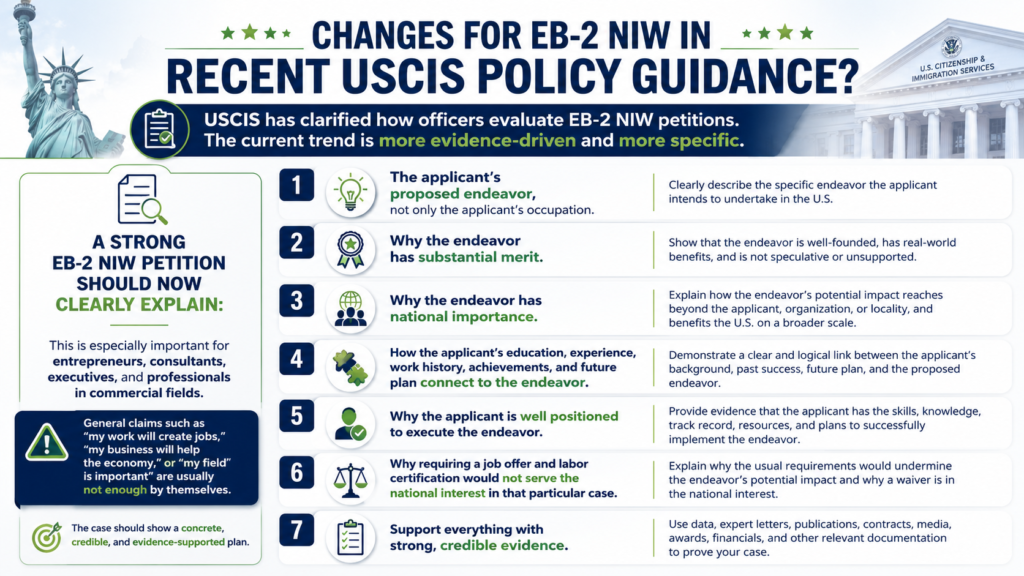
USCIS has clarified how officers evaluate EB-2 NIW petitions. The current trend is more evidence-driven and more specific.
A strong EB-2 NIW petition should now clearly explain:
- The applicant’s proposed endeavor, not only the applicant’s occupation.
- Why the endeavor has substantial merit.
- Why the endeavor has national importance.
- How the applicant’s education, experience, work history, achievements, and future plan connect to the endeavor.
- Why the applicant is well positioned to execute the endeavor.
- Why requiring a job offer and labor certification would not serve the national interest in that particular case.
This is especially important for entrepreneurs, consultants, executives, and professionals in commercial fields. General claims such as “my work will create jobs,” “my business will help the economy,” or “my field is important” are usually not enough by themselves. The case should show a concrete, credible, and evidence-supported plan.
Who Is EB-2 NIW Best For?
EB-2 NIW may be a strong option for professionals whose work has broader U.S. importance, such as:
- Artificial intelligence and machine learning specialists
- Cybersecurity professionals
- Healthcare and public-health professionals
- Engineers and infrastructure experts
- Renewable energy and climate-technology professionals
- University researchers and applied scientists
- Data scientists and advanced analytics professionals
- Entrepreneurs with scalable, documented business models
- Education, workforce-development, and public-policy professionals
- Professionals working in national-priority areas such as supply chain resilience, digital infrastructure, semiconductor technology, biotechnology, aviation, transportation, agriculture, or environmental monitoring
The key question is not simply whether the person is qualified. The stronger question is:
Can we show that this person’s future work has importance beyond one employer, one client, or one local business interest?
What Is EB-1A?
EB-1A is the employment-based first preference category for individuals with extraordinary ability in the sciences, arts, education, business, or athletics.
Like EB-2 NIW, EB-1A does not require a U.S. employer sponsor or PERM labor certification. The applicant may self-petition. However, the legal standard is much higher.

To qualify for EB-1A, the applicant must show extraordinary ability through sustained national or international acclaim. USCIS must be persuaded that the applicant’s achievements have been recognized in the field and that the applicant is among the small percentage who have risen to the very top of the field.
The applicant must also show that they intend to continue working in the area of extraordinary ability and that their work will substantially benefit the United States.
EB-1A Evidence Requirements
An EB-1A applicant may qualify by showing a one-time major internationally recognized award, such as a Nobel Prize, Olympic medal, Academy Award, or similarly recognized achievement.
Most applicants do not have that type of award. Therefore, most EB-1A cases are built by proving at least three of the regulatory evidence categories, such as:
- Nationally or internationally recognized awards
- Membership in associations that require outstanding achievements
- Published material about the applicant in major media or professional publications
- Judging the work of others
- Original contributions of major significance
- Authorship of scholarly articles
- Display of work at artistic exhibitions or showcases
- Leading or critical roles for distinguished organizations
- High salary or high remuneration compared with others in the field
- Commercial success in the performing arts
Meeting three criteria is only the first step. USCIS then conducts a final merits review. At that stage, the officer evaluates the full record to decide whether the evidence as a whole proves sustained acclaim and extraordinary ability.
This is why EB-1A petitions can be denied even when the applicant appears to meet three criteria. The evidence must be strong in context, not only listed in categories.
What Changed for EB-1A in Recent USCIS Policy Trends?
Recent USCIS guidance and adjudication trends emphasize the quality, context, and field-level meaning of evidence.
For example:
- Awards should be explained in terms of selectivity, reputation, and field relevance.
- Memberships should show that admission required outstanding achievement, not simple payment or open registration.
- Media coverage should be about the applicant and their work, not only a company announcement or promotional article.
- Judging should show trust in the applicant’s expertise.
- Original contributions should show field-level significance, adoption, influence, implementation, citation, commercial use, policy use, or independent recognition.
- Leading or critical roles should show why the role mattered to a distinguished organization.
- High salary should be supported by comparison data.
The strongest EB-1A cases do not simply collect evidence. They explain why the evidence proves that the person stands at the top of the field.
EB-1A vs EB-2 NIW: Main Differences
1. Legal Standard
EB-2 NIW focuses on the proposed endeavor and its national importance. USCIS wants to know whether the applicant’s future work benefits the United States enough to waive the normal job-offer and labor-certification requirement.
EB-1A focuses on the applicant’s extraordinary ability. USCIS wants to know whether the applicant has sustained national or international acclaim and is among the top people in the field.
2. Level of Recognition
EB-2 NIW does not always require national or international fame. A person can qualify by showing advanced expertise, a strong proposed endeavor, national importance, and a realistic plan.
EB-1A requires a much higher level of recognition. The applicant must show a record of achievements that places them near the top of their field.
3. Evidence Style
EB-2 NIW evidence usually includes:
- Academic credentials
- Professional experience
- Project documentation
- Publications, patents, or technical reports where relevant
- Recommendation letters
- Government, industry, or institutional support where available
- Business plans or implementation plans
- Evidence of national need or policy alignment
- Proof of the applicant’s ability to execute the endeavor
EB-1A evidence usually includes:
- Awards and honors
- Media coverage about the applicant
- Scholarly publications
- Citations
- Peer review or judging work
- Selective memberships
- Original contributions with independent proof of impact
- High remuneration evidence
- Leading or critical role documentation
- Expert letters explaining field-level significance
4. Processing Time
Both EB-1A and EB-2 NIW are filed on Form I-140. Premium processing is available for both categories, but the premium-processing timeline is different.
As of 2026, EB-1A premium processing is generally 15 business days, while EB-2 NIW premium processing is generally 45 business days. Premium processing does not guarantee approval. It only requires USCIS to take action within the premium-processing period, such as approval, denial, Request for Evidence, or Notice of Intent to Deny.
Standard processing times can vary by service center, workload, and case complexity.
5. Visa Bulletin and Priority Dates
A major mistake in older articles is saying that EB-1A has “no backlog” or that EB-1A is always faster. That is not always accurate.
Visa availability depends on the applicant’s country of chargeability and the monthly Visa Bulletin. EB-1 may be current for many countries while still backlogged for India or China. EB-2 can also move, retrogress, or become unavailable for certain countries depending on demand and annual limits.
This means the correct strategy must consider both:
1. I-140 approval strategy, and
2. Green card availability through the Visa Bulletin.
For many applicants, EB-1A may still provide a better priority-date position than EB-2 NIW. For others, especially those whose EB-1A evidence is not yet strong enough, EB-2 NIW may be the more realistic first step.
Can You Qualify for Both EB-2 NIW and EB-1A?
Yes. Some applicants may qualify for both EB-2 NIW and EB-1A, especially if they have a strong record of professional achievement and their work also has clear national importance.
For example, a researcher may qualify for EB-2 NIW because their work addresses a national healthcare, cybersecurity, energy, or infrastructure problem. The same researcher may later qualify for EB-1A if their work gains major recognition through citations, awards, invited speaking, media coverage, peer review, adoption, patents, or independent expert recognition.
However, the same evidence should not be copied without strategy. EB-2 NIW and EB-1A require different legal arguments.
For EB-2 NIW, the evidence must answer:
Why does this proposed endeavor matter to the United States, and why is this person positioned to advance it?
For EB-1A, the evidence must answer:
Why does this record prove sustained acclaim and extraordinary ability at the top of the field?
Example: From EB-2 NIW to EB 1A
Consider a renewable-energy engineer who first files EB-2 NIW based on a proposed endeavor to improve grid resilience and reduce energy waste through advanced battery-management systems. The NIW case may focus on national importance, infrastructure modernization, clean-energy policy alignment, and the applicant’s technical ability to carry out the endeavor.
Over the next two years, the engineer publishes influential papers, receives independent citations, contributes to industry standards, wins a recognized technical award, receives media attention, judges innovation competitions, and documents adoption of their methods by other organizations.
At that stage, the person may have a stronger EB-1A profile because the record now shows broader recognition and field-level impact. The EB-1A case would focus less on the proposed endeavor and more on the applicant’s extraordinary ability and sustained acclaim.
Which Category Is Better for You?
The right category depends on your current evidence, country of chargeability, urgency, and long-term immigration strategy.
EB-2 NIW may be better if:
- You have a master’s degree, Ph.D., or bachelor’s degree plus five years of progressive experience.
- Your field connects to U.S. national priorities.
- You have a strong proposed endeavor.
- Your work has importance beyond one employer.
- You have meaningful experience, projects, publications, patents, funding, implementation evidence, or expert support.
- Your EB-1A recognition is still developing.
- You want a self-petition option without employer sponsorship.
EB-1A may be better if:
- You have strong national or international recognition.
- You have awards, media, judging, publications, citations, original contributions, selective memberships, or high salary evidence.
- Independent experts can explain your field-level significance.
- You have evidence that your work has influenced others in the field.
- You can prove more than ordinary professional success.
- Your country’s EB-1 category offers a better Visa Bulletin position than EB-2.
A dual strategy may be better if:
- You already have a strong NIW case and a developing EB-1A profile.
- You are from a country facing EB-2 backlog pressure.
- You want to preserve one strategy while building a stronger profile for another.
- Your achievements support both national importance and extraordinary ability.
- You need a profile-building plan before filing EB-1A.
Common Myths About EB-1A and EB-2 NIW
Myth 1: EB-2 NIW is easy.
EB-2 NIW may be more accessible than EB-1A for many professionals, but it is not easy. USCIS still requires a strong proposed endeavor, national importance, proof that the applicant is well positioned, and a persuasive argument for waiving the job offer and labor certification.
Myth 2: EB-1A only requires meeting three criteria.
Meeting three EB-1A criteria is only part of the process. USCIS also reviews the entire record to decide whether the applicant has truly demonstrated extraordinary ability and sustained acclaim.
Myth 3: EB-1A always has no backlog.
This is not always true. Visa Bulletin movement changes monthly. EB-1 may be current for some countries and backlogged for others.
Myth 4: EB-2 NIW approval means immediate green card.
An approved I-140 does not automatically give the applicant a green card. The applicant must still complete adjustment of status or immigrant visa processing, and the priority date must be current.
Myth 5: Recommendation letters alone can win the case.
Recommendation letters can help, but they are stronger when supported by independent evidence. USCIS gives more weight to specific, well-supported letters that explain the applicant’s achievements, impact, and future work in detail.
How to Build a Strong EB-2 NIW Case in 2026
A strong EB-2 NIW petition should begin with a clear proposed endeavor. The endeavor should be specific enough for USCIS to understand, but broad enough to show national importance.
A strong NIW case usually includes:
- A well-defined proposed endeavor
- Evidence of substantial merit
- Evidence of national importance
- Strong connection between the applicant’s background and the endeavor
- Proof of past achievements
- A realistic future plan
- Expert letters from credible sources
- Evidence of market, policy, scientific, technical, or public need
- Documentation showing why the applicant is well positioned
- A clear explanation of why the United States benefits from waiving the job offer and labor certification
The strongest cases connect the applicant’s evidence to all three Dhanasar prongs. They do not leave the officer to guess.
How to Build a Strong EB-1A Case in 2026
A strong EB-1A petition should be built around field-level recognition. The evidence should show that the applicant is recognized as a leading figure, major contributor, or top expert in the area of extraordinary ability.
A strong EB-1A case usually includes:
- A clear field definition
- A strong explanation of the applicant’s area of extraordinary ability
- Evidence mapped to at least three regulatory criteria
- Independent proof of impact
- Strong expert letters
- Media or published material where available
- Awards, judging, memberships, citations, patents, commercial adoption, policy influence, or leadership evidence
- Context showing why the evidence matters in the field
- A final merits argument explaining sustained acclaim and top-level standing
The best EB-1A petitions do not only list evidence. They explain the importance, selectivity, independence, and field-level meaning of each item.
EB-1A vs EB-2 NIW: Practical Strategy
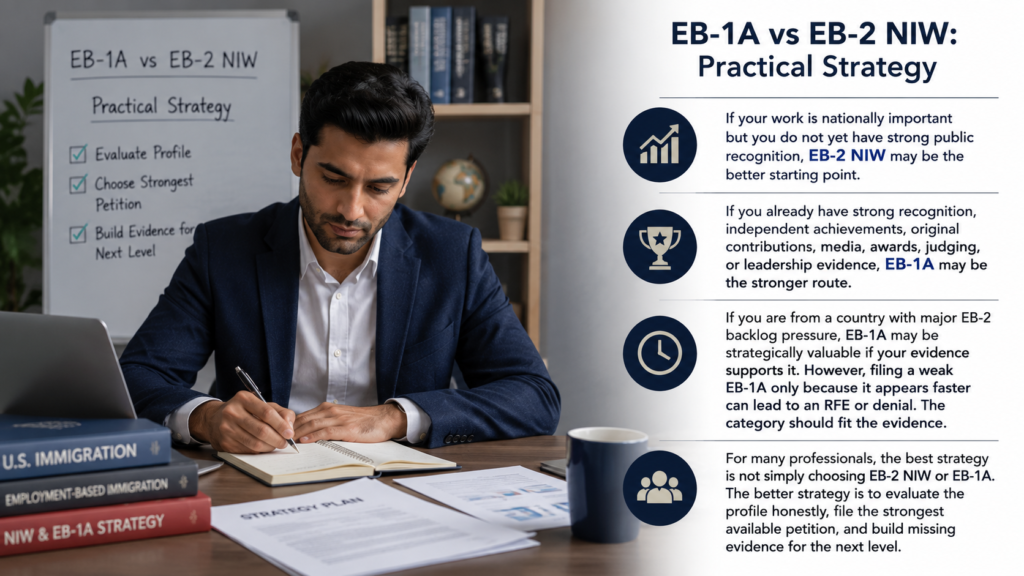
If your work is nationally important but you do not yet have strong public recognition, EB-2 NIW may be the better starting point.
If you already have strong recognition, independent achievements, original contributions, media, awards, judging, or leadership evidence, EB-1A may be the stronger route.
If you are from a country with major EB-2 backlog pressure, EB-1A may be strategically valuable if your evidence supports it. However, filing a weak EB-1A only because it appears faster can lead to an RFE or denial. The category should fit the evidence.
For many professionals, the best strategy is not simply choosing EB-2 NIW or EB-1A. The better strategy is to evaluate the profile honestly, file the strongest available petition, and build missing evidence for the next level.
How Immignis Can Help
Immignis helps professionals, entrepreneurs, researchers, executives, and high-achieving individuals evaluate whether EB-2 NIW, EB-1A, or a staged strategy may fit their profile.
Our work focuses on:
- Profile evaluation
- EB-2 NIW proposed endeavor development
- EB-1A evidence mapping
- Petition strategy
- Recommendation-letter planning
- Profile Building
- Expert-letter coordination
- Evidence organization
- RFE response strategy
- Long-term profile-building for stronger immigration positioning
A successful petition requires more than documents. It requires a clear legal theory, strong evidence, credible presentation, and a strategy that matches the applicant’s actual achievements.
EB-1A and EB-2 NIW are two powerful green card options for qualified professionals who want to apply without employer sponsorship. However, they serve different types of applicants.
EB-2 NIW focuses on the national importance of the applicant’s future work and whether the applicant is well positioned to advance that work. EB-1A focuses on extraordinary ability, sustained acclaim, and recognition at the top of the field.
In 2026, applicants should pay close attention to USCIS policy guidance, Visa Bulletin movement, premium-processing rules, and the quality of evidence. The best path is the one that matches the applicant’s real profile and long-term immigration goals.
If you are deciding between EB-1A and EB-2 NIW, Immignis can help you evaluate your profile, identify the strongest route, and build a strategy that reflects your achievements, field, timeline, and future plans.
Frequently Asked Questions About EB-1A vs EB-2 NIW
Is EB-1A better than EB-2 NIW?
EB-1A may be better for applicants with strong national or international recognition and evidence of extraordinary ability. EB-2 NIW may be better for applicants whose work has national importance but who do not yet have the level of acclaim required for EB-1A.
Is EB-2 NIW easier than EB-1A?
For many applicants, EB-2 NIW is more accessible than EB-1A because it does not require proof of sustained national or international acclaim. However, EB-2 NIW still requires a strong proposed endeavor, national importance, and evidence that the applicant is well positioned to advance the work.
Can I apply for both EB-1A and EB-2 NIW?
Yes. Some applicants file both, either at the same time or in stages. The strategy depends on the strength of the evidence, Visa Bulletin conditions, cost, timing, and risk tolerance.
Does EB-1A require a job offer?
No. EB-1A allows self-petitioning and does not require a job offer or PERM labor certification.
Does EB-2 NIW require a job offer?
No. EB-2 NIW allows the job-offer and labor-certification requirements to be waived if the applicant satisfies the national-interest standard.
Does EB-1A require publications and citations?
Publications and citations can help, especially in academic and scientific fields, but they are not mandatory for every EB-1A case. USCIS evaluates the evidence according to the applicant’s field.
Does EB-2 NIW require publications?
No. Publications can strengthen an EB-2 NIW case, especially for researchers and STEM professionals, but many strong NIW cases also rely on projects, patents, technical work, business plans, implementation evidence, funding, expert letters, or policy relevance.
Which is faster, EB-1A or EB-2 NIW?
EB-1A can be faster at the I-140 stage with premium processing because the premium-processing timeframe is generally shorter than EB-2 NIW. However, the full green card timeline also depends on the Visa Bulletin, country of chargeability, adjustment of status, or consular processing.
Can an EB-2 NIW approval help with EB-1A later?
It can help indirectly because some evidence may overlap, but EB-1A has a separate and higher standard. An NIW approval does not automatically prove extraordinary ability.
Is EB-1A a good option for Indian or Chinese applicants?
It may be strategically useful if the applicant has strong EB-1A evidence and EB-1 offers a better Visa Bulletin position than EB-2. However, EB-1 may also experience backlogs for India or China, so applicants should always check the latest Visa Bulletin.
Is EB-2 NIW a good option for entrepreneurs?
Yes, EB-2 NIW can be a strong option for entrepreneurs, but the case should show more than a general business idea. Strong entrepreneur NIW cases usually include evidence of traction, customers, users, funding, partnerships, technology, market need, job creation potential, or broader U.S. economic or public benefit.
Does premium processing guarantee approval?
No. Premium processing only speeds up USCIS action. USCIS may approve, deny, issue a Request for Evidence, or issue a Notice of Intent to Deny.
What is the main difference between EB-1A and EB-2 NIW?
The main difference is the legal focus. EB-1A asks whether the applicant has extraordinary ability and sustained acclaim. EB-2 NIW asks whether the applicant’s proposed endeavor has national importance and whether the United States benefits from waiving the job offer and labor certification.
Ready to move forward? Explore our EB-2 NIW petition strategy and EB-1A extraordinary ability petition services, or let Immignis evaluate your profile and recommend the strongest path for your green card goals.



Comments
Surge in EB-1A Visa Demand: A Competitive Landscape
June 30, 2026 - 11:43 am[…] The EB-1A extraordinary ability green card remains one of the most valuable U.S. immigration options for top professionals because it allows self-petitioning, avoids PERM labor certification, and can move quickly at the I-140 stage with premium processing. But demand and competition have changed the way applicants should approach the category. […]
EB-1 vs EB-2 Visa Categories in 2026: Critical Differences You Must Know
July 1, 2026 - 8:10 pm[…] What Is the Main Difference Between EB-1 vs EB-2? […]