Key facts at a glance
| Outcome | EB-1A approval for an Indian AI chip verification scientist working at a U.S.-based semiconductor company. |
| Approval date | Approved on August 21, 2024. |
| Field niche | AI-assisted verification for complex chip architectures, with a focus on regression triage, coverage gaps, rare failure patterns, and verification reliability before silicon release. |
| Starting problem | He held a strong technical role, but much of the work was employer-confidential. Independent acclaim, public authorship, judging, and evidence tracing verification methods to him were limited. |
| Path used | Ethical EB-1A profile building through verification method papers, patent filings, non-confidential framework documentation, an invited semiconductor conference talk, technical media commentary, peer review, senior professional membership, high-salary evidence, and independent EDA expert letters. |
| USCIS EB-1A criteria activated | Scholarly articles, original contributions, published material, judging, memberships, and high salary. Patent evidence strengthened attribution and the original-contribution record. |
This EB-1A success story began with thousands of passing verification results and one failure that refused to make sense.
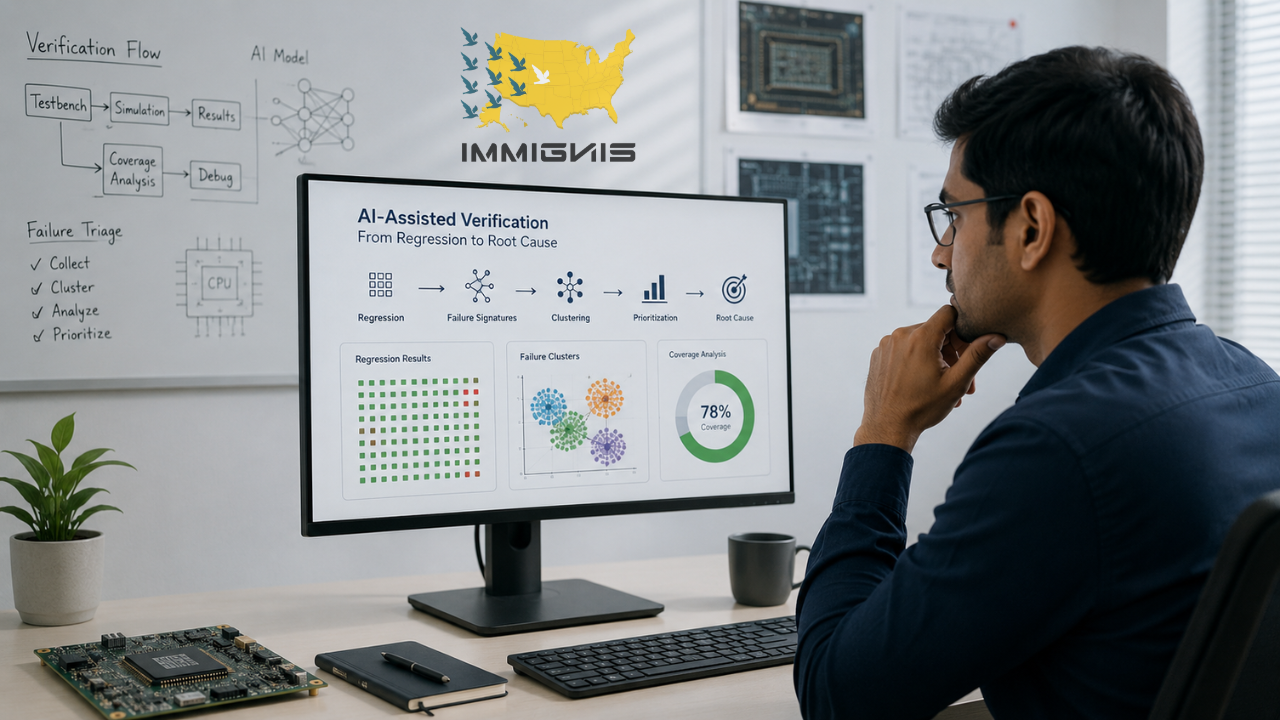
Then one test reached a rare sequence of states and broke. The engineer did not know yet whether the problem came from the design, the testbench, a timing assumption, or the way failures were being grouped for triage. He knew one thing: a green dashboard could hide the wrong kind of uncertainty.
He was an Indian verification scientist working at a U.S.-based semiconductor company. His specialty was AI-assisted verification for complex chip architectures.
Why did an advanced chip verification career still look ordinary on paper?
It referred to regressions, coverage, debugging, and architecture work, yet it did not identify the verification problem that repeatedly drew his attention.
Complex chip architectures can generate large regressions, many failure signatures, difficult corner cases, and coverage questions. Engineers still must decide which failures are related, which deserve immediate investigation, and where verification effort should move next.
The EB-1A green card is a self-petition immigrant classification for individuals who can demonstrate extraordinary ability through sustained national or international acclaim and recognized achievements in their field.
Advance My Profile, powered by Immignis, reviewed his record with legal strategists and semiconductor domain specialists and defined the field around AI-assisted verification for complex chip architectures.
His niche was the verification decision made after the regression finished
His work examined how teams could compare failure signatures, identify clusters, prioritize unusual behavior, and use model-assisted analysis to focus engineering review.
The evidence also addressed coverage gaps and the relationship between test generation, observed states, and areas that still needed stronger verification.
The petition documented non-confidential methods, framework logic, patent records, and public technical work without exposing employer-owned chip designs or proprietary test environments.
What did USCIS need to see in an AI chip verification EB-1A case?
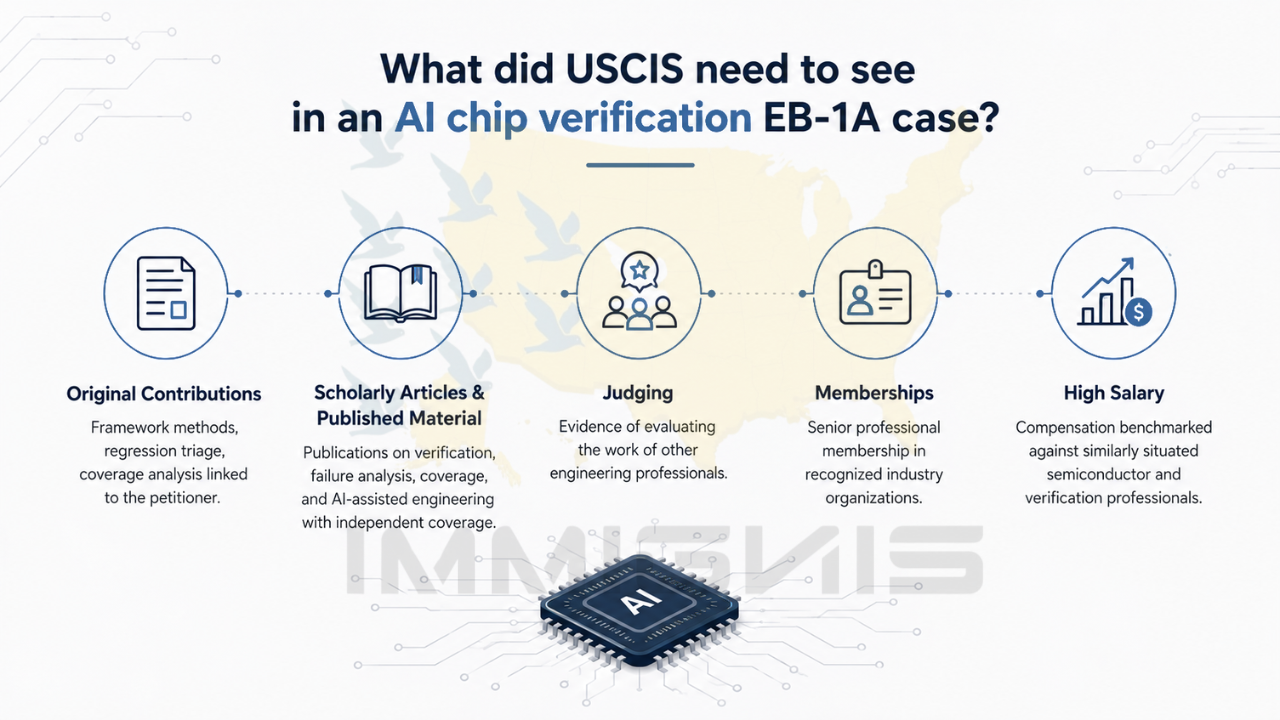
For original contributions, the petition identified framework methods, regression-triage logic, coverage analysis, and technical concepts linked to him. Independent EDA experts explained why the methods mattered to verification efficiency and design confidence.
Scholarly articles addressed chip verification, failure analysis, coverage, and AI-assisted engineering. Published material required independent coverage, while judging required actual evaluation of other specialists’ work.
High salary required a reliable comparison with occupational and geographic evidence for similarly situated semiconductor and verification professionals.
Patent filings were documented by status and inventorship. They supported attribution and original contributions, and were not presented as a separate EB-1A criterion.
The verification framework was documented without exposing a confidential chip
The record traced what happened after a regression: collect failure information, compare signatures, identify related groups, flag unusual patterns, connect failures to coverage questions, and direct engineering review.
Framework documentation showed how AI-assisted analysis could rank or organize verification evidence while engineers still reviewed the underlying design behavior.
The team also documented how recurring signatures could be tracked across regressions without assuming that every similar log represented the same design issue. That distinction mattered because aggressive grouping can hide an outlier, while weak grouping can leave engineers reviewing the same failure pattern again and again.
The public version excluded protected architecture diagrams, confidential block names, customer information, and internal design data.
The publications examined the part of verification dashboards often hide
With domain support, he developed papers on regression triage, failure-signature clustering, coverage gaps, rare event patterns, and AI-assisted prioritization.
One paper examined why many passing tests can still leave uncertainty when coverage is uneven. Another studied how to group similar failures without losing an unusual signature that may point to a different design issue.
Semiconductor engineers often have their strongest work hidden inside regressions, verification frameworks, design reviews, and confidential programs. A free EB-1A profile assessment can identify which technical methods are attributable to you and where authorship, judging, membership, media, or independent recognition still needs development.
Patent evidence helped trace technical concepts to the verification scientist
The file documented inventorship, filing status, and the technical subject in the available patent materials.
Where a filing connected him to a verification or analytical concept, the petition explained that relationship under original contributions.
Significance came from framework documentation, method papers, verification evidence, and independent EDA experts who explained why the problem mattered.
The invited conference talk asked engineers what ‘coverage closure’ really means
A team can run extensive regressions and still struggle to decide whether coverage gaps reflect weak stimulus, unreachable states, or areas that need another verification strategy.
He discussed how failure triage and coverage analysis can inform each other when verification teams face large result volumes.
The talk also addressed black-box ranking. Engineers still need to inspect why a failure was grouped, why an event was prioritized, and what evidence supports the next verification decision.
Technical media gave the public a clearer explanation of chip verification
He explained why chip verification searches for design behavior under many conditions, including rare sequences that can be difficult to reproduce or prioritize.
He also discussed AI-assisted regression triage, failure grouping, and verification planning.
Peer review became evidence that other specialists trusted his verification judgment
Journals and technical venues invited him to review work in semiconductor verification, EDA, hardware reliability, and AI-assisted engineering.
He assessed technical methods, experimental claims, validation logic, comparison baselines, and whether conclusions followed from the evidence.
Senior membership was supported by the actual advancement standard
The evidence documented the senior grade, its experience or achievement requirements, and the professional assessment involved in advancement.
The high-salary argument was built from the right comparison group
The petition documented his compensation and compared it with wage or remuneration evidence relevant to semiconductor verification professionals, the geographic market, and his level of work.
The analysis used compensation components that could be documented and explained. It did not inflate the comparison with speculative equity values or unrelated compensation figures. The goal was to show how his remuneration compared with professionals doing comparable semiconductor verification work.
Independent EDA experts explained why the framework mattered
The strongest letters began with the verification problem: complex designs generate large amounts of test evidence, yet teams still need to find rare behavior, close coverage gaps, and separate related failures from unusual ones.
Independent experts discussed his papers, framework documentation, patent filings, conference talk, peer review, and non-confidential verification evidence.
They explained why structured triage and model-assisted analysis can focus engineering attention on evidence most likely to require deeper review.
How did the EB-1A success story come together under the USCIS criteria?
Scholarly articles: Focused papers connected his authorship to regression triage, failure-signature analysis, coverage gaps, rare event patterns, and AI-assisted verification methods.
Original contributions: Verification framework documentation, patent evidence, method records, and independent EDA letters explained his individual technical contribution and its significance.
Published material: Independent technical coverage discussed him or his expertise in AI-assisted chip verification, semiconductor reliability, and complex architecture testing.
Judging the work of others: Peer-review records documented genuine evaluation of semiconductor, EDA, hardware-reliability, and allied technical work produced by other specialists.
Memberships: Senior professional membership evidence included the applicable advancement standard and documentation of professional assessment based on achievement or experience.
High salary: Compensation evidence was compared with appropriate occupational and geographic benchmarks relevant to semiconductor verification professionals.
The papers explained the problem. Framework documentation made the method examinable. Patent evidence supported attribution. The conference talk, media, peer review, senior membership, high-salary evidence, and expert letters documented recognition from several directions.
Approval came on August 21, 2024
The approved EB-1A petition gave him a self-petition immigration path without employer sponsorship or labor certification. The Form I-140 filing established a priority date for the immigrant petition, while later permanent-residence timing can depend on visa availability and the applicant’s next immigration step.
If your strongest semiconductor work is hidden behind an NDA
Maybe you work on regression triage, coverage closure, formal verification, failure localization, verification IP, or test generation. Define the problem closely enough that another verification engineer would recognize your method.
Document safe technical methods and your role. Publish from real verification questions. State patent status accurately. Build judging through genuine technical review and use senior membership only when its advancement rules support the criterion.
Do not build a semiconductor EB-1A profile from low-quality papers, staged awards, paid citations, inflated patent language, or claims that AI made a chip error-free. USCIS can examine the full record, and verification engineers will test whether the reasoning survives design review.
FAQ
Can an internal chip verification framework support an EB-1A original-contribution claim?
Yes, when the applicant’s individual method can be identified and the evidence shows major significance in the field. Non-confidential framework documentation, method papers, patent evidence, role records, and independent EDA analysis can help explain the contribution without disclosing a protected chip design.
Does a patent filing automatically prove an original contribution of major significance?
No. A patent filing can help document inventorship and a technical concept, but USCIS still evaluates the significance of the contribution. The wider record may need evidence of use, technical importance, influence, or independent expert analysis.
Can peer review of semiconductor or EDA papers count as judging for EB-1A?
Genuine peer review can support the judging criterion when the engineer evaluates technical work produced by other specialists in the same or an allied field. The record should document the invitation and actual review activity.
How can a semiconductor verification engineer use high salary evidence for EB-1A?
The comparison should use remuneration evidence relevant to the applicant’s occupation, geography, and professional level. Comparing a senior chip verification specialist with a broad engineering population may be weak if the groups are not similarly situated.
Is verification work too confidential for an EB-1A profile?
No. Confidentiality can limit the evidence strategy, but non-confidential method descriptions, public technical papers, patent records, speaking, judging, independent coverage, and expert letters may document expertise. Employer-owned architecture and protected design data should not be exposed.
Do I need a PhD or a large citation count to pursue EB-1A as a semiconductor engineer?
No specific PhD or citation count is required by the EB-1A regulations. A semiconductor professional may rely on applicable evidence such as original contributions, scholarly authorship, judging, published material, qualifying memberships, high remuneration, and sustained independent recognition. USCIS evaluates the full record.
Build an EB-1A success story around the verification problem your engineering work has taught you to solve
If you work in chip verification, EDA, AI hardware, semiconductor architecture, hardware reliability, or design verification, your strongest contribution may still be hidden inside internal regressions and confidential programs.
Immignis and Advance My Profile help identify a defensible technical niche, document individual methods, build credible field recognition, and prepare an EB-1A record around evidence you can verify and defend professionally.