Key facts at a glance
| Outcome | EB-1A approval for a Serbian AI education scientist working at a U.K.-based edtech research center. |
| Approval date | Approved on August 14, 2024. |
| Field niche | AI tutoring systems for underserved STEM learners, with a focus on measurable access and learning outcomes. |
| Starting problem | The technology was promising, but the original record did not yet prove that the AI tutoring work produced measurable education outcomes or independent field recognition. |
| Path used | Ethical EB-1A profile building through peer-reviewed studies, school-pilot data, a policy paper for education networks, podcast and media coverage, professional award recognition, peer review, invited teaching-technology talks, and independent letters from education and learning-science researchers. |
| USCIS EB-1A criteria activated | Scholarly articles, original contributions, published material, recognized prizes or awards, judging, and leading or critical role. |
On August 14, 2024, USCIS approved her Form I-140. Did the tutor actually help? But an EB-1A petition could not be built on a polished product demonstration. For a scientist working on AI tutoring systems for underserved STEM learners, the real evidence had to live in students, classrooms, pilot data, and measurable learning outcomes.
Promising was not the same as proven.
Why was an impressive AI tutoring system not enough for this EB-1A case?
Education technology is full of demonstrations that look intelligent. A system can answer a question smoothly and still fail to improve learning. It can personalize content and still work better for students who already have strong academic support. It can increase engagement without showing whether a learner actually understands more.
The EB-1A green card is a self-petition immigrant category for people who can demonstrate extraordinary ability through sustained national or international acclaim and evidence placing them among the small percentage at the top of their field.
Her technical work in adaptive tutoring had potential, but the profile did not yet show enough independent recognition or a strong body of measurable education evidence. USCIS still needed to understand what changed for learners.
Advance My Profile, powered by Immignis, therefore built the profile around a harder standard than ‘innovative AI.’
The turning point was moving the story from the algorithm to the student
The profile was narrowed to AI tutoring systems for underserved STEM learners.
Legal strategists, education researchers, learning-science specialists, and technical writers reviewed her work together. The team separated general generative-AI activity from the tutoring research that reflected her strongest expertise.
The focus shifted to adaptive support, error patterns, learner progression, accessible STEM practice, and the evidence needed to evaluate whether students improved after using the system.
She was building authority around a specific question: how can AI tutoring be evaluated as a learning intervention for students who are least likely to have continuous one-to-one STEM support?
What did USCIS need to see in an AI education EB-1A case?
For original contributions, the petition had to identify her own tutoring methods, learner-modeling work, intervention design, or evaluation approach. The record then needed to show why that work mattered in education research or practical STEM instruction.
School-pilot evidence was especially important. A pilot could not be described as successful merely because students logged in or teachers liked the interface. The evidence had to document the questions studied, the learner groups involved, the outcome measures used, and the applicant’s personal role in designing or interpreting the work.
The case also needed to distinguish access from learning. Reaching more students can be important, but an original-contribution claim required evidence explaining how the tutoring approach influenced learning support, performance, persistence, or another relevant education outcome.
For published material, her own peer-reviewed studies belonged under scholarly authorship. Independent media or podcast coverage had to discuss her work or expertise.
For awards, the petition needed the actual recognition and its selection standards. An application or nomination alone could not be treated as a prize.
The school pilots changed the case because the evidence moved into real learning settings
Advance My Profile helped organize non-confidential school and program data around the questions the research was actually trying to answer. The team did not invent performance percentages or force a positive conclusion where the data did not support one.
The evidence documented learner participation, baseline and follow-up measures where available, patterns of tutor use, common errors, completion behavior, and the relationship between specific tutoring features and observed student outcomes.
Some learners used the system more consistently than others. School settings differed. Teacher involvement mattered. Access to devices and study time could affect results. She was studying how an AI tutoring intervention behaved in the uneven conditions that underserved STEM learners actually face.
Peer-reviewed studies turned pilot findings into a research record
With education and domain-PhD support, studies were developed on adaptive tutoring, student error patterns, learning support, and the evaluation of AI-assisted STEM instruction.
The strongest studies connected technical system design with learning-science questions: what kind of hint helps a student continue without giving away the answer, when should a tutor change difficulty, and how should outcomes be measured when students begin from different levels of preparation?
Why did the policy paper speak to education networks rather than software buyers?
The policy paper examined what education networks should ask before treating AI tutoring as an access solution for underserved STEM learners.
It addressed outcome measurement, teacher oversight, learner privacy, bias, uneven digital access, and the risk of confusing usage metrics with educational improvement.
Its argument was narrower: where individualized STEM support is scarce, AI tutoring may have value, but education systems should demand credible evidence about who benefits, under what conditions, and how learning is measured.
Podcast and media coverage made her useful to the public conversation
In podcast discussions and education-technology coverage, she explained why a fluent chatbot is not automatically a good tutor. She discussed the difference between answering and teaching, the importance of error-sensitive feedback, and the need to evaluate underserved learners separately rather than assume that average results describe every student.
Independent published material began to place her name beside measurable AI tutoring outcomes rather than generic education technology.
Professional awards and invited talks showed that recognition was moving beyond the research center
Advance My Profile reviewed eligibility, selection standards, and the relationship between the recognition and her actual AI tutoring work. The petition used documented recognition, not the mere fact that an award application had been submitted.
Teaching-technology and education audiences asked her to discuss adaptive tutoring, STEM access, and how schools should interpret AI learning evidence.
Peer-reviewed studies showed scientific work. Pilot data showed real-world evaluation. Media made the expertise public. Awards documented professional recognition. Invited talks showed that organizations wanted her to explain the field to others.
Peer review and independent education letters answered whether the field trusted her judgment
Journals and technical venues invited her to assess studies in education technology, AI-supported learning, learning analytics, or related areas. The evidence documented genuine review activity rather than listing generic editorial invitations.
Immignis developed a referee strategy around education researchers, learning scientists, and specialists familiar with technology-supported STEM learning.
The strongest letters explained why outcome evidence matters in AI education. They discussed the difficulty of measuring learning across uneven student populations and why school-pilot data can be more informative than a controlled product demonstration.
Advance My Profile prepared evidence-based drafts for expert review. Referees could revise the language and sign only what they considered accurate.
Why was ethical profile building especially important in AI education?
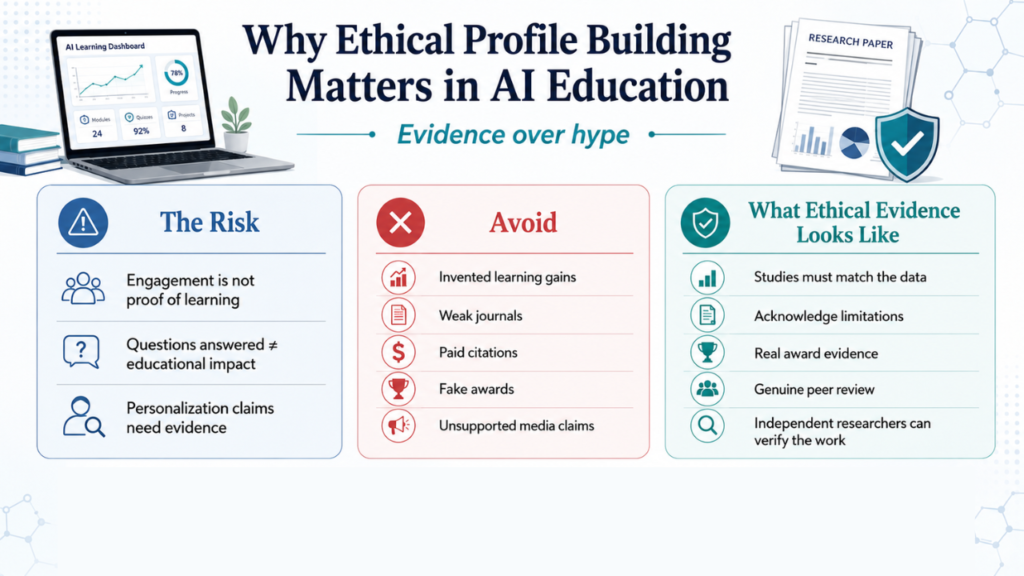
A company may celebrate engagement. A dashboard may show thousands of questions answered. A press release may describe personalized learning.
The profile therefore avoided invented learning gains, weak journals, paid citations, fake awards, and media claims that could not be supported by the pilot record.
The studies had to match the data. The policy paper had to acknowledge limitations. The award evidence had to be real. Peer review had to be genuine. Independent researchers had to understand the work they were discussing.
Do not build an education profile around outcomes you would be uncomfortable showing to a teacher or research-methods reviewer.
Which USCIS EB-1A criteria did the final Form I-140 petition activate?
Scholarly articles: Peer-reviewed studies connected her authorship to AI tutoring, adaptive STEM support, student error patterns, and the measurement of learning outcomes.
Original contributions: School-pilot data, tutoring-system research, evaluation methods, and independent education letters explained her individual contribution to AI-supported STEM learning and its practical significance.
Published material: Independent podcast and media coverage discussed her work and expertise in AI tutoring and measurable learning outcomes, building public recognition around the defined niche.
Recognized prizes or awards: Professional education-technology recognition was supported with evidence of the award, its selection framework, and the connection between the honor and her work.
Judging the work of others: Peer-review assignments documented genuine evaluation of research by other specialists in education technology, AI-supported learning, and related fields.
Leading or critical role: Research-center and project evidence showed why her scientific and technical judgment was important to significant AI tutoring research and school-pilot activities.
The papers showed scientific depth. School pilots showed evaluation in real learning settings. The policy paper translated evidence questions for education networks. Media and podcasts created public recognition. Awards and invited talks showed outside interest. Peer review showed evaluative trust. Independent letters explained why the work mattered.
It showed a scientist whose work had become recognized for asking whether AI tutoring actually improved access and learning for underserved STEM students.
What did the August 2024 EB-1A approval mean?
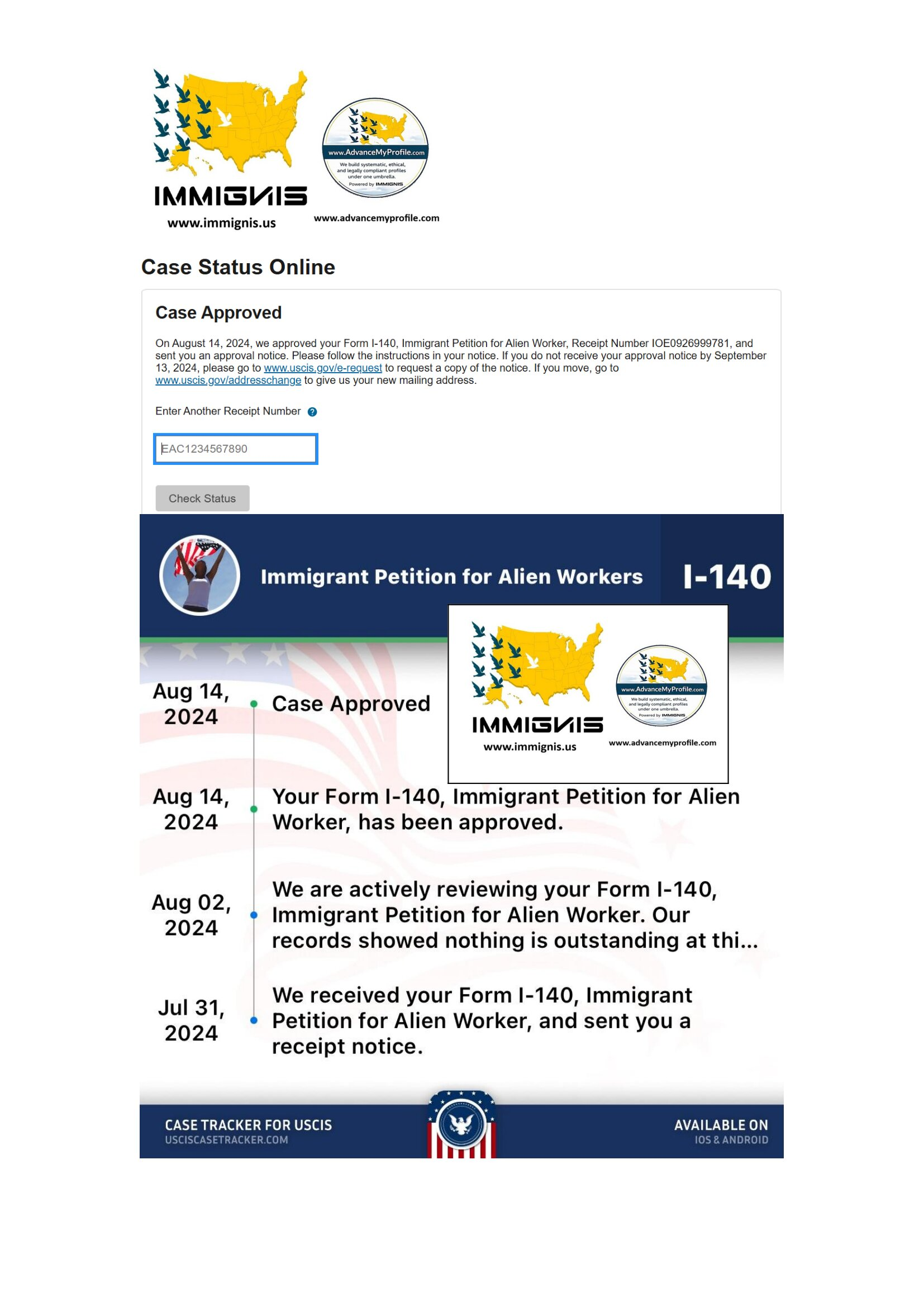
USCIS approved the Form I-140 on August 14, 2024. The displayed case history shows receipt of the petition on July 31, active review on August 2, and approval on August 14. It does not show a request for additional evidence.
She had peer-reviewed studies, school-pilot evidence, a policy paper for education networks, podcast and media coverage, professional recognition, peer-review activity, invited teaching-technology talks, and independent letters from education researchers. The approval gave her an EB-1A self-petition path without employer sponsorship or labor certification.
A school network could see the policy question she studied. A journalist could identify her expertise. A journal could recognize her review area. An education researcher could examine the outcome evidence behind the tutoring work. The career result was a public authority record built around proof, not promise.
If your AI product looks impressive but your impact is still hard to prove
Start with the outcome your field actually cares about. For an education scientist, that may be learning, access, persistence, or another measurable student outcome. For a healthcare researcher, it may be clinical evidence. For an engineer, it may be reliability, adoption, or technical performance.
Publish what the data supports. Document implementation. Explain limitations. Accept genuine judging work. Develop independent recognition from experts who can evaluate the contribution.
A strong EB-1A profile should make your professional work more credible after the petition is approved.
FAQ
Can school-pilot data support an EB-1A original-contribution claim in AI education?
Yes, when the evidence identifies the applicant’s individual scientific or technical contribution and shows why the pilot findings are significant to the field. The petition should document the pilot design, relevant outcomes, the applicant’s role, and independent evidence explaining why the work matters beyond one product or research center.
Is high student engagement enough to prove an AI tutor improves learning?
No. Engagement can be useful evidence, but usage does not automatically equal learning. Strong education research should consider appropriate outcome measures, student starting points, the type of task being studied, and whether observed improvement can reasonably be connected to the tutoring intervention.
Can AI tutoring for underserved students be an EB-1A field niche?
It can be a credible niche when the applicant has a genuine body of work and independent recognition in that specialty. The petition still must satisfy the USCIS EB-1A criteria and show, in the record as a whole, sustained acclaim and extraordinary ability in the defined field.
Do professional education awards automatically satisfy the EB-1A awards criterion?
No. The evidence should document the actual prize or award, the basis for recognition, the selection process, and the field in which the award was given. An application, nomination, or participation certificate should not be presented as a qualifying award without evidence supporting the criterion.
Can peer review count as judging for an AI education researcher?
Genuine peer review can support the judging criterion when the applicant evaluates the work of other researchers. The record should document review invitations, completed activity where available, and the relationship between the reviewed work and the applicant’s education-technology or learning-science field.
Do I need a PhD in education or computer science for an EB-1A AI tutoring case?
No specific degree is required for EB-1A extraordinary ability. Education can support expertise, but USCIS evaluates the extraordinary-ability evidence and the record as a whole. Original contributions, scholarly work, judging, awards, published material, leading or critical roles, and independent recognition may all be relevant.
Build an EB-1A success story around outcomes your field can measure
If you work in AI education, edtech research, learning analytics, adaptive tutoring, STEM access, or another technology-supported learning field, your product may be visible before your scientific contribution is.
Immignis and Advance My Profile help professionals identify a defensible niche, build credible recognition around real evidence, document individual impact, and prepare an EB-1A record that connects technical work with measurable field outcomes.
Start with a free EB-1A profile assessment and find out whether your education or AI work can be developed into a clearer authority record.