
Air quality scientist EB-1A: How a Ghanaian atmospheric-data scientist converted shared dashboards, sensor networks, satellite observations, government-use records, scientific publications, peer review, and media attribution into a coherent record of individual achievement in urban air-quality forecasting.
Key facts at a glance
| Petition outcome | Form I-140 approved under EB-1A on October 16, 2024. |
| Professional profile | Ghanaian atmospheric-data scientist developing air-quality models that combine satellite observations, low-cost sensors, and ground measurements for rapidly growing African cities. |
| Field niche | Urban air-pollution forecasting and exposure mapping in data-scarce regions. |
| Starting weakness | Public agencies used the forecasts, but authorship and technical responsibility were dispersed across shared dashboards, international collaborations, sensor programs, and institutional reports. |
| Profile-building focus | Model authorship documentation, government-use records, atmospheric-science publications, international air quality network roles, peer-review evidence, conference presentations, and media attribution. |
| Principal EB-1A evidence areas developed | Original scientific contributions of major significance, authorship of scholarly articles, judging the work of others, leading or critical roles, and published material about the scientist and the scientist’s work. |
| Central issue | Showing that public-facing air-quality forecasts and exposure maps resulted from this scientist’s modeling choices, validation work, and integration of imperfect data sources. |
| Approval lesson | When a scientific product is public but its authorship is diffuse, the petition must reconstruct the technical decisions, external use, and individual responsibility behind the product. |
The approval made the person behind the forecast visible
Air-pollution maps are designed to look simple. A color scale shows where concentrations are higher, a forecast indicates what may happen next, and a public agency uses the result to issue guidance or plan monitoring. The clean display can conceal the difficult scientific work that made the map possible.
The petitioner worked in that concealed layer. The record involved combining satellite observations, low-cost sensor readings, reference-grade ground measurements, weather data, calibration procedures, exposure estimates, and uncertainty analysis. Each source had limitations. The scientific contribution was not merely placing data on a dashboard; it was deciding how the different sources could be reconciled well enough to support public decisions.
USCIS approved the Form I-140 petition on October 16, 2024. The case became stronger when the evidence stopped treating the forecast as an institutional product and began tracing its model design, validation, deployment, and use back to the individual scientist.
Why air quality work in data-scarce cities creates an attribution problem
Atmospheric research in a well-instrumented setting may rely on dense regulatory monitoring networks and long historical records. Many fast-growing cities do not have that advantage. A scientist may need to combine sparse reference stations with lower-cost sensors, satellite products, short field campaigns, land-use information, and meteorological estimates. The result is collaborative by necessity.
That collaboration creates an immigration-evidence problem. Dashboards may carry the name of a ministry, university, donor program, laboratory, or international consortium. Reports may list a large team. Public officials may rely on a forecast without knowing which person designed the fusion method, selected calibration rules, evaluated bias, or decided how uncertainty should be communicated.
The petition therefore did not argue that urban air pollution is important and leave the reader to assume that the petitioner was extraordinary. It separated the importance of the environmental problem from the significance of the petitioner’s own work.
A precise field definition kept the case from becoming an argument about all environmental science
The field was defined as urban air-pollution forecasting and exposure mapping in data-scarce regions. This was narrower than atmospheric science, environmental data science, or public health. It matched the actual work and provided a sensible comparison group.
The definition also explained why the petitioner’s expertise crossed traditional boundaries. The work required atmospheric interpretation, statistical modeling, sensor evaluation, geospatial analysis, satellite-data use, exposure estimation, and communication with public institutions. Those elements were not separate careers. They formed one specialized practice aimed at producing usable air-quality intelligence where conventional monitoring was incomplete.
At final merits, that focus mattered. The relevant question was not whether the petitioner stood above every atmospheric scientist. It was whether the total record showed sustained recognition and high-level achievement within this specific technical field.
Model authorship was proved through technical choices, not dashboard screenshots
A screenshot can show that a forecast existed. It does not show who built the model or why the model was reliable. The evidence therefore reconstructed authorship from the technical record.
Useful records included model-development notes, code or version histories where available, calibration procedures, validation plans, contribution statements, methodology sections, internal technical reports, presentation materials, project correspondence, and detailed letters from collaborators who understood the work. These materials identified the decisions the petitioner made rather than simply confirming participation.
The strongest attribution evidence explained matters such as how satellite estimates were corrected, how low-cost sensors were screened, how missing observations were handled, how weather conditions entered the forecast, how spatial exposure surfaces were produced, and how uncertainty was tested. Those choices turned a collection of measurements into a scientific system.
Sensor integration and validation supported the original contributions argument
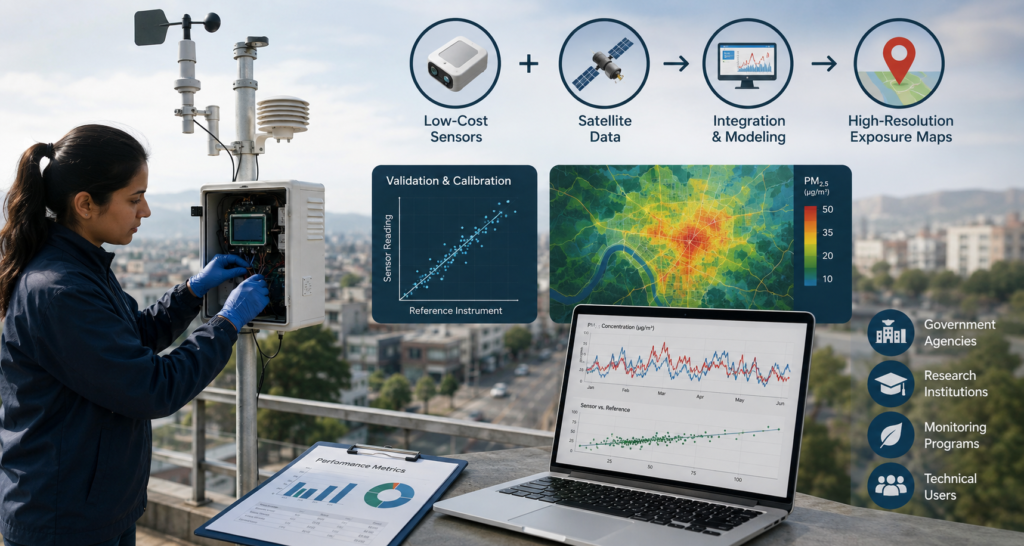
Low-cost sensors can expand geographic coverage, but they can also drift, respond differently under changing humidity or temperature, and produce readings that are not directly comparable with reference instruments. Satellite observations add broad coverage but do not measure street-level exposure in the same way as a ground monitor. Integrating these sources is a scientific problem, not a clerical task.
The petition organized the evidence around the petitioner’s solution to that problem. It explained what was different about the modeling or validation approach, how performance was assessed, and why the approach mattered in places with limited conventional monitoring. Where quantitative results were confidential or context-dependent, authorized summaries and responsible expert letters described the improvement without inventing public numbers.
Major significance required evidence beyond originality. The record therefore examined whether agencies, researchers, monitoring programs, or other technical users relied on the method, data product, calibration approach, or exposure map. Use outside the petitioner’s immediate team was especially important because it showed that the contribution had moved beyond internal experimentation.
Government use showed external reliance, but the petition avoided overstating policy impact
Government use can be persuasive when it is documented carefully. A public institution may use a forecast to identify monitoring gaps, issue health guidance, plan field campaigns, evaluate neighborhoods, or support environmental reporting. The case connected those uses to the petitioner’s model or analysis rather than treating any reference to air quality as evidence of personal recognition.
Supporting records could include agency correspondence, technical meeting minutes, implementation documents, dashboard acknowledgments, training records, official reports, or letters from responsible public officials. The most useful evidence explained what the institution used, why it selected the work, and what role the petitioner played in maintaining or interpreting it.
The petition did not claim that the scientist alone changed national policy unless the record could support that statement. It used more precise language: the work informed decisions, supplied technical evidence, or became part of an agency’s operating process. That restraint made the documented impact more credible.
Publications explained the science practical use showed what happened beyond the paper
The scholarly record helped establish that the petitioner had contributed to atmospheric science and data-driven air quality research. Authorship evidence identified the subject of each paper, the petitioner’s role, the relevance of the venue, and any objective signs that other researchers engaged with the work.
Citation evidence was used as context rather than a universal score. In an applied and regionally focused field, influence may also appear through dataset reuse, model implementation, agency reliance, technical guidance, invitations, training, or adoption by related projects. Those forms of use can be especially informative when the work addresses locations that have historically been underrepresented in the literature.
The publication record and the operational record therefore supported each other. The papers explained the method; the external-use evidence showed that the method did not remain only on the page.
Peer review and international service showed that others trusted the petitioner’s judgment
Completed peer review supported the judging criterion when the petitioner had actually evaluated the work of other scientists in the same or an allied field. Invitations alone were not enough. The record documented completed assignments through journal systems, editorial confirmations, certificates, or other reliable records while protecting confidential manuscript content.
International air-quality network roles, conference participation, and technical committees were analyzed according to substance. Open membership in a professional organization would not satisfy the regulatory membership criterion merely because the organization was respected. A selective appointment, technical responsibility, or invited service role could still support the overall record by showing that recognized professionals sought the petitioner’s expertise.
Conference presentations were useful when they were invited, competitive, or connected to later use of the work. They helped show that the petitioner was not only producing models but also explaining methods to the scientific and policy communities that needed them.
A leading or critical role had to be proved through responsibility and consequence
Collaborative environmental programs often use titles that reveal little about actual authority. The petition did not rely on a job title. It documented the functions for which the petitioner was responsible: model design, data integration, validation standards, quality control, technical supervision, interpretation, training, or delivery of the public-facing product.
Letters were strongest when they identified a concrete decision and explained its consequence. A statement that the petitioner was “essential” carried less weight than an explanation that the petitioner established the calibration protocol, resolved a known data-quality problem, directed the modeling workflow, or approved the forecast before institutional use.
The distinguished reputation of the relevant institution, laboratory, public program, or international project also had to be documented independently. A role can be critical only in relation to an organization or undertaking whose standing is established in the record.
Published material and media coverage had to discuss the scientist, not only the pollution problem
Air pollution attracts substantial media attention, but coverage of a city’s pollution levels is not automatically published material about the petitioner. The evidence was useful when an article, interview, broadcast, or professional feature discussed the scientist, the scientist’s work, or the methodology in a meaningful way and met the applicable publication requirements.
Media development was approached ethically. The goal was not to manufacture publicity. It was to help credible journalists and professional outlets understand a technically significant body of work that had previously appeared only through institutional products. Accurate attribution also served the public because it identified who could explain the model’s limits and proper use.
The same principle applied to dashboards and agency reports. A visible institutional product became stronger evidence when contribution statements, acknowledgments, credits, or supporting documents accurately named the person responsible for the scientific method.
Why this case worked
The case worked because it followed the chain from raw observation to public use. It showed the data sources, the modeling problem, the petitioner’s technical choices, the validation process, the resulting forecast or exposure map, and the external institutions that relied on the work.
It also avoided a common weakness in STEM petitions: confusing the importance of a field with proof of the individual’s standing. Urban air pollution, public health, satellite monitoring, and environmental justice provided context. The evidentiary argument concerned the petitioner’s original method, authorship, judgment, responsibility, and recognition.
No single document was asked to prove the entire case. Publications, government records, technical files, peer review, conference service, media coverage, and expert letters performed different functions. Together, they made the record understandable to a reader who did not work in atmospheric modeling.
Practical lessons for atmospheric scientists and environmental data specialists
Scientists who build public dashboards, forecasting systems, exposure maps, or decision-support tools often have more evidence than appears on a conventional curriculum vitae. The evidence may be stored in code repositories, calibration files, technical annexes, government correspondence, training records, model-validation reports, presentation decks, review systems, and project documentation.
The first task is attribution. The record should identify which decisions belonged to the scientist and which outcomes followed from those decisions. The second task is external reliance: who used the work, for what purpose, and why did the user trust it? The third is independent recognition through publications, peer review, invitations, media coverage, or other evidence appropriate to the field.
Ethical profile building does not invent acclaim. It documents genuine work more clearly and supports legitimate professional development, such as publishing completed research, accepting appropriate peer-review assignments, presenting methods to relevant audiences, seeking accurate contribution statements, and maintaining records of adoption or use.
Frequently asked questions
Can air-quality modeling support an EB-1A petition?
Yes, when the individual record satisfies the EB-1A standard. The importance of air pollution does not replace evidence of the scientist’s sustained acclaim, qualifying achievements, and overall standing in the field.
What may count as an original contribution in atmospheric data science?
A contribution may involve a model, calibration method, data-fusion approach, sensor-validation procedure, exposure-mapping system, uncertainty method, dataset, or other technical development. Major significance requires evidence that the contribution influenced or was relied upon beyond routine internal work.
How can a scientist prove authorship of a model shown on a shared dashboard?
Useful evidence may include methodology documents, contribution statements, code or version histories, model notes, validation files, project correspondence, presentations, acknowledgments, and detailed letters from people with direct knowledge of the work.
Does government use automatically prove major significance?
No. Government use is stronger when the record identifies the specific model, dataset, forecast, or method used; explains the purpose of the use; and connects that technical product to the petitioner’s individual contribution.
Can low-cost sensor work be significant even when the sensors themselves are commercially available?
Yes. The contribution may lie in calibration, quality control, network design, data integration, validation, interpretation, or a method that makes the sensors useful in a setting where conventional monitoring is limited. The evidence must show originality and influence.
Are citation counts required for an applied atmospheric scientist?
There is no single citation threshold for every field. Citations can help, but applied influence may also appear through agency use, model adoption, dataset reuse, training, technical guidance, invitations, peer review, and reliance by other projects.
Can completed manuscript review satisfy the judging criterion?
Yes, when the scientist actually evaluated the work of others in the same or an allied field. Invitations should be accompanied by evidence that the reviews were completed.
Does membership in an air quality network satisfy the membership criterion?
Only when admission to the membership itself requires outstanding achievements judged by recognized experts. Open membership generally does not qualify, although a selective technical appointment or substantive network role may support the overall record.
Can media coverage of a pollution forecast count as published material?
Published material generally must be about the petitioner and the petitioner’s work and must meet the applicable publication requirements. Coverage focused only on the pollution problem, agency, or dashboard may be insufficient without meaningful discussion of the scientist.
How can confidential government or project records be used?
Authorized summaries, redacted technical reports, cleared descriptions, contribution letters, and non-sensitive performance documentation may establish the work without disclosing protected data, security information, personal health information, proprietary methods, or restricted institutional records.
What makes a role leading or critical in a collaborative monitoring program?
The record should show responsibility for important technical decisions or functions and explain why those responsibilities mattered to a distinguished organization, laboratory, program, or project. A title or participation certificate alone is not enough.
What should an expert letter explain?
A useful letter identifies the writer’s expertise and basis of knowledge, describes the petitioner’s contribution with specificity, explains why it mattered, and points to objective records rather than relying on broad praise.
Make the invisible contribution visible
A strong atmospheric-data profile may already exist across model files, sensor records, validation reports, publications, government correspondence, dashboards, conference materials, peer-review assignments, professional roles, media coverage, and letters from collaborators or agencies. The weakness may be that every document names the project more clearly than it names the scientist.
Identify which achievements can be documented now, which records require permission or redaction, and which ethical professional-development activities may strengthen a future petition.