How a UAE-based airline safety record became an EB-1A approval by documenting AI methods for aircraft maintenance events without exposing confidential airline data
Key facts at a glance
| Outcome | EB-1A approval for an Emirati aviation safety AI architect working with a UAE-based airline group. |
| Approval date | Approved on October 9, 2025. |
| Field niche | AI safety analytics for aircraft maintenance events, with a focus on predictive-maintenance signals, event classification, engineering review, and operational use of maintenance-risk information. |
| Starting problem | His work was high-impact inside airline maintenance and safety operations, but much of the proof was employer-based, confidential, and difficult to translate into EB-1A evidence. |
| Profile-building path | The record was built through non-confidential safety papers, predictive-maintenance case metrics, an aviation safety white paper, media commentary, conference judging, invited talks, selective membership evidence, and independent letters from aviation safety and maintenance experts. |
| EB-1A criteria supported | Original contributions, scholarly articles, published material, judging, memberships, and leading or critical role. |
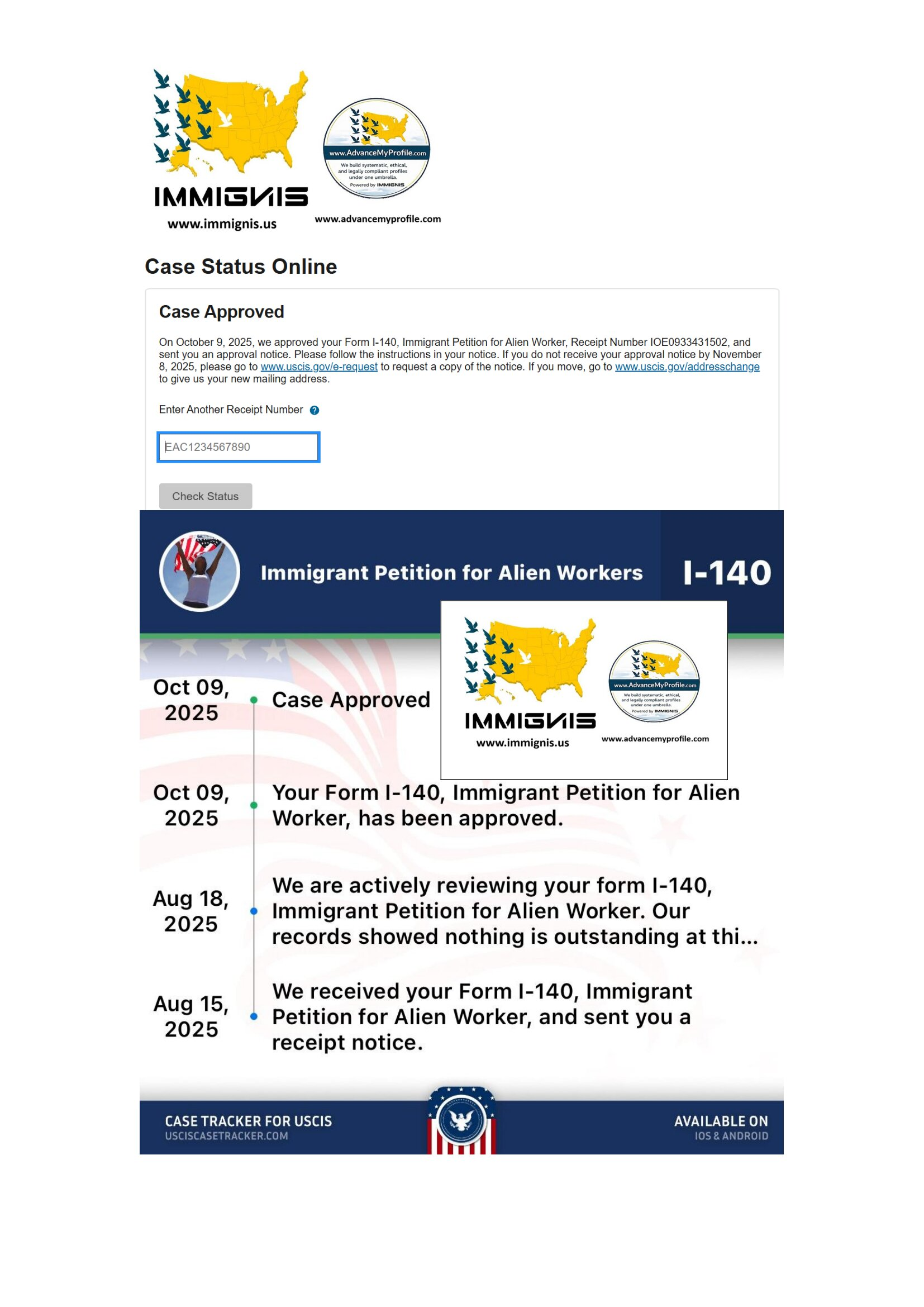
On October 9, 2025, USCIS approved the Form I-140 petition of an Emirati aviation safety AI architect whose work sat inside a UAE-based airline group.
The approval was not built on the idea that he had worked for a major airline. It was built on a more difficult showing: that his methods for analyzing aircraft maintenance events had become recognizable professional expertise, and that the evidence could be presented without exposing confidential airline systems, aircraft records, vendor information, or internal safety investigations.
That distinction mattered. Airline maintenance and safety work can be technically serious, operationally sensitive, and important to public safety. It can also be almost invisible outside the employer. A petition that merely describes internal dashboards, predictive maintenance projects, or safety analytics tools may still look like corporate job performance. EB-1A requires more.
This case succeeded after the record explained what he actually contributed: an aviation AI safety analytics method for maintenance events, engineering review, and risk-informed operational decisions.
The approval came from making the safety method visible
His work involved aircraft maintenance events, predictive signals, component behavior, inspection histories, alert thresholds, engineering review, and the difficult question of when a maintenance pattern deserves closer attention. Inside an airline group, those questions are practical. A maintenance team must decide whether a signal is noise, a normal operating pattern, an early warning, or a condition that should move into deeper engineering assessment.
For EB-1A, the same work had to be described differently. USCIS needed to see more than a capable professional using AI tools in aviation. The petition had to show a specialist whose methods could be identified, explained, evaluated by independent experts, and connected to recognized work outside one employer.
The starting record did not do that well enough. It showed responsible roles and important projects. It did not yet show a sustained public authority record in aviation safety analytics. It also contained material that could not be placed in a petition in its internal form.
Advance My Profile, powered by Immignis, reviewed the record with legal strategists and aviation-domain support. The profile was narrowed to AI safety analytics for aircraft maintenance events, rather than a broad claim of “aviation AI” or “digital transformation.” That narrower field became the center of the petition.
Why aviation AI work can look ordinary on paper
Many aviation technology professionals face the same evidentiary problem. The work may affect maintenance planning, aircraft availability, safety review, inspection timing, or engineering escalation, but the proof often lives in protected systems.
A dashboard may show fewer repeated alerts. A maintenance workflow may change how anomalies are routed. Engineers may rely on a classification model or risk score when reviewing component histories. None of that automatically proves extraordinary ability. USCIS still asks who created the method, what the method changed, whether the contribution has significance beyond routine employment, and whether the field recognizes the person as having risen to the top of the area.
In this case, the record had to separate three things that are often blurred together: airline operations, software implementation, and aviation safety methodology. The petition did not claim that the applicant personally made aircraft safe, replaced maintenance engineers, or controlled all safety outcomes. It showed that he developed and applied AI-supported methods that helped maintenance and safety teams identify, classify, and review events more consistently.
What USCIS needed to see in this aviation safety AI case
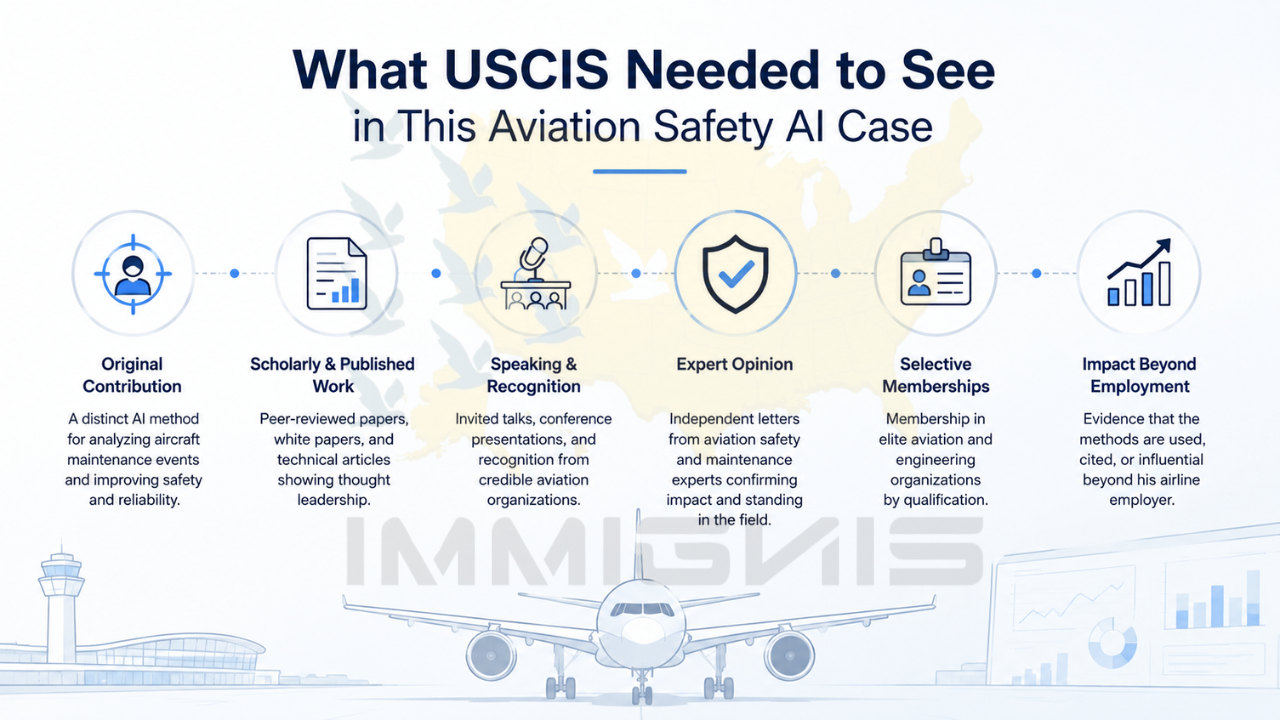
The EB-1A green card is a self-petition immigrant classification for individuals who can demonstrate extraordinary ability through sustained national or international acclaim and recognized achievements in the field. Meeting a few evidence categories is not the whole test. USCIS also reviews whether the full record shows the level of expertise required for EB-1A.
For original contributions, the petition needed to identify the applicant’s own technical methods and explain why they mattered in aviation maintenance and safety analytics. Internal project importance alone could not carry the argument.
For scholarly articles, the record needed focused authorship on predictive maintenance, event classification, aircraft maintenance analytics, safety data interpretation, or related topics. General technology writing would not have been enough.
Published material required qualifying coverage about him, his expertise, or his work. A company announcement about a digital program would have been weak if it did not identify his individual role or professional standing.
Judging required actual evaluation of other professionals’ work, such as conference submissions, aviation innovation entries, technical papers, or safety-technology work. Speaking at an event did not become judging unless he evaluated others.
Membership evidence had to show selective admission or elevation based on achievement, not ordinary dues-based participation. Leading or critical role evidence had to show that significant airline safety or maintenance analytics work relied on his technical judgment.
The confidential airline record was rebuilt around non-confidential decisions
The strongest evidence could not be copied directly into a public-facing petition. Aircraft identifiers, operational details, maintenance records, vendor systems, internal thresholds, route information, and safety-review materials had to remain protected.
The solution was not to weaken the story. It was to describe the professional method at the right level.
Project evidence was organized around decisions rather than proprietary systems. What maintenance event was being classified? Which signal suggested a pattern rather than an isolated occurrence? What data could responsibly support escalation? Which alerts needed engineering review? How were false positives controlled? What happened when a model pointed to a risk that the operational team still had to interpret?
That structure allowed the petition to show a real contribution while staying away from protected information. The evidence described event categories, review logic, validation approaches, safety-use boundaries, and the role of engineering judgment. It did not publish confidential aircraft records or claim that an algorithm made final safety decisions.
The papers gave his aviation safety work a public language
The publication strategy did not ask him to become a general AI commentator. It focused on the narrow questions that matched his actual work: predictive maintenance, classification of maintenance events, uncertainty in alerting systems, model validation, false-call management, and the handoff between analytics and engineering review.
One paper examined why maintenance-event prediction should not be judged only by whether a model produces an alert. In aviation, the useful question is often what happens after the alert: who reviews it, what context is checked, which prior events matter, and what action is appropriate under maintenance and safety procedures.
Another paper addressed rare-event behavior. Aviation maintenance datasets may include many ordinary observations and comparatively few examples of the failure patterns teams most want to catch. A model that performs well on common events may still require careful validation before it can support safety-relevant decisions.
These papers helped turn internal analytics experience into public technical authorship. More importantly, they made the subject understandable to aviation safety experts who could evaluate the contribution without seeing the employer’s internal systems.
Predictive-maintenance metrics were handled carefully
Metrics can help an EB-1A petition, but they can also create risk when they are overstated.
In this case, the record used predictive-maintenance case metrics only where the evidence supported them. The petition did not claim that one AI model prevented every maintenance event, eliminated safety risk, or produced every improvement in aircraft availability. Airline operations involve many teams, procedures, suppliers, inspections, and regulatory requirements.
Instead, the evidence traced the applicant’s role in the method: identifying relevant data, shaping event categories, improving review logic, reducing unnecessary alert burden where records supported it, or helping teams prioritize maintenance information for technical assessment. Where several process changes occurred together, the petition did not assign the full result to one person or one model.
That discipline strengthened the case. Independent experts could see that the record was not trying to turn correlation into causation. It was explaining how his work contributed to safer, more reliable use of maintenance analytics.
The aviation safety white paper connected the method to the field
The white paper was written for aviation safety, maintenance, and airline technology audiences. It discussed how AI analytics can support maintenance-event review when the system is designed around engineering use rather than technology hype.
Its central point was practical: predictive maintenance is useful only when the organization understands the signal, the uncertainty, the review process, and the boundary between a model recommendation and a safety decision.
The paper addressed data quality, event taxonomy, maintenance histories, rare events, alert fatigue, validation, and the need to keep qualified human review attached to safety-relevant decisions. It also explained why AI tools should be evaluated against the operational question they are supposed to support, not merely against a model-performance score.
For the EB-1A record, the white paper helped show a safety analytics specialist speaking to the field, not just an employee describing a product.
Media commentary moved the discussion beyond aviation buzzwords
The media evidence worked because it did not present him as a generic AI expert. His commentary focused on aircraft maintenance events, predictive signals, fraud-free safety reporting, model limits, and the importance of engineering review.
He explained that aviation safety analytics should not be reduced to a promise that AI will predict every problem. A useful system may help teams notice patterns earlier, reduce repeated manual sorting, or bring the right events to engineering attention. It still must fit maintenance procedures and the safety culture of the organization using it.
That type of public explanation supported published-material evidence and also reinforced the petition’s broader theme. The applicant was not simply associated with a confidential airline AI project. He was becoming a professional voice on how maintenance analytics should be used responsibly.
Invited talks and judging showed recognition beyond the employer
The invited talks gave aviation and technology audiences a chance to evaluate the method. The presentations used non-confidential scenarios involving recurring maintenance alerts, unusual component behavior, rare-event detection, and the problem of deciding when a maintenance pattern should move from monitoring to closer engineering review.
The most useful questions from audiences were not about whether AI sounded impressive. They were about validation, false positives, safety boundaries, and accountability. Those questions helped show that the talks were tied to a real professional debate in aviation technology.
Judging evidence was documented separately. The record included conference judging and evaluation activity where he reviewed the work of other professionals in aviation technology, safety analytics, maintenance innovation, or related fields. That distinction matters because USCIS does not treat attendance, presenting, or ordinary panel participation as judging unless the person actually evaluates others’ work.
Peer review also supported the judging criterion where records showed genuine review assignments. The petition documented the venue, subject area, and completed evaluation activity where available.
Selective membership evidence was not treated as a shortcut
Professional memberships can be useful in EB-1A cases, but only when the admission or elevation standard matters. Open enrollment does not show that a person has been selected because of recognized achievement.
The petition therefore examined the actual membership rules. Where the record relied on selective membership or elevation, it documented eligibility standards, achievement requirements, review procedures, and the basis for selection. Ordinary association participation was not presented as more than it was.
This approach kept the case accurate. It also helped prevent the membership evidence from distracting from the stronger record: original aviation analytics methods, public technical authorship, judging activity, independent letters, and the applicant’s role in significant safety-related work.
Independent letters explained significance without revealing protected data
Independent aviation safety and maintenance experts played a central role. Their letters did not simply praise him as talented. They explained why AI analytics for maintenance events is technically difficult, why false alarms and missed patterns both matter, and why a method that connects prediction to engineering review can have significance beyond one airline.
The best letters also addressed attribution. They identified what part of the method was linked to the applicant and why his work was not merely routine software implementation. They connected his papers, white paper, public commentary, and documented airline role into one coherent professional record.
That mattered at final merits. USCIS needed to see a specialist whose achievements pointed in the same direction. The letters helped explain the significance of the evidence, but they did not replace the evidence itself.
How the EB-1A evidence worked together
The petition was strongest because the evidence did not sit in isolated categories. Each part supported the same field niche.
The scholarly articles showed that he could explain predictive maintenance and safety analytics as technical subjects. The original-contribution evidence connected his methods to maintenance-event classification and engineering review. Published material showed public recognition of his expertise. Judging and peer review showed that other professionals trusted his technical assessment. Selective membership evidence supported recognition in the professional community. Leading or critical role evidence showed that significant airline safety analytics work depended on his judgment.
No single piece had to do all the work. The approval came from a record that made his specialty clear and then supported that specialty from several independent directions.
Why this case matters for aviation AI professionals
This case is useful for aviation engineers, data scientists, maintenance specialists, safety analysts, and airline technology leaders because it shows how easily strong work can be under-documented.
Aviation professionals often assume that the seriousness of their employer’s industry will be obvious. It is not enough. EB-1A petitions must show the applicant’s individual contribution, the significance of that contribution, and recognition that reaches beyond ordinary employment.
The lesson is not to expose confidential safety data or exaggerate outcomes. The lesson is to build a safe, accurate, public record around the method: what problem the professional solved, how the method worked, where the evidence shows use, how the field evaluated it, and why independent experts consider it significant.
The result
USCIS approved the Form I-140 petition on October 9, 2025.
The case did not turn on a claim that AI alone can make aviation maintenance safe. It succeeded because the petition showed a specialized professional record in AI safety analytics for aircraft maintenance events. The evidence connected internal airline work, public technical authorship, independent recognition, judging activity, selective membership, and expert analysis into a credible EB-1A record.
For the applicant, the approval recognized more than a job title. It recognized that his aviation safety analytics work had been documented as field-level expertise.
Lessons for professionals with confidential safety or infrastructure work
Aviation is not the only field where important work can disappear inside an employer. Similar problems appear in transportation safety, cybersecurity, utilities, healthcare systems, defense technology, financial infrastructure, energy operations, and other environments where the strongest evidence may be confidential.
The key is not to publish what should remain private. The key is to identify the professional method that can be safely explained, supported, and recognized. A strong EB-1A record may use public papers, non-confidential white papers, expert commentary, judging, selective membership, independent letters, and carefully framed adoption evidence to show what the professional contributed.
For aviation AI professionals, the question is not whether the employer is important. The question is whether the record proves individual expertise, sustained acclaim, and a contribution that matters beyond ordinary internal performance.
Frequently asked questions
Can aviation safety or maintenance work support an EB-1A petition?
Yes, aviation safety and maintenance work can support an EB-1A petition when the applicant can show individual achievements, recognized expertise, and evidence that fits the EB-1A criteria. The record should identify the professional’s own contribution rather than relying only on the employer’s reputation.
Can confidential airline work be used without exposing sensitive data?
Yes. The petition can use non-confidential summaries, role records, public technical papers, expert letters, safe metrics, and method descriptions. Protected aircraft data, operational records, safety investigations, customer information, and proprietary systems should not be disclosed.
Is predictive maintenance automatically an original contribution for EB-1A?
No. Predictive maintenance is a field of work. To support original contributions, the petition must show what the applicant personally developed or improved and why that contribution has significance in the field.
Does speaking at aviation conferences count as judging?
Not by itself. Speaking can support recognition, but judging requires actual evaluation of other professionals’ work, such as reviewing papers, scoring submissions, evaluating innovation entries, or serving in a documented assessment role.
Can an airline employee qualify if most recognition came after profile building?
A later-built record can help when it is based on real expertise and genuine professional activity. The evidence must be accurate, verifiable, and connected to the applicant’s actual work. USCIS still reviews the quality of the record as a whole.
Build an EB-1A record around the aviation safety method you can prove
If you work in aviation AI, predictive maintenance, aircraft safety analytics, reliability engineering, maintenance-event review, or safety-critical technology, your strongest work may be locked inside employer systems. That does not mean it cannot be documented. It means the record has to be built carefully.
Immignis and Advance My Profile help professionals identify a defensible authority niche, organize non-confidential evidence, develop public recognition, and prepare an EB-1A record around achievements that can be verified and explained professionally.