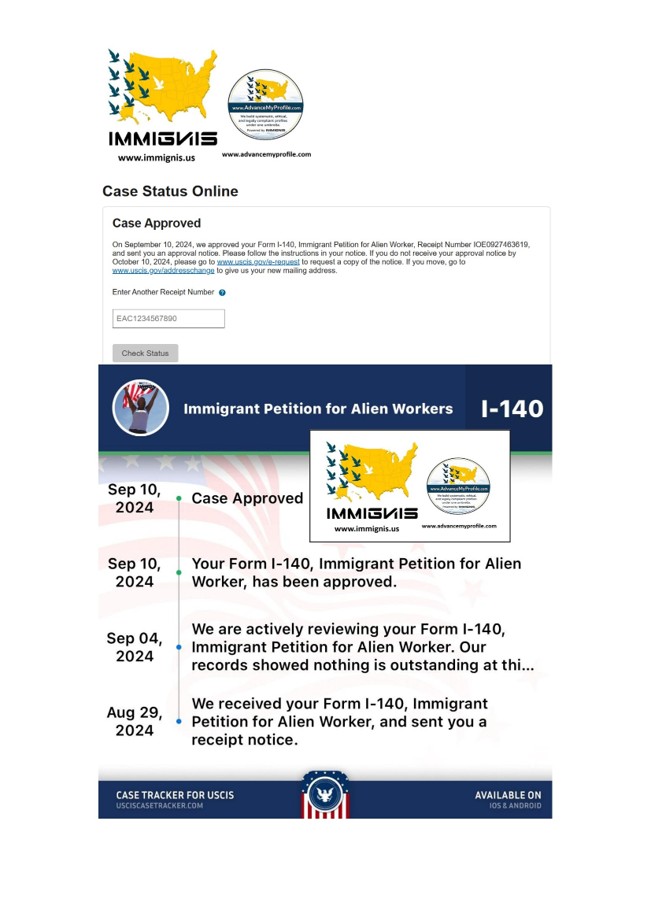
Bioinformatics scientist EB-1A: How a Georgian computational biologist secured approval by documenting authorship of pathogen-genomics pipelines, software and dataset use, first-author publications, completed peer review, international surveillance roles, public-health agency reliance, and independent media attribution.
Key facts at a glance
| Petition outcome | Form I-140 approved under EB-1A on September 10, 2024. |
| Professional profile | Georgian computational biologist building genomic-surveillance pipelines for emerging pathogens and antimicrobial resistance. |
| Field niche | Pathogen genomics and outbreak bioinformatics. |
| Starting weakness | Public-health institutions used the pipelines, but credit was spread across sequencing laboratories, international programs, shared repositories, and long collaborative author lists. |
| Profile-building focus | Pipeline-authorship documentation, software and dataset-use records, first author publications, public-health agency letters, international genomic-surveillance roles, completed peer review, conference participation, and media attribution. |
| Principal EB-1A evidence areas developed | Original contributions of major significance, authorship of scholarly articles, judging the work of others, leading or critical role, and published material about the petitioner and the petitioner’s work. |
| Central issue | Separating one scientist’s architecture, algorithms, validation work, and public-health impact from the collective output of laboratories and multinational surveillance programs. |
| Approval lesson | Collaborative bioinformatics can support EB-1A when the record identifies who designed the analytical system, who relied on it, what decisions it informed, and why the contribution mattered beyond one institution. |
Thousands of sequences passed through the pipeline; the petition had to identify its author
Pathogen-genomics programs produce collective outputs. A sequencing laboratory generates reads. Epidemiologists define the public-health question. Bioinformaticians clean, assemble, compare, and interpret the data. Health agencies decide whether the results justify an investigation or response. When the work succeeds, the public sees an outbreak map, a surveillance report, or a warning about antimicrobial resistance. The analytical system behind that result may remain unnamed.
The petitioner had built and refined computational pipelines used to process pathogen sequences, detect related samples, identify resistance markers, and convert raw genomic data into information that public-health teams could use. Her contribution was technically central, but it did not appear neatly in one patent, one laboratory report, or one short author list.
USCIS approved the Form I-140 petition on September 10, 2024. Immignis and Advance My Profile organized the case around a practical evidentiary problem: how could the record show that the petitioner did more than contribute code to a large surveillance program and instead created an analytical system on which other scientists and institutions relied?
Why outbreak bioinformatics often hides the person who made the analysis possible
The field rewards collaboration because no single laboratory can monitor every organism, geography, or transmission chain. That collaborative structure, however, can make an immigration record difficult to read. Software may be stored in institutional repositories. Pipeline outputs may appear under a public-health program’s name. Papers may include dozens of authors from sequencing, clinical, epidemiological, and policy teams.
The petitioner’s strongest evidence was therefore dispersed across source-code histories, validation files, workflow diagrams, release notes, laboratory adoption records, manuscripts, agency correspondence, peer-review invitations, and conference materials. None of those records alone explained the full contribution.
The petition defined the field precisely as pathogen genomics and outbreak bioinformatics. It did not present the petitioner as a general data scientist or a laboratory researcher. The narrower field made it possible to explain why pipeline architecture, genomic clustering, resistance detection, quality control, reproducibility, and public-health implementation were meaningful indicators of standing in the profession.
Pipeline authorship required more than a software repository
A repository can show that a person wrote code, but code ownership is not the same as field significance. The record had to explain what the pipeline did, which parts the petitioner designed, and why those parts were consequential.
The evidence mapped the pipeline from input to output. It identified the petitioner’s responsibility for workflow design, sequence-quality controls, assembly or mapping steps, variant analysis, phylogenetic or clustering modules, resistance-gene detection, reporting logic, validation, and version management where applicable. Commit histories, technical memoranda, design notes, release records, contribution statements, and letters from direct collaborators supported the attribution.
This approach prevented the case from becoming a list of programming tasks. It showed the scientific decisions embedded in the software: thresholds, reference choices, filtering rules, validation standards, error handling, and the way results were translated into reports that epidemiologists and laboratories could interpret.
Validation records showed that the pipeline produced dependable public-health results

For bioinformatics used in surveillance, an elegant method is not enough. Laboratories need to know whether the workflow is reproducible, whether it handles imperfect samples, whether its outputs agree with accepted methods, and whether changes between software versions alter conclusions.
The petition organized validation evidence around those questions. It used benchmark datasets, comparison studies, quality-control reports, reproducibility tests, error analyses, documented improvements, and laboratory feedback to show that the system had been evaluated rather than merely proposed.
Where exact performance data or internal laboratory records were restricted, cleared summaries identified the test, the petitioner’s role, the result that could be disclosed, and the decision that followed. This allowed USCIS to evaluate the scientific contribution without requiring disclosure of sensitive health, laboratory, or security information.
Software and dataset use turned an internal tool into evidence of broader reliance
One of the most useful questions in the case was simple: who used the work after it was built? The answer came from adoption records rather than general praise.
The petition documented laboratories, surveillance teams, research groups, or public-health programs that installed, adapted, cited, or relied on the pipeline. Usage records, repository activity, technical-support correspondence, training materials, implementation reports, and letters from institutional users helped show that the contribution extended beyond the petitioner’s own workstation or employer.
Dataset evidence was handled with the same care. When the petitioner created curated reference datasets, annotation resources, resistance-marker collections, or reproducible analysis packages, the record identified how those resources were used in later studies or surveillance work. This helped connect technical authorship to independent reliance.
Public-health agency letters explained why the outputs mattered
Letters were strongest when they did not describe the petitioner as simply talented or hardworking. The useful letters explained what decision depended on the analysis.
Agency and laboratory officials described how the pipeline helped identify related isolates, detect unusual resistance patterns, prioritize samples for further investigation, improve reporting speed, standardize analysis across sites, or support an outbreak assessment. They identified the writer’s direct knowledge and separated the petitioner’s work from the broader institution.
These letters did not replace technical records. They interpreted them. Used with validation files, source-code evidence, publications, and usage records, they showed why the contribution had practical significance in a field where the value of an analytical tool is often measured by the decisions it enables.
First-author publications gave the scientist a visible intellectual record
Large surveillance papers can leave readers unsure about who developed the computational method. The publication strategy therefore emphasized accurate first-author, corresponding-author, or clearly documented methods leadership when the record supported those roles.
The strongest papers addressed pipeline design, genomic epidemiology, resistance detection, benchmarking, reproducibility, outbreak analysis, or the implementation of genomic surveillance. Contribution statements and coauthor letters explained the petitioner’s responsibility in collaborative articles rather than relying on author order alone.
This evidence supported the scholarly-articles criterion and reinforced the original-contribution argument. It also created a public record that allowed later researchers, conference organizers, and journalists to connect the analytical system to the scientist who developed it.
Peer review documented completed judging, not an invitation list
The petitioner’s peer-review record showed that journals, conferences, or research programs trusted her to assess work in pathogen genomics, bioinformatics, sequencing, antimicrobial resistance, or related computational methods.
The petition documented completed reviews through editor confirmations, reviewer dashboards, certificates, correspondence, or verified review histories. It identified the subject matter and showed that the work being evaluated belonged to the petitioner’s field.
This distinction mattered. An invitation to review is evidence of interest; a completed review is evidence that the petitioner actually judged the work of others. The completed service supported the judging criterion and also contributed to the final-merits picture of professional trust.
International surveillance roles showed recognition beyond one laboratory
International genomic-surveillance networks often operate through technical groups, data-sharing initiatives, working groups, training programs, or advisory committees. Participation alone did not establish extraordinary ability. The record had to show selection, responsibility, and substantive work.
The petition documented roles in which the petitioner helped shape analytical protocols, harmonize workflows, train laboratories, evaluate methods, advise on data standards, or coordinate cross-border technical work. Appointment records, agendas, deliverables, meeting minutes, training materials, and letters from network leaders established the nature of the service.
These records supported leading or critical role arguments where the organization or program had a distinguished reputation and the petitioner’s work was consequential to its mission. They also showed that her expertise was recognized outside the institution where the pipeline originated.
Media attribution separated published material from authored research
The case kept two forms of publication evidence separate. Articles written by the petitioner were presented under authorship of scholarly articles. Independent material discussing the petitioner and her work was considered for the published-material criterion.
Science and public-health coverage was useful when it named the petitioner, described the analytical method, and appeared in a qualifying professional, major trade, or major media outlet. Institutional announcements were evaluated carefully to determine whether they were genuinely independent and whether they focused on the petitioner rather than merely mentioning a project.
This separation improved the legal clarity of the record. It prevented the petition from counting the same article under incompatible theories and helped the final-merits analysis show that recognition came from several independent sources.
The original contribution argument focused on reliance, not the number of code lines
The petition did not argue that the contribution was major because the pipeline was complicated. Complexity alone does not establish significance. The argument focused on what changed because the system existed.
Evidence of adoption, repeated use, faster analysis, improved consistency, detection of meaningful genomic relationships, resistance-marker identification, laboratory standardization, policy or investigation use, and independent citation helped establish the contribution’s effect. Expert letters placed those results within the field and explained why the methods went beyond routine bioinformatics support.
The case also avoided claiming every public-health outcome as the petitioner’s personal achievement. It attributed the analytical system to her while recognizing that sequencing, epidemiology, clinical interpretation, and agency decisions remained collective responsibilities.
Leading role was proved through technical authority, not title inflation
Computational scientists may lead crucial work without holding an executive title. The petition therefore documented technical authority directly.
Architecture ownership, approval of releases, responsibility for validation, resolution of analytical failures, supervision of contributors, training of user laboratories, authorship of standard operating procedures, and responsibility for final analytical outputs were stronger than a broad claim that the petitioner was a “lead scientist.”
The evidence also described the reputation of the laboratory, surveillance program, or international network in which the role was performed. This connected the petitioner’s responsibility to a distinguished organization or endeavor rather than treating ordinary team leadership as automatically qualifying.
Final merits connected the separate records into one professional history
Meeting several evidentiary criteria did not end the analysis. The petition had to show, through the record as a whole, that the petitioner had sustained recognition and belonged among the small percentage at the top of the defined field.
The final-merits presentation connected the evidence chronologically and substantively. The petitioner designed the analytical system, validated it, supported its adoption, published the methods, reviewed the work of other scientists, served in international surveillance roles, and received independent recognition for the work. Those facts reinforced one another rather than appearing as unrelated activities collected for immigration purposes.
The field definition also mattered at this stage. The question was not whether the petitioner was one of the world’s most famous biologists. It was whether the record placed her at the top of pathogen genomics and outbreak bioinformatics, the area in which her work was actually recognized.
How ethical profile building strengthened the record
The profile-building work did not create a fictional career or add activities unrelated to the petitioner’s expertise. It identified records that already existed, corrected gaps in attribution, and developed public-facing work that accurately reflected completed research and professional service.
That included preserving contribution histories, preparing accurate methods papers, seeking legitimate first-author opportunities, documenting completed peer review, obtaining detailed user and agency letters, presenting verified work at relevant conferences, and creating media opportunities based on real scientific contributions.
The process also respected confidentiality, health-data restrictions, cybersecurity concerns, publication ethics, and institutional ownership. Evidence was cleared, generalized, or redacted where necessary rather than disclosed simply because it might strengthen a petition.
Why this case worked
The case worked because it solved the authorship problem before making broad claims about public-health importance. The petition showed who built the pipeline, what scientific decisions it contained, how it was validated, and who used it.
It then used different evidence for different legal purposes. Scholarly articles established authorship. Completed peer review supported judging. Agency and laboratory records showed reliance. International roles supported recognition and responsibility. Independent media material addressed published material. Adoption and impact evidence supported original contributions and final merits.
Most importantly, the record did not confuse a large collaborative program with individual acclaim. It presented a scientist whose work could be identified inside that collaboration and whose analytical system had become useful to others.
What other pathogen genomics professionals can learn
A collaborative author list is not necessarily a weakness, but it requires explanation. Contribution statements, repository records, method ownership, laboratory letters, and direct evidence of implementation can show what one scientist contributed.
Software use should be documented early. Version histories, release notes, training records, support requests, institutional adoption, citations, forks, downloads, validation files, and downstream publications may become difficult to reconstruct years later.
Professionals should also keep the EB-1A categories distinct. Writing a methods paper is different from being the subject of published material. Reviewing a manuscript is different from speaking at a conference. Ordinary membership is different from admission based on outstanding achievement. Clear classification makes the petition easier to evaluate and more credible.
Frequently asked questions
Can a pathogen bioinformatics scientist qualify for EB-1A?
Yes, when the evidence establishes sustained acclaim and shows that the scientist belongs among the small percentage at the top of the defined field. Employment in public health or participation in an important surveillance program is not enough by itself.
Can software development support the original contributions criterion?
It can when the record identifies the scientist’s contribution and shows that the software had major significance through adoption, reliance, implementation, documented improvements, independent use, citation, or other field-level evidence. Writing code alone does not establish major significance.
How can pipeline authorship be proved in a collaborative laboratory?
Useful records include repository histories, release notes, architecture diagrams, technical memoranda, validation reports, contribution statements, standard operating procedures, meeting records, and letters from people with direct knowledge of the work.
Do software downloads prove major significance?
Downloads may support use, but they should be interpreted carefully. Stronger evidence shows who used the software, what they used it for, whether it influenced research or public-health work, and whether the use was independent of the petitioner.
Can confidential public health records be used in an EB-1A petition?
Often yes, through authorized summaries, redacted records, de-identified examples, performance ranges, agency letters, and other evidence that explains the contribution without disclosing protected health, laboratory, security, or personal information.
Can a long author list still support the scholarly-articles criterion?
Yes. The criterion concerns authorship of qualifying scholarly articles. The petition should document the petitioner’s actual role through contribution statements, author position where meaningful, coauthor letters, methods ownership, or related records.
Does first authorship automatically prove extraordinary ability?
No. First authorship may show responsibility for a publication, but USCIS considers the full record. The article’s quality, subject, influence, the petitioner’s contribution, and other evidence of recognition remain important.
Can manuscript review satisfy the judging criterion?
Yes, when the petitioner completed reviews of the work of others in the same or an allied field. Editor confirmations, reviewer records, certificates, and verified review histories can document the completed service.
Do conference presentations count as a separate EB-1A criterion?
Conference speaking is not a standalone regulatory criterion. It may support original contribution, leading role, published material, or final merits when the selection, event, audience, and subject show professional recognition.
Can international working-group participation satisfy the membership criterion?
Not automatically. The membership criterion generally requires admission based on outstanding achievements judged by recognized experts. A substantive working-group role may instead support leading or critical role, original contribution, or final merits.
What makes a public health agency letter useful?
The strongest letter identifies the writer’s basis of knowledge, the specific analytical problem, the petitioner’s contribution, how the pipeline was used, and the practical or scientific effect. General praise carries less weight than detailed attribution.
What counts as published material about a bioinformatics scientist?
Qualifying material generally discusses the scientist and the scientist’s work in professional, major trade, or major media outlets. Papers written by the scientist belong under the scholarly-articles criterion and should be presented separately.
Can antimicrobial resistance work strengthen an EB-1A case?
It can provide important context and evidence of impact, but the public importance of antimicrobial resistance does not by itself prove extraordinary ability. The petition must document the scientist’s own contribution, significance, recognition, and standing in the field.
How can ethical profile building help a collaborative scientist?
It can preserve attribution, organize software and dataset records, develop accurate publications and presentations, document completed judging and network service, obtain specific user letters, and create a public record based on genuine work without inventing achievements.
Make the scientist visible inside the surveillance system
A strong pathogen-genomics record may already exist across repositories, pipeline releases, validation files, datasets, laboratory implementation records, publications, peer-review histories, agency correspondence, network appointments, conference programs, and media coverage. The weakness may be that those records describe the surveillance program more clearly than the scientist who built its analytical core.
Identify which contributions can be documented now, which institutional records require clearance, and which ethical profile-building activities may strengthen a future petition.