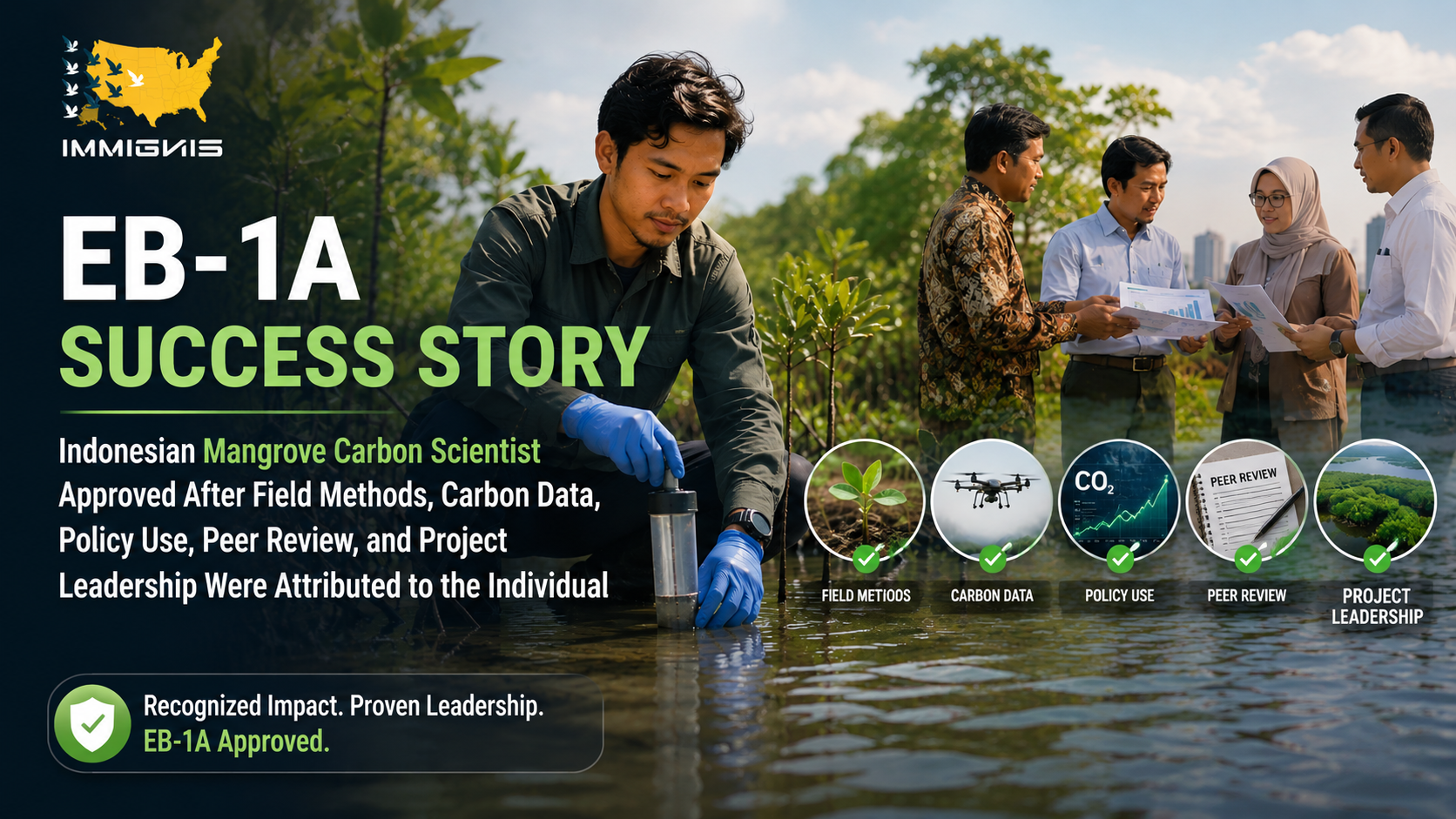
Blue carbon scientist EB-1A approval was secured by an Indonesian coastal scientist who organized a record of mangrove field methods, blue-carbon calculations, restoration verification, scholarly publications, peer review, policy use, media coverage, and project leadership.
Key facts at a glance
| Petition outcome | Form I-140 approved under EB-1A on August 19, 2025. |
| Professional profile | Indonesian coastal scientist quantifying carbon storage, restoration performance, and climate benefits across tropical mangrove systems. |
| Field niche | Blue-carbon measurement and mangrove-restoration verification. |
| Starting weakness | Restoration programs received international attention, but the scientist’s field methods, datasets, calculations, and verification work were absorbed into institutional climate claims. |
| Profile building focus | Method authorship documentation, field-dataset records, blue carbon publications, international coastal network roles, policy-use evidence, completed peer review, media coverage, and project-leadership letters. |
| Principal EB-1A evidence areas developed | Original scientific contributions of major significance, authorship of scholarly articles, leading or critical roles, judging the work of others, and qualifying published material about the scientist and the work. |
| Central issue | Showing that the carbon figures used by projects, institutions, and policy actors resulted from this scientist’s methods and judgment rather than from an unnamed team or a generic restoration program. |
| Approval lesson | Climate work becomes stronger immigration evidence when the record traces a public claim back to the individual method, dataset, calculation, verification decision, independent use, and professional recognition. |
The case was not about planting mangroves. It was about proving what the restoration achieved
Mangrove restoration is easy to describe in photographs. A damaged coastline is replanted, seedlings take root, and the returning vegetation becomes visible. Blue-carbon science asks a harder question: how much carbon is stored, where it is stored, whether the change can be measured reliably, and how much of the claimed benefit can fairly be attributed to the intervention.
The petitioner worked at that less visible stage. The record involved field sampling, carbon calculations, restoration monitoring, dataset management, and verification work across tropical mangrove systems. Institutions could point to restored coastlines and climate claims. The scientist’s role was harder to see because the methods and calculations appeared inside technical reports, project files, shared datasets, and collaborative publications.
USCIS approved the Form I-140 petition on August 19, 2025. The case succeeded after the evidence connected the public-facing restoration claims to the person who designed, applied, interpreted, and defended the underlying measurement work.
Why blue-carbon work can hide the scientist behind the project
A mangrove project may involve coastal communities, government agencies, universities, conservation organizations, funders, field technicians, remote-sensing specialists, and carbon-accounting teams. Public communications usually emphasize the coastline, the community, or the institution. Technical authorship is often reduced to a logo on a report or a long list of contributors.
That structure created the starting weakness. The petitioner’s strongest achievements were not a single laboratory discovery or a stand-alone product. They were methods that shaped how field measurements were taken, how datasets were cleaned and interpreted, how uncertainty was handled, and how restoration outcomes were translated into defensible climate numbers.
The petition therefore did not rely on the size of the environmental problem alone. Mangroves and climate adaptation may be important, but national or global relevance does not prove extraordinary ability. The evidence had to establish the petitioner’s own contribution and the recognition that followed from it.
A precise field definition kept the record focused
The field was defined as blue-carbon measurement and mangrove-restoration verification. That description was narrower than coastal science and more accurate than a general label such as environmental researcher. It brought the petitioner’s field methods, carbon calculations, restoration monitoring, publications, policy use, and professional service into one coherent record.
The field definition also helped explain why the work crossed several technical boundaries. Measuring mangrove carbon can involve vegetation surveys, soil sampling, spatial analysis, statistical treatment, monitoring design, and documentation of change over time. The petition treated these as connected parts of a verification discipline rather than as unrelated projects.
This mattered at final merits as well. The question was not whether the petitioner stood at the top of all climate science. The relevant comparison concerned a much more specific community of professionals who develop and apply methods for measuring and verifying carbon outcomes in mangrove and related coastal systems.
Method authorship was reconstructed from the technical record
The strongest contribution began with a basic attribution question: who designed the method that produced the figures? A project report may state a carbon estimate without naming the person who selected sampling locations, determined measurement intervals, adapted a protocol to local conditions, resolved data-quality problems, or decided how uncertainty should be reported.
The record was organized around those decisions. Where available, it used methodology sections, protocol drafts, dataset notes, field manuals, calculation files, contribution statements, project correspondence, technical presentations, and letters from people who directly observed the work. The aim was not to turn routine participation into authorship. It was to identify the scientific choices that belonged to the petitioner and explain why those choices mattered to the reliability of the result.
This distinction was important because blue-carbon estimates can appear authoritative simply because they are numerical. The petition showed that a defensible number depends on judgment about field design, data treatment, comparability, and the limits of the evidence. That judgment was part of the contribution.
Field datasets became evidence of intellectual ownership rather than background material

The petitioner’s datasets were not presented as collections of measurements with no context. Each dataset was linked to a research question, field design, quality-control process, analytical use, and resulting output. The record also identified whether the data supported a publication, restoration assessment, policy document, technical report, or later work by another group.
Dataset documentation can be especially valuable in collaborative environmental research. It may show that other papers or institutional claims depend on measurements that one scientist assembled and made usable. At the same time, the petition avoided treating data possession as proof of major significance. The stronger evidence came from demonstrated use, reliance, replication, policy application, independent discussion, or continued adoption of the method built around the data.
Where sensitive locations or community information were involved, the evidence could be summarized or redacted. The petition needed enough detail to establish the nature of the work without exposing protected ecological, commercial, governmental, or community information.
Scholarly publications supplied context, but citation counts did not carry the case alone
The publication record showed that the petitioner had contributed to scholarly discussion in blue carbon, mangrove ecology, restoration monitoring, or closely related fields. Authorship was documented through the articles themselves, journal information, contribution records where available, and evidence that the publications were scholarly in nature.
The petition used citations carefully. Citations can help show that other researchers noticed or relied on a paper, but a single number rarely explains the full significance of applied coastal science. Some methods influence practice through project manuals, policy documents, technical guidance, training, datasets, or institutional use before they accumulate large academic citation totals.
The record therefore combined bibliometric evidence with practical evidence. It asked what the publication introduced, who used the method or data, whether the work shaped later analysis, and whether independent experts could explain the contribution with reference to objective records.
Policy use was tied to the underlying scientific work
A policy citation is useful only when it shows more than the popularity of the subject. The case traced policy or program use back to the petitioner’s method, dataset, calculation, or verified finding. This helped distinguish a broad reference to mangrove restoration from actual reliance on the scientist’s work.
The supporting record could include policy documents, technical annexes, implementation guidance, government or organizational correspondence, meeting records, and letters explaining how the work informed a decision. The petition also identified the level of use. A document that merely listed a publication was different from a program that incorporated the method, accepted the resulting figures, or used the dataset to plan or evaluate restoration.
This evidence strengthened the original-contributions analysis because it showed movement beyond the petitioner’s immediate employer or research team. It also helped explain why reliable verification matters: governments, funders, and climate programs cannot make sound claims if the underlying measurements are weak or cannot be reproduced.
Project leadership was shown through decisions, responsibility, and consequence
Environmental projects often use collaborative titles that do not reveal authority. The petition did not rely on a job title alone. It documented the petitioner’s control over field design, technical review, analytical decisions, quality assurance, team coordination, reporting, or acceptance of results.
Letters from project leaders and institutional officials were most useful when they described a specific responsibility and its consequence. General statements that the petitioner was essential were not enough. The stronger letters explained which part of the work depended on the petitioner, what technical problem was addressed, how the decision affected the project, and why another qualified professional could evaluate that role.
The distinguished reputation of the relevant organization, program, laboratory, or project also had to be documented separately. A critical role must be critical to something with an established reputation; the petitioner’s praise cannot substitute for proof about the organization.
Peer review and professional service showed that the field trusted the petitioner’s judgment
Completed peer review supported the judging criterion because the petitioner had been asked to evaluate the work of other researchers in the same or an allied field. Invitations alone were not treated as completed judging. The record used reviewer histories, editorial confirmations, certificates, or other evidence showing that evaluations were actually performed.
International coastal or blue-carbon network roles were analyzed according to what the petitioner did. Open membership would not satisfy the regulatory membership criterion. A substantive role, however, could support leading role, judging, original contribution, or final merits when it involved technical selection, working-group responsibility, review of methods, or contribution to professional guidance.
Invited presentations and media coverage were used in the same careful way. Speaking is not a separate EB-1A criterion, and media attention to mangroves is not automatically published material about the scientist. The evidence was useful when the invitation or article focused on the petitioner’s expertise, methods, findings, or leadership and when the publication met the relevant evidentiary requirements.
Why this case worked
The petition gave the reader a clear chain of evidence. It identified a measurement problem, showed the petitioner’s role in solving it, documented the resulting method or dataset, and then traced the work into publications, project use, policy reliance, peer review, professional roles, and public recognition.
It also respected the difference between importance of the subject and importance of the contribution. Climate change, mangrove loss, and coastal resilience provided context. The case did not ask USCIS to infer extraordinary ability from those issues. It showed how this scientist’s work improved the reliability of the numbers used to describe restoration and climate benefit.
Most importantly, the evidence was cumulative. No single paper, dataset, letter, or media article was asked to carry the petition. Together, the records showed sustained work, independent recognition, technical trust, and influence beyond the petitioner’s immediate assignments.
Practical lessons for environmental and climate scientists
Scientists working in conservation, restoration, carbon accounting, hydrology, ecology, and related fields often have more evidence than they realize, but it may be stored in project archives rather than professional profiles. A useful audit begins with methods, datasets, policy documents, technical decisions, completed reviews, field leadership, independent use, and records showing who relied on the work.
The strongest profile-building activity is not the creation of artificial recognition. It is the ethical documentation and continued development of genuine work. That may include publishing a method, preserving contribution records, completing legitimate peer review, presenting verified results, participating substantively in professional networks, and obtaining letters from people who can explain the work from direct knowledge.
For blue-carbon scientists in particular, the central question is often attribution. A restored coastline may be visible to everyone. The petition must still show whose scientific method made the resulting carbon claim credible.
Frequently asked questions
Can mangrove restoration work support an EB-1A petition?
Yes, when the individual record satisfies the EB-1A standard. The importance of mangroves or climate mitigation does not replace evidence of the person’s sustained acclaim, qualifying criteria, and standing near the top of the defined field.
What can count as an original contribution in blue carbon science?
A contribution may involve a measurement method, field protocol, analytical approach, dataset, verification framework, uncertainty treatment, or other scientific development. Major significance should be supported through independent use, policy reliance, adoption, publications, citations, expert evaluation, or another objective effect in the field.
How can a scientist prove authorship of a field method used by an institution?
Protocol drafts, methodology sections, contribution statements, technical files, project correspondence, field manuals, calculation records, presentations, and detailed letters from people with direct knowledge can connect the method to the scientist.
Do project carbon estimates prove major significance by themselves?
Not necessarily. A carbon estimate may show that work was performed, but the petition should explain the petitioner’s contribution and provide evidence that the method or result had importance beyond an ordinary assignment.
Can policy citation support an EB-1A case?
It can be useful when the policy document relies on the petitioner’s method, dataset, finding, or analysis. A general citation to the subject of mangroves is weaker than documented use of the person’s work in a policy or program decision.
Are scholarly citations required for an applied environmental scientist?
No fixed citation threshold applies to every field. Citations can support influence, but applied use, policy reliance, dataset adoption, technical guidance, peer review, project leadership, and other evidence may also matter.
Can completed manuscript review satisfy the judging criterion?
Yes, when the scientist actually evaluated the work of others in the same or an allied field. Invitations should be supported by evidence that the reviews were completed.
Does participation in an international coastal network satisfy the membership criterion?
Only if the membership itself requires outstanding achievements judged by recognized experts. Open membership usually does not qualify, although a substantive network role may support other criteria or the final-merits analysis.
Can media coverage of a restoration project count as published material?
Published material generally must be about the petitioner and the petitioner’s work, and it must meet the applicable publication requirements. Coverage focused only on the institution or project may not be enough without meaningful discussion of the scientist.
How can confidential or sensitive field records be used?
Authorized summaries, redacted reports, de-identified datasets, cleared technical descriptions, and letters from responsible officials may document the work without disclosing protected locations, community information, proprietary data, or other restricted material.
What makes a project role leading or critical?
The record should show responsibility for important decisions or functions and explain why those responsibilities mattered to a distinguished organization, program, laboratory, or project. A title alone is not sufficient.
What should an expert letter explain?
A useful letter identifies the writer’s expertise and basis of knowledge, describes the petitioner’s contribution with specificity, explains its significance, and refers to objective evidence rather than relying on broad praise.
Make the climate claim traceable to the scientist
A strong blue-carbon profile may already exist across field protocols, datasets, publications, policy documents, project files, peer-review records, technical presentations, network roles, media coverage, and letters from collaborators or institutions. The weakness may be that every document names the project more clearly than it names the scientist.
Identify which achievements can be documented now, which records require permission or redaction, and which ethical professional development activities may strengthen a future petition.