A Botswanan HIV-prevention scientist secured EB-1A approval after contribution mapping, first author research, guideline committee work, international HIV-society roles, conference faculty records, judging activity, and immigration specific profile building separated one scientist’s record from the noise of multinational consortium science.
Key facts at a glance
| Professional profile | Botswanan HIV-prevention scientist who played a central role in major prevention and treatment as prevention research conducted through multinational study groups. |
| Field niche | HIV prevention science in high prevalence settings. |
| Starting weakness | The strongest studies carried very long author lists, making the science highly visible while leaving the petitioner’s own responsibility difficult to distinguish. |
| Profile-building focus | Consortium contribution-attribution, first author positioning, study role documentation, international HIV-society responsibilities, guideline committee records, conference faculty work, judging activity, expert letters, and a coherent public research identity. |
| Principal EB-1A evidence areas developed | Authorship of scholarly articles, original contributions, judging the work of others, membership based on professional distinction, and leading or critical roles. |
| Central issue | Showing that participation in large collaborative trials was not interchangeable team membership, but attributable scientific work on which study quality, interpretation, or implementation depended. |
| Approval lesson | A long consortium author list does not have to erase individual achievement. The case becomes stronger when the record reconstructs what the scientist personally designed, directed, analyzed, reviewed, authored, or translated into guidance. |
The approval
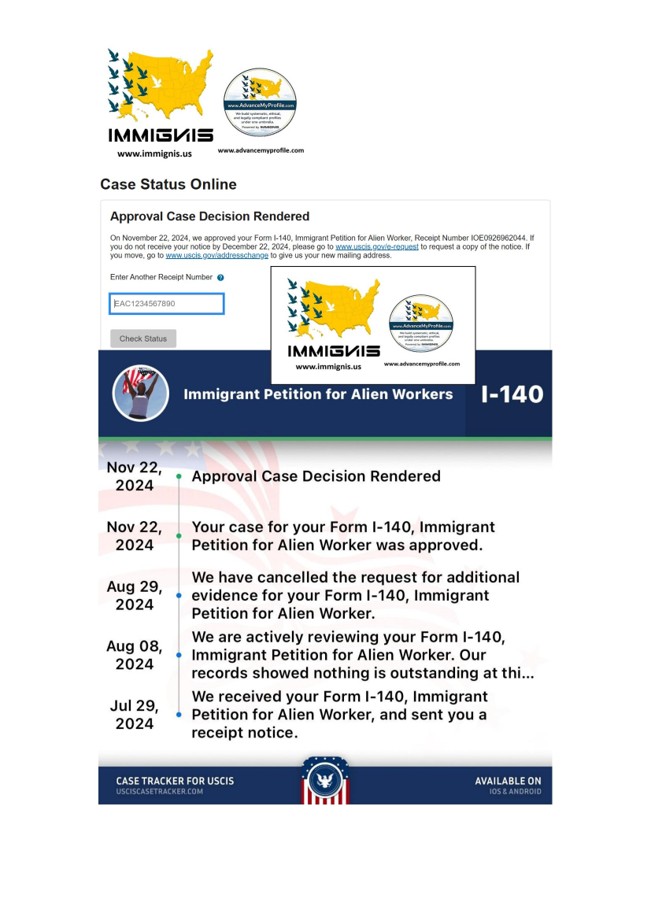
A paper with a hundred authors can be one of the strongest publications in medical research and one of the hardest documents to use in an individual immigration case. On November 22, 2024, USCIS approved the Form I-140 petition of a Botswanan scientist working in HIV prevention and treatment as prevention research.
The public case status history supplied for this story also records that USCIS cancelled a request for additional evidence on August 29, 2024. It does not disclose what the request concerned. For that reason, the story reports the status accurately but does not describe it as a substantive challenge to any particular criterion.
The central problem was authorship without visibility. The petitioner had contributed to important multinational studies, but the published record often presented the science as the work of a consortium. Immignis and Advance My Profile therefore built the case around attribution: identifying the petitioner’s actual scientific responsibilities and connecting them to study documents, publications, committees, professional roles, and independent validation.
A hundred names can hide one indispensable scientist
Large HIV studies depend on collaboration. Clinical sites, laboratories, statisticians, community teams, data centers, ethics bodies, investigators, sponsors, and guideline experts may all contribute to a single research program. The resulting paper can legitimately carry dozens or even hundreds of names.
That structure is good science, but it creates a difficult EB-1A question. USCIS does not evaluate whether the consortium was distinguished. It evaluates the petitioner. A prestigious study title and a place in the author list do not, by themselves, show what one scientist did or why the role rose above ordinary participation.
The petition did not try to shrink collaborative research into a solo achievement. It did the opposite. It respected the team and then located the petitioner inside it with enough precision that the officer could see which parts of the research depended on his judgment, continuity, or technical responsibility.
The field was defined around prevention in high-prevalence settings
The case described the professional niche as HIV prevention science in high-prevalence settings. That definition mattered because prevention research is not limited to testing whether a product or intervention works under ideal conditions. It also asks whether people can access it, use it consistently, remain in care, achieve viral suppression, and benefit within real health systems and communities.
Treatment as prevention forms part of this landscape. Effective antiretroviral treatment that achieves and maintains viral suppression prevents sexual transmission of HIV. Research in this area has influenced clinical care, prevention strategy, public communication, and the design of programs serving people living with HIV and their partners.
The petition used this context carefully. It did not claim that the broad importance of HIV prevention automatically made every researcher extraordinary. It explained why the petitioner’s particular study responsibilities and professional recognition mattered within a field where methodological quality can directly affect guidance and public health practice.
Contribution mapping turned consortium science into personal evidence
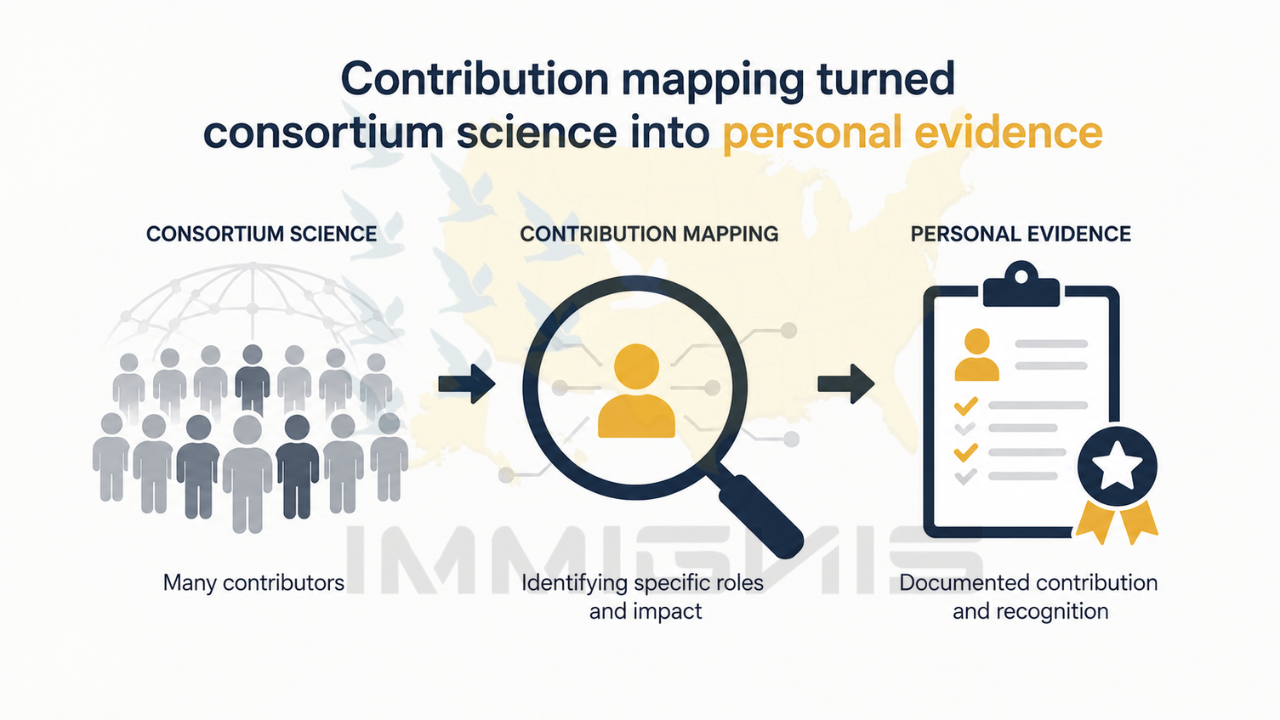
The most important profile-building exercise was a contribution map. Each major study, publication, committee, and technical output was reviewed against a practical question: what did the petitioner personally do?
Possible answers in consortium science include protocol development, site leadership, participant recruitment and retention systems, clinical or laboratory oversight, data quality responsibility, endpoint interpretation, statistical input, community engagement, implementation design, safety review, manuscript drafting, or coordination across institutions. The petition relied on the functions supported by the case record rather than treating every possible role as interchangeable.
Study protocols, authorship contribution statements, consortium task records, committee materials, correspondence, institutional documents, and detailed letters from investigators helped connect the petitioner to identifiable work. The strongest evidence described the decision made, the responsibility held, the problem solved, and the consequence for the study.
This transformed a vague claim of participation into a record of scientific dependence. The point was not that the petitioner appeared on an important paper. The point was that important work within the study had been entrusted to him.
Authorship order was not treated as a universal ranking system
Publication evidence needed field specific explanation. In some disciplines, the first and last author positions carry familiar meanings. In large clinical and public health collaborations, however, group authorship rules, alphabetical ordering, site representation, writing committees, and consortium conventions may affect where a person appears.
The petition therefore avoided a simplistic argument based only on name position. It examined authorship policies, contribution statements, writing group records, acknowledgments, and the petitioner’s work on the underlying study. A middle-author position could still be significant when the evidence showed responsibility for a major scientific or operational component.
At the same time, the strategy did not pretend that every consortium publication carried equal value. Publications were prioritized where the petitioner’s role was clearest, the study was most relevant to the defined niche, and independent evidence could explain why his contribution mattered.
First-author work gave the record a voice of its own
A first-author strategy added a different kind of evidence. Consortium papers showed participation in large research programs, but first-author or clearly led work allowed the petitioner’s own scientific questions, analysis, and interpretation to be seen without a hundred name filter.
The publication plan focused on topics tied to the petitioner’s genuine expertise and available data. Depending on the underlying record, that could include prevention implementation, retention, adherence, viral suppression, community delivery, trial operations, subgroup analysis, or lessons from high-prevalence settings. The purpose was not to manufacture a new identity. It was to make an existing one legible.
This strengthened the scholarly authorship criterion and helped the final merits analysis. The record now showed both forms of scientific standing: trusted participation in major collaborative research and the capacity to lead a focused body of work under the petitioner’s own authorship.
Original contribution required more than a landmark study name
The petition did not argue that association with a landmark study automatically established an original contribution of major significance. It asked a harder question: what part of the science, study operation, data, or interpretation could be attributed to the petitioner, and how did others rely on it?
Evidence of significance could include adoption of a study method, use of a dataset or analytic approach, replication across sites, incorporation into later research, reliance by guideline or program bodies, or expert explanation that a specific contribution solved a recognized problem. The record was strongest when independent professionals described concrete reliance rather than offering general praise.
This distinction protected the credibility of the case. The petitioner did not borrow the entire reputation of a multinational trial. The petition identified the contribution inside that trial that belonged to him and then documented why it mattered beyond one job assignment.
Guideline committee work showed translation from evidence to practice
Guideline committees occupy an important position in HIV science. Members must evaluate study design, strength of evidence, benefits, risks, feasibility, population needs, and the limits of available data before research can be translated into recommendations.
The profile-building strategy documented the petitioner’s actual committee responsibilities rather than citing a committee name alone. Appointment records, terms of reference, meeting materials, evidence-review assignments, drafting responsibilities, and contribution to recommendations could show that the petitioner was trusted to help interpret the work of the field.
Where the role involved evaluating studies or recommendations produced by other professionals, it could also support the judging criterion. It reinforced the broader narrative that the petitioner was not merely generating data. Other institutions relied on his judgment about what the data meant and how it should be used.
International HIV-society roles needed substance, not logo value
International HIV-society activity helped place the petitioner beyond one institution or country. The evidence was strongest where the role involved selection, election, committee responsibility, scientific-program work, abstract review, technical leadership, or another function linked to professional expertise.
Ordinary paid membership was not presented as sufficient for the EB-1A membership criterion. The petition examined admission standards, nomination requirements, selection procedures, and the responsibilities attached to any advanced grade or appointed role.
This was especially important in a field filled with large organizations and major conferences. A respected logo can provide context, but it cannot substitute for evidence that the petitioner was chosen to perform meaningful work.
Conference faculty records created a visible professional trail
Conference faculty service supplied a public record outside the consortium publication system. Invited talks, panel roles, session leadership, workshops, scientific-program duties, and abstract-review assignments showed how professional bodies used the petitioner’s expertise.
The petition documented more than attendance. Programs, invitations, speaker biographies, review confirmations, session descriptions, and organizer letters helped establish what the petitioner contributed and why he was selected.
This evidence also made the case easier for a non-specialist officer to understand. A technical publication may require extensive interpretation. A record showing that an international HIV meeting repeatedly asked the petitioner to teach, evaluate, or lead can provide a more direct signal of peer trust when the underlying selection is properly documented.
Judging evidence came from completed evaluation work
Judging appeared through activities native to health research: journal peer review, abstract assessment, protocol review, grant evaluation, ethics review, guideline appraisal, thesis examination, or scientific-committee work. Invitations alone were not enough. The record documented completed evaluations wherever possible.
The case also separated routine internal supervision from genuine assessment of other professionals’ work. Strong judging evidence identified the material reviewed, the standards applied, the petitioner’s selection, and the independent professional context in which the evaluation occurred.
This criterion fitted the case naturally. Prevention science advances through repeated scrutiny of methods, safety, data, and interpretation. The petitioner had moved from contributing to studies to being trusted with the quality of work produced by others.
Leading role evidence focused on responsibility, not title
A title such as investigator, coordinator, scientist, or committee member can mean very different things across research programs. The leading-role argument therefore centered on function and consequence.
The petition examined whether the petitioner directed a study component, held responsibility for a site or network, controlled a critical process, solved a recurring operational or scientific problem, or served in a role whose failure would have affected data quality, safety, implementation, or interpretation. Institutional reputation and program importance were documented separately from the petitioner’s own duties.
This approach helped distinguish a critical scientist from a large supporting workforce without diminishing the contribution of the team. The case showed why this particular role mattered to the success and credibility of the research enterprise.
How Immignis and Advance My Profile changed the record
Before profile building, the petitioner’s strongest achievements were visible mainly at consortium level. Major trials, long author lists, international meetings, and guideline work showed an impressive environment, but they did not automatically reveal the individual scientist inside it.
Immignis and Advance My Profile rebuilt the record around attribution. Publications were paired with contribution evidence. Consortium work was organized by responsibility rather than prestige. First-author research created a clearer individual voice. Society, guideline, conference, and judging records showed peer trust outside the petitioner’s employer and study group.
The resulting case did not claim that one scientist produced multinational research alone. It showed something more credible: within collaborative science, the petitioner repeatedly received responsibilities that required uncommon expertise and produced work other researchers, committees, and programs depended on.
Why the case held together
Every major evidence category answered a different weakness. Contribution mapping identified the petitioner inside long author lists. First-author work showed independent scientific direction. Original-contribution evidence documented reliance. Guideline and judging roles showed professional trust. Society and conference records demonstrated recognition beyond the home institution. Leading-role evidence connected responsibility to research quality and implementation.
The approval hook was extracting one scientist’s signal from hundred-author noise. Once the authorship record was read together with study responsibilities, committee work, peer evaluation, and external recognition, the petitioner no longer looked like an interchangeable name in a consortium. He looked like a scientist whose work repeatedly carried consequence.
What consortium researchers can learn from this case
Large-team science requires an evidence habit. Researchers should preserve contribution statements, protocol roles, committee assignments, writing-group records, site responsibilities, completed reviews, presentations, and independent correspondence that identifies their work. Waiting until petition preparation can make accurate attribution much harder.
Applicants should also resist two extremes. A person should not claim the entire success of a major trial, but should not disappear behind the consortium either. The strongest record is specific about both collaboration and personal responsibility.
Finally, publication count is only the beginning. In a field where papers can have a hundred authors, USCIS needs to understand which scientific decisions, methods, analyses, operational systems, or interpretive tasks belonged to the applicant and why those contributions mattered.
Conclusion
The Botswanan HIV-prevention scientist’s EB-1A approval was built around a problem common to modern medicine: the most important research is often produced by teams too large for an ordinary author list to explain individual distinction.
The petition solved that problem without rewriting the history of the studies. It traced the petitioner’s work through consortium records, first-author research, guideline responsibilities, judging, professional-society service, conference faculty roles, and independent expert analysis. The team remained visible, and so did the scientist.
The client’s name and identifying details are omitted to protect privacy. The professional field, approval date, and evidence strategy reflect the underlying case information provided for this success story.
Frequently asked questions
Can an HIV-prevention scientist qualify for EB-1A?
Yes. A scientist working in HIV prevention can qualify when the submitted evidence addresses the regulatory criteria and the record as a whole demonstrates the required level of sustained professional recognition. The case must focus on the individual, not only the importance of HIV research.
Do papers with very long author lists count for EB-1A?
They can. The petition should explain authorship conventions and document the applicant’s actual contribution through contribution statements, study records, writing-group materials, investigator letters, or other reliable evidence. A name in the list is a starting point, not the complete argument.
Does a middle-author position mean the contribution was minor?
Not necessarily. In consortium science, author order may reflect group rules, writing committees, site representation, alphabetical arrangements, or other conventions. USCIS should be given field-specific evidence showing what the applicant did.
Can treatment-as-prevention research support an original-contributions claim?
Potentially. The petition must identify the applicant’s own method, data, analysis, implementation system, scientific finding, or other contribution and document its significance through adoption, reliance, later research, guidelines, or independent expert evidence.
Can guideline-committee service count as judging?
It may, when the applicant actually evaluates studies, evidence, recommendations, or the work of other professionals. Appointment records, terms of reference, completed assignments, and contribution to evidence appraisal are more persuasive than a committee title alone.
Does membership in an international HIV society satisfy EB-1A?
Ordinary membership generally does not establish the regulatory criterion by itself. Selective fellowship, elected status, or an achievement-based appointment may be more relevant when the admission standards and peer-selection process are documented.
What is the best evidence of a leading role in a multinational trial?
Useful evidence may include protocols, organizational charts, task assignments, site or workstream responsibility, study documents, performance records, and detailed letters explaining why the applicant’s function was important to research quality, safety, data, or implementation.
Why develop first-author work when consortium publications are already strong?
First-author or clearly led research can make the applicant’s own questions, analysis, and conclusions easier to identify. It complements major collaborative papers rather than replacing them.
Can conference faculty work strengthen an EB-1A case?
Yes, depending on the evidence. Invited speaking, session leadership, scientific-program work, abstract review, and technical workshops can show peer recognition when the selection basis and completed activity are documented.
How should an applicant describe a cancelled USCIS evidence request?
Only from the available record. A status entry showing that a request was cancelled should not be described as a substantive RFE on a specific issue unless the notice or case file establishes what occurred.
Make your contribution visible inside collaborative science
Researchers in HIV, clinical medicine, epidemiology, public health, global health, and other consortium driven fields may already have strong EB-1A evidence scattered across protocols, authorship statements, study committees, guideline work, conference programs, peer review, and institutional records.