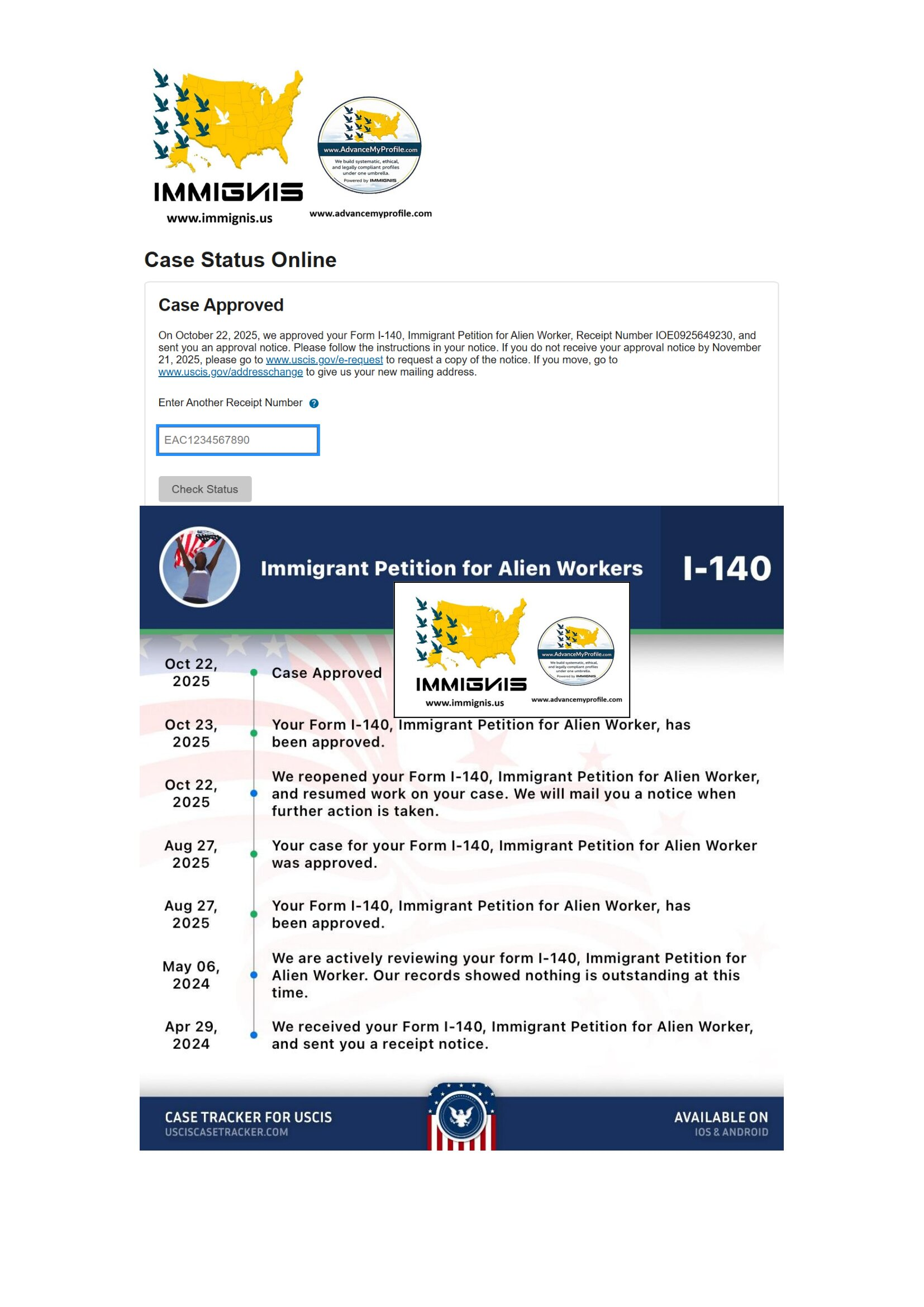
How a Brazilian synthetic biology scientist secured EB-1A approval by connecting microbial strain development, patent inventorship, pilot use, first author publications, peer review, biotechnology network roles, science-media coverage, and immigration specific profile building into a documented record of extraordinary ability.
Key facts at a glance
| Petition outcome | Form I-140 approved under EB-1A on October 22, 2025. |
| Professional profile | Brazilian synthetic-biology scientist engineering microbial systems that convert agricultural residues and processing byproducts into higher-value chemicals and biomaterials. |
| Field niche | Synthetic biology for agricultural waste bioconversion. |
| Starting weakness | The research crossed biology, agriculture, fermentation, and industrial chemistry, leaving personal credit scattered across laboratories, patents, pilot programs, multidisciplinary papers, and collaborative development records. |
| Profile-building focus | Strain-development attribution, patent and inventorship documentation, first author publication strategy, pilot adoption records, peer-review evidence, biotechnology network roles, project leadership records, science-media coverage, and expert validation. |
| Principal EB-1A evidence areas developed | Original contributions, authorship of scholarly articles, judging the work of others, published material about the petitioner, and a leading or critical role for distinguished organizations or projects. |
| Central issue | Showing that the petitioner did not merely participate in a multidisciplinary waste conversion program, but personally shaped microbial strains, pathways, or methods on which later research and pilot work depended. |
| Approval lesson | Synthetic biology cases become stronger when patents, papers, pilot records, peer review, leadership evidence, and independent validation all identify the scientist behind the biological system rather than only the institution or consortium. |
The feedstock looked like waste. The scientific record looked like fragments.
Agricultural residues are easy to describe after the science has worked. A material once treated as a disposal problem becomes a source of chemicals, polymers, enzymes, or other useful products. The public story can sound simple: microbes convert waste into value.
The scientific work is not simple. A useful bioconversion system may require feedstock characterization, pretreatment, enzyme selection, strain engineering, pathway balancing, tolerance improvement, fermentation control, product recovery, analytical validation, and repeated testing under conditions that differ sharply from a clean laboratory medium.
The petitioner contributed inside that collaborative system. Yet the professional record did not initially show one clear scientific identity. Papers had several disciplines and many authors. Patent rights were held by organizations. Pilot activities carried project names. Laboratory records showed technical progress but were not written for an immigration officer. The work was real, but personal attribution had to be reconstructed carefully.
USCIS approved the Form I-140 petition on October 22, 2025. Immignis and Advance My Profile organized the case around a direct question: which scientific decisions, engineered biological elements, and validated methods could be traced to this petitioner, and what evidence showed that others relied on them?
Why agricultural waste bioconversion is a demanding synthetic biology field
Synthetic biology applies engineering approaches to biological systems. In agricultural waste bioconversion, that usually means designing or improving cells, enzymes, pathways, regulatory elements, or microbial communities so that difficult feedstocks can be converted into useful outputs with greater consistency or efficiency.
Agricultural residues are not uniform raw materials. Their chemical composition can change by crop, region, season, storage, moisture, harvesting practice, and processing history. Pretreatment may release sugars while also producing compounds that inhibit microbial growth. A strain that performs well in a defined laboratory medium may behave differently when exposed to a real hydrolysate or mixed byproduct stream.
The engineering problem therefore extends beyond inserting a gene. Scientists may need to modify transport, metabolism, cofactor use, stress response, product tolerance, enzyme expression, redox balance, or regulatory control. They must also test whether the biological design remains stable and useful outside the narrow experiment in which it was first created.
The petition translated those scientific facts into plain immigration language. It explained that a strain, pathway, or method can be original without yet being a mass market product. It also explained that originality alone is not enough for the EB-1A original-contributions criterion. The record must show why the contribution was of major significance in the field.
The field was defined as synthetic biology for agricultural waste bioconversion
A broad description such as biotechnology scientist would have hidden the petitioner inside a very large field. A narrow description limited to one organism, one feedstock, or one laboratory project could have made later evidence look unrelated. The petition used a field definition that matched the recurring technical work: synthetic biology for agricultural waste bioconversion.
This niche connected the petitioner’s microbial engineering, pathway development, fermentation research, patent activity, pilot records, publications, peer review, and professional roles. It also allowed the evidence to be compared with the right community: scientists and engineers working on biological conversion of residues, biomass, byproducts, and other complex feedstocks.
A precise field definition helped prevent two common errors. The case did not claim that the petitioner was extraordinary across all biotechnology. It also did not reduce the scientist to one employer project. The evidence was evaluated within the technical area where the petitioner had built a sustained record.
Strain development attribution identified what the scientist actually created
The strongest part of the case began with contribution mapping. Laboratory notebooks, invention disclosures, experimental plans, sequence or construct records, strain histories, internal reports, data packages, and letters from collaborators were reviewed to determine what the petitioner personally designed, developed, tested, interpreted, or materially improved.
This was important because strain development is often cumulative. One researcher may create a parent strain, another may alter a pathway, another may improve tolerance, and another may establish a process condition that makes the organism useful. A later result can depend on all of those steps. The petition did not collapse team science into a claim of sole ownership.
Instead, it separated distinct contributions. The record could identify responsibility for a genetic design, a screening strategy, a pathway modification, a tolerance method, an analytical framework, or a decision that moved the work from one development stage to the next. Contemporaneous records were used where available so that attribution did not depend only on retrospective praise.
That approach made the original contributions argument more credible. USCIS could see the scientific problem, the petitioner’s identifiable work, the evidence of originality, and the later reliance on the resulting strain, method, or dataset.
Major significance was shown through reliance, not through technical novelty alone
A new strain or method may be scientifically interesting without being a contribution of major significance. The petition therefore looked beyond the fact that an experiment was novel. It examined what happened after the petitioner’s work was created.
Relevant evidence included use in later experiments, incorporation into a pilot workflow, transfer to another laboratory or development team, reliance by collaborators, support for a patent family, continuation in funded work, adaptation to additional feedstocks, citation or discussion in technical literature, and independent expert explanation of why the contribution mattered.
Pilot adoption records were especially useful because they connected biological design to practical testing. A pilot does not automatically prove commercial success, and the petition did not describe it that way. It showed that qualified teams considered the petitioner’s work sufficiently promising and technically credible to carry forward beyond the original bench experiment.
Letters were used to explain reliance, but they did not stand alone. The strongest statements matched dated technical records, invention documents, publications, project decisions, or pilot materials. This created an evidence chain rather than a collection of adjectives.
Patent records clarified inventorship, ownership, and scientific contribution
Patent evidence can be helpful in synthetic-biology cases because it can identify inventors and describe a protected technical concept. It can also show that an organization considered the work valuable enough to pursue intellectual property protection. But a patent is not a substitute for the full EB-1A analysis.
The petition distinguished inventorship from ownership. An employer, university, sponsor, or other entity may own the patent rights while the scientist remains a named inventor. It also distinguished a filed application from a granted patent and avoided implying that every claim had been commercially adopted.
For each relevant invention, the evidence explained the petitioner’s role, the biological problem addressed, the relationship to the defined field, and the later use or technical reliance that supported major significance. Where patent language was broad or difficult to understand, non-confidential technical summaries made the contribution readable without disclosing unpublished sequences, constructs, or process details.
This kept the patent evidence in its proper place. It supported originality and attribution, while pilot use, research reliance, follow-on development, and expert validation addressed significance.
First author publications made the scientific identity easier to see
The petitioner already appeared in multidisciplinary work, but long author lists did not always show who drove the central biological question. A publication strategy was used to make the research identity more visible through work in which the petitioner’s scientific responsibility could be documented clearly.
First authorship was useful where it accurately reflected the petitioner’s contribution. It was not treated as a universal requirement or manufactured merely for immigration. In some fields, contribution statements, corresponding authorship, senior authorship, shared first authorship, or documented control of a method may better explain responsibility.
The publication record was organized by technical theme rather than as a raw list. Articles and conference papers were connected to strain engineering, feedstock tolerance, pathway design, fermentation, analytical validation, agricultural-residue conversion, or related bioproduct development. This allowed USCIS to see a coherent body of work rather than unrelated biotechnology papers.
The petition also kept authorship separate from published material about the petitioner. Articles written by the scientist addressed the scholarly authorship criterion. Independent media or professional coverage discussing the scientist and the work was evaluated separately.
Citation evidence was placed in context
Citation counts can help show that other researchers noticed and used published work, but the petition did not rely on one number without context. Citation practices vary by subfield, publication age, collaboration size, and whether a project is academic, patent-oriented, or industry facing.
The analysis considered which papers were cited, what later authors used them for, whether the petitioner’s method or findings were discussed, and how the citation record compared with relevant work in the same technical area. It also considered non-citation evidence such as strain use, patent reliance, pilot testing, invited presentations, and expert dependence on the petitioner’s results.
This broader approach was important in an applied field. A biological platform can affect development decisions before it accumulates a large academic citation count. The case showed influence through several forms of professional reliance rather than treating citations as the only measure of scientific standing.
Peer review became documented judging of the work of others
Completed peer review for journals, conferences, grants, or other professional programs can support the EB-1A judging criterion when the record proves that the petitioner evaluated the work of others in the same or an allied field.
The evidence included invitations, completed-review confirmations, editorial records, reviewer acknowledgments, or other documentation that showed actual service. A profile page stating that the petitioner was available to review was not enough. Ordinary feedback on colleagues’ work or supervision of junior staff was not automatically presented as judging.
The subject matter also mattered. Reviews involving synthetic biology, metabolic engineering, industrial microbiology, fermentation, biomass conversion, or closely related fields supported the defined area of expertise. Repeated review activity helped show that editors and organizers trusted the petitioner’s judgment over time.
Leadership evidence separated project participation from scientific authority
Large biotechnology programs often distribute responsibility across principal investigators, laboratory leads, strain teams, analytical groups, process engineers, sponsors, and industrial partners. A project name or senior title does not prove that one scientist held a leading or critical role.
The petition documented the petitioner’s actual authority. Relevant evidence included responsibility for a strain-development work package, control over experimental strategy, coordination across biological and process teams, ownership of a method used by other groups, responsibility for a decision gate, supervision of a critical technical function, or leadership in translating laboratory work toward pilot evaluation.
The record also addressed the reputation of the organization, laboratory, consortium, or project. A leading or critical role must be connected to an entity or activity with a distinguished reputation. Evidence of the project’s selection, funding, institutional standing, technical scope, external partners, or recognized outputs helped establish that context without disclosing restricted business information.
This showed why the petitioner mattered to the work. The argument was not that every person on an important project is extraordinary. It was that the project depended on a scientific function for which this petitioner carried identifiable responsibility.
Biotechnology network roles supported professional standing, but titles were not overclaimed
Participation in biotechnology networks, technical working groups, scientific societies, and cross-institutional collaborations helped show that the petitioner’s expertise was recognized outside one laboratory. Committee assignments, invited contributions, technical responsibilities, and recurring roles were more informative than a general membership certificate.
The petition did not assume that ordinary society membership satisfied the EB-1A membership criterion. That criterion requires evidence that admission demanded outstanding achievements judged by recognized experts. Open, paid, or routine professional membership is different.
Network roles still strengthened the final merits analysis. They showed that the scientist was invited into wider technical conversations, trusted with responsibility, and connected to the field beyond the employer or home institution.
Science media coverage explained the work without turning it into publicity
Agricultural-waste conversion can attract public interest because the idea is easy to understand. Media evidence was useful only when it discussed the petitioner and the petitioner’s work in a substantial, independent way.
The record distinguished professional or major media coverage from employer press releases, laboratory announcements, sponsored profiles, copied biographies, and articles that mentioned a project without identifying the scientist. Publication name, author, date, audience, and the amount of coverage devoted to the petitioner were documented where relevant.
The strongest coverage helped a non-specialist understand the scientific problem and the petitioner’s role without exaggerating commercialization, environmental benefit, or product readiness. It made the work accessible while preserving technical accuracy.
The final merits analysis connected a sustained record of scientific reliance
Satisfying at least three regulatory criteria is only the first stage of an EB-1A analysis. USCIS then evaluates the record as a whole to determine whether the petitioner has sustained national or international acclaim and belongs among the small percentage at the top of the field.
The final presentation connected the evidence over time. Strain and method attribution showed originality. Patent records clarified inventorship. Pilot use and follow-on work showed reliance. Publications placed the science in professional circulation. Peer review showed trust in the petitioner’s judgment. Leadership evidence showed that distinguished projects depended on the petitioner’s technical authority. Independent coverage and expert letters made the record understandable beyond one laboratory.
No single item carried the case by itself. The strength came from repeated evidence pointing to the same professional identity: a synthetic-biology scientist whose engineered systems and methods helped move agricultural-residue conversion from a research question toward practical use.
Why this case worked
The case worked because it separated the scientist from the consortium without denying the collaborative nature of the science. It did not ask USCIS to treat every coauthored paper, patent, or pilot as personal acclaim. It showed where the petitioner’s responsibility began, how the work was recorded, and why others continued to rely on it.
The evidence also moved in a logical order. It identified the biological problem, traced the petitioner’s contribution, documented validation, showed follow-on use, and added independent professional context. That structure made a complex field easier to evaluate without reducing it to a generic sustainability claim.
Agricultural residue supplied the feedstock. The petition supplied the attribution.
What other synthetic-biology and multidisciplinary scientists can learn
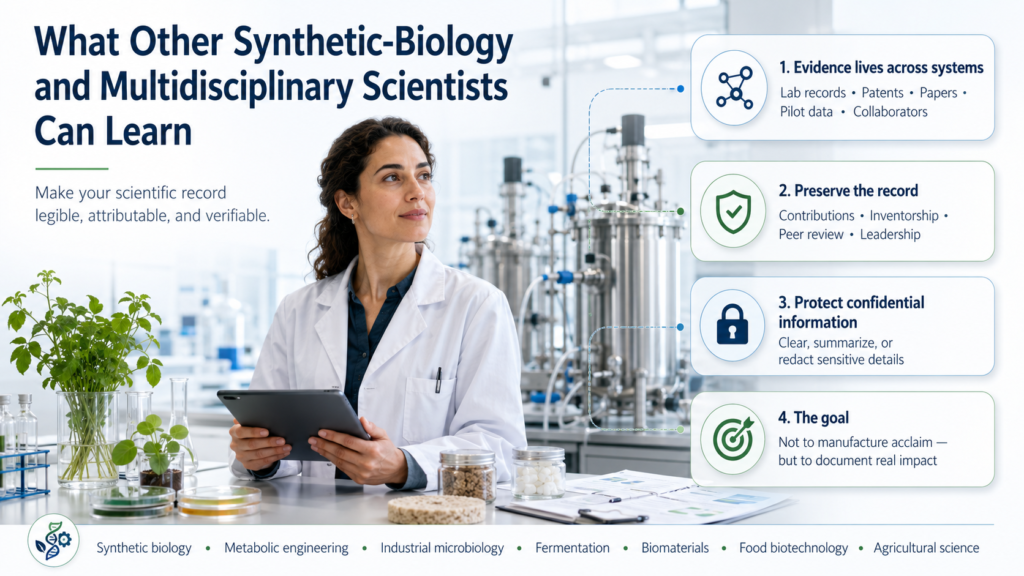
Scientists working in synthetic biology, metabolic engineering, industrial microbiology, fermentation, biomaterials, food biotechnology, agricultural science, and related fields often have evidence spread across several systems. Laboratory records show design decisions. Patent files show inventorship. Papers show authorship. Pilot records show continued development. Collaborators and partners know who solved the central technical problem.
A useful profile-building process begins before the petition is written. Scientists should preserve contribution statements, invention records, strain or method histories, pilot decisions, completed peer-review evidence, invited presentations, leadership assignments, and independent documentation of reliance. Confidential information should be cleared, summarized, or redacted rather than exposed.
The aim is not to manufacture acclaim. It is to make an existing scientific record legible, attributable, and verifiable.
Frequently asked questions
What is EB-1A?
EB-1A is an employment-based immigrant classification for a person of extraordinary ability in the sciences, arts, education, business, or athletics who satisfies the applicable evidentiary framework and demonstrates sustained national or international acclaim in the final assessment.
Can a synthetic-biology scientist qualify for EB-1A?
Potentially. The petition must be based on the scientist’s own record. Original contributions, scholarly authorship, judging, leading or critical roles, qualifying published material, awards, selective membership, high remuneration, or comparable evidence may be relevant depending on the facts.
Can an engineered microbial strain support the original contributions criterion?
Yes, when the evidence shows that the petitioner personally created or materially advanced the strain or method and that the contribution was of major significance. Novelty alone is not enough; adoption, reliance, follow-on use, pilot testing, citations, licensing, or independent validation may help show significance.
Does a patent automatically prove an original contribution of major significance?
No. A patent can document inventorship and originality, but major significance usually requires additional evidence of technical use, reliance, adoption, licensing, continued development, field influence, or qualified independent explanation.
How can a scientist prove contribution within a large multidisciplinary team?
Useful evidence may include contribution statements, laboratory and project records, invention disclosures, work-package assignments, data ownership, method histories, dated communications, publications, and letters from people with direct knowledge. The petition should identify the person’s work without claiming sole credit for team achievements.
Can pilot testing support an EB-1A case?
It can. Pilot records may show that a strain, pathway, or process was carried beyond the original experiment because qualified teams considered it useful. The evidence should explain the petitioner’s role and avoid treating a pilot as automatic proof of commercial success.
What counts as scholarly authorship for a synthetic-biology scientist?
Qualifying work may include peer-reviewed or appropriate professional articles and conference papers in synthetic biology, metabolic engineering, fermentation, industrial microbiology, biomass conversion, or related fields. The petitioner must be an author, and the publication must meet the applicable requirements.
Is first authorship required for EB-1A?
No. First authorship can clarify contribution, but it is not universally required. Corresponding authorship, senior authorship, shared first authorship, contribution statements, and other records may also show scientific responsibility, depending on field practice and the evidence.
Can peer review satisfy the judging criterion?
Yes, when the petitioner actually completed reviews of the work of others in the same or an allied field and the service is documented. Invitations without completed reviews and ordinary internal feedback are generally weaker.
Do biotechnology-network roles satisfy the membership criterion?
Not automatically. The membership criterion requires evidence that admission demanded outstanding achievements judged by recognized experts. Network and committee roles may still strengthen leading-role, judging, original-contribution, or final-merits arguments when their selection and responsibilities are documented.
How can a scientist prove a leading or critical role?
The evidence should establish the distinguished reputation of the organization or project and document the petitioner’s actual authority, responsibility for a critical work package, control over scientific strategy, coordination duties, method ownership, or other function on which the work depended.
What counts as published material about the petitioner?
The strongest evidence is professional or major media material substantially about the petitioner and the petitioner’s work. Articles written by the petitioner are evaluated under scholarly authorship, while independent coverage about the petitioner is a separate evidence category.
Can confidential genetic or process information be used?
It may be documented through authorized summaries, redacted records, cleared technical descriptions, inventorship records, and letters from people with direct knowledge. Unpublished sequences, constructs, process conditions, customer information, and proprietary data should not be disclosed without authorization.
Does EB-1A require a U.S. employer or labor certification?
EB-1A does not require a permanent job offer or labor certification, and an eligible person may self-petition. The petition must still show that the person intends to continue work in the area of extraordinary ability in the United States.
How does EB-1A differ from EB-2 NIW for a synthetic-biology scientist?
EB-1A focuses on extraordinary ability and sustained acclaim under its own evidentiary framework. EB-2 NIW requires EB-2 qualification and a showing that waiving the job-offer and labor-certification requirements is in the national interest. The stronger option depends on the individual record and proposed U.S. work.
How does ethical profile building help a scientist?
It identifies existing evidence, improves truthful attribution, develops legitimate publications and peer-review service, preserves pilot and leadership records, and organizes the case without inventing results, exposing confidential information, buying false recognition, or overstating collaborative work.
Make the scientist behind the biological system visible
A multidisciplinary research record can be stronger than it first appears. The evidence may exist in strain histories, laboratory records, patents, contribution statements, pilot files, publications, peer-review systems, project decisions, conference programs, and the knowledge of specialists who relied on the work.