Private installations, confidential pricing, and missing criticism can hide the career of a serious visual artist. This case showed how a sculpture record could be documented without exposing private clients or weakening artistic integrity.
Key facts at a glance
| Outcome | EB-1A approval for a Chinese contemporary sculptor whose work included monumental installations for corporate and municipal spaces. |
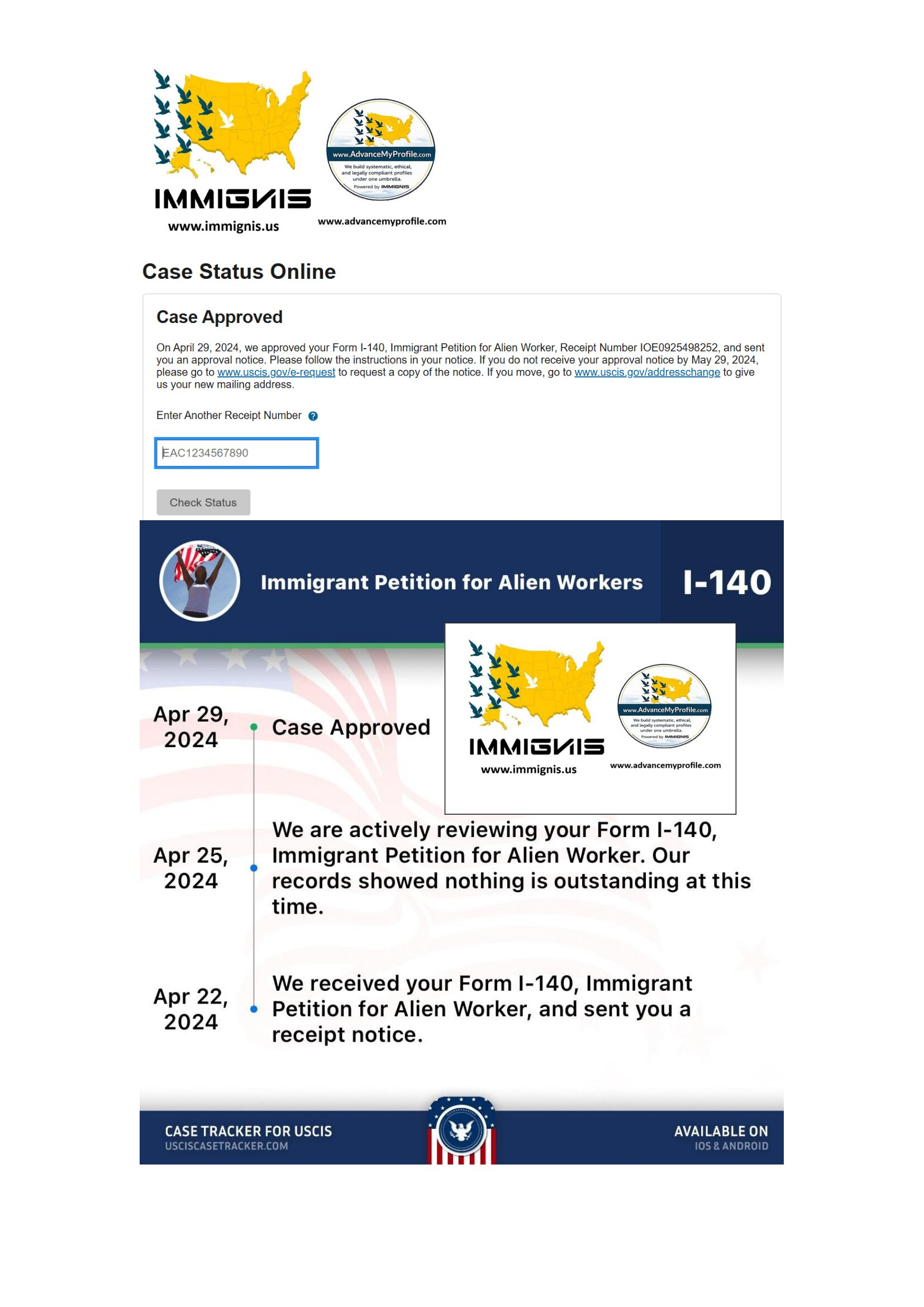
| Approval date | Approved on April 29, 2024. |
| Field niche | Monumental sculpture blending traditional materials with industrial fabrication. |
| Starting problem | The work existed in high-value private and public commissions, but the artist had limited gallery presence, limited critical writing, and confidential pricing records. |
| Profile-building path | Immignis and Advance My Profile built a disclosure safe record using commission documentation, art-critic essays, biennale participation, museum-acquisition evidence, judging for sculpture prizes, and independent letters from curators and public-art specialists. |
| EB-1A evidence presented | Display of work in artistic exhibitions and showcases, original artistic contributions, published material, judging, and market/commission evidence used to support standing and comparable visual-arts evidence. |
| Approval hook | Private commissions were converted into public proof of artistic standing without disclosing confidential client terms or reducing the art to price alone. |
USCIS approved his Form I-140 on April 29, 2024.
The approval did not turn on one dramatic exhibition opening, one large commission, or one flattering letter. The strength of the case was that the record finally made a quiet but substantial artistic career visible.
Chinese contemporary sculptor EB-1A, He was a Chinese contemporary sculptor known for monumental works that blended traditional materials with industrial fabrication. His installations appeared in corporate, municipal, and built environment settings. Some were seen every day by people who never asked who made them. Others were commissioned for private spaces where photographs, budgets, and contract terms could not be freely published.
That was the central EB-1A problem. The work was physically large, but the public record around the artist was small.
Why serious sculpture work can look invisible in an EB-1A record
Visual artists do not all build their careers through the same paper trail. A painter with gallery catalogues, museum reviews, auction records, and solo exhibitions may have a familiar evidentiary path. A sculptor working through private commissions, corporate collections, public-art calls, fabricators, architects, and municipal spaces may have a different kind of record.
In this case, the strongest proof existed in places USCIS would not automatically understand: commission agreements, fabrication documents, installation photographs, client approvals, design revisions, site records, valuation restrictions, and correspondence with curators or project owners.
The original profile risked sounding like a successful commercial practice rather than an extraordinary artistic career. That distinction matters. EB-1A does not ask whether a person has worked hard or completed expensive projects. It asks whether the person has risen to a level of sustained acclaim and recognized achievement in the field.
For this sculptor, the challenge was not inventing acclaim. It was documenting the acclaim that already existed in fragmented, partially private, and field specific forms.
The niche was not just “contemporary sculpture”
The first strategic decision was to narrow the artistic identity. “Contemporary sculptor” was too broad. It described the field but not the contribution.
The record was instead organized around monumental sculpture blending traditional materials with industrial fabrication. That framing mattered because it explained the artistic problem behind the work: how to bring cultural material language, scale, structure, surface, and fabrication into a form that could live in public and institutional spaces.
The case did not present him as a general artist who happened to receive commissions. It presented a sculptor whose practice required artistic authorship, engineering collaboration, material judgment, and site-specific execution.
That focus gave curators, critics, and independent experts a clearer question to answer: what did this artist add to contemporary sculpture, and why did his work deserve recognition beyond the client spaces where it appeared?
What USCIS needed to see in a visual-arts EB-1A case
For a sculptor, the EB-1A analysis cannot be copied from a scientist, engineer, or business executive. USCIS needed evidence that matched the way standing is recognized in the visual arts.
The petition focused on several evidence streams. First, the display criterion required proof that his work had been shown in qualifying artistic exhibitions or showcases. Biennale participation, curated displays, public-art showcases, and documented installation contexts helped show that his work had been placed before art audiences or public viewers in recognized settings.
Second, published material required criticism or coverage about him or his work. A client announcement was not the same as independent art writing. The record therefore used art-critic essays, design-press features, and publications that discussed the sculptural practice, not merely the completion of a project.
Third, original contributions required more than a claim that the sculptures were beautiful or large. Independent experts addressed the artistic significance of his material approach, fabrication language, and contribution to contemporary monumental sculpture.
Fourth, judging evidence came from his evaluation of other artists or sculpture submissions. Being invited to judge sculpture prizes or public-art competitions showed that others relied on his artistic judgment.
Finally, market and commission evidence had to be handled carefully. USCIS has a commercial success criterion written for the performing arts. A visual artist’s private commission value is not the same as box office receipts. The petition therefore used disclosure-safe commission evidence to support market standing, demand, and comparable visual-arts evidence, rather than forcing the facts into the wrong regulatory box.
Private commissions were documented without breaching confidence
One of the most important parts of the case was the handling of commission evidence. Private commissions can be persuasive because they may show demand, trust, artistic selection, scale, and institutional confidence. They can also be risky if the record overstates what the documents actually prove or reveals information the artist has no right to disclose.
Immignis and Advance My Profile worked with the available record to separate what could be shown from what had to remain protected. The petition used disclosure safe descriptions of the commissioning party, project type, artistic scope, selection process, installation context, and role of the sculptor.
Where valuation information was available, it was presented carefully. The purpose was not to say that a high price alone proves extraordinary ability. The purpose was to show that serious institutional or private clients invested in his work, selected him for significant projects, and treated his sculpture as a meaningful artistic asset.
That distinction helped the record stay credible. Private commission value can support the story of professional standing, but it cannot replace independent recognition, criticism, exhibitions, or expert explanation.
Art criticism gave the work a public language
Before profile building, some of the artist’s strongest projects were visible as objects but weak as evidence. USCIS could see images, but images alone rarely explain field significance. The petition needed language from independent voices who could place the work in context.
Art-critic essays and design-publication features became important because they did what a contract could not do. They described the artistic method, the relationship between traditional materials and industrial fabrication, the meaning of scale, and the way the installations interacted with public or institutional space.
The strongest published material did not read like advertising. It addressed the artist’s work as art. It discussed visual choices, material strategy, cultural reference, and the sculptural experience. That kind of writing helped connect the commissions to the field of contemporary sculpture rather than leaving them as decorative projects.
Biennale participation and museum acquisition changed the context
A private installation may be important, but adjudicators often need help understanding why a commissioned object belongs in an extraordinary-ability record. Exhibition and acquisition evidence can change that context.
Biennale participation placed the sculptor’s work inside a curated art setting. It showed that the work was not only purchased or commissioned but selected for presentation within a recognized artistic platform. The petition documented the event, the selection process where available, the work displayed, and the artist’s role.
Museum acquisition evidence added another layer. A museum acquisition can show that an institution considered the work worthy of preservation, collection, or public interpretation. The case did not treat acquisition as automatic proof of extraordinary ability. Instead, it explained why that acquisition mattered in the broader record: it confirmed that the sculptural practice had moved beyond private client use into institutional recognition.
Judging evidence showed that the field trusted his eye
Many artists focus only on being exhibited. EB-1A also asks whether the person has judged the work of others in the same or allied field. For a sculptor, this can be especially useful because it shows that the field values the artist’s judgment, not only the finished objects.
The record documented his service evaluating sculpture prizes, public-art submissions, or related artistic competitions. The evidence identified the organization, the selection process, the type of work reviewed, and the nature of his judging role.
This mattered because it moved the case beyond self-presentation. Other institutions had asked him to assess artistic quality, originality, feasibility, or public space suitability. That helped support a record of professional recognition.
Original contribution was explained through artistic method, not adjectives
The original contribution section avoided vague praise. It did not rely on words such as visionary, iconic, or world class without proof. Instead, the petition explained the sculptor’s method and why experts considered it significant.
The work combined traditional material references with industrial fabrication processes. That combination required decisions about scale, surface, weight, installation, finish, site relationship, and visual meaning. The petition traced how those decisions appeared across his projects and how they distinguished his sculptural practice.
Independent letters were most useful when they were specific. Strong letters explained what the artist did, how his method differed from ordinary commissioned production, why the work mattered within contemporary sculpture, and how curators or public-art professionals understood its significance.
The case did not ask USCIS to accept that every large sculpture is important. It showed why these particular works, by this particular artist, reflected a recognizable contribution.
How the EB-1A evidence came together
The final petition was not a pile of attractive project images. It was a connected record.
• Artistic exhibitions and showcases: Biennale participation, curated displays, public-art contexts, and documented installations showed that his sculpture had been presented in recognized settings.
• Published material: Art criticism, design writing, and independent features discussed the artist or his work rather than simply announcing a project.
• Original contributions: Curator and expert letters explained his contribution to monumental sculpture, material practice, and the bridge between traditional artistic language and industrial fabrication.
• Judging: Sculpture prize and public-art evaluation records showed that professional organizations relied on his artistic judgment.
• Market and commission evidence: Disclosure safe records of commissions, valuations, acquisitions, and institutional selection helped show professional demand and standing in the visual-arts market.
Together, these materials gave USCIS a record that could be reviewed. The artist’s career no longer depended on private knowledge, informal reputation, or client confidentiality. It became documented.
Why the approval matters for artists outside the gallery system
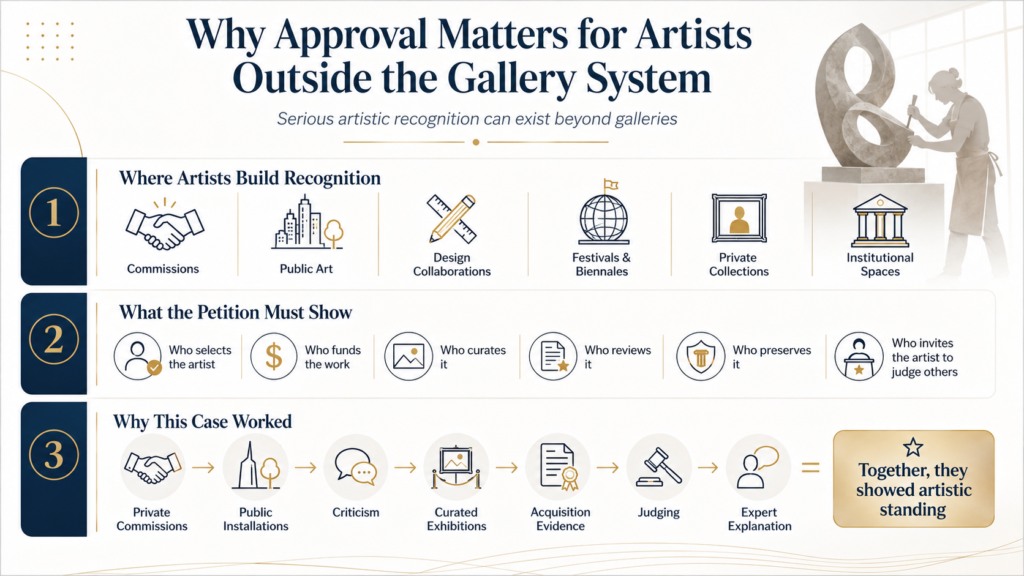
This case is useful for many visual artists because it challenges a narrow assumption about artistic evidence. Not every serious artist has a conventional gallery ladder. Some build their records through commissions, public art, design collaborations, architecture, festivals, biennales, municipal projects, private collections, or institutional spaces.
That does not make the work weaker. It does make documentation more important. For artists outside the gallery system, the petition must explain the field’s hierarchy of recognition. Who selects the artist? Who funds the work? Who curates it? Who reviews it? Who preserves it? Who invites the artist to judge others? What public or institutional setting gives the work significance?
The Chinese contemporary sculptor’s case succeeded because it did not pretend that private commissions were the same as museum retrospectives. It showed how private commissions, public installations, criticism, curated exhibitions, acquisition evidence, judging, and expert explanation could work together.
The result
USCIS approved the Form I-140 on April 29, 2024.
The approval reflected a record that made the artist’s standing visible in a form USCIS could evaluate. The petition did not expose confidential pricing, exaggerate private client relationships, or reduce the sculptures to financial value. It showed artistic authorship, independent recognition, field-specific credibility, and a documented contribution to contemporary monumental sculpture.
For a sculptor whose work had long been present in important spaces but absent from a clear public record, that was the central achievement: private commissions became public proof of artistic standing.
Lessons for visual artists considering EB-1A
This success story offers several practical lessons for artists, sculptors, installation artists, designers, and public-art professionals.
• Do not assume a weak gallery record means a weak EB-1A case. The question is whether the field recognizes your work and whether that recognition can be documented.
• Commission evidence must be specific. USCIS needs to understand selection, role, scope, artistic authorship, and significance.
• Private pricing should be handled carefully. Confidential figures can sometimes be summarized, verified, or contextualized without revealing protected terms.
• Published material should be independent and substantive. A project announcement is less useful than criticism or analysis about the artist’s work.
• Judging, curation, acquisition, and exhibition evidence can help show that the field relies on the artist, not only that clients buy the artist’s work.
The strongest EB-1A art cases do not merely say that the artist is talented. They show how the field has recognized the artist’s work, how the work has been selected or displayed, and why the artistic contribution matters.
Frequently asked questions
Can a visual artist qualify for EB-1A without major gallery representation?
Yes. Gallery representation can help, but it is not the only path. Public-art commissions, biennale participation, museum acquisitions, curated installations, critical reviews, judging roles, and independent expert letters may also support a visual-arts EB-1A record when properly documented.
Can private commissions support an EB-1A petition?
They can, but they must be handled carefully. A commission should be tied to the artist’s selection, role, authorship, project significance, and field recognition. Private price information should not be disclosed unless the artist has permission and a strategic reason to use it.
Does USCIS accept commercial success evidence for sculptors?
USCIS has a commercial-success criterion written for the performing arts. For sculptors and other visual artists, market demand, commission value, acquisition evidence, and sales history may still be relevant, but they should be framed accurately, often as part of comparable evidence or final-merits support rather than forced into the wrong category.
Are exhibitions and public installations the same for EB-1A?
Not always. A qualifying exhibition or showcase should be documented with context: who organized it, how the artist was selected, what was displayed, who the audience was, and why the setting matters in the field. A public installation may support the case, but the petition should explain its artistic and professional significance.
Why are curator and museum letters important?
Strong letters can explain artistic significance in terms USCIS can evaluate. The best letters do not simply praise the artist. They identify the work, explain the contribution, compare it to field norms, and describe why the artist’s practice matters.
Build an EB-1A record around the art the field already recognizes
If you are a sculptor, installation artist, public artist, designer, photographer, painter, performer, or creative professional, your strongest evidence may not sit neatly inside a resume. It may be in commissions, catalogues, reviews, juried selections, private collections, public installations, licensing records, audience data, or letters from curators and institutions.
Immignis and Advance My Profile help creative professionals identify a defensible artistic niche, document individual authorship, build independent recognition, and prepare an EB-1A record around evidence that can be verified and professionally presented.