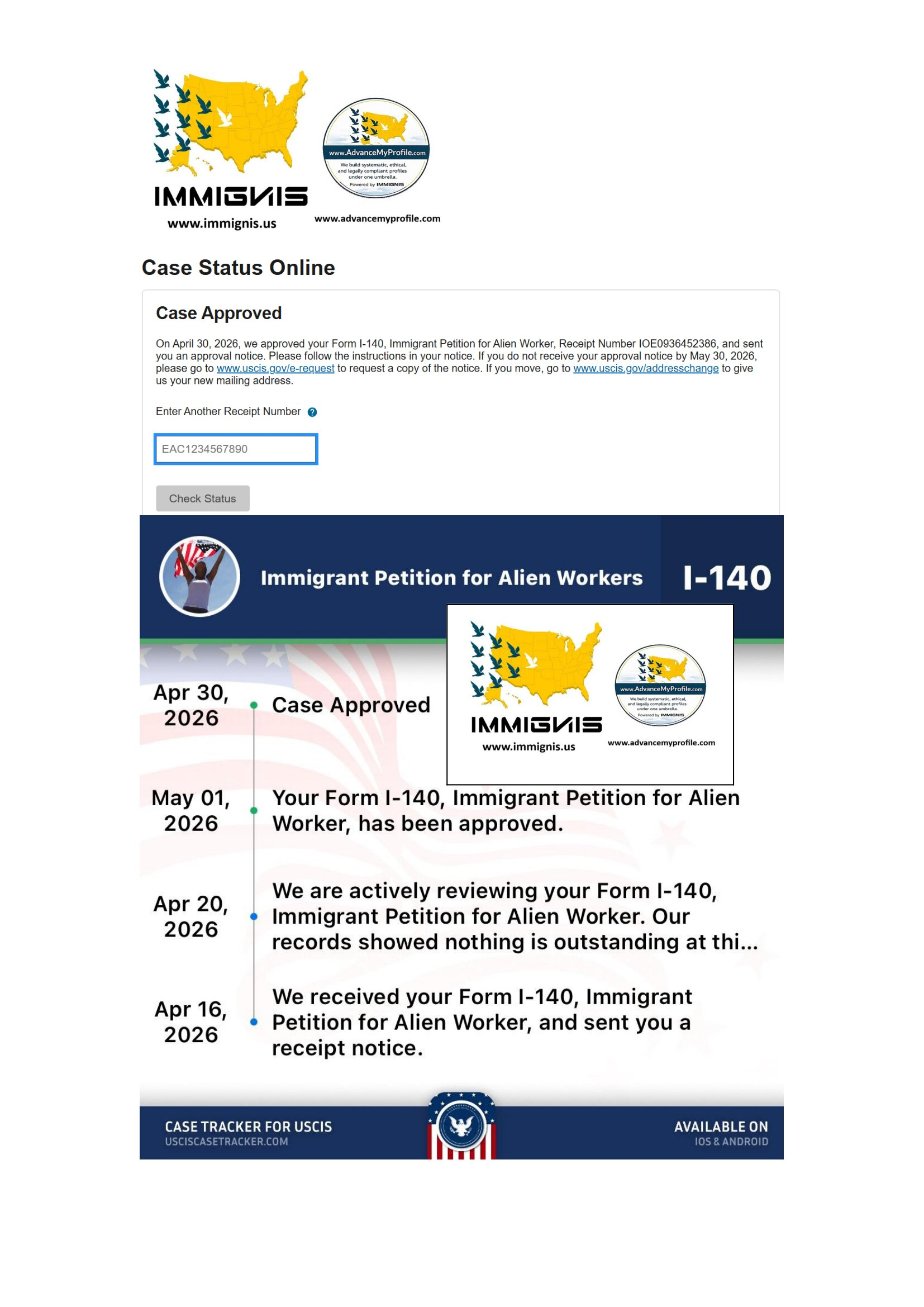
How a marketplace strategy leader turned disclosure safe performance documentation, trade press commentary, e-commerce summit talks, industry association roles, high remuneration evidence, and independent consulting engagements into a USCIS approved EB-1A record.
Key facts at a glance
| Petition outcome | Form I-140 approved under EB-1A on April 30, 2026. |
| Professional profile | Chinese strategist who built export channels moving significant volume between manufacturing hubs and Western marketplaces. |
| Field niche | Cross border marketplace strategy and compliance. |
| Starting weakness | Success was measured in GMV that outside parties could not easily verify, and much of the evidence lived in confidential company dashboards. |
| Profile-building focus | Disclosure safe performance documentation, trade press commentary, e-commerce summit talks, industry association roles, consulting engagements, and remuneration evidence. |
| EB-1A criteria supported | Leading role, original contributions, published material, high remuneration, and memberships. |
| Central issue | Showing that the petitioner’s marketplace strategy and compliance expertise belonged to him personally and was valued beyond one company. |
| Approval lesson | Private commercial metrics can support EB-1A when they are translated into safe documentation, independent validation, and a clear field-specific narrative. |
The approval
On April 30, 2026, USCIS approved the Form I-140 petition of a Chinese cross border e-commerce strategist whose work had helped move significant sales volume between Asian manufacturing hubs and Western online marketplaces.
Inside the business, the value of his work was obvious. Marketplace channels expanded. Compliance risk decreased. Product listings performed better. Gross merchandise value, or GMV, grew across multiple platforms and regions. But most of that proof lived inside company dashboards and private marketplace accounts.
For EB-1A, the petition had to show that this was not routine sales support or ordinary e-commerce operations. It had to prove extraordinary ability in a defined field: cross-border marketplace strategy and compliance.
That became the heart of the case: turning private commercial performance into independent, adjudicator-readable proof that the field valued this strategist’s specific expertise.
The evidence problem in cross-border e-commerce strategy
Cross-border e-commerce can look deceptively simple from the outside. To a casual reader, it may sound like selling products online. In reality, high-level marketplace strategy can involve platform compliance, catalog architecture, pricing systems, international logistics, advertising efficiency, seller-risk controls, and market-entry execution across different jurisdictions.
The petitioner’s starting weakness was not lack of results. It was lack of verifiable public evidence. The strongest proof was GMV, but GMV is usually private. A company may know the numbers, but USCIS cannot simply accept confidential dashboard claims without supporting documentation.
This required a tighter field definition. The case was not presented as general online selling, import-export work, or digital marketing. It was built around cross border marketplace strategy and compliance, a more specialized niche where commercial performance, platform knowledge, and regulatory execution intersect.
That field definition mattered. It gave the petition a realistic measuring stick. The question was not whether the petitioner was famous to consumers. The question was whether marketplace companies, trade groups, and independent clients treated him as a high-level strategist in cross-border e-commerce.
Why GMV was only the beginning
It would have been tempting to rely on large GMV numbers alone. That would have been risky. USCIS could reasonably ask whether marketplace growth came from the brand, the product category, advertising spend, the supply chain, a broader team, or the petitioner’s own strategy.
The record therefore treated GMV as a starting point, not the conclusion. The petition had to show what the petitioner actually designed, led, or changed in the marketplace system, and why those actions mattered beyond ordinary business execution.
The strongest evidence came from disclosure safe performance documents, employer-cleared explanations, trade-press commentary, industry-association roles, summit speaking records, and independent consulting engagements that showed other organizations wanted his knowledge.
That distinction changed the case. Instead of asking USCIS to trust private sales figures, the petition translated business impact into documented strategy, outside validation, and field-level recognition.
Disclosure-safe performance evidence became the backbone of the case
In some EB-1A fields, strong evidence appears in patents, citations, or formal awards. In cross-border e-commerce, some of the strongest evidence may appear in marketplace growth, seller-performance improvements, compliance outcomes, and channel expansion. The difficulty is that companies cannot always disclose the raw data publicly.
The petition used that reality carefully. The goal was not to expose confidential GMV, supplier terms, advertising costs, or marketplace account data. The goal was to create a disclosure safe record that confirmed the scale and nature of the petitioner’s contribution without damaging the business.
Good evidence did not say only that he “increased sales.” It explained what he did: built export channel strategies, improved marketplace positioning, reduced compliance failures, developed product-entry playbooks, coordinated regional platform requirements, and helped turn manufacturing capacity into Western marketplace revenue.
Those materials gave USCIS a way to understand private commercial impact without requiring the company to release sensitive dashboards. They also made the petitioner’s role more precise, which is essential in business EB-1A cases.
Leading role evidence had to show strategic control, not routine operations
A senior business title can help, but it is rarely enough. Many people in e-commerce manage accounts, campaigns, or product launches. EB-1A requires evidence showing why the petitioner’s work was leading, critical, or unusually influential within the organization or field.
The petition documented the petitioner’s authority over marketplace strategy, export-channel design, compliance planning, and cross-market execution. It showed that he was not simply maintaining online stores; he was shaping how products moved from manufacturing hubs into competitive Western digital marketplaces.
That evidence helped separate strategic leadership from routine marketplace management. The case showed that his decisions affected market access, revenue expansion, platform stability, and the company’s ability to compete internationally.
For business professionals, this is often the difference between a weak and strong record. A résumé may list responsibilities. An EB-1A petition must prove that the petitioner’s responsibilities were important enough to distinguish him from ordinary professionals in the field.
Original contribution in a marketplace strategy case
Original contribution can be difficult in e-commerce cases because strategy work is often practical rather than academic. A marketplace strategist may improve trade flows, compliance systems, and seller performance without publishing a technical invention or receiving public credit.
For this petitioner, the original-contribution evidence was built around his cross-border marketplace methods. The petition showed how his approach to channel selection, compliance risk management, listing architecture, seller performance, and market-entry sequencing produced results that others could understand and value.
That mattered because USCIS looks for contributions of significance, not ordinary job performance. The evidence had to show that his work created a meaningful advantage in the field, not just a good outcome for one employer.
The petition did not claim that he invented e-commerce. It made a narrower and more defensible point: within cross border marketplace strategy and compliance, his methods helped convert manufacturing capacity into scalable, platform compliant export revenue and were recognized by others as valuable expertise.
Published material and industry visibility
The original profile had limited public authorship. That is common for e-commerce strategists because the most important work happens inside seller accounts, marketplace dashboards, supplier relationships, and platform-policy workflows.
Trade-press commentary, interviews, and practical articles helped make the petitioner’s expertise visible outside the company. They also helped explain why cross border marketplace strategy is a serious field rather than a generic sales function.
The petition treated public visibility as supporting evidence, not decoration. The best published material connected his name to marketplace strategy, compliance trends, export growth, platform risk, and the operational intelligence needed to succeed across jurisdictions.
High remuneration and independent consulting validation
The high-remuneration criterion can be useful for business strategists, but it must be handled carefully. Compensation must be compared against the correct peer group, not against unrelated sales, retail, or general marketing positions.
In this case, remuneration evidence was organized around relevant peers: cross-border marketplace strategists, senior e-commerce growth leaders, export-channel executives, and compliance-oriented marketplace consultants. That made the comparison more credible and more useful.
Independent consulting engagements added another important layer. They showed that outside businesses were willing to pay for the petitioner’s specific judgment, not merely benefit from his employer’s brand. That consulting record helped prove that the field itself recognized commercial value in his mind and methods.
Memberships and industry association roles
Industry-association evidence can be weak if it reflects only open enrollment. In this case, the record focused on roles and memberships that showed actual participation, trust, or visibility within cross-border trade and e-commerce circles.
Association roles helped show that the petitioner was not working silently inside one company. He was participating in a broader professional community where marketplace strategy, export compliance, and platform growth were being discussed and evaluated.
The petition connected these roles to the rest of the record. Their value came from alignment with speaking invitations, trade commentary, consulting work, and documented performance evidence.
How the EB-1A criteria worked together
The petition did not depend on one perfect document. It worked because multiple forms of evidence pointed in the same direction and supported the same theory of the case:
- Leading role: Employer-cleared records showed responsibility for cross-border marketplace strategy, compliance planning, export-channel growth, and platform execution.
- Original contributions: Disclosure-safe impact briefs and technical explanations showed that his marketplace methods helped expand compliant export revenue across Western platforms.
- Published material: Trade-press commentary and industry articles made his expertise visible beyond private dashboards and internal company records.
- High remuneration: Compensation and consulting-fee evidence was benchmarked against relevant e-commerce strategy and marketplace leadership roles.
- Memberships: Industry association roles helped show recognized participation in the broader cross-border e-commerce and trade community.
The strongest part of the record was coherence. The case did not drift into generic claims about entrepreneurship, sales, or hard work. It stayed focused on cross-border marketplace strategy and compliance as a defined field niche.
The final-merits argument
At the final merits stage, the petition had to show more than satisfaction of individual criteria. It had to demonstrate that, taken together, the evidence established sustained acclaim and extraordinary ability in the petitioner’s field.
The argument centered on independent validation rather than private numbers alone. The petitioner was not presented as someone who merely worked in a successful e-commerce company. He was presented as a strategist whose work was documented by the employer, discussed in trade settings, sought by outside clients, and recognized within industry associations.
The final record showed that his expertise had been recognized through strategic responsibility, confidential-but-verified performance evidence, public commentary, consulting demand, relevant remuneration, and professional participation.
That is why the case was stronger than a file built around GMV alone. It told USCIS who the petitioner was within the cross-border marketplace field and why his contribution mattered.
Why the approval mattered
The approval mattered because it showed how a business professional in e-commerce can qualify when the evidence is specific, attributed, and independently supported. Cross-border marketplace work may not look like a traditional extraordinary-ability field at first, but the right record can show top level expertise clearly.
For this Chinese e-commerce strategist, the petition did not try to present him as a celebrity entrepreneur or a general seller. It documented him as what he actually was: a cross-border marketplace strategy and compliance expert whose work influenced international commercial channels and whose expertise was valued outside one employer.
The approval confirmed the central lesson of the case: private GMV can support EB-1A only when it is translated into safe documentation, professional validation, and a clear explanation of the petitioner’s personal role.
Lessons for e-commerce strategists and marketplace leaders
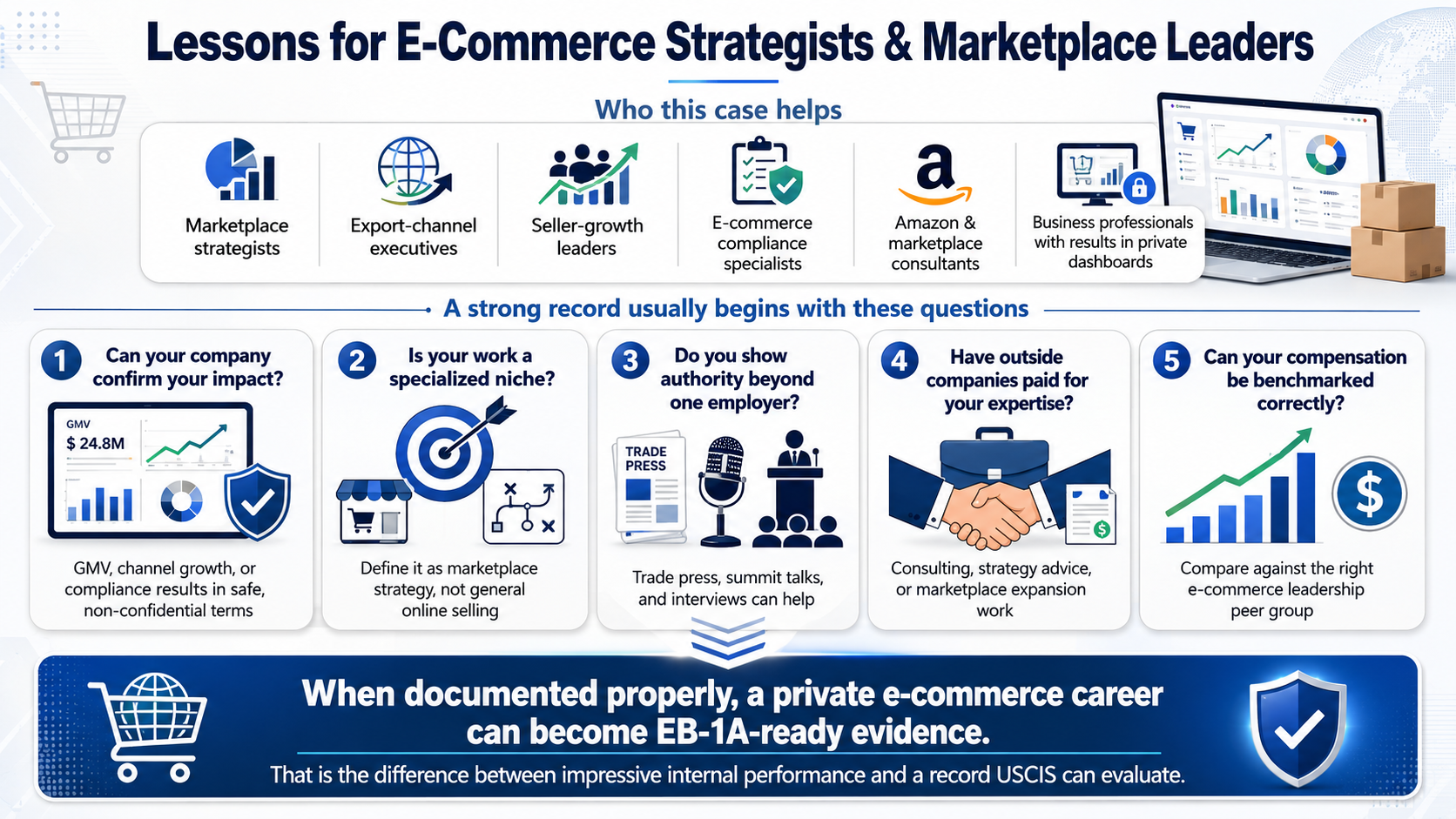
This case is useful for marketplace strategists, export channel executives, seller-growth leaders, e-commerce compliance specialists, Amazon and marketplace consultants, and business professionals whose strongest results live in private dashboards.
A strong record usually begins with the following questions:
- Can your company confirm your GMV, channel growth, or compliance impact in safe, non-confidential terms?
- Can your work be defined as a specialized marketplace strategy niche rather than general online selling?
- Do trade-press articles, summit talks, or interviews show authority beyond one employer?
- Have outside companies paid you for consulting, strategy advice, or marketplace expansion work?
- Can your compensation or consulting fees be benchmarked against the correct e-commerce leadership peer group?
When those questions are answered with documents, a private e-commerce career can become a record USCIS can evaluate. That is the difference between impressive internal performance and EB-1A-ready evidence.
Frequently asked questions
Can an e-commerce strategist qualify for EB-1A?
Yes. An e-commerce strategist may qualify for EB-1A if the evidence shows sustained acclaim and extraordinary ability in a clearly defined field. The case becomes stronger when the petition documents strategy, impact, industry visibility, and independent validation rather than general sales activity.
Can confidential GMV support an EB-1A petition?
It can support the petition when documented safely. Useful evidence may include employer-cleared impact briefs, executive letters, platform performance summaries, consulting records, and explanations that confirm the petitioner’s role without revealing sensitive business data.
Is cross-border marketplace strategy a strong EB-1A field niche?
It can be strong when defined carefully. Cross border marketplace strategy and compliance is more specific than general e-commerce because it involves platform rules, export channels, seller risk management, market entry strategy, and international commercial execution.
How do consulting engagements help an EB-1A business case?
Consulting engagements can show that outside companies value the petitioner’s expertise enough to pay for it. They are especially helpful when they confirm that recognition is not limited to one employer or internal team.
Can industry-association roles support an EB-1A petition?
They may support the petition when they show recognized participation, leadership, or trust within the field. Their value increases when they are connected to speaking roles, trade commentary, consulting work, and other independent evidence.
Can Immignis and Advance My Profile help e-commerce professionals build EB-1A evidence?
Immignis and Advance My Profile help e-commerce strategists, marketplace consultants, export-channel leaders, founders, and business executives define a focused field niche, organize confidential impact evidence safely, and build a professional record that can be presented clearly and credibly in an EB-1A petition.
Build an EB-1A record around marketplace impact and independent validation
Many e-commerce professionals create major value inside companies but remain almost invisible outside them. Disclosure safe performance briefs, trade commentary, summit talks, association roles, consulting engagements, and compensation evidence can support an EB-1A case when they are organized around a clear field niche.