
Disaster robotics EB-1A: How a Filipino disaster-robotics engineer secured EB-1A approval by converting deployment records, autonomy and navigation evidence, robotics publications, emergency-agency letters, patents, international presentations, judging activity, and professional recognition into a clear record of extraordinary ability.
Key facts at a glance
| Petition outcome | Form I-140 approved under EB-1A on October 10, 2024. |
| Professional profile | Filipino robotics engineer developing autonomous systems for search, mapping, sensing, and communications after typhoons, earthquakes, and infrastructure collapse. |
| Field niche | Field robotics for disaster response and inaccessible environments. |
| Starting weakness | Successful deployments were credited to emergency programs and institutions, while the engineer’s autonomy, sensing, navigation, and field-integration work remained hidden inside team operations. |
| Profile-building focus | Deployment-attribution records, robotics publications, emergency agency letters, patent documentation, international disaster-technology presentations, competition judging, professional-society roles, and expert evidence. |
| Principal EB-1A evidence areas developed | Original contributions of major significance, leading or critical role, authorship of scholarly articles, judging the work of others, and published material about the petitioner and the petitioner’s work. |
| Central issue | Showing that reliable field performance resulted from the petitioner’s identifiable technical decisions rather than ordinary participation in a large emergency-response team. |
| Approval lesson | Disaster-robotics work can support EB-1A when field deployments are traced to specific engineering contributions and reinforced by publications, patents, agency validation, judging, and recognition beyond one institution. |
When rescuers could not enter, the machines went first
The petitioner worked on robotic systems intended for places where human access was unsafe, delayed, or impossible. After a typhoon, earthquake, landslide, structural collapse, or communications failure, a machine may need to move through debris, build a map, locate hazards, transmit images, carry sensors, or restore a communications link before responders can enter.
The machines were visible during deployments. The engineering decisions that made them dependable were not. Public reports often credited an emergency program, university, agency, laboratory, or response team. They rarely explained who designed the autonomy logic, selected the sensor arrangement, solved the navigation problem, or adapted the system to real field conditions.
USCIS approved the Form I-140 petition on October 10, 2024. Immignis and Advance My Profile organized the case around a practical evidentiary question: how could the record connect successful emergency deployments to one engineer without taking credit away from the responders, operators, institutions, and multidisciplinary teams involved?
Why disaster robotics cases are difficult to explain
Disaster robotics sits between mechanical engineering, electronics, software, control systems, telecommunications, sensing, mapping, human-machine interaction, and emergency operations. A prototype that performs well in a laboratory may fail in mud, smoke, dust, rain, darkness, unstable structures, damaged networks, or cluttered terrain.
This field therefore produces evidence in unusual places. Important proof may appear in deployment logs, operator reports, mission debriefs, sensor recordings, field photographs, technical-change records, emergency-agency correspondence, internal validation documents, or after-action reviews. Much of that material was created to manage an emergency, not to document an individual engineer’s professional standing.
The petition defined the field narrowly as field robotics for disaster response and inaccessible environments. That definition kept the case focused on the petitioner’s actual expertise and explained why field reliability, deployment adoption, technical attribution, agency trust, peer review, patents, and professional presentations were appropriate measures of recognition.
Deployment attribution records turned team operations into personal evidence
Deployment evidence became useful only after the petitioner’s contribution was separated from the wider operation. The petition did not claim that the petitioner alone conducted a rescue mission or created an entire emergency-response system. It identified the technical work for which the petitioner was responsible.
Records from people with direct knowledge described the problem the robot faced, the petitioner’s role in the system, the engineering change or decision involved, and how that contribution affected performance. Depending on the deployment, the relevant work could involve locomotion, obstacle negotiation, autonomous route selection, mapping, sensor fusion, communications resilience, power management, payload integration, or operator control.
The strongest records connected a technical decision to an observable operational result without inventing unsupported statistics. They showed that the petitioner’s work mattered because the system could enter, map, sense, communicate, or remain functional under conditions that defeated ordinary equipment.
Autonomy, sensing, and navigation were documented as distinct contributions
Large robotic systems contain many technical layers. A petition becomes weaker when it treats the entire platform as one undivided invention. The case therefore mapped the petitioner’s work to specific engineering functions and explained how those functions interacted.
Autonomy evidence addressed how the machine interpreted conditions and selected actions. Sensing evidence addressed how cameras, thermal devices, ranging instruments, environmental sensors, or other payloads produced usable information. Navigation evidence addressed positioning, mapping, obstacle avoidance, route planning, or movement when ordinary location signals were unreliable or unavailable. This contribution mapping helped USCIS evaluate originality and responsibility. It showed that the petitioner was not merely operating commercially available equipment or following an existing deployment checklist. The record identified engineering choices that allowed the system to work in a difficult emergency environment.
Emergency agency letters supplied direct operational validation
Letters from emergency agencies, response organizations, operators, project leaders, and technical partners were important because these witnesses understood what happened in the field. The best letters did more than praise the petitioner or describe a job title.
They identified the deployment context, the technical limitation that had to be overcome, the petitioner’s specific responsibility, and why the solution mattered to responders. Where possible, the letters also explained whether the method was reused, incorporated into later work, requested for another mission, or treated as a reference for future deployments.
Agency letters were not presented as substitutes for technical records. They were used with deployment documents, publications, patents, presentation records, and expert analysis so that operational reliance and engineering originality supported each other.
Robotics publications made field lessons available to the profession
Scholarly and technical publications gave the petitioner a public record beyond emergency operations. Articles could address autonomy, mapping, sensor integration, communications, mobility, human-machine coordination, field testing, reliability, or lessons learned from disaster environments without revealing sensitive operational details.
The petition connected each publication to the petitioner’s actual contribution. It did not rely only on the number of papers or the order of authors. Contribution statements, research records, and expert explanations showed which method, experiment, analysis, or technical interpretation the petitioner supplied.
This evidence supported the scholarly-articles criterion and strengthened the original-contribution analysis. It also showed that the petitioner converted field experience into knowledge that other robotics professionals could evaluate and use.
Patent documentation showed protected technical originality
Patent and invention records helped document technical solutions that were developed for mobility, sensing, communication, control, deployment safety, or other robotic functions. A patent did not establish major significance by itself, but it could show inventorship, novelty, and a formal attempt to protect the solution.
The petition explained the problem addressed by each relevant invention, the petitioner’s role in the inventive concept, and the relationship between the protected technology and disaster-response performance. Where an employer or institution owned the patent, the record kept ownership separate from inventorship.
Evidence of implementation, testing, licensing, use, or technical reliance was considered separately. This prevented the case from treating every patent as proof of commercial or field success while still using the record to establish originality.
International presentations showed recognition beyond one response program
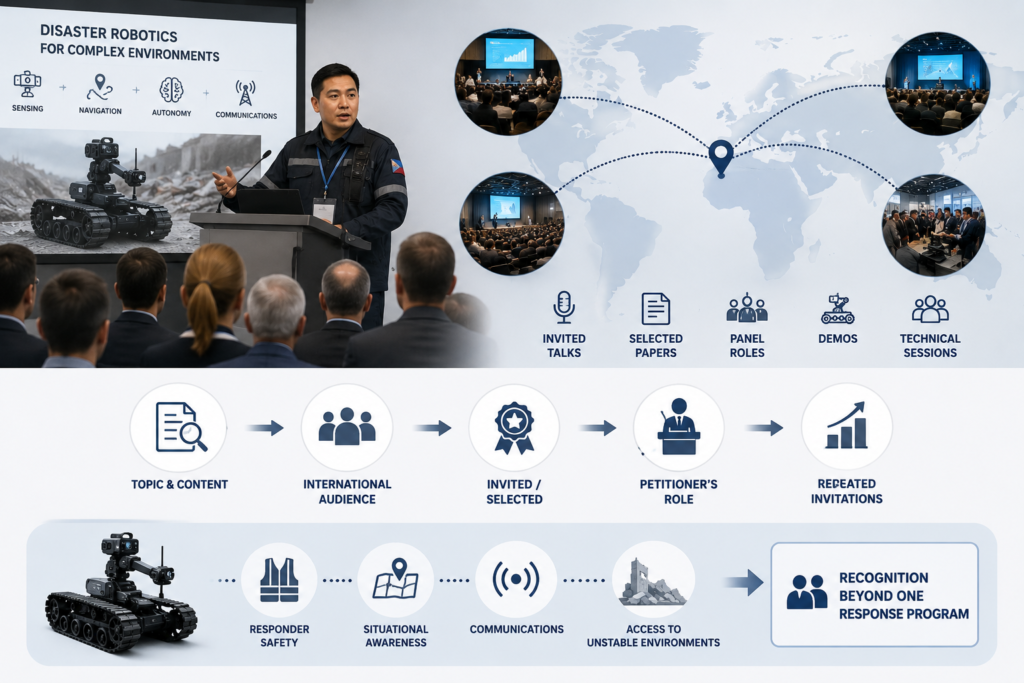
International disaster-technology, robotics, engineering, and emergency-management presentations helped move the petitioner’s work beyond one institution. Invited talks, competitively selected papers, panel roles, demonstrations, and technical sessions allowed peers to examine the methods and field lessons.
The petition documented the substance of the appearance rather than listing conference attendance. It identified the topic, audience, selection process where available, and the petitioner’s role. Repeated invitations or requests to discuss field experience were useful because they showed continuing professional interest.
These presentations also made a highly technical case understandable. They linked autonomy, sensing, and navigation decisions to practical questions about responder safety, situational awareness, communications, and access to unstable environments.
Competition judging and peer review documented trust in the engineer’s judgment
Judging evidence came from completed evaluation of robotics competitions, student or professional designs, technical papers, conference submissions, research proposals, or other work by professionals in the field. The record documented the work evaluated and the petitioner’s completed role.
An invitation alone was not enough. The petition showed that the petitioner actually assessed the work of others and that the subject matter related to the petitioner’s expertise. Repeated selection as a judge or reviewer supported the argument that the field trusted the petitioner’s technical judgment.
This evidence was especially relevant in disaster robotics because reliability claims must be examined critically. A judge or reviewer must understand whether a system can perform outside a controlled demonstration and whether the technical conclusions are supported by the evidence.
Professional society roles were described accurately
Professional-society and technical-network roles helped show recognition beyond the petitioner’s employer. Committee service, working-group responsibilities, standards discussions, conference organization, technical mentorship, or invited participation could support leading role, judging, and the final merits analysis.
The petition did not treat ordinary membership as achievement-based membership. The EB-1A membership criterion requires admission based on outstanding achievements judged by recognized experts. Where that standard was not established, the role was used for the evidentiary value it actually carried rather than overstated.
This distinction improved credibility. It allowed the case to show professional reliance while preserving the separate legal requirements of each EB-1A criterion.
Published material connected the engineer’s name to the deployments
Media coverage of disaster-response technology often focuses on the emergency, the institution, or the machine. The petitioner may appear only as part of a group, or not at all. Profile building therefore focused on accurate attribution rather than promotional publicity.
Qualifying published material identified the petitioner, described the petitioner’s work, and appeared in professional, major trade, or major media outlets. Technical interviews and field-focused features were useful when they explained the petitioner’s role in a genuine deployment or engineering method.
Articles written by the petitioner were kept under the scholarly-articles criterion. Articles about the petitioner and the petitioner’s work were evaluated separately as published material. That separation prevented double counting and made the evidence easier to follow.
Leading role was proved through technical command, not title alone
A disaster-robotics engineer may lead critical technical work without holding the highest administrative title. The petition therefore examined who made the engineering decisions that determined whether the robot could be deployed safely and whether the information it produced could be trusted.
Evidence of leading or critical role included responsibility for system architecture, autonomy strategy, field integration, deployment readiness, technical troubleshooting, operator coordination, testing approval, or post-deployment redesign. Letters and project records explained why the organization or program was distinguished and why the petitioner’s work was important to its performance.
This approach avoided equating seniority with leadership. It showed the actual decision-making responsibility that made the petitioner central to the technical outcome.
Why the case worked
• The field was defined precisely as field robotics for disaster response and inaccessible environments.
• Deployment records identified the petitioner’s technical contribution without claiming ownership of the entire emergency operation.
• Autonomy, sensing, navigation, communications, and field integration were mapped as separate engineering functions.
• Emergency-agency and operator letters supplied direct attribution and operational context.
• Publications and patents created a professional record outside internal deployment files.
• International presentations, judging, and professional roles showed recognition beyond one employer or project.
• Published material connected the petitioner’s name to the work rather than merely describing the institution or machine.
• The petition distinguished originality, major significance, authorship, judging, published material, and leading role instead of blending them together.
The approval did not rest on the general importance of disaster response. It rested on evidence that this engineer made identifiable contributions, was trusted with consequential technical responsibility, and received recognition extending beyond routine employment.
What other robotics and emergency technology professionals can learn
Field robotics often produces strong achievements before it produces a clean public profile. A system may have entered a collapsed structure, mapped an inaccessible area, restored a communications link, or supplied information to responders, yet the engineer’s name may appear only in an internal project list.
The practical lesson is to preserve attribution while the work is happening. Maintain contribution records, cleared technical summaries, deployment documentation, publication files, patent records, presentation evidence, judging records, and letters from people who directly observed the engineering role.
Profile building should not manufacture acclaim or expose sensitive emergency information. It should make genuine work understandable, document who did what, and place the evidence under the correct immigration criteria.
Frequently asked questions
Can a disaster robotics engineer qualify for EB-1A?
Yes, when the evidence establishes sustained acclaim and shows that the engineer belongs among the small percentage at the top of the defined field. A successful deployment alone is not enough; the petition must document personal contribution, significance, recognition, and the final merits record.
Can emergency deployments prove an original contribution of major significance?
They can help when the record identifies the engineer’s contribution, shows why the technical problem was difficult, and documents adoption, reliance, reuse, measurable operational value, or influence beyond routine project duties.
How can an engineer prove individual credit in a team deployment?
Contribution maps, design records, change logs, deployment reports, patents, publications, technical presentations, and letters from people with direct knowledge can separate the engineer’s work from the larger institutional or emergency operation.
Are agency letters enough to prove extraordinary ability?
No. Agency letters are strongest when supported by technical records and when they explain the writer’s basis of knowledge, the engineer’s specific role, the problem solved, and the significance or later use of the contribution.
Can robotics publications support the scholarly-articles criterion?
Yes, when the petitioner authored qualifying scholarly articles in the field. The petition should also explain the petitioner’s contribution to collaborative papers and how the publications relate to the defined specialty.
Does a patent automatically prove a major contribution?
No. A patent may show inventorship and novelty, but major significance generally requires additional evidence such as implementation, use, adoption, licensing, technical reliance, or expert analysis.
Can judging a robotics competition satisfy the judging criterion?
Completed judging may qualify when the petitioner evaluated the work of others in the same or an allied field. The selection, event, judging duties, and completed evaluation should be documented.
Can peer review of robotics papers also count as judging?
Yes. Completed review of journal manuscripts, conference papers, research proposals, or other professional work may support the criterion when the subject matter and completed duties are shown.
Does ordinary membership in a robotics society satisfy the membership criterion?
Usually not. The criterion requires admission based on outstanding achievements judged by recognized experts. Committee roles and technical service may still support other criteria or the final merits analysis.
How can an engineer prove a leading role without being the project director?
The record can show responsibility for system architecture, autonomy, sensing, navigation, deployment readiness, technical approvals, operator integration, troubleshooting, or other work that was essential to a distinguished program or organization.
What counts as published material about the engineer?
Qualifying material generally discusses the engineer and the engineer’s work in professional, major trade, or major media outlets. Articles authored by the engineer belong under the scholarly-articles criterion and should be treated separately.
Can confidential or security-sensitive deployment work be used?
Often yes, through cleared summaries, redacted records, contribution statements, authorized letters, and nonconfidential technical publications. The petition should not disclose information the petitioner is not permitted to release.
Does the importance of disaster response automatically prove extraordinary ability?
No. The social importance of disaster response provides context, but the petition must still prove the petitioner’s own achievements, significance, recognition, and standing in the field.
How can ethical profile building strengthen this type of case?
It can organize existing evidence, preserve contribution attribution, develop accurate public publications and presentations, document judging and professional roles, obtain specific validation letters, and connect the record to the correct EB-1A criteria without fabricating achievements.
Make the engineer visible without diminishing the response team
A strong disaster-robotics record may already exist across deployment files, technical designs, patents, publications, agency correspondence, conference programs, judging records, media coverage, and post-mission reviews. The weakness may be that the documents describe the machine or program more clearly than the engineer.
Identify which achievements can be documented now, which deployments need clearer attribution, and which ethical profile-building activities may strengthen a future petition.