How a Rwandan engineer built an EB-1A case around drone delivery networks for medical supply access
Key facts at a glance
| Outcome | EB-1A approval for a Rwandan drone logistics engineer working with a U.S.-based logistics startup. |
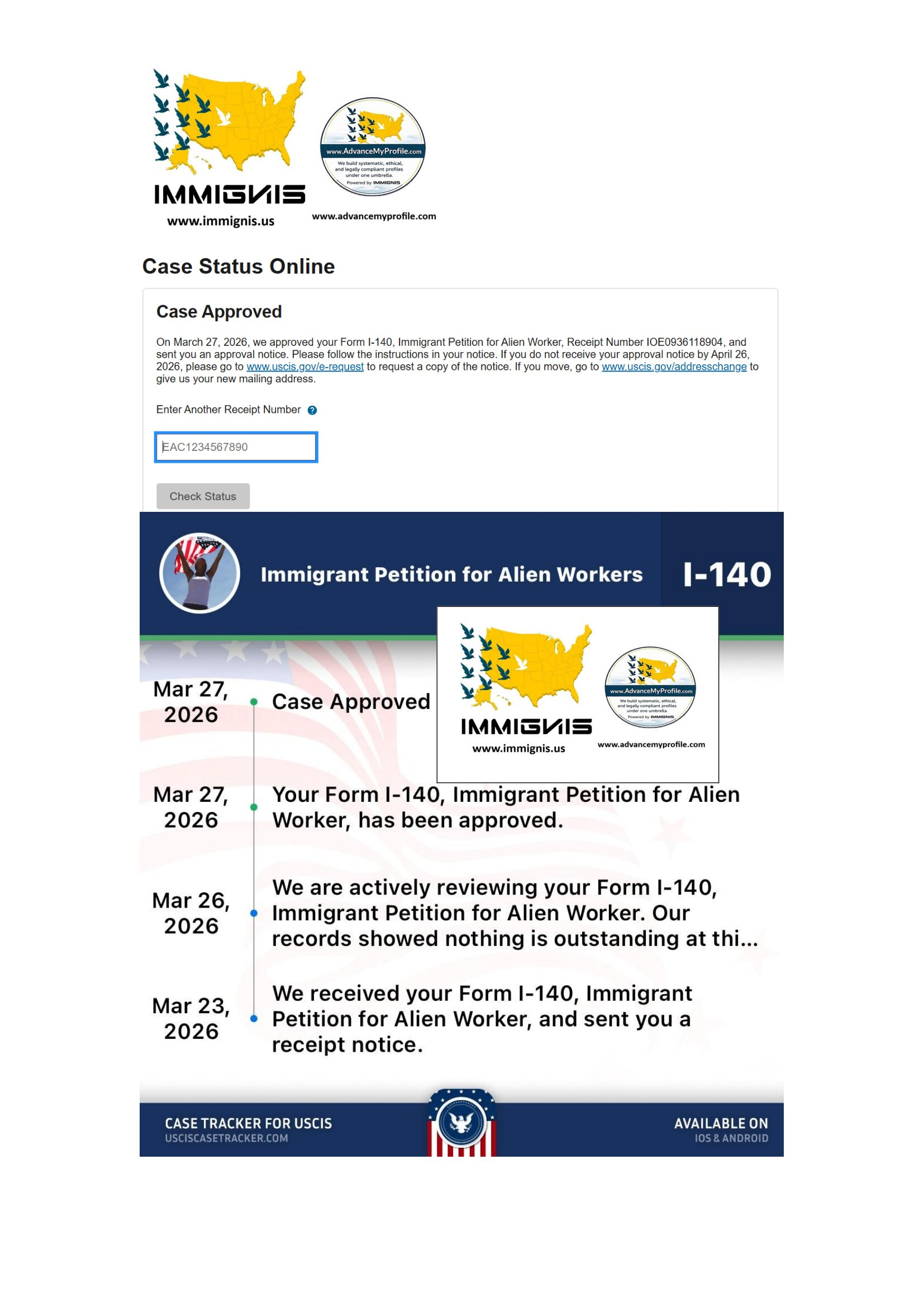
| Approval date | Approved on March 27, 2026. |
| Field niche | Drone delivery networks for medical supply access, with a focus on routing, service reliability, delivery timing, field operations, and integration with health-supply-chain needs. |
| Starting weakness | The field deployments were strong, but the early record did not yet provide enough scholarly depth, independent media recognition, judging evidence, or clear proof that the work was more than one startup project. |
| Profile-building path | The record was strengthened through technical papers, operational metrics, a health-supply-chain white paper, trade-media coverage, conference talks, judging in innovation contests, patent and trademark evidence, and independent letters from drone logistics and health-supply-chain experts. |
| EB-1A criteria supported in the petition | Original contributions, scholarly articles, published material, judging, and leading or critical role. Patent and trademark evidence supported attribution and public identification of the work, but were handled carefully and not overstated. |
| Approval hook | USCIS approved the case after the record showed drone logistics as a medical-access contribution, not merely a startup story. |
On March 27, 2026, USCIS approved the Form I-140 petition of a Rwandan drone logistics engineer whose work focused on medical supply access through unmanned delivery networks.
The approval did not come from presenting drones as exciting technology. It came from showing why his work mattered to a specific public-health and logistics problem: how time-sensitive medical supplies can reach facilities and communities when roads, distance, terrain, weather, inventory gaps, or distribution delays make ordinary delivery unreliable.
That distinction mattered. A drone can be a product. A startup can be a company story. EB-1A requires something different: evidence that the individual has achieved sustained acclaim and that the field recognizes the person as having made original, meaningful contributions.
His early record had useful deployments and strong practical results. It still needed a sharper professional identity, stronger public proof, and a way to explain the work without turning the petition into a marketing pitch for a company.
The issue was not whether the work was useful
Medical drone delivery can be easy to misunderstand. To the public, it may look like a dramatic flight: a package lifted from one site and dropped at another. For the people responsible for health supply chains, the harder problem begins before the aircraft leaves and continues after it lands.
Which items are urgent enough to justify drone delivery? Which route is safe and repeatable? How should a system handle failed delivery, low inventory, battery limits, payload constraints, weather, landing-site readiness, or communication gaps? How should a delivery record connect back to the clinic, laboratory, pharmacy, or blood bank that requested the item?
His work sat inside those questions. The petition could not simply say that drone delivery improves healthcare access. It had to identify his own contribution to the network design, operating method, deployment logic, and performance evidence behind medical-supply delivery.
The field was narrowed to medical supply access, not drones in general
Advance My Profile, powered by Immignis, reviewed his background with legal strategists and domain specialists and narrowed the profile to drone delivery networks for medical supply access.
That field definition helped avoid two common EB-1A problems. First, it prevented the case from becoming too broad by claiming expertise in all drones, all robotics, or all logistics technology. Second, it prevented the case from becoming too narrow by treating the record as one company deployment with no wider professional meaning.
The better frame was operational and public-health focused. His work concerned how drone delivery could support access to medical supplies when conventional distribution systems face time, distance, infrastructure, or reliability barriers.
The evidence was organized around route planning, delivery reliability, payload and service constraints, facility coordination, operational monitoring, emergency or time-sensitive demand, and the use of delivery data to improve medical supply access.
What USCIS needed to see in a drone logistics EB-1A case
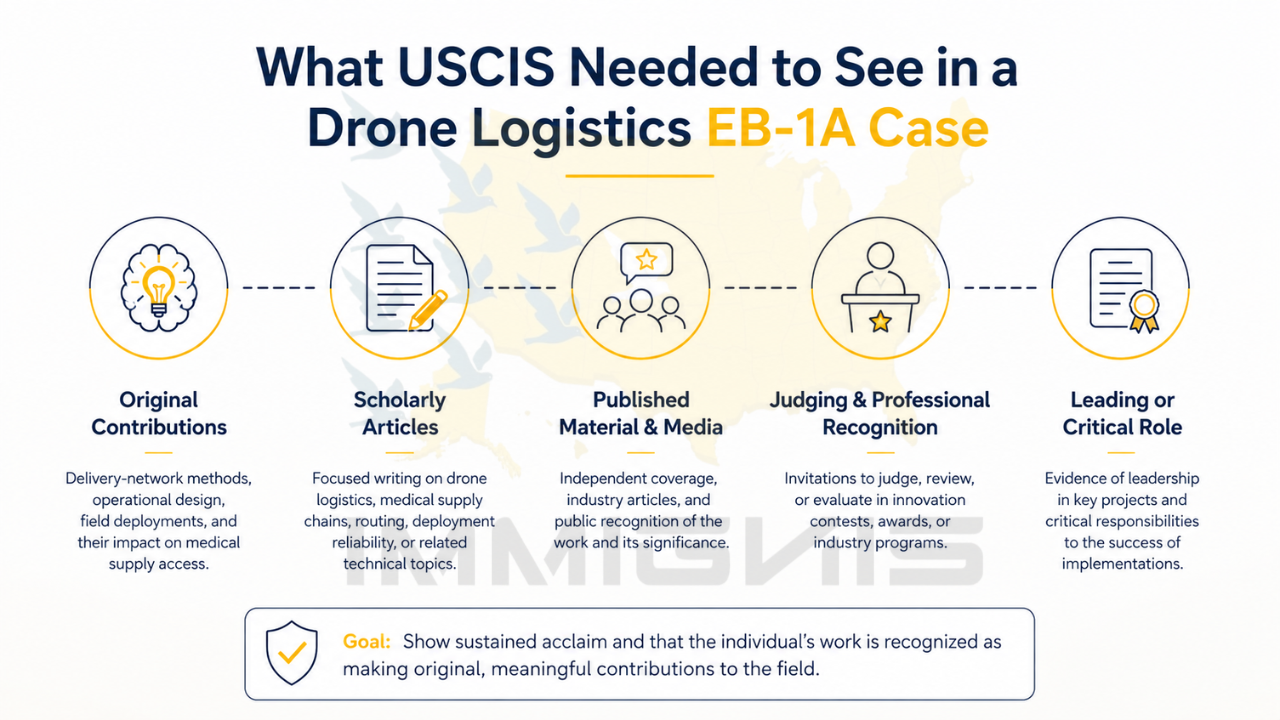
For EB-1A, a strong story is not the same as a strong petition. USCIS needed evidence that fit the regulatory criteria and also supported a favorable final-merits determination.
For original contributions, the petition had to identify his delivery-network methods, operational design work, field-deployment contributions, and documented influence on medical supply access. Deployment evidence alone could not carry the argument unless the record explained what he personally developed and why it mattered beyond routine implementation.
For scholarly articles, the record needed focused writing on drone logistics, medical supply chains, routing, field deployment, reliability, or related technical subjects. Articles unrelated to his niche would add volume without adding clarity.
For published material, the petition needed independent coverage about him, his work, or his expertise. Coverage about the startup alone would not necessarily prove his individual recognition.
For judging, the evidence had to show real evaluation of other professionals work, such as innovation-contest submissions, technical proposals, or peer-reviewed work. A speaking role or event attendance could not be treated as judging.
For leading or critical role, the file needed to show that significant drone-logistics or medical-supply-chain work depended on his technical judgment, not merely that he held a job title inside a promising company.
The deployment record was rebuilt around decisions, not flight counts
One of the most important improvements was how the implementation evidence was organized. A simple count of flights, routes, facilities, or deliveries can impress a general reader, but USCIS still asks whether the evidence proves the individual contribution and the level of recognition required for EB-1A.
The petition grouped the operational material by the decisions his work affected: how routes were selected, how delivery timing was monitored, how payload limits were handled, how facilities prepared to receive items, how failed or delayed delivery was addressed, and how delivery evidence connected back to health-supply-chain needs.
Where metrics were available, they were used with care. The record did not invent lives saved, disease outcomes, or public-health results that the evidence could not prove. Instead, it focused on supported operational indicators, such as delivery reliability, service reach, fulfillment processes, time-sensitive logistics, or documented use by health-system stakeholders.
That approach made the deployment evidence more credible. It showed a logistics method being used in the real world without exaggerating the medical consequences beyond the record.
The technical papers gave the work a public language
Many engineers in emerging fields face the same problem: their most valuable work is visible inside operational systems but not in public authorship. For this case, the publication strategy did not try to recreate confidential company records. It turned the professional questions behind the work into publishable subjects.
The papers addressed drone delivery networks, medical supply routing, service reliability, last-mile access, payload and route constraints, and the integration of unmanned delivery into health supply chains.
One article examined why the value of a drone network cannot be measured only by whether a flight succeeds. A delivery system for medical supplies must also consider request timing, inventory needs, route repeatability, facility coordination, and whether the result helps the health system act sooner or more reliably.
Another paper addressed the difference between a demonstration flight and a delivery network. A demonstration proves that a route can be flown. A network requires repeatable service logic, operational monitoring, exception handling, and a way to connect delivery events with supply-chain decisions.
The health-supply-chain white paper made the public value easier to understand
The white paper was written for healthcare logistics, public-health, and innovation audiences. Its purpose was not to advertise a product. It explained the conditions under which drone delivery may become relevant to medical access.
The paper organized the subject around stockouts, distance, road disruption, time-sensitive supplies, laboratory and pharmacy coordination, payload limitations, landing-site readiness, delivery confirmation, and the governance needed when health systems use new logistics channels.
It also kept the claims disciplined. Drone delivery is not a replacement for health-system planning, inventory management, emergency transport, or local clinical capacity. Its value depends on whether the delivery network solves a defined access problem and whether the system can use the delivered item at the right time.
That balanced explanation helped the case. It showed technical and policy maturity rather than startup enthusiasm.
Media coverage and talks moved the story beyond the startup
Trade-media coverage helped make the client visible as a professional voice in drone logistics and medical supply access. The strongest coverage did not merely describe a company announcement. It connected him to the technical and operational questions that defined his niche.
He explained why medical drone delivery depends on more than aircraft capability. The public discussion covered route reliability, payload planning, receiving-site coordination, cold-chain or handling concerns where relevant, service continuity, and how delivery records can support better decisions by health-supply-chain teams.
Conference talks added another form of recognition. They placed his work in front of professionals who could challenge the assumptions behind medical drone networks: reliability, safety, scale, regulatory environment, data capture, and the difference between an impressive pilot and an operational service.
Those talks were documented as speaking and professional recognition. Where he evaluated other innovators or submissions, that evidence was handled separately under judging.
Judging evidence showed reliance on his technical judgment
The petition documented judging in innovation contests where he evaluated submissions or proposals connected to drones, health logistics, supply-chain innovation, robotics, or public-interest technology.
This evidence mattered because judging asks a different question from authorship or media. It shows that an organization trusted the petitioner to assess the work of others. The case documented the event, selection process where available, his actual judging role, and the types of submissions he reviewed.
The petition did not confuse participation with judging. Attendance, speaking, mentoring, or networking can support the broader professional story, but judging requires evaluation of other professionals work. Keeping that distinction clear improved the credibility of the file.
Patent and trademark evidence were used carefully
The record included patent or invention-related evidence where it helped connect him to a technical concept in drone logistics, delivery-network design, routing, payload handling, operational monitoring, or related systems.
Patent evidence can help show inventorship and attribution, but a patent filing is not automatically proof of major significance. The petition connected the invention evidence to the broader record: deployments, technical papers, expert letters, and the medical-supply-chain problem the work addressed.
Trademark evidence was treated differently. It helped identify a public-facing platform, product, or brand associated with the work where relevant, but it was not presented as proof that a technical contribution was significant. This distinction prevented the record from sounding inflated.
Independent letters explained why the work mattered
Independent expert letters helped translate the record for USCIS. The most useful letters did not offer generic praise. They explained the medical logistics problem, the role of drone networks, the petitioners specific contribution, and why the work was significant beyond one employer or one deployment context.
Letters from drone-logistics, health-supply-chain, public-health, and technology experts addressed practical questions: how medical supply delay affects access, why network reliability matters, how unmanned delivery changes distribution options, and why the petitioners work represented more than routine implementation.
The letters also helped connect the criteria to final merits. USCIS could review the papers, deployments, media, talks, judging, and role evidence as one record of a professional whose expertise had been recognized in a defined field.
How the EB-1A evidence came together
This case was not approved because one document was dramatic. It worked because the evidence pieces supported the same professional identity.
The scholarly articles gave the field a technical foundation. The operational metrics showed that the work was not purely theoretical. The white paper explained the public-health and supply-chain context. Media coverage and talks showed public recognition. Judging showed that outside organizations relied on his technical assessment. Patent and trademark evidence supported attribution and visibility where appropriate. Independent letters explained why the contribution mattered beyond one startup story.
Most importantly, the petition kept returning to one narrow authority niche: drone delivery networks for medical supply access.
Why this approval matters for other founders and engineers
Many startup engineers believe product traction will speak for itself. Sometimes it does. Often it does not.
A product may be useful, a pilot may be promising, and a company may attract attention, but EB-1A still requires evidence of the individuals extraordinary ability. The petition must show what the person contributed, how the field recognized the work, and why the record as a whole demonstrates sustained acclaim.
This case showed how a field deployment record can become an immigration-ready authority record when the evidence is organized around the real professional contribution. The story was not that drones are innovative. The story was that this engineer developed and documented drone logistics methods that helped medical supplies move through difficult access environments more reliably.
Approval result
USCIS approved the Form I-140 on March 27, 2026. The approved record presented the client as a Rwandan drone logistics engineer with a focused contribution to medical supply access, supported by technical authorship, documented implementation evidence, independent recognition, judging, invention-related materials, and expert analysis.
The approval is a reminder that EB-1A is not limited to traditional academic careers. Engineers, founders, and operators in applied technology fields can also build strong records when their work is documented with precision and recognized beyond the employer or startup.
For drone logistics, robotics, and health-technology professionals
If your strongest work sits inside deployments, field trials, operating dashboards, client projects, product evidence, or confidential startup records, the first question is not whether the technology sounds impressive. The first question is whether your individual contribution can be identified, documented, and understood by independent experts.
Immignis and Advance My Profile help professionals define a defensible niche, document original contributions, build credible public recognition, and prepare EB-1A records around evidence that can be verified and defended professionally.
Start with a free EB-1A profile assessment and find out whether your drone logistics, robotics, health-supply-chain, or field-deployment work can be developed into a clearer authority record.
Frequently asked questions
Can a startup engineer qualify for EB-1A?
Yes, but startup work must be documented carefully. A promising product, employer title, or investment story is not enough by itself. The record must show the individuals contribution, recognition, and evidence that fits EB-1A requirements.
Can drone delivery deployments support original contributions?
They can, especially when the petition identifies the method behind the deployment, the petitioners role, the use of the work, and its significance beyond routine implementation. Deployment evidence is stronger when supported by technical papers, independent letters, and credible operational records.
Do patents or trademarks prove extraordinary ability?
Not automatically. Patent evidence can help show inventorship and attribution. Trademark evidence can help identify a public-facing platform or brand. Neither should be treated as automatic proof of extraordinary ability or major significance without supporting evidence.
Is media coverage about the startup enough?
Usually not by itself. Published material is strongest when it discusses the petitioner, the petitioners expertise, or work that can be clearly attributed to the petitioner. Company-only publicity may help background context, but it may not prove individual acclaim.
What if the strongest metrics are confidential?
Confidential metrics can sometimes be summarized or supported through non-confidential documentation, employer letters, redacted materials, expert explanations, and safe operational descriptions. The petition should avoid exposing protected data while still explaining what the evidence proves.