How an Israeli founder used patent filings, field-trial evidence, robotics publications, media coverage, judging, an innovation award, and independent expert letters to show that autonomous harvesting work mattered beyond one startup.
Key facts at a glance
| Outcome | EB-1A approval for an Israeli agritech robotics founder working through a U.S.-based agritech startup. |
| Approval date | Approved on June 15, 2026. |
| Field niche | Autonomous harvesting robotics for specialty crops, with a focus on fruit detection, gentle crop handling, picking decisions, field variability, and harvest reliability. |
| Starting problem | The founder had product traction and useful field work, but the original record still looked like a startup story. It needed EB-1A-grade independent acclaim and clearer proof that his robotics contribution had significance beyond company development. |
| Profile built | Patent filings, field-trial data, robotics publications, an agriculture white paper, trade-media coverage, a broadcast-style interview opportunity, a pitch or innovation award, judging activity, leading-role evidence, and independent letters from agritech and robotics specialists. |
| Evidence presented under EB-1A criteria | Original contributions, published material, awards, judging, and leading or critical role. Patent filings supported attribution and original-contribution evidence; they were not treated as a separate EB-1A criterion. |
USCIS approved his Form I-140 on June 15, 2026.
The approval did not turn on the fact that he had founded a robotics company. Many founders build interesting products. For an EB-1A Agritech Robotics Founder, the legal standard is different. EB-1A asks a different question: does the record show extraordinary ability through sustained acclaim and recognized achievements in the field?
For this founder, the answer had to be built from the field itself: rows of specialty crops, unpredictable plant conditions, harvest timing, fragile fruit, labor pressure, and a robot that had to make useful decisions outside a clean laboratory setting.
The strongest story was not the pitch deck
The early record showed a founder with product traction. It described an agritech startup, an autonomous harvesting idea, field testing, and conversations with growers. That was meaningful business evidence, but it was not yet a strong EB-1A record.
A pitch deck can explain market opportunity. It can show that investors, customers, or partners are interested. It rarely proves, by itself, that the founder is recognized as one of the few at the top of a technical field.
Advance My Profile, powered by Immignis, reviewed the record with legal strategists and agritech robotics specialists. The team narrowed the case to one defensible field niche: autonomous harvesting robotics for specialty crops. That niche was specific enough for USCIS to evaluate and broad enough to matter outside one company.
The case then shifted away from general startup language. Instead of presenting him mainly as a founder trying to commercialize a machine, the petition documented the robotics work behind the machine: perception, crop identification, motion planning, end-effector design, gentle handling, field reliability, and the practical problem of harvesting crops that are not arranged for the convenience of a robot.
Why autonomous harvesting is harder than it sounds
A specialty crop field is not a factory aisle. Fruit may be hidden by leaves, shaped differently from one plant to the next, or positioned at angles that make detection and picking difficult. Light changes. Dust, wind, humidity, and plant movement affect what a sensor sees. A robot also must avoid damaging the crop, the plant, and nearby fruit that is not ready for harvest.
The technical question was not whether robotics can be used in agriculture. The narrower question was whether an autonomous harvesting system can identify a marketable crop, approach it safely, detach it with acceptable handling, and repeat that process under real field conditions often enough to reduce harvest loss or labor strain.
That distinction mattered for EB-1A. A broad claim that agriculture needs automation would have sounded like market commentary. A focused record showing how his work addressed crop detection, picking decisions, field-trial reliability, and specialty-crop constraints gave independent experts something concrete to evaluate.
What USCIS needed to see in this founder case
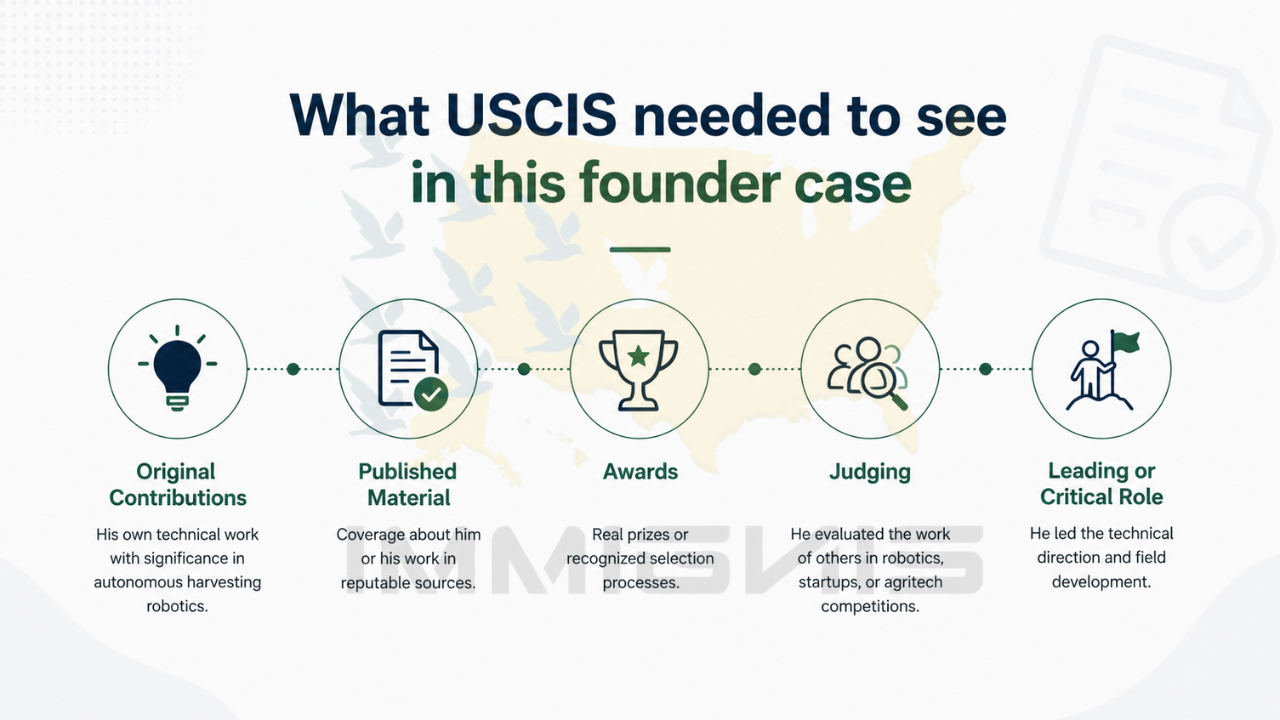
USCIS did not need a business plan. It needed evidence of individual recognition and original contribution.
For original contributions, the petition had to identify the founder’s own technical work and explain why it had significance in autonomous harvesting robotics. Product traction helped only if the record connected it to a method, invention, field-trial result, or adoption pattern linked to him.
Published material required coverage about him or his work, not general articles about farming technology. Awards evidence had to show a real prize or recognized selection process, not a paid listing or marketing badge. Judging evidence had to show that he evaluated the work of others, such as startup pitches, innovation submissions, robotics competitions, or agritech awards.
For leading or critical role, the file had to show that the startup’s technical direction and field development depended on his work. Founder status alone was not enough. The petition needed role evidence, technical decision records, product-development responsibility, and outside confirmation that his leadership mattered to the company’s robotics progress.
At final merits, the evidence also had to tell one coherent story. The patent filings, field trials, media coverage, award evidence, judging, publications, and expert letters all had to describe the same person in the same specialty.
Field-trial data changed the case from promise to evidence
The most useful product evidence came from trials that showed the robot working against real agricultural conditions. The petition did not need to claim perfect performance. In fact, the stronger approach was more careful: document the problem, explain what was tested, identify the founder’s role, and show what the trials revealed about the system’s usefulness.
The evidence addressed crop detection, picking attempts, handling conditions, repeatability, operator review, field constraints, and the difference between a demonstration and a harvest environment. Where records supported pilot outcomes, the petition used them. Where the records did not support a number, the article or petition did not invent one.
This made the original-contribution argument more credible. The robot was not presented as a miracle solution to every farm labor issue. It was presented as a technical contribution to a defined problem: helping specialty-crop growers reduce dependence on manual harvesting where timing, labor availability, and crop loss can affect the value of the harvest.
Patent filings helped trace the invention to the founder
Patent filings were important because they helped connect technical concepts to him. The filings supported attribution: who was named, what problem the invention addressed, and how the claimed concept related to autonomous harvesting.
The petition did not treat a patent filing as a shortcut to EB-1A approval. A filing by itself does not prove that a contribution has major significance. The stronger record connected patent evidence with field-trial work, technical publications, media explanation, expert letters, and the broader agricultural problem the robotics work addressed.
That combined approach made the invention evidence more useful. It showed that the founder was not only promoting a company. He was building and documenting technical work in a recognized agritech robotics specialty.
The robotics publications gave the work a public technical language
Before profile building, much of the founder’s evidence lived inside product materials and startup communications. Those materials were useful, but they were not written for USCIS and did not fully explain the engineering method.
Focused publications helped solve that problem. The papers discussed autonomous harvesting, machine vision in field environments, robotic crop handling, end-effector constraints, field-trial validation, and the gap between a laboratory prototype and a system that must work in a crop row.
The publications were not written to disclose confidential company details. They translated the technical problem into a public record that researchers, engineers, and USCIS could understand. That was especially important because many founders have strong internal know-how but little peer-facing evidence that explains their technical contribution.
The agriculture white paper connected robotics to labor and crop-loss challenges
The white paper was written for an audience beyond the startup. It addressed why specialty crops create a different automation problem from large-scale commodity harvesting. Labor shortages, harvest timing, variable crop presentation, and damage-sensitive picking all affect whether automation can be useful.
The paper did not present autonomous harvesting as a simple replacement for farm labor. It examined where robotics can help, where human oversight remains important, and why field validation matters. That tone strengthened the case because it showed technical judgment rather than sales language.
For EB-1A, the white paper helped frame the founder’s work as part of a larger agricultural and robotics conversation. It gave independent experts a public document they could discuss when explaining why his contribution mattered.
Media coverage and the interview opportunity made the work understandable
Trade-media coverage helped move the record outside the startup. The strongest coverage did not merely announce a company milestone. It explained the agricultural problem and connected the founder to the robotics approach being used to address it.
A broadcast-style interview opportunity also helped because it required the founder to explain complex robotics work to a broader audience. He could describe why specialty-crop harvesting is difficult, how automation must handle field variability, and why a useful robot must be judged by more than whether it works once in a controlled demonstration.
That public communication mattered because EB-1A published-material evidence is not only about being mentioned. The better question is whether independent sources recognized the person or the work in a way that helps establish acclaim in the field.
The award and judging evidence served different purposes
The pitch or innovation award helped show outside recognition. The record documented the nature of the award, the selecting body, the competition or review process, and the basis for recognition. That mattered because not every startup prize carries the same evidentiary weight.
Judging evidence answered a different question. It showed that others trusted him to evaluate the work of founders, engineers, competitors, or innovators. When properly documented, judging can support EB-1A because it shows the petitioner was asked to assess other people’s work in the same or an allied field.
The petition kept those two categories separate. Winning or being selected for an award is not the same as judging the work of others. Treating them separately made the file more precise and easier to defend.
Independent letters explained why the work mattered beyond one startup
The independent letters were important because founder-led evidence can look self-interested. Letters from agritech, robotics, and agricultural-innovation specialists helped explain the field significance of the work without relying only on company materials.
The strongest letters did not use generic praise. They discussed autonomous harvesting, specialty-crop constraints, field validation, labor pressure, crop-loss risk, and the technical difficulty of building a robotic system that can operate under real agricultural conditions. They also explained why the founder’s specific work was different from ordinary product development.
That kind of expert analysis helped connect the evidence. Patent filings showed attribution. Field trials showed practical testing. Publications and white papers explained the method. Media and awards showed public recognition. Independent letters helped USCIS understand why those pieces mattered together.
How the EB-1A evidence came together
Original contributions were supported by the autonomous harvesting methods, patent-linked concepts, field-trial evidence, technical documentation, and expert analysis explaining the significance of the work.
Published material was supported by independent media coverage and interview opportunities that discussed him or his agritech robotics work, not merely the general promise of automation in agriculture.
Awards evidence was supported by documentation of the pitch or innovation recognition, the selection process, and the relationship between the award and the robotics work.
Judging was supported by records showing that he evaluated the work of others in startup, innovation, agritech, robotics, or sustainability settings.
Leading or critical role evidence showed why the startup’s autonomous harvesting direction depended on his technical and business leadership. The petition connected founder status to specific responsibilities, decisions, and outcomes.
Patent filings strengthened the original-contribution record by helping trace inventions and technical concepts to him. They were used carefully and did not replace the need to prove field-level significance.
The approval
USCIS approved the Form I-140 on June 15, 2026.
The approval showed what can happen when a founder’s record is rebuilt around evidence rather than enthusiasm. The petition did not ask USCIS to approve him because agriculture needs robots or because the startup had potential. It presented a focused record showing that his autonomous harvesting work had been documented, tested, recognized, and explained by independent voices.
For founders, that distinction is critical. EB-1A is not a startup visa. It is a classification for people who can show extraordinary ability. A founder can qualify, but the evidence must prove the person’s own standing in the field.
What other agritech founders can learn from this case
Many agritech founders assume their product will speak for them. It usually does not. A product can attract customers, investors, pilots, and media attention while still leaving USCIS with unanswered questions about the founder’s individual acclaim.
A stronger EB-1A record asks more exact questions. What technical method belongs to the founder? What was tested? Who adopted or evaluated it? Who outside the company recognized it? Has the founder judged other work? Is there a real award? Are patents connected to the claimed contribution? Do independent experts explain why the work matters to the field?
When those questions are answered carefully, a founder’s record becomes easier to understand. The story moves from a company trying to succeed to a professional whose work has been recognized in a defined field.
Frequently asked questions
Can a startup founder qualify for EB-1A?
Yes, but founder status alone is not enough. USCIS must see evidence that the founder has extraordinary ability in the field. Product traction, investment, or customer interest may help, but the petition should connect those facts to the founder’s own recognized achievements and original contributions.
Can patent filings support an EB-1A petition?
Patent filings can support an EB-1A case when they help prove attribution, invention, or a technical contribution. They do not automatically prove major significance. The stronger case explains how the patented or patent-pending concept fits into the field and why independent experts consider it important.
Can field-trial data count as original-contribution evidence?
Field-trial data can be useful when it is reliable, non-confidential where needed, and connected to the petitioner’s own technical work. It should be presented carefully. The petition should avoid unsupported performance claims or inflated impact numbers that the records do not prove.
Is media coverage enough for EB-1A?
Media coverage can support published-material evidence if it is independent and discusses the petitioner or the petitioner’s work in a meaningful way. General coverage about a company, industry trend, or technology category may be less useful unless it clearly connects to the person’s recognized expertise.
What made this agritech robotics case stronger?
The case became stronger when the record moved from general startup traction to a defined authority niche: autonomous harvesting robotics for specialty crops. The petition then connected patent filings, field-trial evidence, publications, media coverage, award recognition, judging, leadership, and independent letters to that one field.
Build an EB-1A record around the technical problem your company is solving
If you are a founder in agritech, robotics, climate technology, food systems, advanced manufacturing, or a related field, your strongest evidence may not be your pitch deck. It may be the technical method behind your product, the field evidence showing why it works, and the outside recognition that proves the work matters beyond your own company.
Immignis and Advance My Profile help founders and technical professionals identify a defensible authority niche, document original contributions, build credible independent recognition, and prepare an EB-1A record around evidence that can be verified and defended professionally.