Key facts at a glance
| Outcome | EB-1A approval for a Hungarian plant scientist working at a U.S.-based agricultural university. |
| Approval date | Approved on February 12, 2025. |
| Field niche | Crop resilience traits for heat and drought conditions, with applied work tied to cultivar and field-trial evaluation. |
| Starting problem | She had a research record, but media visibility, judging activity, and evidence showing how her work moved into field and agricultural-use settings were still limited. |
| Path used | Ethical EB-1A profile building through focused publications, cultivar and field-trial documentation, an agricultural extension brief, invited talks, peer review, selective professional memberships, agricultural trade-media coverage, and independent plant-science letters. |
| USCIS EB-1A criteria activated | Scholarly articles, original contributions, published material, judging, and memberships. |
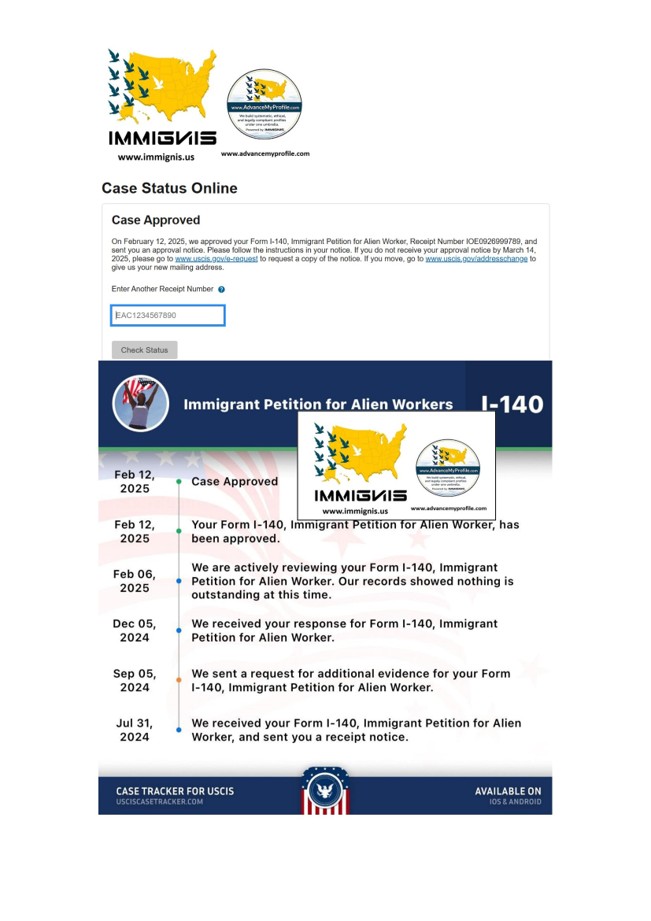
On February 12, 2025, USCIS approved her Form I-140 in her EB-1A approval after RFE case.
Her scientific files were less tidy than that timeline. They contained publications, cultivar records, trial notes, and evidence from work on crops exposed to heat and limited water.
She was a Hungarian plant scientist at a U.S. agricultural university. Her research asked a practical breeding question: which crop traits remain useful when high temperature and drought arrive in the same growing environment?
Her papers showed the science. The documents made her individual role and outside recognition harder to follow. An immigration officer needed to be able to trace her contribution through research teams, trial programs, and the wider crop-resilience community.
A crop can survive one dry season and still tell a scientist very little
Plant resilience research is difficult to reduce to a single result. A cultivar may perform differently when drought begins early, when heat arrives during reproduction, or when soil and management conditions change. Researchers also have to separate traits that look promising in one environment from traits that remain useful across repeated testing.
Her work sat inside that problem. She studied crop resilience traits under heat and drought and worked with field-trial and cultivar evidence.
A publication list could show that she had studied stress biology. It did not automatically show which evaluation questions she had helped shape, how her analyses were used, or why people outside her university should recognize her.
That gap matters in EB-1A extraordinary ability cases. A strong scientific position can produce excellent work while the scientist’s public record remains narrow.
Where the original EB-1A record was thin
There were papers, but the authorship record needed a tighter crop-resilience focus. Field work existed, but the documents did not consistently trace her individual role. Media visibility was limited. She had little developed judging evidence. Professional memberships had not been reviewed for whether the admission standards could support a USCIS EB-1A criterion. Advance My Profile, powered by Immignis, mapped the case with legal strategists and plant-science PhDs.
For USCIS, the plant trait had to lead back to the scientist
Crop and cultivar research is usually collaborative. Breeding teams, field technicians, statisticians, laboratories, and university programs may all appear in the record. USCIS still has to decide what the EB-1A petitioner personally contributed.
The two-step EB-1A review associated with Kazarian makes the distinction important. Evidence may first meet individual regulatory categories, such as scholarly authorship or judging. USCIS then considers the record as a whole in the final-merits review and asks whether the applicant has sustained acclaim and the required top-level standing in the field.
In this case, the file had to identify her scientific contribution within field-trial and cultivar work. The record needed to explain the trait questions she studied, the analyses or evaluation work linked to her, the practical use of that work where it could be documented, and the way outside plant scientists understood her contribution.
Field-trial records became stronger evidence once they were organized around decisions
Trial protocols, comparative observations, phenotype records, research summaries, collaborator evidence, and use context were organized around her individual role. Where a trial had many contributors, the file identified the part she handled instead of giving her credit for the entire program.
Once organized this way, the trial records showed where her scientific judgment entered the work. An independent plant scientist could see how she evaluated crop behavior under stress and how the work related to heat and drought resilience.
The agricultural extension brief was written for people who needed to use the science
Her agricultural extension brief translated crop-resilience research for agricultural and extension audiences. It dealt with the practical interpretation of heat and drought traits, field-trial evidence, and the limits of drawing conclusions from one season or one location.
The brief stayed close to her research. It did not promise a universal drought-proof crop or turn preliminary findings into a commercial claim.
This kind of work helped the profile because it showed that she could explain plant-resilience evidence outside a narrow academic paper. Agricultural professionals could see the questions she worked on and the care needed when trial results move toward breeding or production decisions.
The public record grew in ways a plant scientist would actually use
Agricultural trade-media coverage stayed within the same area. The useful questions were specific: why heat and drought together can complicate field interpretation, why a promising cultivar still needs repeated evaluation, and what researchers look for when studying resilience traits.
Peer review added a different form of recognition. Journals and scientific venues invited her to evaluate research by other specialists in plant science, crop stress, breeding, or closely related areas. The record documented genuine review activity and completed work where available.
Professional memberships were reviewed one by one. Open associations can be useful for networking, but the EB-1A membership criterion has its own requirements. Where membership evidence was used, Immignis documented the admission or advancement standards and how her qualifications were considered.
Researchers often come to us with years of real work and a CV that makes the work look smaller than it is. A free EB-1A profile assessment can show which evidence is already usable and where recognition, attribution, or documentation still needs work.
Independent letters had to read like plant science, not immigration praise
The letters were strongest when they explained the technical problem first. Heat and water limitation can affect crops differently depending on timing, environment, developmental stage, and genotype. A useful resilience trait has to be studied in a way that accounts for those differences.
The experts then addressed her own work. They discussed the trial and cultivar evidence available to them, the research questions she had pursued, and the place of her contribution in crop-resilience research. The letters did not rely on praise such as ‘world-renowned’ or ‘groundbreaking.’ The scientific explanation did the work.
Then came the RFE
USCIS sent a Request for Evidence on September 5, 2024.
What is documented is the later sequence. USCIS received the response on December 5. The case returned to active review on February 6, 2025. Approval followed on February 12.
The response was organized around the existing evidentiary record and the defined field. Focused publications, field-trial and cultivar documentation, the agricultural extension brief, invited talks, peer review, membership standards, trade-media coverage, and independent plant-science letters were presented as parts of the same professional history.
An RFE can expose weak explanations even when the underlying work is good. In a collaborative agricultural research case, the response has to make attribution easy to follow and keep every claim tied to documents the officer can evaluate.
What made this EB-1A success story work in plant science?
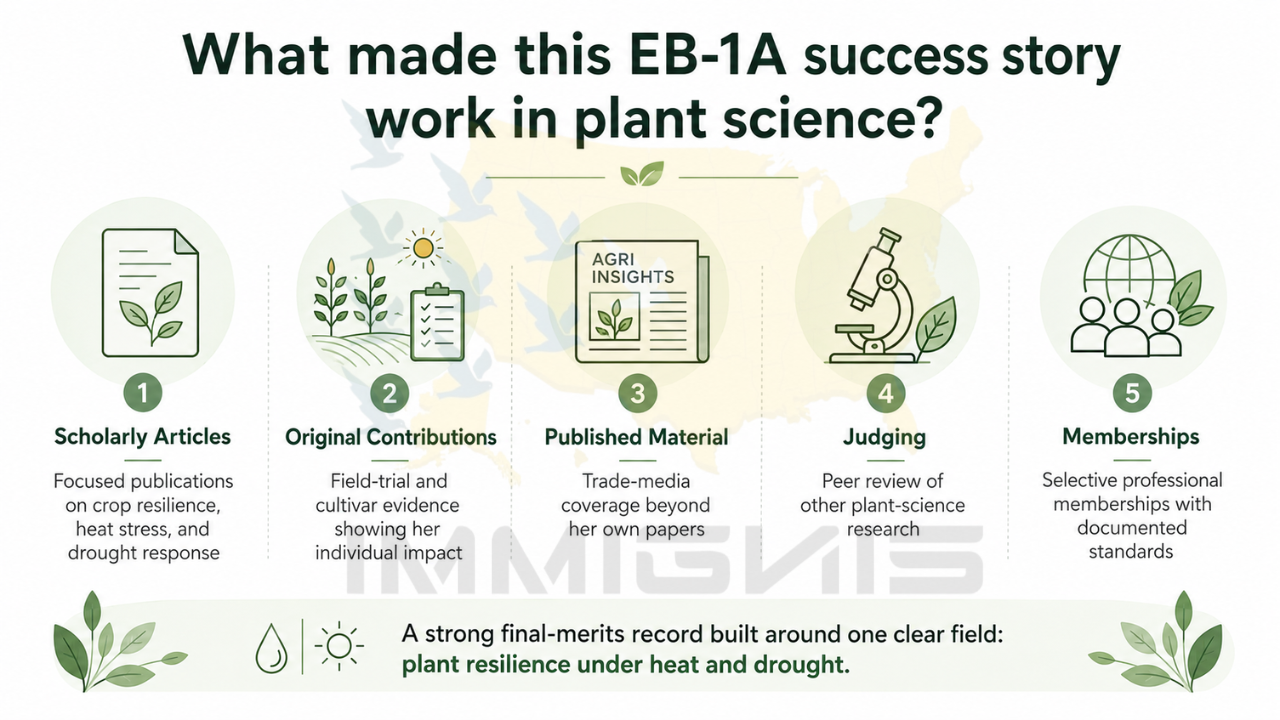
Scholarly articles: Focused publications tied her authorship to crop resilience traits, heat stress, drought response, and the evaluation of crops under difficult growing conditions.
Original contributions: Field-trial and cultivar documentation, use context where supported, and independent expert analysis explained her individual scientific contribution and its applied relevance to crop-resilience work.
Published material: Agricultural trade-media coverage discussed her work or expertise in heat and drought resilience, creating a public record outside her own authored papers.
Judging the work of others: Peer-review activity documented genuine evaluation of research by other plant-science and crop-stress specialists.
Memberships: Selective professional membership evidence was supported with the relevant admission or advancement standards and documentation of how her qualifications were assessed.
At final merits, USCIS could read the evidence as one plant-science career. Her crop-resilience work appeared in publications, field-trial records, extension communication, peer review, professional participation, trade coverage, and independent expert analysis. The petition did not depend on one paper or one media feature. The same field could be traced across several years of work and several kinds of evidence.
Approval on February 12, 2025
USCIS approved the Form I-140 on February 12, 2025.
The approval gave her an approved EB-1A extraordinary ability petition and a self-petition path that did not require employer sponsorship or labor certification. Form I-140 approval is one stage of the employment-based immigrant process; visa availability, the priority date, and the later adjustment-of-status or immigrant-visa process may still affect when permanent residence can be completed.
After filing, the same materials still had professional use. The extension brief could support agricultural outreach. Journals had a clear review area for her. Trade audiences could identify her work in crop resilience, and independent plant scientists had documents they could discuss without relying only on a university title. The EB-1A approval came after an RFE. The work that supported the case remained part of her plant-science career.
If your best crop research is buried inside a breeding or field program
You may have several seasons of trial work, phenotype data, cultivar comparisons, collaborator records, and internal research summaries with very little public recognition.
That situation is common in applied plant science. The first task is to identify what can be attributed to you and what the documents actually show.
From there, EB-1A profile building should follow the scientific subject. Publish around the same research problem. Explain field use carefully. Take genuine peer-review opportunities. Build professional visibility in crop and agricultural audiences that fit your expertise. Ask independent experts to discuss work they can evaluate.
EB-1A without employer sponsorship is available to qualifying extraordinary ability applicants, but a university position or a long publication list does not settle the case by itself. Start with the field evidence. The recognition work should grow from it.
FAQ
Can crop field-trial data support an EB-1A original-contribution claim?
Yes, when the record identifies the applicant’s own scientific contribution and provides evidence showing why that contribution has significance in the field. Trial protocols, role evidence, cultivar or phenotype documentation, use context, and independent expert analysis can help explain the contribution. A large trial by itself does not establish the applicant’s individual influence.
Does a plant scientist need a named commercial cultivar or patent for EB-1A?
No. A released cultivar or patent may be useful in some cases, but neither is a universal EB-1A requirement. Plant scientists may rely on original research contributions, scholarly articles, judging, qualifying memberships, published material, and other applicable USCIS EB-1A criteria, followed by the final-merits review of the full record.
Can an EB-1A case still be approved after a Request for Evidence?
Yes. An RFE is a request for additional evidence or clarification and is not a denial. In this case, the public tracker shows an RFE on September 5, 2024, receipt of the response on December 5, and approval on February 12, 2025. The tracker does not disclose the issue raised, so the story does not speculate about it.
Does peer review count as judging for a crop scientist?
Genuine peer review can support the criterion for judging the work of others when the scientist actually evaluates another researcher’s work. The evidence should document the invitation, the review activity, and the relationship of the work reviewed to the applicant’s field.
Should a drought-resilience researcher use EB-1A or EB-2 NIW?
The two categories ask different questions. EB-1A focuses on extraordinary ability, sustained acclaim, and the applicant’s standing in the field, while EB-2 NIW uses the national-interest-waiver framework and examines the proposed endeavor under its own legal test. A researcher may have facts relevant to both categories, but the evidence should be assessed against each standard separately.
What does final-merits review mean in an EB-1A plant-science case?
Meeting at least three regulatory criteria is only the first part of the analysis when there is no qualifying one-time achievement. USCIS then considers the evidence together and asks whether the record shows sustained national or international acclaim and that the applicant is among the small percentage at the top of the field. For a plant scientist, the officer may look at the quality and context of publications, field influence, judging, outside recognition, and the way independent evidence explains the applicant’s individual contribution.
Build an EB-1A success story from the field evidence you already have
If you work in crop breeding, plant physiology, phenotyping, agronomy, climate-resilient agriculture, or agricultural biotechnology, a publication count may tell only part of your professional story.
Immignis and Advance My Profile review whether your contribution can be traced to you, whether field or cultivar evidence can be documented, and which profile-building activities make sense for your discipline. The work may include authorship, extension communication, peer review, selective memberships, invited speaking, media, or independent expert evidence when each activity is genuine and relevant.