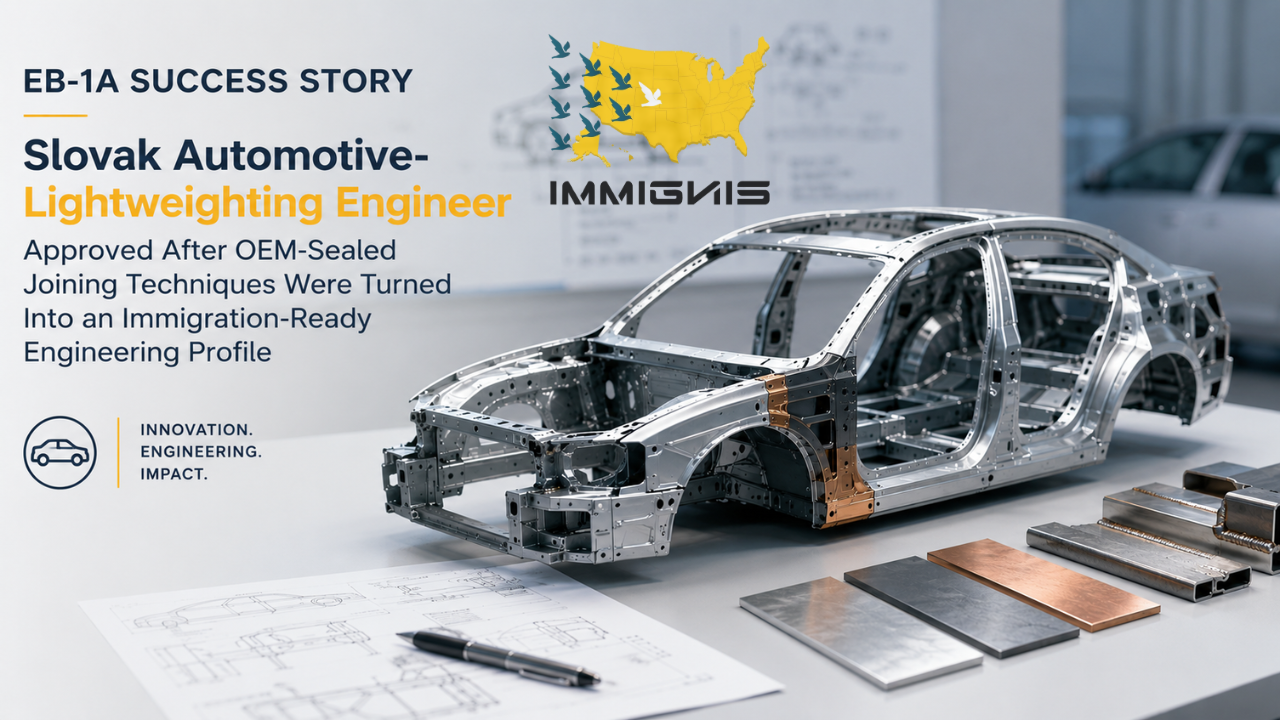
EB-1A Automotive Lightweighting Engineer: How a Slovak materials engineer secured EB-1A approval by converting confidential mixed-metal vehicle lightweighting work into a USCIS-readable record built on patent documentation, cleared technical papers, automotive-engineering society roles, conference presentations, supplier-industry letters, remuneration benchmarking, and ethical profile building.
Key facts at a glance
| Petition outcome | Form I-140 approved under EB-1A on August 22, 2024. |
| Professional profile | Slovak materials engineer whose joining techniques for mixed-metal automotive body structures were used in mass production. |
| Field niche | Multi-material joining for vehicle lightweighting. |
| Starting weakness | OEM secrecy kept the techniques inside production lines, patents, supplier systems, and confidential technical records, while the engineer's name appeared in little public literature. |
| Profile-building focus | Patent portfolio documentation, cleared technical papers, automotive-engineering society roles, conference presentations, supplier-industry letters, remuneration benchmarking, and immigration-specific profile building. |
| EB-1A criteria supported | Original contributions, scholarly articles, membership, high remuneration, and judging. |
| Central issue | Showing that confidential joining methods used in production vehicles were not routine engineering tasks, but original contributions in a strategically important vehicle-lightweighting field. |
| Approval lesson | In industrial engineering EB-1A cases, patents, cleared technical papers, supplier letters, and industry remuneration evidence can turn confidential shop-floor innovation into a strong immigration profile. |
The approval
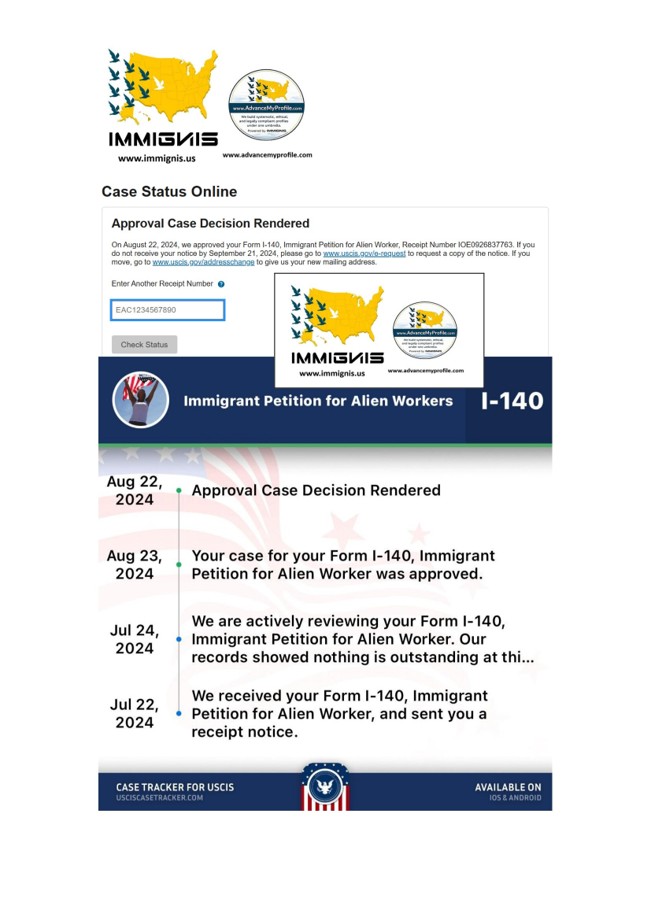
On August 22, 2024, USCIS approved the Form I-140 petition of a Slovak automotive-lightweighting engineer whose work focused on multi-material joining for vehicle body structures.
The approval mattered because the petitioner's strongest achievements were not highly visible in public media or academic citation databases. His techniques were used where automotive innovation often becomes invisible: inside OEM programs, supplier documentation, production lines, patents, and restricted engineering files.
The case therefore required careful EB-1A profile building. The work was real and technically significant, but the public-facing record did not naturally explain why his joining methods mattered to vehicle lightweighting, emissions reduction, crash performance, manufacturing efficiency, and next-generation automotive design.
Immignis and Advance My Profile helped translate that industrial record into a petition-ready immigration profile. The strategy combined patent portfolio documentation, cleared technical papers, automotive-engineering society roles, conference presentations, supplier-industry letters, remuneration benchmarking, and immigration-specific profile building designed for a confidential engineering environment.
The evidence problem in automotive lightweighting
Automotive lightweighting is one of the core engineering challenges in modern vehicle manufacturing. Carmakers must reduce mass while preserving strength, safety, durability, cost control, and manufacturability. That is why multi-material joining has become so important: steel, aluminum, advanced alloys, adhesives, mechanical fasteners, and hybrid joining systems must work together under demanding production and safety conditions.
The difficulty for USCIS is that this work rarely looks public. A successful joining technique may run in thousands or millions of vehicles, but the engineer who developed or optimized it may not be named in brochures, press releases, or journal articles. The result is a familiar profile-building problem: extraordinary industrial work can look ordinary because the evidence is locked inside corporate systems.
The petitioner's starting weakness was exactly that. The techniques were on the line, but his name was not in the literature. The OEM and supplier environment protected the intellectual property, and individual engineering credit dissolved into program names, vehicle platforms, and company branding.
The petition therefore defined the field precisely as multi-material joining for vehicle lightweighting. That field definition allowed the evidence to be evaluated through the right lens: not as general manufacturing work, but as a specialized materials-engineering niche central to lower-emission transportation and advanced vehicle design.
Why patents became the public record the industry allowed
The strongest approval hook was simple: patents became the publication record the industry allowed. In automotive engineering, important methods are often protected through patents or internal know-how rather than open academic publication. For a materials engineer working under OEM secrecy, patents can be the clearest public proof that the work was original, technical, and valuable enough to protect.
The petition used patent portfolio documentation to show authorship, technical novelty, and practical relevance. Instead of treating patents as decorative evidence, the profile-building strategy explained what each protected method solved, how it related to mixed-metal body construction, and why those problems mattered in mass production.
This evidence supported the original-contributions criterion because it connected the petitioner's methods to real engineering barriers in vehicle lightweighting. The patents showed that his work was not merely execution. It involved technical solutions recognized through formal intellectual-property channels.
For engineering profile building, immigration profile building, and EB-1A evidence development, this is an important lesson. In confidential industries, the public evidence may not be newspaper fame. It may be patent records, cleared technical summaries, supplier validation, and carefully explained production relevance.
Cleared technical papers gave USCIS the science without breaching confidentiality
Cleared technical papers helped solve the gap between confidential industrial work and USCIS-readable explanation. The petition did not expose proprietary formulas, vehicle programs, or restricted production details. Instead, it used approved non-confidential technical writing to explain the engineering principles behind the petitioner's work.
This helped show scholarly and professional authorship while respecting OEM and supplier limits. The papers explained joining challenges, material behavior, process reliability, durability considerations, and lightweighting strategy in a way a non-specialist adjudicator could understand.
The point was not to make the case look academic when it was industrial. The point was to show that the petitioner's technical knowledge could be expressed, reviewed, and recognized beyond internal emails and plant documentation.
This is where professional profile building and immigration-specific profile building became especially useful. The profile did not simply collect documents. It built a safe, public-facing explanation of confidential engineering work so that the petitioner's expertise could be evaluated against EB-1A criteria.
Supplier-industry letters turned production impact into attributed evidence
Supplier-industry letters were critical because they helped attribute work that would otherwise remain hidden behind company and platform names. In automotive programs, suppliers, tooling partners, materials specialists, and manufacturing stakeholders often know exactly which engineer solved a technical barrier, even when public records never say so.
The strongest letters explained the petitioner's role in the development or implementation of joining methods, the technical problem being solved, the importance of the solution, and the scale or significance of the production impact. These letters helped show that the petitioner was not merely part of a large engineering team, but a recognized contributor to specific lightweighting advances.
This evidence supported both leading role and original contributions. It also helped USCIS understand why confidentiality should not be mistaken for lack of distinction.
As part of ethical profile building, the letters had to be precise and credible. They could not overclaim confidential facts, and they could not reduce the case to vague praise. They had to explain contribution, attribution, and field relevance in a way that was useful for immigration adjudication.
Automotive-engineering society roles and conference presentations created field visibility
Automotive-engineering society participation and conference presentations helped place the petitioner inside the recognized professional community. For industrial engineers, these platforms often matter because they are where applied knowledge is shared without exposing proprietary details.
The petition used society roles to show professional standing and membership in relevant engineering circles. Conference presentations showed that the petitioner's expertise was not trapped inside one employer. His knowledge was valuable enough to be shared with the broader automotive and materials-engineering field.
These materials also helped with profile improvement. They gave USCIS a clearer picture of the petitioner as a professional voice in multi-material joining, lightweighting, and production engineering, rather than an unnamed employee inside a confidential OEM structure.
For applicants searching for EB-1A profile building, EB-2 NIW profile building, professional profile building, or profile building for engineers, this case shows why industry visibility matters. Even when full project details are protected, conference platforms and professional society roles can make an otherwise invisible technical career easier to prove.
Remuneration benchmarking helped show market recognition
High remuneration can be difficult to present in engineering cases because compensation depends on country, company size, seniority, and confidentiality rules. A salary figure alone rarely proves much unless it is compared carefully to the right market.
The petition used remuneration benchmarking to explain the petitioner's compensation in the context of his specialized skills, industry segment, geographic market, and technical responsibility. This helped show that the market valued his expertise at a high level relative to comparable professionals.
This evidence mattered because multi-material joining is not a generic engineering function. It sits at the intersection of materials science, production feasibility, safety performance, vehicle efficiency, and proprietary manufacturing knowledge. When the market pays a premium for that expertise, remuneration becomes part of the recognition story.
The remuneration evidence did not stand alone. It supported the overall profile together with patents, cleared papers, letters, society roles, and presentations. That combination made the case stronger than any single document could have been.
Judging and peer review showed trust in his technical judgment
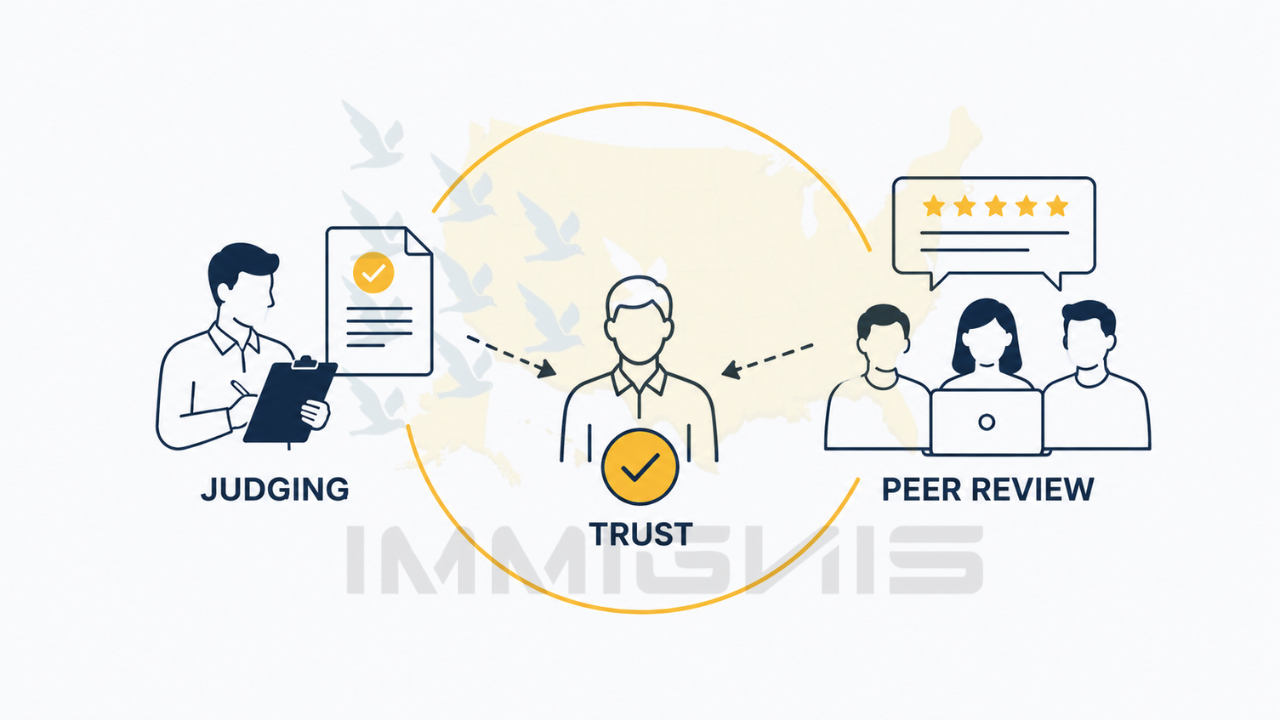
Judging evidence in this case came through peer review, technical evaluation, and professional assessment responsibilities connected to the automotive engineering field. In applied engineering, judging is not always a formal award panel. It can include reviewing technical work, evaluating papers, assessing methods, or contributing to professional standards and review processes.
The petition framed these activities carefully so USCIS could see that the petitioner was trusted to evaluate the work of others in his field. That trust supported the judging criterion and also strengthened the final merits argument.
Peer review was particularly important because the petitioner worked in an environment where publications were limited by industrial secrecy. When a professional is asked to review technical work, it confirms that others recognize his expertise even when his own proprietary contributions cannot be fully published.
This helped complete the profile. It showed that the petitioner was not only developing solutions, but also participating in the quality-control and knowledge-assessment systems of the field.
How profile building changed the case
Before profile building, the record could have looked incomplete. The petitioner had important methods, confidential project impact, technical responsibility, and industry value, but the evidence was scattered across patents, employment records, supplier relationships, professional activity, and limited public writing.
Immignis and Advance My Profile helped organize that evidence into a coherent EB-1A story. The profile-building work clarified the field niche, identified the strongest criteria, improved public-facing technical explanation, and connected confidential engineering impact to documents USCIS could evaluate.
The case also shows the difference between ordinary resume improvement and immigration-specific profile building. A resume may show job titles and responsibilities. A petition-ready immigration profile must show original contributions, recognition, field significance, and evidence that maps to USCIS criteria.
That is why this case became stronger after structured profile building. The petition did not invent achievements. It translated real automotive engineering achievements into legally usable evidence.
Why this case worked
The case worked because it treated OEM secrecy as a real evidence challenge rather than an excuse. The petition did not ask USCIS to accept vague claims of confidential importance. It built a documentary record using patents, cleared technical papers, supplier letters, professional society involvement, conference visibility, peer review, and remuneration evidence.
The field definition also mattered. By framing the petitioner as a specialist in multi-material joining for vehicle lightweighting, the petition connected his work to broader industry priorities: lower vehicle mass, emissions reduction, advanced body structures, production efficiency, and the transition toward more efficient transportation.
The approval hook was especially persuasive: patents as the publication record industry allows. In this niche, patents were not secondary evidence. They were central proof of what the petitioner contributed and what the automotive industry valued enough to protect.
Together, the evidence turned a confidential industrial engineering career into a strong EB-1A immigration profile.
Conclusion
The Slovak automotive-lightweighting engineer's EB-1A approval shows that extraordinary ability can be documented even when the most important work is hidden inside OEM confidentiality, supplier systems, patents, and production programs.
The petition succeeded because it used ethical profile building to turn confidential joining techniques into a visible and credible record. Patent documentation, cleared technical papers, supplier-industry letters, engineering society roles, conference presentations, peer review, and remuneration benchmarking worked together to show top-level expertise in a precise field niche.
For engineers in automotive, manufacturing, materials science, battery systems, mobility, industrial decarbonization, or other confidentiality-heavy sectors, the lesson is clear: a strong immigration profile can be built when the evidence is organized around contribution, attribution, and field significance rather than simple publicity.
Frequently asked questions
Can an automotive engineer qualify for EB-1A?
Yes. An automotive engineer can qualify for EB-1A when the record shows original contributions, leading roles, patents, technical publication, professional recognition, judging, high remuneration, or other evidence that the person stands out in a defined engineering niche.
Can patents support an EB-1A engineering petition?
Yes. Patents can be powerful evidence when they are tied to technical significance, industry use, production relevance, or expert explanation. In confidential industries, patents may be one of the strongest public records available.
What if an engineer's work is confidential because of OEM or supplier restrictions?
A strong petition can still be built. Cleared technical papers, redacted documentation, supplier letters, patent records, conference presentations, and expert letters can help prove the work without breaching confidentiality.
Does vehicle lightweighting qualify as a strong EB-1A field niche?
It can. Vehicle lightweighting is a technically important field connected to emissions reduction, energy efficiency, safety, and advanced manufacturing. The petition must show how the applicant's specific work contributed to that field.
Can remuneration benchmarking help an engineering EB-1A case?
Yes. High remuneration evidence is stronger when it is benchmarked against the correct country, industry, role, and specialization. It should support, not replace, the broader evidence record.
Can Immignis and Advance My Profile help engineers build EB-1A or EB-2 NIW evidence?
Yes. Immignis and Advance My Profile help engineers define a niche, document technical impact, improve public-facing visibility, prepare immigration-specific profile building strategies, and build evidence for EB-1A and EB-2 NIW petitions.
Build an EB-1A record around engineering innovation, patents, and confidential industry impact
Many engineers already have strong technical achievements, but their evidence is hidden inside patents, internal reports, supplier communications, production programs, conference records, and restricted project files.