Key facts at a glance
| Outcome | EB-1A approval for a Cuban ballet choreographer whose work moved from one-company recognition into a documented international record. |
| Approval date | Approved on April 21, 2026. |
| Field niche | Contemporary choreography rooted in Cuban classical technique. |
| Starting problem | He had a strong body of work, but much of the recognition lived inside one national company. The record lacked enough independent commissions, dance-press analysis, curated exhibition or performance documentation, judging evidence, and letters from curators or artistic directors. |
| Evidence presented under the EB-1A criteria | Artistic exhibitions and performance showcases, published material, judging, original artistic contributions, awards or juried recognition where supported, and leading or critical role. |
| Profile-building path | Immignis and Advance My Profile documented independent commissions, festival and showcase records, dance-press reviews, master classes, jury service, artist residency evidence, awards or selections supported by the record, and independent letters from artistic directors, curators, and museum or festival professionals. |
| Approval hook | The case showed that his role in distinguished dance organizations was proven through programs, contracts, playbills, commissions, reviews, and expert letters, not adjectives. |
USCIS approved the case on April 21, 2026
On April 21, 2026, USCIS approved the Form I-140 petition of a Cuban EB-1A Ballet Choreographer who had spent years developing contemporary choreography from the discipline, line, rhythm, and theatrical precision of Cuban classical technique.
At first glance, the case had a familiar weakness for performing artists. His strongest reputation was real, but it was concentrated. Many works had been staged through one national company. Much of the proof appeared in programs, rehearsals, institutional announcements, and the memories of dancers and directors who had worked with him. That kind of record can show a career. It does not automatically show EB-1A extraordinary ability.
The petition had to answer a harder question: was he merely an important creative figure inside one organization, or had his choreography become recognized beyond that setting as part of a defined contemporary dance field?
The answer came from evidence, not description. Programs, contracts, commissioned works, independent reviews, festival records, jury invitations, master-class documentation, and letters from artistic leaders turned a company-centered record into a national and international artistic profile.
The problem was not talent. It was attribution.
Artists often assume that the work speaks for itself. Immigration records rarely work that way.
A choreographic career can be visible to dancers, audiences, and artistic directors while still looking thin in a petition. A performance program may list a title but not explain the creative method. A company biography may praise the artist without proving independent recognition. A video may show a piece beautifully, yet fail to establish who commissioned it, where it was staged, whether critics reviewed it, or why the work mattered to the field.
That was the risk here. His file contained a strong body of choreography, but the evidence did not yet draw a clean line from his name to a recognized artistic contribution. The work was described as Cuban, classical, contemporary, expressive, and technically demanding. Those words were not enough.
The EB-1A record needed to show the specific artistic language he had developed: contemporary choreography shaped by Cuban classical training, but not limited to revival, repertory maintenance, or routine company assignments. It needed to show that other companies, critics, curators, festival organizers, dancers, and adjudicators treated him as a creative authority.
Why this was an EB-1A arts case, not just a performing resume
The EB-1A category is available to individuals in the arts who can show sustained national or international acclaim and recognized achievements. For artists, the evidence often looks different from the evidence used by scientists, engineers, or business executives.
A choreographer may not have scholarly citations or patents. The stronger record may involve curated performances, commissioned works, reviews, awards, festival selections, judging, master classes, distinguished company roles, and letters from recognized artistic professionals. USCIS still looks for extensive documentation and a final record showing that the artist has reached a level of distinction well above ordinary professional practice.
This distinction mattered. A long list of performances by the same company could have been read as ordinary employment or internal creative work. The petition therefore separated routine participation from evidence that carried EB-1A weight.
A work staged because an employer assigned it was treated differently from an independent commission. A company biography was treated differently from a dance-press review. An appearance in a program was useful, but stronger when combined with evidence of selection, curation, audience, venue, critical discussion, or institutional reputation.
The field was narrowed to contemporary choreography rooted in Cuban classical technique
The original profile risked being too broad. It referred to ballet, contemporary dance, Cuban dance, teaching, staging, and company leadership. All of those were true, but together they blurred the case.
Immignis and Advance My Profile narrowed the authority niche to contemporary choreography rooted in Cuban classical technique. That phrasing did important work. It allowed the petition to connect three parts of the record: the discipline of classical training, the choreographer’s contemporary vocabulary, and the cultural and technical lineage that made his work recognizable.
The case did not claim that he invented Cuban ballet or singlehandedly created a movement. It showed a more careful point: his choreography carried identifiable features that critics, directors, dancers, and curators could discuss, and those works had moved beyond a single institutional environment through commissions, showcases, reviews, and professional recognition.
That narrower field also helped the evidence avoid a common mistake in artist petitions. The petition did not ask USCIS to admire dance in general. It asked USCIS to evaluate a defined choreographic contribution in a recognizable field.
What USCIS needed to see in this choreography case
For a ballet choreographer, the strongest evidence had to do more than prove that performances occurred. The petition had to show the quality, independence, and field meaning of those performances.
For artistic exhibitions and showcases, the record documented where his choreographic works were displayed, staged, or presented, and why those venues or programs mattered. Playbills, festival catalogs, curated program pages, performance records, and documentation from presenting organizations helped show that his work reached audiences beyond internal rehearsal rooms.
For published material, the petition focused on articles and reviews about him or his work. A listing was not treated as critical coverage. A brief calendar mention was not overstated. Stronger evidence came from dance writers, cultural journalists, and art publications that discussed his choreographic voice, commissioned works, or contribution to contemporary Cuban-rooted ballet.
For judging, the petition documented invitations to evaluate emerging-artist prizes, festival entries, student choreography, or professional dance competitions. The evidence had to show that he was judging the work of others, not merely participating in a panel or attending an event.
For original artistic contributions, the record identified choreographic works, movement methods, repertory contributions, collaborations, and expert explanations of why his work mattered. Independent letters from artistic directors, curators, choreographers, and museum or festival professionals gave USCIS a way to understand the contribution without relying on promotional language.
For leading or critical role, the case used programs, contracts, commissions, rehearsal records, institutional materials, and letters from distinguished organizations. The point was simple: if a company, festival, or cultural institution relied on his choreography for a major production or program, the file had to prove that reliance with documents.
The exhibition and showcase evidence changed the center of the case
The arts criteria can be powerful when they are used carefully. For this client, the display or performance-showcase evidence helped move the story from employment to public artistic recognition.
The record collected programs for choreographic works, festival materials, curated performance listings, gallery or museum-related dance programming where available, and documentation showing the presenting organization, date, location, role, and work performed. Where a piece was restaged, the file identified whether the restaging came through the original company, an independent commission, a festival invitation, or a separate artistic partnership.
That distinction mattered. Ten internal performances of the same piece may show productivity. One curated international showcase, supported by an independent program and later critical review, can help show recognition in a broader artistic field.
The petition did not rely on vague phrases such as “internationally celebrated” or “world-class choreographer.” It showed the venues, the works, the roles, and the people who selected or discussed them.
Independent commissions proved that the work traveled
The most important strategic shift was documenting commissions outside the original national-company environment.
Commission evidence showed that other organizations wanted his choreographic voice, not merely his availability. Contracts, letters of invitation, rehearsal schedules, performance programs, and statements from artistic directors explained why the commission was offered and how the work fit the presenting company’s artistic plan.
The petition separated commissioned choreography from guest teaching, repertory assistance, and informal collaboration. That made the record easier to evaluate. A commission showed creative reliance. A master class showed professional authority. A review showed public reception. Jury service showed trust in his judgment. Together, those evidence streams supported a coherent EB-1A case.
Dance-press reviews gave the work a public critical record
Before profile building, much of the reputation lived inside the dance community. That can be a problem because USCIS cannot adjudicate private respect unless the petition documents it.
The profile therefore developed and collected independent reviews, interviews, cultural features, and dance-press analysis. The strongest articles did not merely announce a performance. They discussed choreography, movement language, staging choices, thematic concerns, or the way his work drew from Cuban classical technique while addressing contemporary subjects.
Published material was organized by source, audience, author, and subject. The record showed whether the article was about the choreographer, about a work he created, or about a production in which he held the central creative role. The petition avoided treating every mention as equal.
This helped the final merits argument. A petition can list articles, but the stronger case explains why the coverage matters and how it connects to the claimed field of expertise.
Judging evidence showed that others trusted his artistic eye
Jury service was important because it showed more than performance history. It showed that organizations asked him to evaluate the artistic work of others.
The record documented invitations to serve as a juror or evaluator for emerging-artist prizes, dance festivals, student choreography showcases, and professional or semi-professional performance programs. Where available, the file included invitation letters, event pages, scoring materials, public jury listings, and organizer confirmations.
This evidence was handled carefully. Teaching a master class was not described as judging. Speaking on a panel was not described as judging unless the panel actually evaluated submissions or awarded recognition. That discipline made the petition more credible.
For a choreographer, judging evidence can be especially persuasive because it shows that others value the artist’s standards, taste, technical judgment, and ability to distinguish promising work from ordinary work.
The master-class record supported authority, but it was not overstated
Master classes can help an artist case, but only when they are documented properly. A class taught to local students may show service. A master class hosted by a recognized company, conservatory, festival, or cultural institution can show that the artist was invited to transmit a method to other professionals or emerging artists.
The petition used master-class records to support the broader narrative of recognition. The evidence showed the host organization, the audience, the subject, and the reason he was invited. Some classes focused on Cuban classical technique as a foundation for contemporary movement. Others addressed choreographic process, partnering, musicality, or the transition from dancer to creator.
The master-class evidence was not asked to do all the work. It supported the profile when combined with commissions, reviews, judging, exhibitions or showcases, and letters from recognized professionals.
Curator, museum, and artistic-director letters explained significance
Expert letters can help an EB-1A case when they explain evidence rather than repeat praise.
For this choreographer, letters from artistic directors, curators, festival leaders, and museum or cultural-program professionals helped USCIS understand why his work mattered. The best letters discussed specific pieces, commissions, staging contexts, audience or institutional relevance, and the choreographic features that distinguished his work from routine ballet production.
A weak letter says an artist is exceptional. A useful letter explains what the artist made, how the work was selected, what changed because of it, and why knowledgeable professionals consider the contribution meaningful.
The petition used letters to connect the artistic record to the EB-1A legal questions. They were not substitutes for programs, reviews, contracts, or festival records. They helped interpret those documents.
How the EB-1A evidence came together
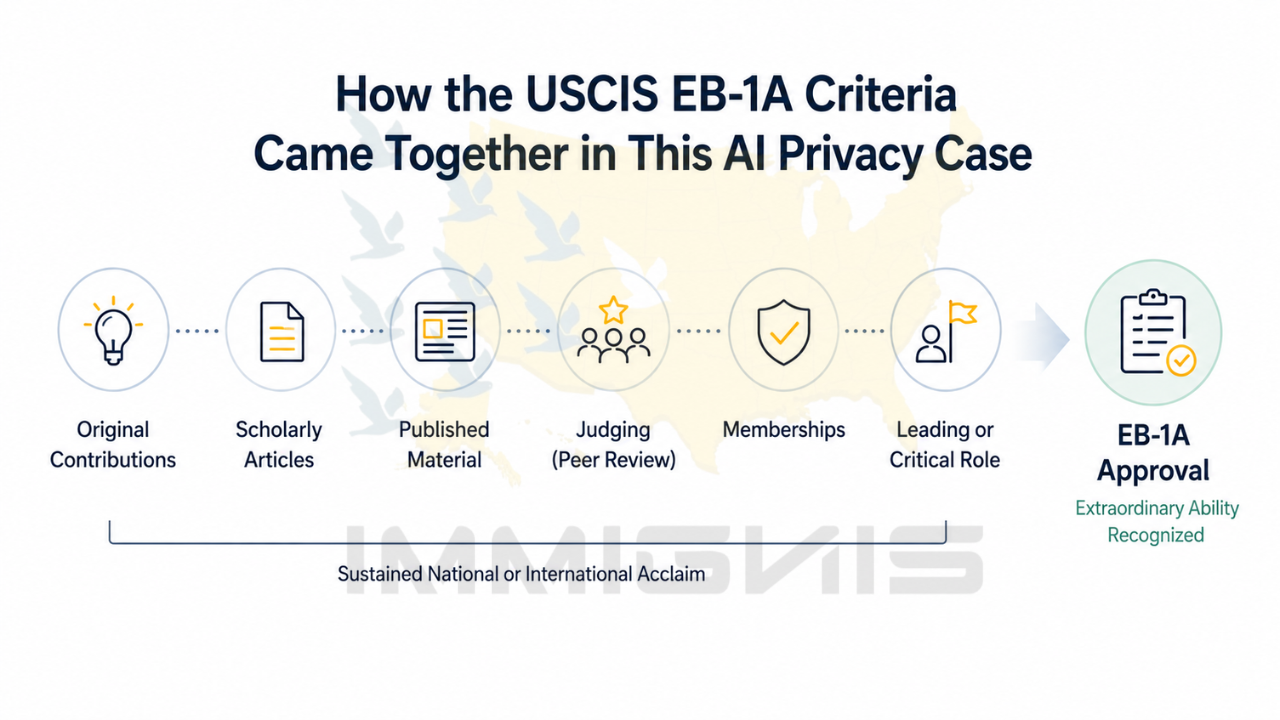
The final record worked because the evidence streams reinforced each other.
The display and showcase evidence showed that his choreographic works were presented to public or professional audiences. The commission evidence showed that independent organizations selected him for creative work. Published material gave the choreography a public critical record. Judging invitations showed trust in his evaluation of other artists. Letters from artistic leaders explained the significance of the works and his role. Awards, juried selections, or residencies were used only where the record supported their scope and selection standards.
No single document carried the case. The petition succeeded because the record stopped asking USCIS to accept reputation on trust. It showed reputation through documents that could be evaluated.
What this approval teaches performing artists
This case is useful for dancers, choreographers, musicians, actors, directors, designers, and other artists because it exposes a common problem. Artistic careers often develop through relationships, companies, festivals, residencies, rehearsals, and performances. Those settings generate real recognition, but they do not always generate clean immigration evidence.
An artist who is known inside one company may still need proof that the field recognizes the work. An artist who has performed many times may still need curated-showcase documentation. An artist with a respected style may still need reviews or expert letters explaining the original contribution. An artist who teaches master classes may still need evidence that the invitations came from recognized institutions and were based on professional achievement.
For this Cuban choreographer, the turning point was not inventing a new biography. It was documenting the career accurately. Once the record showed commissions, critical discussion, jury service, showcase history, and leadership inside distinguished programs, USCIS could evaluate the case as an arts EB-1A petition rather than as an internal company resume.
The approval
USCIS approved the Form I-140 on April 21, 2026. The approval reflected a record that presented the choreographer as more than a talented former principal dancer or a respected company insider. It showed a documented creative professional whose choreography had been commissioned, staged, reviewed, taught, and evaluated within a broader dance field.
The strongest lesson from the case is practical: EB-1A arts petitions are not won with adjectives. They are built with evidence. Programs, playbills, contracts, reviews, festival materials, jury invitations, master-class records, awards, residencies, and letters from recognized artistic professionals can turn artistic reputation into a record USCIS can review.
For artists whose strongest work is still inside one company
If you are a choreographer, dancer, painter, musician, actor, director, designer, curator, or performing artist, your strongest work may not yet be organized in a way that fits EB-1A. Immignis and Advance My Profile help identify a defensible artistic niche, build independent recognition, document public presentation of the work, and prepare an evidence record that can be explained professionally.
Frequently asked questions
Can a choreographer qualify for EB-1A?
Yes. A choreographer may qualify for EB-1A if the record shows sustained national or international acclaim and recognized achievements in the field. Strong evidence may include commissioned works, curated performances, published reviews, awards, judging, leading or critical roles, master classes, and letters from recognized artistic professionals.
Is performance inside one national company enough?
Not always. A national company record can be valuable, especially if the organization is distinguished and the artist performed a leading or critical role. The case is stronger when the record also shows recognition beyond that company through independent commissions, reviews, festivals, jury service, awards, or outside institutional invitations.
How does the artistic exhibition or showcase criterion apply to dance?
For dance and choreography, the criterion may be supported by documented presentation of the artist’s work at artistic exhibitions, festivals, showcases, curated programs, or performance venues. USCIS still needs evidence of the event, the artist’s role, the work displayed or performed, and the significance of the venue or program.
Do critical reviews matter for EB-1A artists?
Yes. Independent reviews can help show published material about the artist or the artist’s work. The strongest reviews discuss the work substantively rather than merely listing a performance date.
Can master classes support an EB-1A arts case?
Master classes can support the broader record when they are hosted by recognized institutions or professional programs and show that the artist was invited because of expertise. They should usually be combined with stronger evidence such as performances, commissions, reviews, judging, awards, or expert letters.
What made this case different from a normal dance resume?
The petition did not rely on a list of roles or performances alone. It connected the choreographer’s creative work to independent commissions, public showcases, dance-press reviews, judging invitations, and letters from artistic leaders who could explain the significance of his work in contemporary choreography rooted in Cuban classical technique.