
How a Latin-American pipeline coach turned scout letters, academy leadership, player-development evidence, salary benchmarking, and showcase judging into an EB-1A approval record.
Key facts at a glance
| Petition outcome | Form I-140 approved under EB-1A on May 5, 2026. |
| Professional profile | Dominican baseball player-development coach who prepared prospects later signed by major-league organizations. |
| Field niche | Latin-American pipeline player development. |
| Starting weakness | Signed players showed results, but the original record did not clearly connect those outcomes to the coach. |
| Profile-building focus | Signing-class attribution letters from scouts and executives, academy leadership records, baseball-media features, salary benchmarking, clinic and showcase judging roles. |
| EB-1A criteria supported | Leading role, original contributions, high remuneration, published material, and judging. |
| Central issue | Proving the coach's role in player development rather than relying on the later success of athletes alone. |
| Approval lesson | In baseball development cases, the strongest evidence often comes from the field's own decision-makers: scouts, academy directors, executives, and player-development officials. |
The approval
On May 5, 2026, USCIS approved the Form I-140 petition of an EB-1A Baseball Coach whose career had a problem that many coaches in elite sports understand immediately. His results were visible through the players. His own name was not always visible in the record.
Several athletes he helped prepare later entered professional pathways and were signed by major-league organizations. To people inside the baseball pipeline, that meant something. It suggested that his coaching was not recreational, informal, or ordinary. It showed that he worked in the serious development channel where raw talent is identified, trained, corrected, tested, and presented to scouts.
For EB-1A, however, that was not enough by itself. A prospect's signing agreement does not automatically prove that a specific coach has extraordinary ability. A player may have been influenced by family, scouts, trainers, academies, games, showcases, strength programs, and timing. The petition had to prove what this coach actually did and why people with authority in baseball credited his work.
That became the heart of the case: converting a reputation known around fields, academies, and scouting circles into documents that USCIS could evaluate.
The evidence problem in baseball development
Baseball is full of informal reputation. A scout may know which coach consistently prepares prospects. An academy director may know which instructor fixes swing decisions, throwing mechanics, defensive reads, base-running habits, or mental discipline. A general manager may hear the same name from evaluators across a region. But those judgments are often exchanged in calls, WhatsApp messages, clubhouse conversations, showcase notes, or private scouting reports. They do not naturally become a public immigration record.
The petitioner's starting weakness was not a lack of real work. It was that the strongest proof lived in places that were not automatically visible: athlete development history, internal academy records, scout memory, and the coach's reputation for preparing players before they became known. USCIS needed evidence that could show individual contribution, field recognition, and sustained professional standing.
This required a narrower field definition. The case was not presented as general baseball coaching, youth training, or sports management. It was built around Latin-American pipeline player development: the specialized work of identifying, preparing, and advancing players from academy and showcase environments toward professional opportunity.
That field definition mattered. It gave the petition a realistic measuring stick. The question was not whether the coach was famous to casual baseball fans. The question was whether he had achieved recognition among the people who evaluate, sign, train, and advance prospects in the Latin-American baseball pipeline.
Why signed players were only the beginning
It would have been tempting to make the case about the players who were signed. That would have been risky. USCIS could reasonably ask whether those signings proved the athlete's talent rather than the coach's ability. A strong EB-1A petition cannot simply stand next to another person's achievement and claim ownership of it.
The record therefore treated signed-player outcomes as a starting point, not the conclusion. The question became: who can credibly explain the coach's role in those outcomes? The answer came from the baseball community itself.
The strongest evidence included letters from scouts, executives, academy leaders, and other baseball professionals who could describe his contribution in concrete terms. Good letters did not merely say he was hardworking or respected. They explained how he evaluated raw players, what he changed in their development, which skills he helped refine, and why his training made them more prepared for professional assessment.
That distinction changed the case. Instead of asking USCIS to assume that player signings proved the coach's ability, the petition showed how qualified baseball decision-makers attributed specific development work to him.
Scout and executive letters became the currency of acclaim
In some fields, acclaim appears in citations, museum catalogs, patents, major awards, or peer-reviewed journals. In player development, one of the most meaningful forms of recognition can come from scouts and front-office professionals. These are the people whose job is to identify whether a player is ready, projectable, disciplined, and worth organizational investment.
The petition used that reality carefully. Scout and executive letters were not treated as courtesy endorsements. They were framed as field evidence because they came from individuals with direct knowledge of the player-development system. They could explain what separates ordinary training from meaningful prospect preparation.
The best letters answered practical questions: Did the coach work with players who later advanced? What part of the development process did he control? Was his work known to scouts before the player became prominent? Did evaluators rely on his judgment? Did his academy role or training method influence how prospects were presented to professional organizations?
These letters gave USCIS a way to understand a career that does not always produce neat public records. They also helped the petition avoid exaggerated claims. The point was not that every player outcome belonged to the coach. The point was that independent baseball professionals recognized his contribution as important within the pipeline.
Academy leadership showed more than a job title
The case also needed leading-role evidence. In sports, a title can be misleading. A person may be called a coach but have limited responsibility, or he may have a modest title while controlling the core development decisions that determine whether a prospect becomes ready for elite evaluation. USCIS needed more than a label.
The petition documented the coach's role within academy and player-development environments. It focused on what he actually did: organizing training, guiding prospect preparation, coordinating with evaluators, developing players for showcases, and helping create the conditions under which athletes could be assessed by higher-level baseball organizations.
That evidence helped show that his role was leading or critical within distinguished organizations or development settings. It also kept the story grounded. The case did not ask an officer to accept that any baseball academy position is extraordinary. It showed why this petitioner's responsibilities mattered within the organizations where he worked.
For coaches, this is often the difference between a weak and strong record. A resume may list coaching positions. An EB-1A petition must show why those positions carried recognized responsibility and why the person's work was important to the organization's athletic mission.
Original contribution in a coaching case
Original contribution can be difficult in sports cases because coaching methods are often practical, not academic. A coach may not publish a research paper about swing timing or defensive footwork. Yet a serious coach may develop a recognizable training approach that other athletes, academies, or evaluators rely upon.
For this petitioner, the original-contribution evidence was built around player-development methodology. The petition explained how he evaluated prospects, corrected skill gaps, prepared athletes for showcases, and helped translate raw ability into professional readiness. The work was not described as a vague passion for mentoring. It was described as a technical development system within baseball.
That mattered because USCIS looks for contributions of major significance, not ordinary job performance. The evidence therefore had to show adoption, reliance, or recognition. Letters from scouts and executives explained why his methods produced players who were better prepared for professional evaluation. Academy records showed that his role was not isolated. Media coverage and clinic records helped show that his knowledge had moved beyond private training.
The petition did not claim that his method reinvented baseball. It made a narrower, more defensible point: within the Latin-American player-development pipeline, his approach to preparing prospects had been recognized and relied upon by serious baseball professionals.
Published material and media coverage
Baseball media often follows players, signings, games, and rankings. Coaches behind the pipeline may appear only in passing. The profile-building work therefore focused on coverage that named the petitioner, described his development work, or placed him inside the broader professional conversation about Latin-American baseball training.
This type of published material helped with two goals. First, it made the coach visible outside private academy networks. Second, it helped explain his field to readers who may not know how prospect development works before a player reaches a major stage.
The petition treated media coverage as supporting evidence, not as decoration. Articles and interviews were useful when they discussed the coach's role, his training philosophy, his player-development results, or his standing among baseball professionals. Passing mentions were less valuable. The strongest pieces helped show that his work had become recognizable in the field.
High remuneration had to be benchmarked correctly
The high-remuneration criterion can be useful for elite sports professionals, but it must be handled carefully. A coach's earnings should be compared against a reasonable group of similar professionals, not against athletes, executives, or unrelated occupations. Otherwise, the evidence can create confusion rather than strength.
In this case, the salary and remuneration evidence was organized with proper context. The petition looked at compensation connected to player development, academy leadership, specialized coaching, showcase preparation, private training, consulting, and related baseball roles. The goal was to show whether the petitioner was paid at a level consistent with recognized expertise in his field niche.
That evidence became stronger when paired with the rest of the record. Compensation alone rarely proves extraordinary ability. But when higher earnings align with scout recognition, academy responsibility, player results, media coverage, and judging or selection roles, they can support the broader conclusion that the person is valued above the ordinary level.
Judging and evaluation inside the baseball pipeline
The judging criterion in a sports case does not always look like academic peer review. In baseball, evaluating athletes at clinics, showcases, camps, tryouts, or selection panels can involve judging the work of others. The key is to document the role, the event, the selection standards, and the level of athletes or applicants being evaluated.
The petition used clinic and showcase judging roles to show that the petitioner was trusted to evaluate other players, not only to train his own athletes. That distinction was important. A coach who is invited to assess talent for selection, ranking, advancement, or competitive opportunity is performing a role that reflects field trust.
The record identified the events, explained the evaluation responsibilities, and connected the work to the baseball development system. This helped turn practical scouting and selection activity into evidence that could fit the EB-1A judging criterion.
How the EB-1A criteria worked together
The petition did not depend on one perfect document. It worked because multiple forms of evidence pointed in the same direction: this coach had become a recognized figure in Latin-American player development, and qualified people in the field could explain why.
- Leading role: Academy leadership records and professional letters documented responsibility in serious player-development settings.
- Original contributions: Methodology evidence and attribution letters showed that his coaching approach helped prepare prospects for professional evaluation.
- High remuneration: Salary and compensation evidence was benchmarked against relevant coaching and player-development roles.
- Published material: Baseball-media coverage made his work visible and explained his role in the development pipeline.
- Judging: Clinic and showcase evaluation roles showed that the field trusted him to assess the ability and readiness of other athletes.
The strongest part of the record was coherence. The evidence did not drift into unrelated claims about general athletic achievement. It stayed focused on the same specialty: developing Latin-American baseball prospects for the professional pipeline.
The final-merits argument
At the final-merits stage, the petition had to show more than satisfaction of individual criteria. It had to demonstrate that the full record established sustained acclaim and that the petitioner belonged among the small percentage at the top of his field.
The argument centered on field recognition rather than publicity. The petitioner was not famous in the way a player may be famous. His acclaim came from the people who understood player development: scouts, executives, academy leaders, coaches, and evaluators. Their evidence carried weight because it came from the system that identifies and advances baseball talent.
The final record showed that his expertise had been recognized through leadership responsibility, trusted evaluation roles, compensation evidence, media coverage, and direct attribution from qualified baseball professionals. It also showed that his work mattered in a field where careers can be shaped long before a player appears on a major broadcast.
That is why the case was stronger than a list of signed players. It told USCIS who the coach was within the field and why the field's own decision-makers credited his work.
Why the approval mattered
The approval mattered because it showed how a sports-development professional can qualify without being the athlete in the spotlight. Baseball depends on people who prepare talent before the public knows the athlete's name. Those professionals can have extraordinary careers, but only if the evidence makes their role visible.
For this Dominican coach, the petition did not try to make him look like a player, a scout, or an executive. It documented his own field: player development. It showed that his contribution existed in the work between raw ability and professional opportunity. That work is often informal, but it can be proven when the right people explain it and the record is organized around a clear specialty.
The approval confirmed the central lesson of the case: in sports coaching, the question is not only who won, signed, or advanced. The question is who can prove a recognized role in making that advancement possible.
Lessons for baseball coaches and player-development professionals
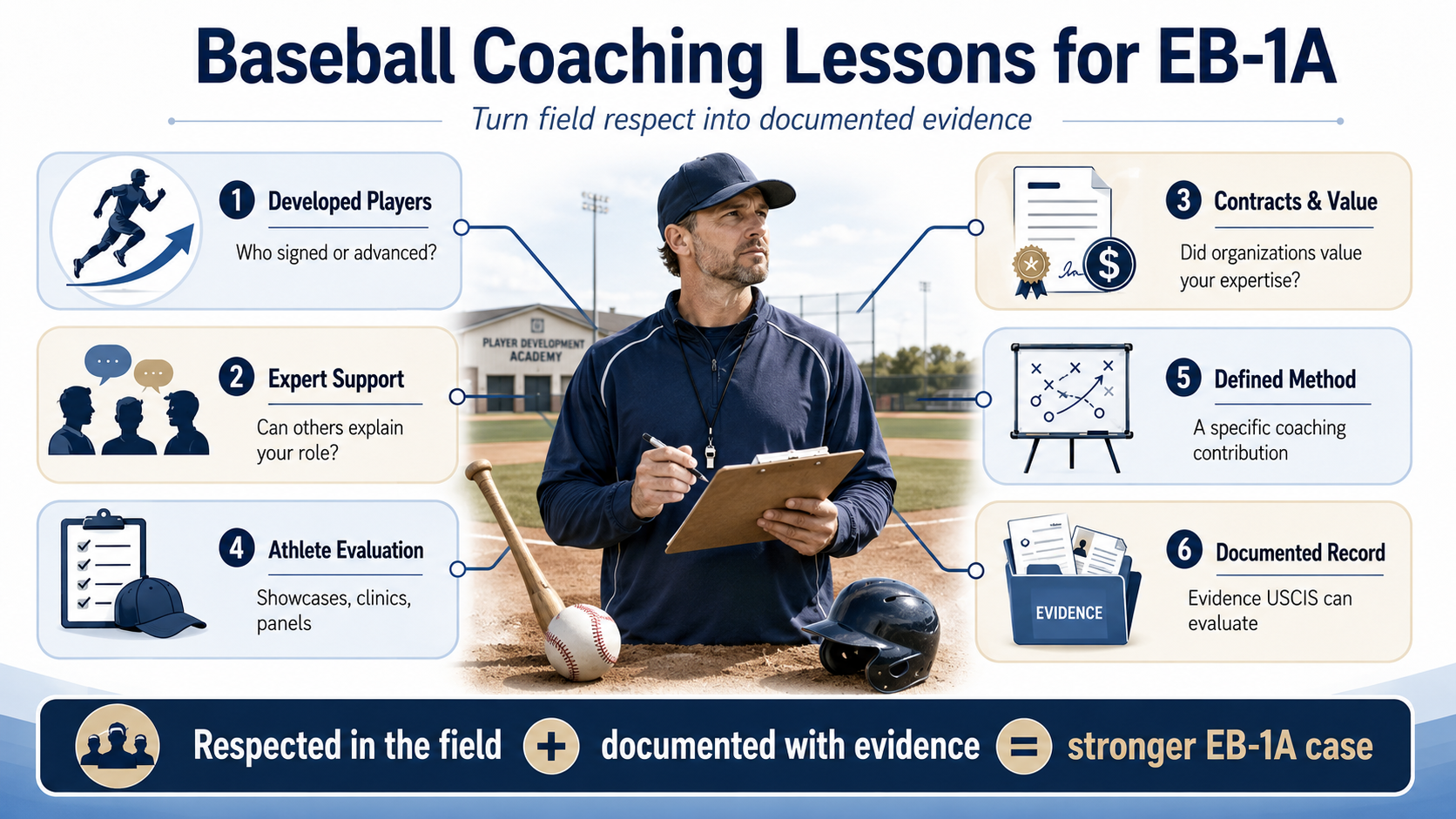
This case is useful for baseball coaches, academy directors, trainers, scouts, strength coaches, player-development coordinators, and sports professionals whose influence appears through athletes rather than through their own headlines.
A strong record usually begins with the following questions:
- Which signed or advanced players can be credibly connected to your specific coaching role?
- Can scouts, executives, academy leaders, or federation officials explain your contribution in detail?
- Do your contracts, leadership records, or compensation documents show that organizations valued your expertise?
- Have you evaluated other athletes through showcases, clinics, selection panels, tryouts, or sanctioned programs?
- Can your development method be described as a specific contribution rather than general coaching experience?
When those questions are answered with documents, a coach's reputation can become a record USCIS can evaluate. That is the difference between being respected in the field and being documented for EB-1A.
Frequently asked questions
Can a baseball coach qualify for EB-1A?
Yes. A baseball coach may qualify for EB-1A if the evidence shows sustained acclaim and extraordinary ability in the coaching or player-development field. The petition must document the coach's own recognition, role, and contribution, not only the success of athletes he trained.
Can signed players support a coach's EB-1A petition?
They can support the petition when credible documents connect those player outcomes to the coach's work. Useful evidence may include letters from scouts, executives, academy leaders, players, and coaches who can explain the petitioner's role in development, preparation, evaluation, or advancement.
What kind of letters are strongest in a baseball coaching EB-1A case?
The strongest letters come from people with authority in the baseball pipeline, such as scouts, general managers, player-development executives, academy directors, federation officials, and respected coaches. The letters should describe specific contributions, not generic praise.
Can showcase or clinic evaluation count as judging for EB-1A?
It may count when the petitioner was invited or assigned to evaluate the work of other athletes and the event, selection process, and judging responsibilities are properly documented. The petition should explain the level of the event and why the evaluation role reflects field trust.
Does high remuneration help a sports coach's EB-1A case?
High remuneration can help if compensation is documented and compared to the right peer group. For a baseball player-development coach, the comparison should be against relevant coaching, academy, training, consulting, or player-development roles rather than unrelated sports or business positions.
Can Immignis and Advance My Profile help sports coaches build EB-1A evidence?
Immignis and Advance My Profile help coaches, athletes, trainers, and player-development professionals identify a focused field niche, organize attribution evidence, document recognition, and build a professional record that can be presented clearly in an EB-1A petition.
Build an EB-1A record around the players you helped develop
Many coaches are known inside their sport but almost invisible on paper. Player results, scout relationships, academy leadership, showcase judging, training methodology, and compensation records can support an EB-1A case when they are organized around a clear professional niche.