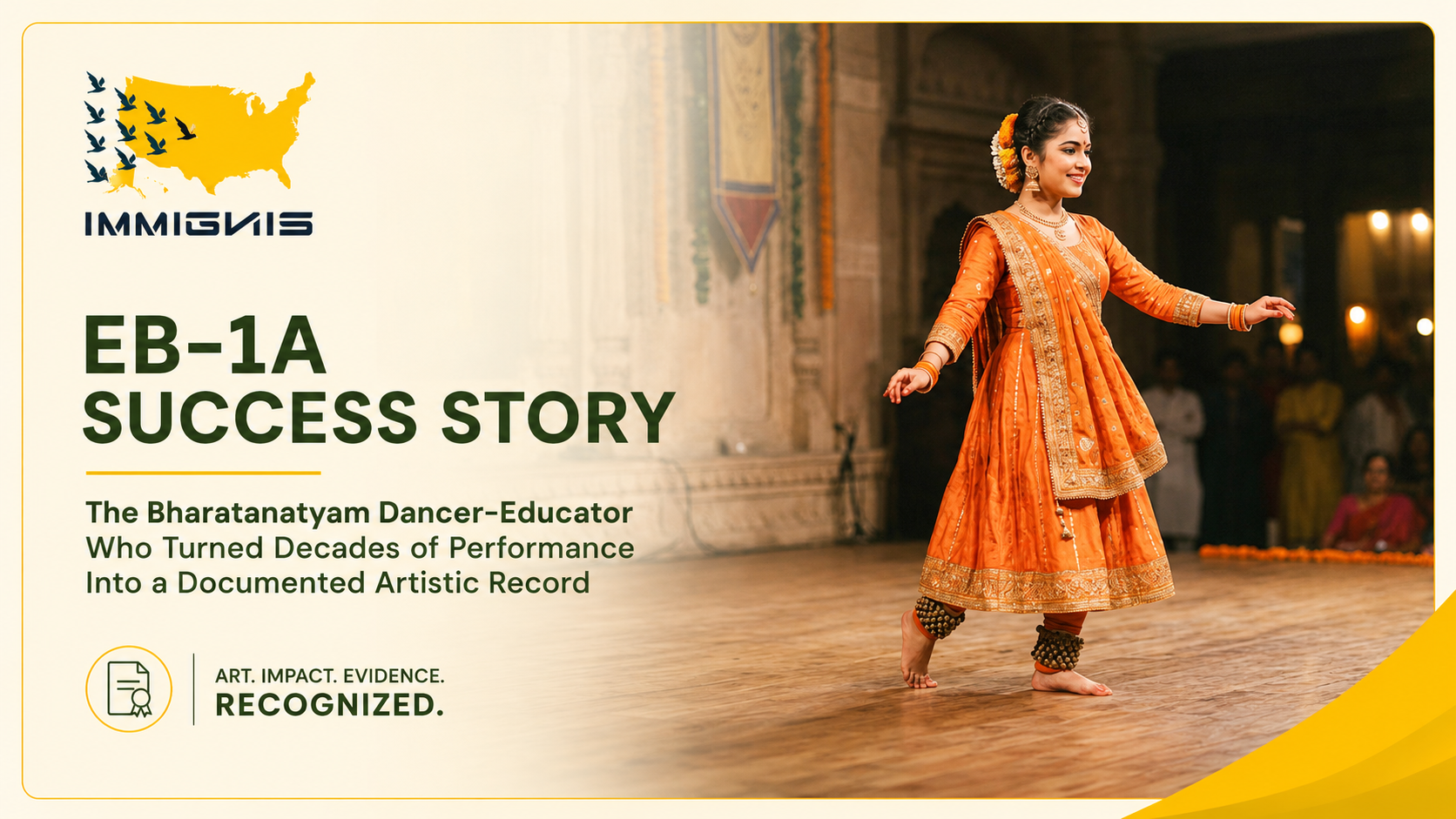
How an Indian classical dancer used festivals, teaching lineage, arts coverage, judging, and cultural institution letters to make a traditional arts career understandable for EB-1A
Key facts at a glance
| Outcome | EB-1A approval for an Indian Bharatanatyam dancer educator with a long record of performance, teaching, and cultural work in the diaspora. |
| Approval date | Approved on March 10, 2026. |
| Field niche | Bharatanatyam performance and pedagogy in the diaspora, with a focus on classical technique, repertoire transmission, teaching lineage, festival performance, and cultural education outside India. |
| Starting problem | The petitioner had decades of performance and academy leadership, but the record had almost no paper trail. Festival programs, institutional invitations, press coverage, adjudication evidence, and documentation of teaching lineage were limited or scattered. |
| Profile-building path | Immignis and Advance My Profile rebuilt the record through documented festival headline performances, arts press coverage, adjudication of classical dance competitions, cultural-institution letters, teaching lineage evidence, academy leadership documentation, and a clearer explanation of Bharatanatyam prestige markers. |
| EB-1A evidence presented | Display of artistic work at performances and cultural showcases, judging, published material, leading or critical role, and original artistic or pedagogical contributions. |
On March 10, 2026, USCIS approved the Form I-140 petition of an Indian EB-1A Bharatanatyam Dancer and educator whose career had been visible to students, cultural organizations, and festival audiences for years, but not yet visible in the way an EB-1A record requires.
Her work did not begin with a new app, a patent filing, or a laboratory result. It began with a classical art form that depends on discipline, memory, lineage, expression, rhythm, and transmission from teacher to student. She had performed at cultural festivals, trained students through her academy, and carried Bharatanatyam into diaspora communities that wanted their children to encounter more than a short stage item at an annual function.
The problem was not whether she had an artistic career. The problem was proof.
For many traditional artists, the most meaningful recognition is oral, institutional, or community-based. A respected organizer invites the dancer again. A senior teacher acknowledges the rigor of the school. Students travel for training. Parents trust the academy. A cultural association gives the artist a headline slot because the audience understands what that means. Years later, very little of that may exist as immigration evidence.
That was the central challenge in this EB-1A case: how to turn decades of Bharatanatyam performance and pedagogy into a documented record that USCIS could evaluate without asking the officer to already understand the hierarchy of Indian classical dance.
The case had to teach USCIS how prestige works in a traditional art form
Bharatanatyam is not measured by the same signals that appear in many commercial entertainment careers. A classical dancer may not have box office rankings, Billboard charts, streaming revenue, or the kind of publicity machinery that follows film and pop music. Prestige can appear through lineage, repertoire, festival selection, teaching authority, institutional invitations, adjudication roles, and recognition by cultural bodies that understand the art form.
The petition therefore needed to do more than describe her as a talented dancer. It had to explain the field itself. It had to show why a headline performance at a recognized cultural festival matters, why a teaching lineage can carry evidentiary value, why judging a classical dance competition reflects trusted expertise, and why letters from cultural institutions are different from friendly testimonials.
This became the legal and editorial theme of the case: traditional arts can qualify for EB-1A, but the petition must translate the field’s own hierarchy of prestige into evidence that is clear, documented, and credible.
Why decades of performance still looked weak at the beginning
The petitioner’s original record had a common weakness. It described many years of performance and teaching, but the documentation was uneven. Some events had posters but no program book. Some programs named the academy but not the dancer’s role. Some festival appearances were known within the community but had no independent press coverage. Teaching had influenced many students, but the record did not yet explain how her pedagogy differed from routine dance instruction.
From an EB-1A perspective, that created risk. A long career can show experience, but experience is not the same as extraordinary ability. A respected academy can show leadership, but USCIS still needs evidence of the organization’s standing and the petitioner’s role within it. A performance list can show activity, but the petition must show where the work was displayed, who selected it, and why those platforms mattered.
Immignis and Advance My Profile reviewed the record and narrowed the field to Bharatanatyam performance and pedagogy in the diaspora. That narrowing made the evidence more coherent. The case was not about all Indian dance, all cultural education, or all stage performance. It was about one classical tradition, taught and performed in communities outside India, where artistic continuity and cultural transmission were central to the petitioner’s work.
What USCIS needed to see in a Bharatanatyam EB-1A case
For a dancer-educator, USCIS needed more than a biography. The petition had to fit the evidence into EB-1A criteria and then show, at final merits, that the whole record demonstrated sustained acclaim and a level of expertise above ordinary professional activity.
The case focused on several evidence questions:
- Where was her artistic work displayed, performed, or showcased, and were those platforms significant within her field?
- Did independent published material discuss her, her performances, her academy, or her cultural work?
- Had she judged the work of other dancers, students, or emerging artists in a setting that required recognized expertise?
- Did cultural institutions rely on her in a leading or critical capacity, rather than treating her as one interchangeable performer?
- Could her teaching methods, repertoire transmission, or academy model be explained as original artistic or pedagogical contributions?
- Did letters from cultural leaders describe specific reliance, selection, or artistic influence instead of offering broad praise?
The petition also avoided a mistake that often weakens arts cases: using adjectives where proof is needed. It did not ask USCIS to accept that a festival was prestigious because someone called it prestigious. It documented the festival, the selection context, the petitioner’s role, and the reason the appearance mattered in the field.
The performance record was rebuilt around selection, platform, and role
The first major evidence stream concerned public performance. A dancer may have appeared on many stages, but EB-1A requires a more precise story. The petition organized performances by venue, event type, cultural significance, selection process, role, and documentation.
Headline or featured performances were separated from ordinary participation. Festival appearances were supported with programs, flyers, invitations, photographs, organizer confirmations, and, where available, independent coverage. The record identified whether she performed as a soloist, academy director, lead artist, featured guest, or educator presenting students under her artistic direction.
This mattered because the display criterion for artists is not satisfied by saying, “She performed many times.” The evidence must show that the petitioner’s work was displayed at artistic exhibitions or showcases. For a Bharatanatyam dancer, a curated cultural festival, classical dance showcase, institutional arts program, or recognized community stage can become meaningful evidence when the record explains the platform and the artist’s selection.
Teaching lineage turned academy work into evidence of artistic authority
The academy record was not treated as a simple business profile. Many artists teach. The question was whether her teaching reflected a recognized role in preserving, adapting, and transmitting Bharatanatyam in the diaspora.
The petition documented her training lineage, repertoire, teaching structure, student progression, performance preparation, and the academy’s cultural role. Evidence from senior artists, cultural institutions, and students helped explain that her work was not limited to weekly classes. She was training dancers in technique, expression, repertoire discipline, stage practice, and cultural context.
This teaching evidence supported the leading-role and original-contribution arguments. It showed how her academy functioned as a cultural and artistic institution, not only as a private class provider. It also helped explain why diaspora pedagogy can require original professional judgment: the teacher must preserve classical rigor while making the tradition accessible to students growing up outside the cultural environment in which the form developed.
Arts-press coverage made the public record less dependent on community memory
Published material was another weakness at the beginning. The petitioner was known in performance and teaching circles, but there was little critical or journalistic writing that named her and described her work. That matters because USCIS cannot evaluate community reputation that exists only in memory.
The profile-building process developed a more visible public record through credible arts and culture coverage. Articles and interviews explained her Bharatanatyam practice, her diaspora teaching work, and the cultural importance of maintaining classical dance training across generations. The strongest coverage did not merely announce an event. It discussed her work, her background, her artistic approach, and the role her academy played in the community.
This type of coverage helped the petition in two ways. First, it supported the published-material criterion when the article was about her or her work. Second, it helped a non-specialist reader understand why the case was not merely about local cultural activity. It placed her work within a recognized artistic tradition and explained the difficulty of maintaining that tradition outside its original cultural setting.
Judging showed that others trusted her classical dance judgement
Judging evidence can be especially useful in performing arts cases because it shows that the field relied on the petitioner to evaluate other performers. For this petitioner, adjudication of classical dance competitions and emerging artist events became an important part of the record.
The petition documented the competitions, the petitioner’s judging role, the type of work evaluated, and the standards she applied. In Bharatanatyam, judging can involve assessment of technique, rhythm, expression, posture, repertoire, abhinaya, musicality, stage presence, and adherence to classical form. Those are not casual preferences. They require trained artistic judgment.
This evidence showed that institutions did not view her only as a performer or teacher. They trusted her to decide whether other dancers met artistic standards. That helped connect her reputation to the wider field rather than leaving it inside her own academy.
Institutional letters had to describe reliance, not admiration
Letters from cultural organizations, festival organizers, senior artists, and institutional partners were useful only because they were specific. General praise would not have carried the case. The strongest letters explained why she was selected, what role she played, how audiences or students benefited, and why the organization considered her work important.
Some letters addressed performance. Others addressed teaching, adjudication, cultural programming, or the academy’s role in sustaining Bharatanatyam training. Together, they helped USCIS see a professional pattern: she was repeatedly asked to perform, teach, lead, or judge because organizations trusted her artistic authority.
This was the difference between a support letter and evidence. The letters did not simply say she was respected. They explained the basis for that respect.
How the EB-1A evidence came together
Display of artistic work: Festival programs, cultural showcases, academy productions, and institutional performance records documented where her Bharatanatyam work was publicly presented and why those settings mattered.
Published material: Arts and culture coverage discussed her work, her teaching, and her role in carrying Bharatanatyam into diaspora communities.
Judging: Adjudication records from dance competitions and emerging-artist programs showed that others relied on her to evaluate dancers and artistic work.
Leading or critical role: Academy records, festival leadership roles, cultural institution letters, and program materials showed that she was not merely one participant but a person whose artistic direction and teaching were central to the work.
Original artistic or pedagogical contributions: The petition explained her contribution to Bharatanatyam pedagogy in the diaspora, including how she preserved classical discipline while building a training model for students outside India.
Why approval mattered for traditional performing artists
USCIS approved the petition because the final record no longer asked the officer to rely on cultural assumptions. It documented the field, the platforms, the selection process, the petitioner’s role, and the evidence of recognition.
The approval also showed an important lesson for traditional artists. EB-1A is not limited to scientists, founders, athletes, or artists with mainstream commercial fame. Classical performers, cultural educators, choreographers, musicians, and other traditional artists can qualify when their records show sustained acclaim, recognized artistic work, and evidence that can be evaluated under the regulatory criteria.
For this Bharatanatyam dancer educator, the most important change was not inventing a new career. It was documenting the career that already existed. Decades of performance and teaching became a structured evidentiary record only after the petition explained what the field values and where her work fit within that hierarchy.
Lessons for dancers, musicians, and cultural artists considering EB-1A
Many performing artists wait too long to document their work. They rely on memory, community reputation, old posters, social media posts, and private messages. That may be meaningful personally, but it is not enough for EB-1A without a stronger record.
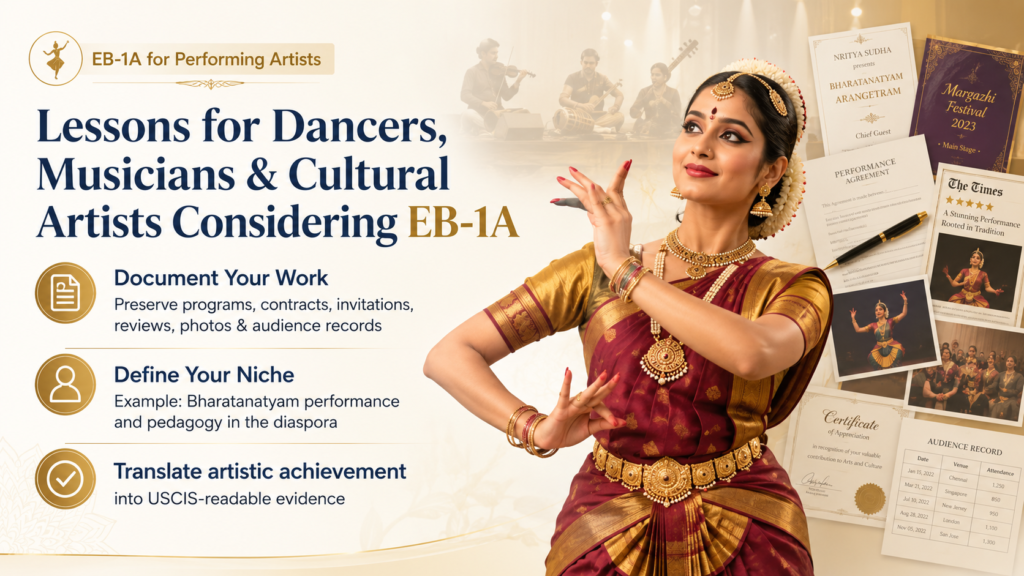
Artists should preserve programs, contracts, invitations, reviews, ticketing or audience records, photos, adjudication appointments, master-class materials, letters from institutions, and proof that performances were curated or selected. They should also think carefully about their field niche. “Dancer” may be too broad. “Bharatanatyam performance and pedagogy in the diaspora” gives the evidence a clearer frame.
A strong EB-1A arts case does not need to imitate a scientist’s record. It needs to prove artistic achievement in the language of the field and then translate that achievement into USCIS-readable evidence.
Frequently asked questions
Can a classical dancer qualify for EB-1A?
Yes. A classical dancer may qualify for EB-1A if the record shows recognized achievement, sustained acclaim, and evidence under the applicable criteria. The case must document the importance of performances, judging roles, published material, institutional reliance, awards or showcases where available, and the artist’s specific contribution to the field.
Do traditional artists need mainstream press to qualify?
Mainstream press can help, but it is not the only form of evidence. For traditional artists, credible arts coverage, festival documentation, cultural-institution letters, curated performance records, adjudication roles, and proof of leadership within recognized organizations can be important. The key is to make the evidence understandable to a non-specialist adjudicator.
Can teaching support an EB-1A case for a performing artist?
Teaching can support EB-1A when it shows more than routine instruction. Evidence of teaching lineage, academy leadership, student development, curriculum design, institutional reliance, master classes, and contribution to preserving or advancing a recognized art form can help show leading role or original contribution.
Does every performance count as an artistic showcase?
No. A performance list alone is usually not enough. The petition should document the platform, selection process, audience or institutional context, and the petitioner’s role. Curated festivals, recognized cultural programs, institutional showcases, and headline performances are stronger than routine appearances when properly documented.
What was the main lesson from this approval?
The main lesson is that traditional arts qualify when the petition teaches the field’s own prestige system and supports it with evidence. The case did not rely on adjectives. It used programs, press, judging, institutional letters, teaching lineage, and performance records to show sustained artistic recognition.
Build an EB-1A record around your artistic career before the paper trail disappears
If you are a dancer, musician, choreographer, visual artist, filmmaker, cultural educator, or traditional performer, your strongest evidence may already exist in programs, invitations, reviews, institutional relationships, teaching records, and judging roles. The challenge is organizing it before it is lost or treated as ordinary activity.
Immignis and Advance My Profile help artists identify a defensible field niche, document public recognition, build credible media and institutional evidence, and prepare an EB-1A record around proof that can be verified and professionally explained.