How an EB-1A Carbon Mineralization Scientist from Iceland secured approval by turning CO2-to-stone injection science into a petition-ready immigration profile built on first-author publications, verification-methodology authorship, climate-tech press profiles, international CCS-body roles, conference keynotes, peer review, and immigration-specific profile building.
Key facts at a glance
| Petition outcome | Form I-140 approved under EB-1A on August 14, 2024. |
| Professional profile | Icelandic geochemist advancing CO2-to-stone injection science at pioneering carbon-mineralization facilities. |
| Field niche | Basalt carbon mineralization and storage verification. |
| Starting weakness | Flagship carbon-storage projects were publicly recognized, but the individual science, verification methods, and authorship underneath the institutional brand were under-attributed. |
| Profile-building focus | First-author publication emphasis, verification-methodology authorship, climate-tech press profiles, international CCS-body roles, conference keynotes, peer review, expert letters, and ethical profile building. |
| EB-1A criteria supported | Scholarly articles, original contributions, published material, judging, and leading role. |
| Central issue | Showing that the petitioner was not merely associated with famous climate-tech projects, but personally shaped the science and verification methods that made basalt carbon mineralization credible. |
| Approval lesson | Institutionally famous climate work can support EB-1A when immigration-specific profile building separates the individual scientist from the project brand and documents personal scientific contribution. |
The approval
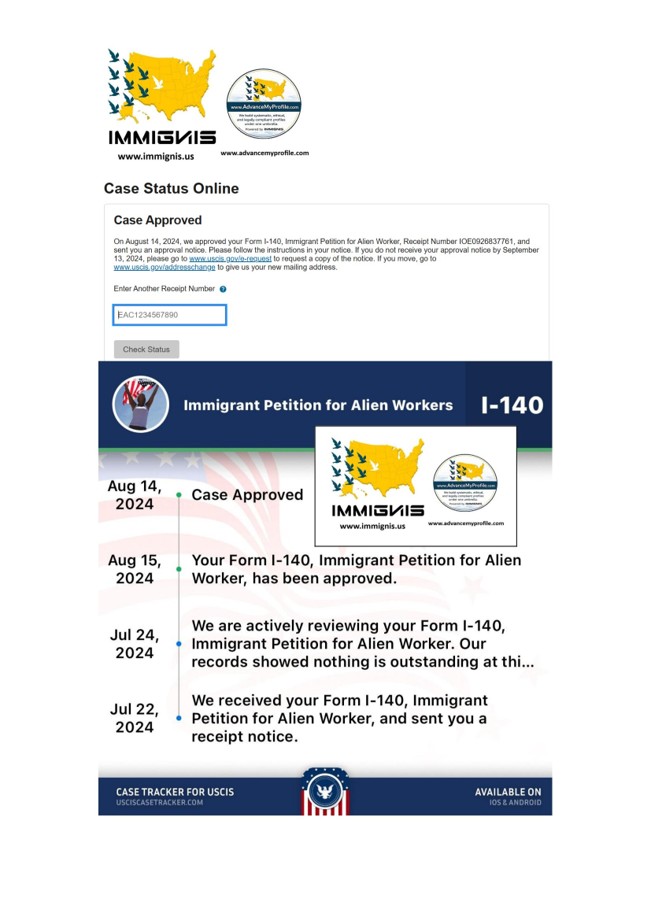
On August 14, 2024, USCIS approved the Form I-140 petition of an Icelandic carbon-mineralization scientist whose work focused on basalt carbon mineralization and storage verification.
The approval was important because the petitioner worked in a field where the public story usually belongs to the facility, the climate-tech project, or the institution. The science may be highly original, but media coverage and project announcements often name the platform rather than the geochemist whose methods make the storage claim credible.
That made this case a strong example of EB-1A profile building, scientific profile building, climate-tech profile building, and immigration profile building. The petitioner already had real technical achievements, but the record had to be structured so USCIS could see personal authorship behind institutional visibility.
Immignis and Advance My Profile helped convert the record into a petition-ready EB-1A profile. The strategy focused on first-author publication emphasis, verification-methodology authorship, climate-tech press profiles, international CCS-body roles, conference keynotes, peer review, and expert letters that traced institutional climate innovation back to the petitioner's scientific work.
The evidence problem in basalt carbon mineralization
Basalt carbon mineralization is a highly specialized area of carbon capture and storage. It involves injecting CO2 into reactive basalt formations and verifying whether the CO2 becomes stable carbonate minerals. The public may describe this as turning air into rock, but the scientific challenge is far more complex.
The field depends on geochemistry, fluid-rock reactions, isotope analysis, reservoir monitoring, mineralization kinetics, injection design, and storage-verification methods. For EB-1A purposes, the field had to be defined precisely because a broad label like climate scientist or geologist would not capture the petitioner's actual expertise.
The starting weakness was attribution. The flagship projects were well known, but the individual science underneath them was harder to see. Institutional articles, facility announcements, and climate-tech media often praised the project as a whole. They did not always explain which scientist designed the verification approach, authored the methodology, or advanced the technical proof that mineral storage was actually happening.
The petition therefore defined the niche as basalt carbon mineralization and storage verification. This gave USCIS a clear measuring stick. It explained why first-author publications, verification-methodology authorship, climate-tech press, CCS-body roles, conference keynotes, and peer review were not random evidence items, but direct indicators of extraordinary ability in this narrow scientific field.
Why institutional fame was not enough
One of the main risks in this case was assuming that a famous project automatically proved the petitioner's extraordinary ability. USCIS does not approve a person simply because the employer, laboratory, facility, or climate platform is famous. The petition has to show what the person personally did and why that work mattered.
That was the central profile-building challenge. The project already had visibility, but the petitioner needed a personal immigration profile. The evidence had to separate project-level reputation from individual scientific authorship without overstating the role or claiming ownership over work that belonged to a team.
The case therefore emphasized contribution mapping. It identified the petitioner's specific role in the science, the verification methodology, publications, presentations, peer review, and professional recognition. This helped transform institutional fame into person-centered EB-1A evidence.
For professionals searching for profile building, immigration profile building, EB-1A profile building, EB-2 NIW profile building, scientific profile building, or climate-tech profile improvement, this case shows why attribution is often the most important part of the evidence strategy.
First-author publications gave the scientist a visible record
First-author publications became a major pillar of the case. In a field as technical as carbon mineralization, publication evidence matters because it shows that the petitioner was not merely present on a project, but was producing scientific knowledge that other researchers could read, test, cite, and build upon.
The petition organized the publication record around the petitioner's role in explaining mineralization mechanisms, verifying storage, evaluating geochemical changes, and communicating methods in a way the field could rely on. First-author work was especially important because it gave the record a clear authorship signal.
This evidence supported the scholarly-articles criterion and strengthened the original-contributions argument. It showed that the petitioner's contribution had entered the professional literature rather than remaining hidden inside institutional reports or internal project files.
As part of publication profile building and immigration-specific profile building, the case emphasized not only that articles existed, but why those articles mattered to the narrow field of basalt carbon mineralization and storage verification.
Verification-methodology authorship proved original contribution
Storage verification was the heart of the case. In carbon mineralization, the claim that CO2 has become rock is only as strong as the verification method behind it. If the field cannot measure, confirm, and explain the mineralization process, the public climate story loses scientific force.
The petition used verification-methodology authorship to show original contribution. It documented how the petitioner helped develop, refine, or author methods for confirming mineral storage, interpreting geochemical data, and supporting credible carbon-storage claims.
This evidence mattered because it connected the petitioner's science to a major field need. The world does not only need carbon-removal ideas. It needs proof that storage is durable, measurable, and trustworthy. The petitioner's work helped address that verification problem.
For EB-1A profile improvement, this was a powerful way to move beyond general climate importance. The petition did not simply say carbon storage is important. It showed how the petitioner personally contributed to the technical proof that makes carbon mineralization a serious climate solution.
Climate-tech press profiles turned technical work into published material
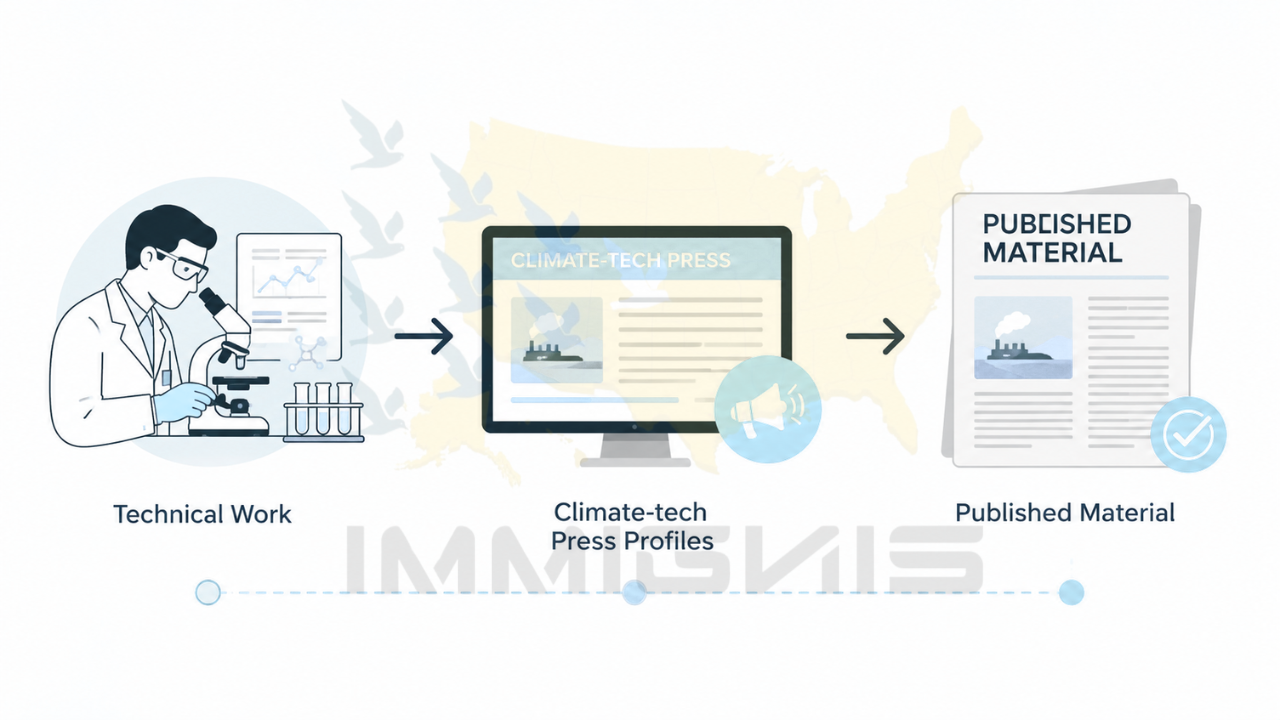
Climate-tech press profiles helped create public-facing evidence around the petitioner's individual expertise. In highly technical scientific fields, media coverage is useful only when it connects the person to specific achievements rather than merely repeating broad institutional messaging.
The petition therefore treated press strategically. The strongest coverage highlighted the petitioner's role in geochemistry, storage verification, scientific communication, and the technical credibility of CO2-to-stone work. This helped support the published-material criterion while also strengthening the final-merits narrative.
This was a necessary profile-building step because many scientists have important work but little public recognition under their own name. Climate-tech press can help translate complex research into language a broader audience understands, while still staying tied to evidence rather than marketing.
As part of professional profile building for immigration, the press record helped USCIS see the petitioner as a named scientist in the field, not just one researcher inside a famous facility.
International CCS-body roles and conference keynotes showed field reliance
International CCS-body roles helped show that the petitioner's expertise was recognized beyond one facility or national project. In carbon capture and storage, professional bodies, technical committees, working groups, and international networks often serve as the places where standards, methods, and field priorities are discussed.
The petition used these roles to support leading role and membership arguments. It showed that the petitioner participated in spaces where carbon-storage science and verification were taken seriously at an international level.
Conference keynotes added another layer of recognition. They showed that the petitioner was not only doing research but was invited to explain the work to professional audiences. In a narrow field, keynote invitations can be especially meaningful because the number of qualified speakers is limited and the audience is technically informed.
This evidence also helped address the small-field issue. The petition made clear that a narrow field is not a weak field. In a specialized scientific niche, recognition by the right expert community can be more meaningful than general public fame.
Peer review strengthened the judging criterion
Peer review was an important part of the case because it showed that journals or scientific communities trusted the petitioner to evaluate the work of others. For EB-1A, judging does not always need to look like a prize committee or public award panel. In research fields, peer review is often one of the clearest forms of professional judgment.
The petition connected peer-review activity to the petitioner's technical expertise in geochemistry, carbon mineralization, carbon storage, and verification science. This supported the judging criterion and reinforced the idea that the petitioner was considered competent to evaluate scientific work in the field.
Peer review also helped the final-merits analysis. It showed that the petitioner had moved from producing knowledge to evaluating knowledge, which is an important sign of professional standing in science.
For immigration profile building, peer review is often underused. When organized properly, it can show recognition, expertise, and field trust, especially for scientists whose public media record is limited.
Expert letters mapped institutional fame back to personal science
Expert letters were necessary because a USCIS officer may understand that carbon storage is important but still need help understanding the petitioner's personal role. In institutional climate projects, experts can explain what the public record leaves unclear.
The strongest letters did not simply praise the petitioner as intelligent or hardworking. They explained the technical difficulty of basalt carbon mineralization, why storage verification is essential, how the petitioner's publications or methods contributed to the field, and why the petitioner's work was significant beyond one employer or facility.
This expert framing was critical to ethical profile building. It helped avoid two common mistakes: giving the petitioner credit for an entire flagship project, or failing to give the petitioner credit for specific scientific work because the project brand was louder.
The letters gave USCIS the context needed to evaluate a specialized scientist whose record was strong but embedded inside institutional climate innovation.
How profile building changed the case
The case changed once the record was reorganized around the petitioner's personal contribution. Before profile building, the evidence could have looked like an impressive climate project with one scientist attached to it. After profile building, it became a scientist-centered record supported by publications, methodology authorship, press, professional roles, keynotes, peer review, and expert testimony.
Immignis and Advance My Profile helped build that structure. The profile-building process connected the petitioner's work to the EB-1A criteria that mattered most: scholarly articles, original contributions, published material, judging, and leading role.
This was not artificial branding. It was profile improvement and immigration-specific profile building. The purpose was to make real scientific impact visible in the form USCIS expects to see.
For scientists searching online for profile building, immigration profile building, EB-1A profile building, EB-2 NIW profile building, research profile building, scientific profile improvement, or climate-tech profile building, this case shows how technical work can be converted into a clear petition-ready immigration profile.
Why this case worked
The case worked because it did not rely on the broad popularity of climate solutions alone. It did not simply argue that carbon removal is important. It showed how the petitioner personally contributed to the science and verification methods behind basalt carbon mineralization.
First-author publications gave authorship. Verification-methodology documentation gave original contribution. Climate-tech press gave published material. International CCS-body roles and conference keynotes showed field reliance. Peer review satisfied judging and demonstrated trust from the scientific community.
Most importantly, the petition solved the attribution problem. It separated the scientist from the institutional brand and then reconnected the petitioner to the parts of the project that were genuinely personal, technical, and field-significant.
That is why the approval hook was strong: turning air into rock was the public story, but turning institutional climate fame into a personal EB-1A record was the immigration strategy.
Conclusion
The Icelandic carbon-mineralization scientist's EB-1A approval shows that climate-tech achievements can support extraordinary-ability petitions when the individual contribution is carefully documented.
The petition succeeded because it used ethical profile building to connect first-author publications, verification-methodology authorship, climate-tech press profiles, CCS-body roles, conference keynotes, peer review, and expert letters into one coherent immigration profile.
The broader lesson is simple: institutional recognition is not enough by itself, but it can become powerful when profile building traces the public success back to the person's own science, authorship, and professional standing.
Frequently asked questions
Can a climate scientist qualify for EB-1A?
Yes. A climate scientist may qualify for EB-1A when the record shows extraordinary ability through evidence such as scholarly articles, original contributions, published material, judging, leading roles, and strong final-merits proof.
Can carbon capture and storage work support an EB-1A petition?
Yes. Carbon capture, carbon storage, and carbon-mineralization work can support EB-1A when the petition documents personal contribution, field significance, publications, expert recognition, and public or professional validation.
How can a scientist prove personal credit when the project is institutionally branded?
The petition should separate institutional reputation from individual contribution through publication authorship, methodology documentation, expert letters, press profiles, conference records, peer review, and role-specific evidence.
Does peer review help an EB-1A scientist case?
Yes. Peer review can support the judging criterion because it shows that journals or professional communities trusted the petitioner to evaluate the work of other scientists.
Can climate-tech press help an EB-1A profile?
Yes. Climate-tech press can support published material when it focuses on the person's work, expertise, or contribution rather than only describing the institution or project.
Can Immignis and Advance My Profile help scientists build an EB-1A or EB-2 NIW profile?
Yes. Immignis and Advance My Profile help scientists, engineers, researchers, and climate-tech professionals define their niche, improve visibility, organize evidence, and build a petition-ready immigration profile through ethical profile building and immigration-specific evidence development.
Build an EB-1A record around climate science, carbon storage, and technical authorship
Many scientists have strong work, but their evidence is scattered across institutional projects, publications, conference records, internal methods, committee roles, peer review, and media coverage.