EB-1A Cashmere Supply Chain Scientist: How a Mongolian cashmere supply chain scientist secured EB-1A approval by turning grading and sustainability standards, protocol adoption, textile-science authorship, luxury brand and cooperative validation, international fiber sector roles, and professional media coverage into a personal record of extraordinary ability.
Key facts at a glance
| Petition outcome | Form I-140 approved under EB-1A on February 28, 2025. |
| Professional profile | Mongolian fiber scientist whose cashmere grading, quality control, and sustainable sourcing work connected herder livelihoods with processors, exporters, and international luxury supply chains. |
| Field niche | Cashmere fiber science and sustainable-sourcing standards. |
| Starting weakness | Luxury houses and exporter networks used the standards, but the scientist was rarely named on product labels, brand reports, sourcing claims, or finished garments. |
| Profile-building focus | Standards authorship documentation, adoption records across cooperatives and exporters, textile-science publication, luxury brand and cooperative letters, international fiber body roles, and sustainability press coverage. |
| Principal EB-1A evidence areas developed | Original contributions, authorship of scholarly articles, leading or critical role, published material about the petitioner, and membership evidence where the admission requirements were sufficiently selective. |
| Central issue | Showing that the petitioner did not merely test cashmere or administer a sourcing program, but helped define the technical and traceability rules on which quality, pricing, producer trust, and brand confidence depended. |
| Approval lesson | A supply chain scientist can build a persuasive EB-1A record when standards authorship, adoption, measurable reliance, independent validation, publication, and professional standing are attached to the individual rather than left under a product or brand name. |
The label named the maison. The standard named no one.
A luxury cashmere garment may identify the brand, collection, country of manufacture, fiber content, and care instructions. It rarely identifies the scientist whose grading rules helped determine whether the raw fiber was fine enough, long enough, clean enough, traceable enough, or consistently processed enough to enter that product at all.
That was the evidence problem in this case. The petitioner worked at the technical center of a supply chain that begins with herding communities and moves through collection, sorting, testing, dehairing, spinning, manufacturing, export, and luxury retail. Her methods affected how fiber was classified and how sourcing expectations were implemented. Yet the public record belonged to companies, finished products, sustainability programs, and country of origin stories. The scientist remained almost invisible.
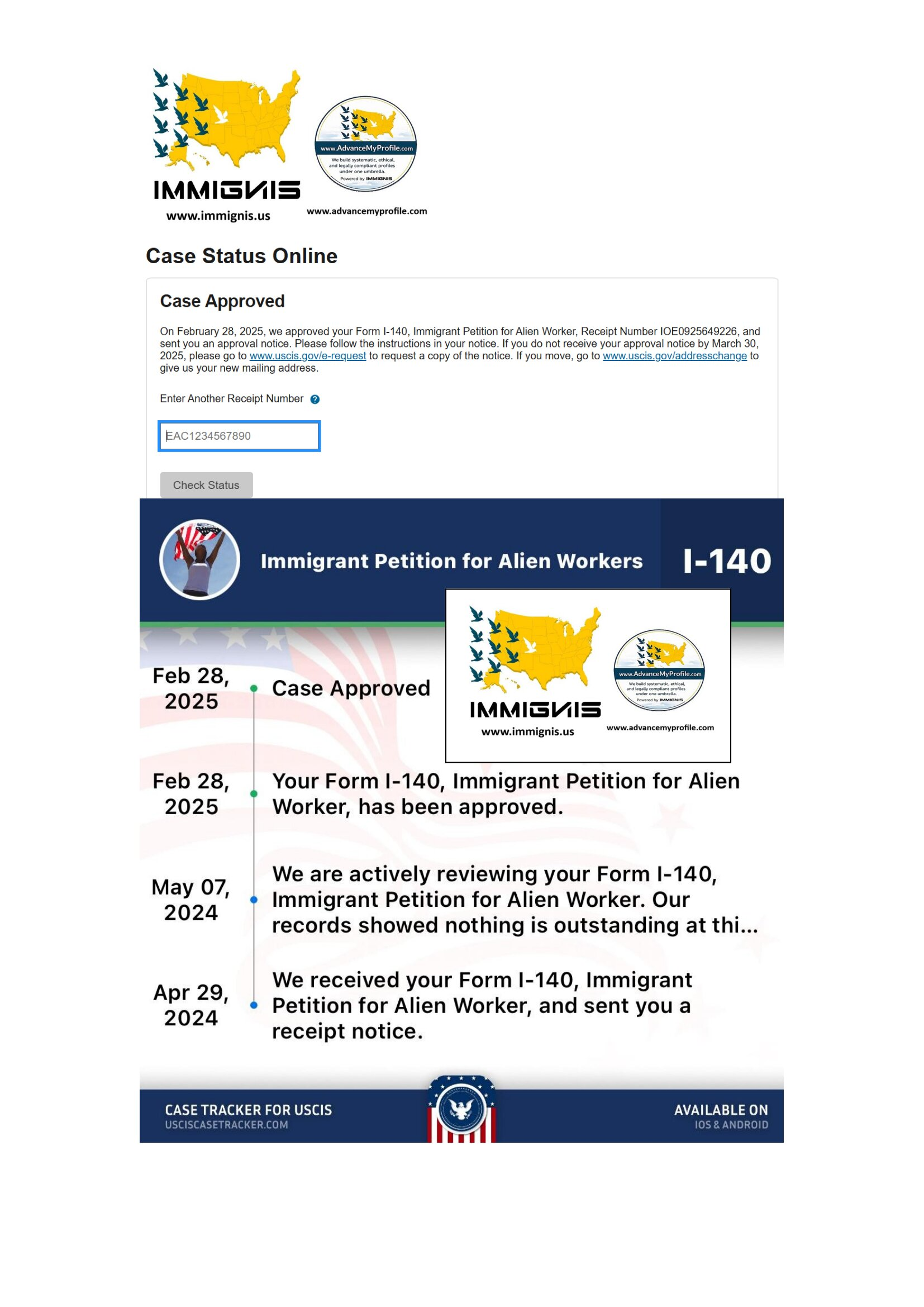
USCIS approved the Form I-140 petition on February 28, 2025. Immignis and Advance My Profile built the record by following the petitioner’s work through the chain: from the standard she helped author, to the laboratories and cooperatives that used it, to exporters and brands that relied on consistent results, and finally to the professional recognition that developed around that expertise.
Why cashmere quality is a scientific and supply chain problem
Cashmere is sold as a luxury fiber, but its value is not created by branding alone. Quality depends on measurable and observable characteristics such as fiber diameter, length, color, contamination, uniformity, usable yield after dehairing, processing behavior, and consistency between lots. Small differences can affect softness, strength, spinning performance, waste, color treatment, and the quality of the finished textile.
Those measurements also carry economic consequences. Grading influences how raw fiber is priced, which lots are accepted, how herders and cooperatives are rewarded, what processors can produce, and whether exporters can meet a buyer’s specifications. Sustainability and traceability requirements add another layer. A sourcing claim must be supported by procedures that can be followed, recorded, checked, and repeated across different actors in the chain.
The petitioner’s work sat at that intersection. It combined fiber science with practical standards, field conditions, laboratory controls, producer realities, processing requirements, and international market expectations. The case had to explain this without reducing her to a laboratory technician or presenting sustainability as a marketing slogan.
The field was defined as cashmere fiber science and sustainable sourcing standards
The petition did not describe the petitioner broadly as an agronomist, textile worker, quality manager, or sustainability professional. It defined her field as cashmere fiber science and sustainable sourcing standards. That definition matched both the technical work and the evidence available.
The fiber science component covered how cashmere is sampled, characterized, graded, compared, and processed. The standards component covered how those technical rules become usable across collection points, cooperatives, laboratories, processors, exporters, and buyers. The sustainable sourcing component addressed traceability, documentation, producer participation, and the practical connection between market requirements and herder livelihoods.
This narrower field definition gave USCIS a meaningful way to evaluate the record. Standards authorship, multi organization adoption, technical publication, brand reliance, cooperative validation, international fiber-sector roles, and professional coverage were no longer unrelated activities. They were different forms of recognition inside one specialized field.
Standards authorship became the center of the original contribution argument
The strongest part of the case was not that the petitioner had worked with cashmere for many years. It was that she helped create or materially refine rules that other organizations followed. Standards authorship converted experience into an identifiable contribution.
The record documented the petitioner’s role in developing grading procedures, sampling rules, laboratory methods, acceptance ranges, quality control protocols, traceability steps, or sustainability requirements. Draft histories, technical notes, committee records, version comparisons, meeting documents, training materials, and testimony from people involved in the process helped separate her individual contribution from the broader organization.
The petition also explained what changed because of the work. A method can be original but still lack major significance if no one relies on it. The evidence therefore connected the standards to actual decisions: fiber classification, lot acceptance, price differentiation, processor confidence, sourcing consistency, dispute reduction, producer training, or buyer verification.
That connection was essential. The argument was not that every written procedure is extraordinary. It was that the petitioner authored or shaped technical rules that became part of how independent actors evaluated and moved a valuable natural fiber through an international supply chain.
Adoption records showed that the standards traveled beyond one office
A standard becomes more persuasive when it leaves the author’s desk. The profile-building process therefore mapped where the petitioner’s methods were adopted, referenced, taught, incorporated, or relied upon. The goal was not to create an inflated count of users, but to show credible movement across distinct parts of the chain.
Useful records included cooperative manuals, exporter procedures, laboratory instructions, buyer specifications, training programs, audit materials, implementation schedules, quality reports, and correspondence showing why an organization adopted the method. Where commercial confidentiality applied, the documentation described the type of organization, the scope of use, and the role of the standard without exposing protected pricing, supplier, or sourcing information.
This adoption map helped show scale and independence. Reliance by several unrelated cooperatives, processors, exporters, or buyers carried more weight than repeated use inside one employer. It also showed that the petitioner’s work was functional: the standard solved a problem people had to manage in practice, not merely a topic discussed in theory.
Cooperative and luxury brand letters connected science to both ends of the chain
The case needed evidence from more than one direction. Letters from cooperatives and producer side organizations explained whether the methods were understandable, usable, and relevant to the people supplying the fiber. Letters from processors, exporters, buyers, or luxury-sector partners explained why consistency, traceability, and verified quality mattered farther downstream.
The strongest letters did not offer ceremonial praise. They identified the technical problem, the petitioner’s role, the method adopted, the reason for reliance, and the consequence of the work. A cooperative could explain how the grading or training process affected producer participation and quality decisions. A commercial partner could explain how the standard reduced uncertainty, improved lot consistency, supported sourcing requirements, or made technical communication more reliable.
This two-sided validation was important because it prevented the case from becoming a brand story or a development story alone. It showed one scientist working across a chain in which producer realities and luxury-market expectations must meet through defensible technical rules.
Textile science publication made an applied career legible to USCIS
The petitioner’s strongest work had been implemented through standards and supply chain practice, but scholarly and technical publication still mattered. Publications gave the record a public, reviewable form and showed that the petitioner could contribute knowledge beyond internal procedures.
The publication strategy focused on subjects grounded in her actual expertise: cashmere characterization, grading reliability, sampling, contamination control, processing yield, quality variation, traceability, sustainable sourcing, cooperative implementation, and the relationship between technical standards and producer outcomes. It did not attempt to reposition her as a purely academic researcher.
Authorship of scholarly articles addressed one evidentiary area. Articles and profiles written about the petitioner addressed another. The petition kept those categories separate. A paper she wrote was evidence of authorship; an independent trade or professional article discussing her work could support published material about her. The distinction protected the credibility of the record.
Leading role evidence followed decision authority, not organizational prestige
The petitioner had worked with organizations whose position in the cashmere chain could be documented, but the case did not assume that association with an exporter, laboratory, program, or industry initiative automatically proved a leading role. The record had to show what depended on her.
Evidence described whether she directed technical development, approved grading rules, supervised implementation, trained laboratories or field teams, resolved disputes, represented the organization in standards discussions, or served as the person others consulted when specifications did not match reality. Organizational charts, project assignments, committee records, implementation plans, and detailed letters helped explain the scope of authority.
Criticality was shown through reliance. If a quality or sourcing program required the petitioner’s judgment to function consistently across different actors, her role could be important even when she was not the chief executive or public spokesperson. In standards-driven industries, the person who controls the technical rules may be less visible than the person who launches the product, but no less central to the result.
International fiber sector roles moved the record beyond a domestic program
Professional roles in international fiber, textile, sourcing, or standards organizations helped demonstrate that the petitioner’s expertise was recognized outside one employer and one country. Committee participation, invited technical work, working-group service, conference roles, or standards discussions could show that other professionals relied on her knowledge.
The petition treated membership carefully. Ordinary membership in a respected organization does not automatically satisfy the EB-1A membership criterion. Where a membership claim was made, the record examined the admission rules, the achievements required, and whether recognized experts judged the candidate. Other professional roles were used for the broader final-merits analysis when they showed trust but did not meet the regulatory membership standard.
This distinction strengthened the case. It allowed the petition to use professional involvement honestly without turning every affiliation into a formal criterion. The most useful evidence was not the logo on a membership card. It was the documented reason the field asked the petitioner to contribute.
Sustainability and textile coverage made the scientist visible without turning the article into advertising
Cashmere attracts media attention through fashion, luxury, land use, animal-fiber sourcing, and the economic conditions of producer communities. Much of that coverage discusses brands or the industry generally. For the published-material criterion, stronger evidence focused on the petitioner and her work.
The profile-building strategy therefore prioritized independent professional, textile, sustainability, business, or science coverage that named the petitioner and explained her standards, research, or supply chain role. The record documented the outlet, author, publication date, audience, subject, and whether the article was editorial rather than paid or controlled by an interested company.
Good coverage did not need to portray the petitioner as a celebrity. Its value was specificity. An article explaining why her grading method, traceability approach, or producer-facing standard mattered could make a technically complex contribution understandable to USCIS and to the wider field.
The final merits analysis followed the standard from author to adoption
Meeting at least three evidentiary categories is only the first stage of an EB-1A analysis. USCIS also evaluates the record as a whole to determine whether the petitioner has sustained national or international acclaim and belongs among the small percentage at the top of the field.
The final presentation followed a clear chain of proof. Draft and committee records identified authorship. Adoption documents showed use. Cooperative, laboratory, exporter, and buyer evidence showed reliance. Publications established technical authorship. Independent coverage created public recognition. International roles showed professional trust. Continued requests for the petitioner’s expertise demonstrated that the recognition was not limited to one past project.
This structure answered the central question. The petitioner was not merely employed near a valuable commodity. She had helped create and carry the technical rules that allowed different actors to agree on what quality, consistency, and responsible sourcing meant in practice.
Why this case worked
The case worked because it attached every broad claim to a traceable function. Rather than saying that cashmere is important, the petition showed what the petitioner measured, authored, changed, taught, and caused others to adopt. Rather than relying on luxury-brand prestige, it documented technical dependence across the chain.
Each evidence type had a separate purpose. Standards records proved authorship. Adoption evidence proved reach. Letters explained reliance. Publications demonstrated knowledge contribution. Media coverage showed outside recognition. Professional roles showed field trust. Leading-role documents established decision authority. Together, they converted an uncredited supply-chain career into a person-centered immigration record.
The argument also remained balanced. It did not claim that one scientist controlled the entire cashmere industry or single-handedly protected every herder and brand. It showed a specialist whose standards helped different parts of a complex chain work from a common technical foundation.
What other standards and supply chain professionals can learn

Many professionals have the same problem in different industries. A method is used, but the product receives the recognition. A standard is adopted, but the committee or company receives the credit. A supply chain improves, but the scientist behind the technical rules appears nowhere in the finished item.
A useful profile-building process begins by locating authorship and reliance. Who drafted the method? Who reviewed it? Which version changed because of the person’s input? Who adopted it? What decision did it control? What measurable or operational problem did it solve? Who outside the employer can explain why the work mattered?
For this Mongolian cashmere scientist, the shift was from an anonymous technical presence behind luxury sourcing to a documented record of standards authorship, multi-actor adoption, textile-science publication, producer and buyer reliance, international professional roles, and recognition tied to her own name.
Frequently asked questions
What is EB-1A?
EB-1A is an employment-based immigrant classification for a person of extraordinary ability in the sciences, arts, education, business, or athletics who can satisfy the regulatory evidence framework and show sustained national or international acclaim in the final assessment.
Can a cashmere or textile supply-chain scientist qualify for EB-1A?
Potentially. The case must be based on the person’s own achievements. Standards authorship, widespread adoption, scholarly work, leading roles, independent coverage, selective professional recognition, judging, remuneration, or other qualifying evidence may be relevant depending on the record.
Can standards authorship support the original-contributions criterion?
It can when the evidence identifies the person’s original role and shows major significance. Draft history, committee records, technical comparisons, implementation documents, adoption evidence, and independent letters can help connect authorship to field-level use.
Is use by a luxury brand enough to prove major significance?
Not by itself. The petition should show what the brand or supplier actually used, why it relied on the method, how the petitioner was connected to it, and whether the reliance had consequences beyond ordinary vendor compliance.
How can confidential brand or exporter evidence be used?
Evidence may be presented through authorized letters, redacted agreements, cleared technical descriptions, implementation records, audit materials, or summaries that establish reliance without exposing supplier identities, prices, proprietary specifications, or protected sourcing information.
What counts as scholarly authorship for a fiber scientist?
Relevant work can include peer-reviewed or qualifying professional articles on fiber characterization, grading, processing, traceability, sourcing standards, quality control, or related scientific issues. The publication must be authored by the petitioner and meet the applicable requirements.
What counts as published material about the petitioner?
The strongest material is professional or major media coverage that is substantially about the petitioner and her work. General articles about cashmere, Mongolia, sustainability, or a luxury brand may be weaker when they do not discuss the individual.
Does membership in a textile or fiber organization automatically qualify?
No. Ordinary membership generally does not satisfy the EB-1A membership criterion. The evidence should show that admission required outstanding achievements judged by recognized experts. Committee service or invited technical roles may still support the broader record even when the membership criterion is not met.
How can a standards scientist prove a leading or critical role?
The record should explain the reputation of the organization or program and then document the person’s actual authority, responsibilities, technical decisions, implementation control, and the organization’s reliance on that role.
Does EB-1A require a U.S. employer or labor certification?
EB-1A does not require a permanent job offer or labor certification, and a qualified person may self-petition. The petition still must show that the person intends to continue working in the area of extraordinary ability in the United States.
What happens if USCIS issues a request for evidence?
An RFE should be answered against the specific concerns raised. The response may need clearer attribution, stronger proof of adoption or significance, better documentation of an organization’s reputation, more precise criterion analysis, or a more connected final-merits presentation.
How is EB-1A different from EB-2 NIW?
EB-1A focuses on extraordinary ability and sustained acclaim under its own evidentiary framework. EB-2 NIW requires EB-2 qualification and a showing that waiving the job-offer and labor-certification requirements is in the national interest. A professional may be better suited to one category or may have strategies involving both.
What is the priority date in an EB-1A case?
For a self-petitioned EB-1A Form I-140, the priority date is generally the date USCIS properly receives the petition. Visa availability and later immigration steps depend on the applicable category, country of chargeability, and Visa Bulletin.
How does a petitioner show sustained acclaim rather than one successful project?
The record should show recognition over time through continued adoption, repeated invitations, multiple publications, ongoing professional roles, independent reliance, later projects, or other evidence demonstrating that the acclaim did not arise from one isolated event.
How does ethical profile building help a supply chain scientist?
It identifies existing evidence, documents authorship and adoption, develops truthful public-facing technical work, improves professional visibility, and organizes the record without inventing awards, buying false recognition, using predatory publications, or exaggerating confidential relationships.
Make the standard visible before the product hides it
Scientists and standards professionals often already have persuasive achievements, but the evidence is scattered across draft files, committee records, laboratory procedures, training materials, audit systems, cooperative programs, buyer requirements, technical papers, and the knowledge of people who relied on them.