Key facts at a glance
| Outcome | EB-1A approval for an Irish clinical trial informatics leader working at a U.S.-based contract research organization. |
| Approval date | Approved on July 26, 2024. |
| Field niche | Decentralized clinical-trial data quality and patient retention, with a focus on identifying operational signals that affect complete and reliable trial data. |
| Starting problem | His work looked like senior clinical-trial operations. The record did not yet show a distinct research and informatics contribution or enough independent recognition outside the CRO. |
| Path used | Ethical EB-1A profile building through method papers, a clinical-trial data-quality playbook, an industry white paper, expert commentary, an invited webinar, judging in health-innovation competitions, a documented professional leadership role, independent expert letters, and comparative high-remuneration evidence. |
| USCIS EB-1A criteria activated | Original contributions, scholarly articles, published material, judging, leading or critical role, and high remuneration. |
USCIS approved his Form I-140 on July 26, 2024. During profile review for an EB-1A Clinical Trial Informatics Leader, the team kept returning to a less dramatic moment in a clinical trial: the point at which a participant begins to disappear from the data.
A remote visit is missed. A device stops transmitting. A questionnaire arrives late. A local laboratory result does not reconcile cleanly with the trial system. Each event may look operational on its own.
For an Irish clinical trial informatics leader working at a U.S. based CRO, those small breaks were the work. He had spent years dealing with the information layer of clinical trials. His role touched data quality, patient participation, remote trial activities, and the operational decisions that determine whether a study record remains usable. His original EB-1A profile, however, read like senior operations management. That was the problem the case had to solve.
Why clinical trial informatics can disappear inside operations
Clinical research organizations are built to deliver studies. Job titles and project descriptions often emphasize timelines, sites, vendors, milestones, and sponsor requirements.
A senior informatics or data leader may spend years developing ways to detect missingness, reconcile remote data streams, identify participant drop-off patterns, or help study teams act earlier when the record begins to deteriorate. On a CV, much of that work can end up under a line such as ‘clinical operations leadership.’
The EB-1A extraordinary ability category allows a qualifying applicant to self-petition by presenting evidence of sustained national or international acclaim and extraordinary ability in the field. A strong corporate title does not answer that standard on its own.
The field was defined around what happens when trial participation becomes fragmented
Decentralized trial elements can move activities away from a traditional trial site. Telehealth, home visits, local health-care providers, remote measurements, and digital tools can make participation more convenient for some patients. They also create new points where data can be delayed, incomplete, inconsistent, or difficult to reconcile.
The profile team mapped the methods he used to look at missing data patterns, remote-task completion, participant contact history, device or platform issues, protocol windows, and other non-clinical signals that study teams may use when deciding whether a participant needs support or whether a data-quality problem is growing. This was not presented as a medical prediction system. He was not diagnosing patients or making treatment decisions.
His contribution concerned clinical trial informatics: how study teams can identify data-quality and retention risk earlier and organize a more consistent response.
What did USCIS need to see in a clinical trial informatics EB-1A case?
The first challenge was individual attribution. A large clinical study can involve a sponsor, CRO, investigators, sites, vendors, data-management teams, statisticians, safety groups, and technology providers. The petition needed to show what this client personally developed, led, or influenced.
For original contributions, the evidence had to identify his methods for organizing trial-quality and retention information and explain why those methods were useful beyond routine project management. Internal job descriptions were not enough.
For scholarly authorship, method papers needed a clear technical subject. Published material required independent coverage about his work or expertise, rather than articles he wrote himself.
Judging evidence had to show real evaluation of other professionals’ work. His professional leadership role required documents explaining why the organization depended on his expertise and what functions he controlled. High-remuneration evidence needed a comparison with others in the relevant field and market.
The method papers gave his operational work a research vocabulary
With domain support, method papers were developed around decentralized trial data quality, missing-data signals, retention monitoring, and the limits of treating every missed task as the same kind of problem.
A participant who misses a questionnaire because of a device issue creates a different operational pattern from a participant who repeatedly misses remote visits or stops responding to all contact. The data record may look incomplete in both situations, but the study team may need different follow-up.
The papers examined these kinds of distinctions at a methodological level. Confidential sponsor data and protected study details were excluded.
A data-quality playbook showed how the method could be used
The data quality playbook was written for study teams. It organized practical questions around remote data sources, missing information, participant follow-up, escalation, reconciliation, and documentation. The playbook did not claim that one dashboard could prevent participant withdrawal or guarantee complete data.
For example, a study team could distinguish a single late entry from a repeating pattern, document the likely source of a missing data point, assign follow-up responsibility, and record whether the problem affected participant contact, a technology workflow, or data reconciliation.
That practical structure was useful in the EB-1A record because it showed a method developed from experience and made available in a form other professionals could examine.
Senior clinical research professionals often have strong EB-1A evidence hidden inside programs, methods, and leadership work. A free profile assessment can identify which contributions are attributable to you and where authorship, judging, public recognition, or independent evidence still needs development.
The industry white paper connected retention to data quality
The white paper addressed a problem many trial teams recognize: participant retention and data quality are often discussed in separate meetings even though the two can affect each other.
A participant who remains enrolled but stops completing key remote activities may create a different trial-data problem from a participant who formally withdraws. A study may also keep a participant engaged while technology failures, delayed local data, or inconsistent remote measurements create gaps in the record.
The paper explained why trial teams should look at participation patterns and data quality signals together when planning follow-up and escalation.
It was written for clinical research and health-innovation audiences, not as a claim that every retention problem can be solved with analytics.
The paper gave his field a clear public question: how should decentralized trial teams act when the patient journey and the data record begin to separate?
Expert commentary and an invited webinar made the niche visible
His public commentary stayed close to trial conduct. When clinical research outlets discussed decentralized trials, remote data, and patient participation, he explained why convenience does not remove the need for careful data oversight. Remote collection can increase participation opportunities and make some activities easier for patients, while trial teams still have to understand whether data are arriving as intended and whether participants are becoming harder to retain.
An invited webinar allowed a longer discussion of the subject. He walked through data-quality warning patterns, participant contact workflows, and the difference between reacting to a single missing item and recognizing a repeated operational pattern.
Judging and professional leadership added evidence of trust
Health-innovation competitions invited him to evaluate projects involving clinical research technology, patient engagement, data workflows, or digital health.
Advance My Profile documented the competitions, the judging role, and the work he was asked to assess. A title on an event page was not treated as enough; the record showed actual evaluation.
The petition described the functions he led, the kinds of study problems that reached his level, the decisions for which teams relied on his judgment, and the relationship between his work and significant CRO programs.
High remuneration needed a real comparison
A high salary criterion is comparative. The fact that someone earns a large number in absolute terms does not show that the remuneration is high in relation to others in the field.
Immignis organized compensation records and market evidence relevant to senior clinical trial informatics and clinical research leadership. The comparison considered role level, geography, and the professional market in which he worked.
The petition avoided using an unrelated software salary benchmark or comparing a senior CRO leader with entry-level clinical research staff.
Independent letters explained why this was informatics work, not ordinary trial administration
Their letters discussed the practical problem before discussing the client. Remote trial activities can create more distributed data sources and more varied participant workflows. Study teams need methods for seeing when operational friction is beginning to affect the completeness or usability of the study record.
The experts then addressed his work: the monitoring logic, the data-quality playbook, the way retention information was organized, and his leadership in applying these methods.
Advance My Profile prepared evidence-based drafts for expert review. Referees could edit the text and sign only what they considered accurate.
How the USCIS EB-1A criteria were supported
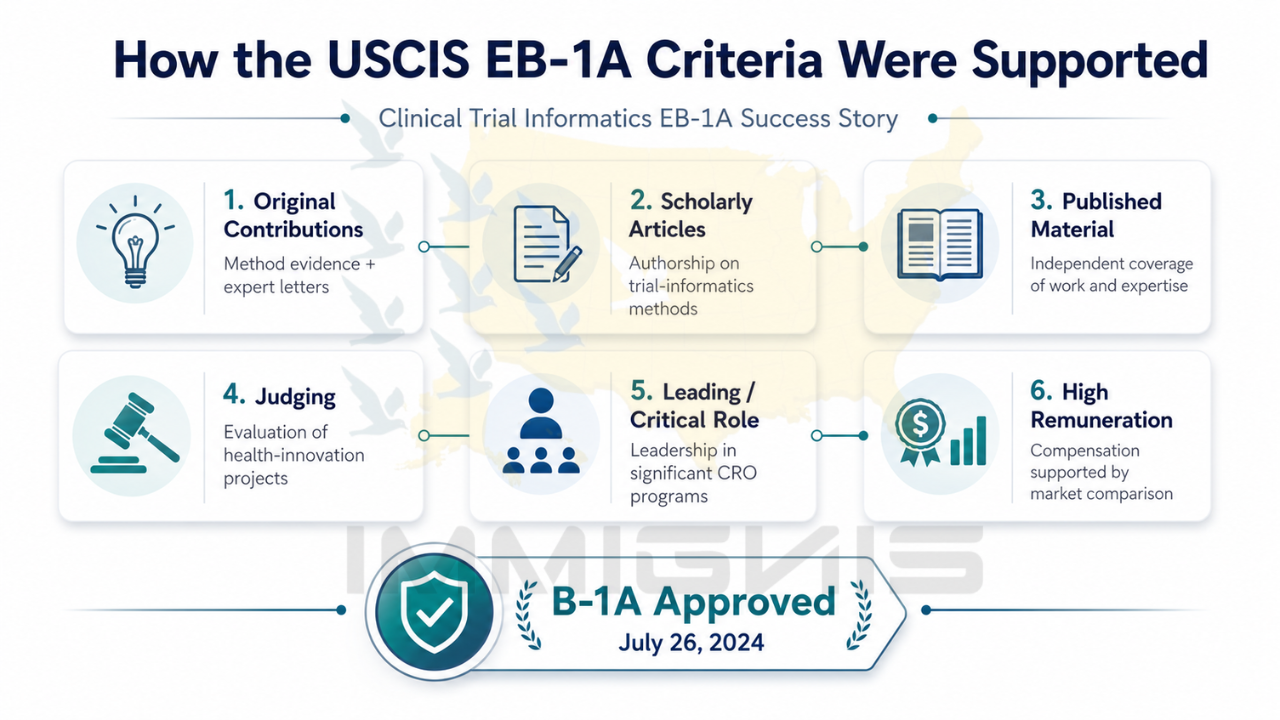
Original contributions: Method evidence, the data-quality playbook, implementation context, and independent expert letters explained his individual work on decentralized trial data quality and participant-retention monitoring.
Scholarly articles: Method papers connected his authorship to decentralized clinical-trial informatics, missing-data signals, retention monitoring, and trial-quality workflows.
Published material: Independent clinical research and health-technology coverage discussed his work or expertise in decentralized trial data quality and patient retention.
Judging the work of others: Health-innovation competition records documented his actual evaluation of projects and professional work submitted by others.
Leading or critical role: CRO leadership evidence showed why significant clinical-trial programs and teams relied on his informatics and data quality judgment.
High remuneration: Compensation records and relevant market comparisons supported the argument that his remuneration was high in relation to others working in the appropriate field and market.
The petition was approved on July 26, 2024
The approved EB-1A petition gave him a self-petition immigration path without employer sponsorship or labor certification. Form I-140 approval is one stage of the employment based immigrant process, and later permanent-residence timing may depend on visa availability and the applicant’s next immigration step.
The work built for the case remained useful in clinical research. The playbook could support future study teams. The method papers created a defined research subject. Health-innovation organizations had a clear area in which to ask him to judge or speak.
If your clinical trial career looks operational on paper
Clinical research professionals often develop ways to manage data quality, participant engagement, site risk, remote technologies, protocol deviations, vendor information, or study oversight. Some of that work may reflect individual expertise that has never been documented outside the employer.
Identify the problem you have repeatedly solved. Separate your own contribution from the study team. Publish where the subject is genuinely yours. Create practical field material that professionals can use. Accept real judging and speaking work. Ask independent experts to explain contributions they can evaluate.
FAQs
What is a decentralized clinical trial?
A decentralized clinical trial includes trial-related activities that occur at locations other than traditional clinical trial sites. Depending on the study, decentralized elements may include telehealth, in home visits, local health-care providers, or remote data collection. The exact design and oversight requirements depend on the clinical investigation.
Can patient retention work support an EB-1A original-contribution claim?
It can when the applicant has developed a method, system, analytical approach, or other individual contribution and the evidence shows recognized significance beyond routine trial management. Implementation records, method papers, field-use context, and independent expert analysis can help explain the contribution.
How is clinical trial data quality connected to patient retention?
A participant may remain enrolled while remote tasks, device data, visits, or other required information become incomplete. Retention and data quality are different concepts, but the operational signals can overlap. Trial informatics methods may help teams identify patterns that deserve follow-up or reconciliation.
Can judging a health-innovation competition count for EB-1A?
It may support the judging criterion when the applicant actually evaluates the work of others. The petition should document the event, the applicant’s role, and the projects, submissions, or professional work the applicant was asked to assess. A speaker or attendee title alone does not prove judging.
How does USCIS assess high salary or remuneration for EB-1A?
The criterion is comparative. Evidence should show that the applicant commanded a high salary or other significantly high remuneration in relation to others in the field. Compensation records and credible market comparisons should fit the applicant’s occupation, seniority, and relevant labor market.
Do I need a PhD in clinical informatics to pursue EB-1A?
No specific PhD is required for EB-1A extraordinary ability. A clinical research or informatics leader may rely on applicable evidence such as original contributions, scholarly authorship, judging, published material, leading or critical roles, high remuneration, and sustained independent recognition. The full record must support the EB-1A standard.
Build an EB-1A success story around the clinical research methods people already rely on
If you work in clinical trial informatics, decentralized trials, data management, patient engagement, CRO leadership, or digital clinical research, your strongest contribution may be hidden inside operational language.
Immignis and Advance My Profile help identify a defensible niche, document the client’s individual methods and leadership, build credible field recognition, and prepare an EB-1A record around work that can be verified.
Start with a free EB-1A profile assessment and find out whether your clinical research experience can be developed into a clearer authority record.