EB-1A Computer Vision Scientist: How a Belarusian agricultural computer-vision scientist secured EB-1A approval by turning real-world crop-monitoring deployments, open-source adoption, scientific publications, international agri-tech visibility, peer review, and immigration-specific profile building into a petition-ready record of extraordinary ability.
Key facts at a glance
| Petition outcome | Form I-140 approved under EB-1A on September 5, 2024. |
| Professional profile | Belarusian agricultural computer-vision scientist whose field-robust crop-monitoring and crop-diagnostics systems were deployed across farms in Eastern Europe. |
| Field niche | Field-robust computer vision for crop diagnostics. |
| Starting weakness | The technology was real and deployed, but geopolitics made institutional endorsement more difficult, and much of the strongest evidence sat inside commercial relationships, software repositories, and implementation results rather than in conventional academic prestige markers. |
| Profile-building focus | Deployment documentation via commercial partners, publication record, open-source contribution documentation, international agri-tech conference roles, peer review, expert letters, and ethical immigration-specific profile building. |
| EB-1A criteria supported | Original contributions, scholarly articles, judging, published material, and leading role. |
| Central issue | Showing that a scientist whose strongest impact appeared through deployed systems, software adoption, and cross-border technical use could still prove extraordinary ability even when politics complicated public institutional recognition. |
| Approval lesson | Open-source adoption metrics, commercial deployment evidence, and field-specific expert validation can form a strong EB-1A record when real technical influence is documented clearly and ethically. |
The approval
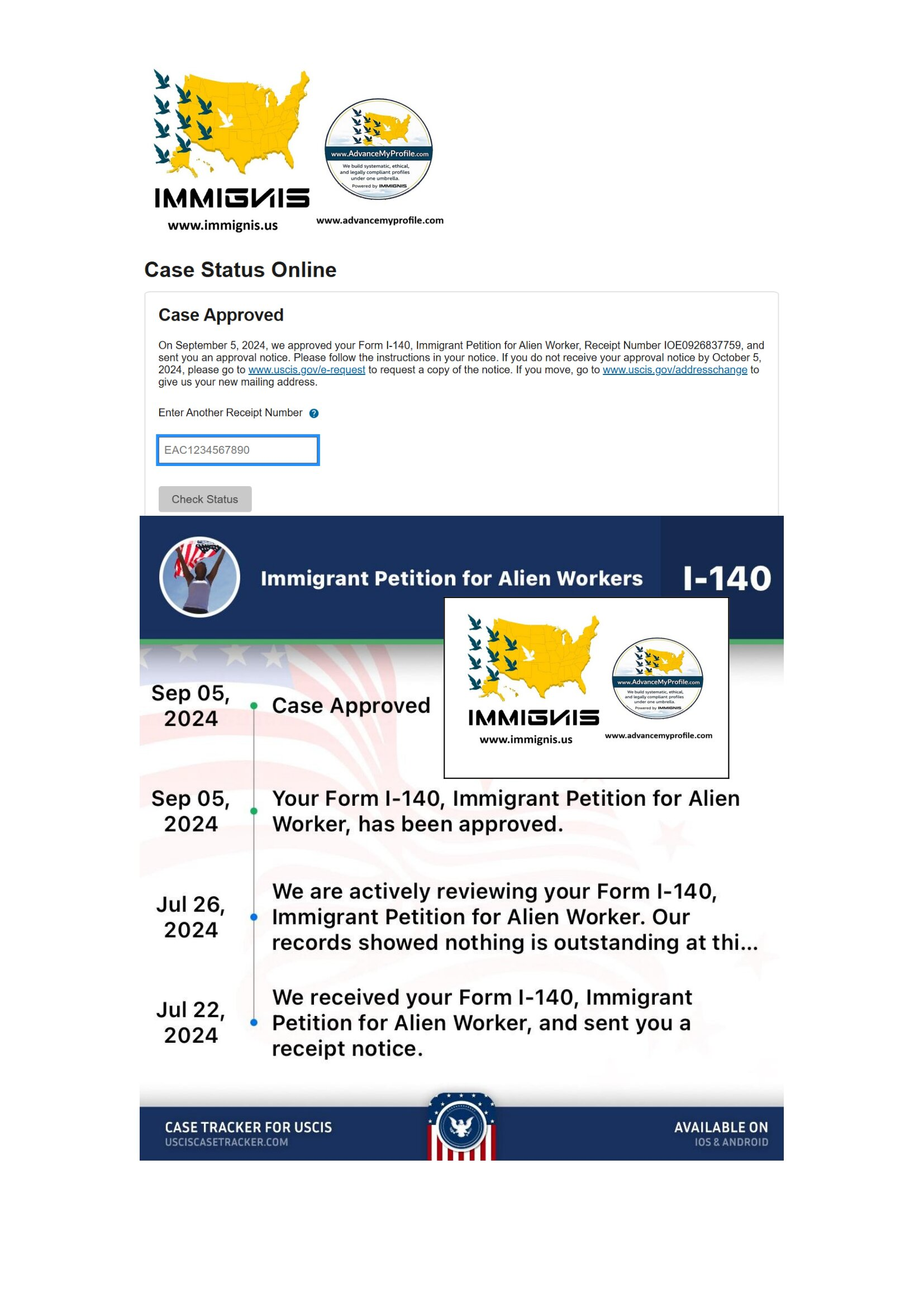
On September 5, 2024, USCIS approved the Form I-140 petition of an EB-1A Computer Vision Scientist whose work focused on field-ready crop-monitoring and crop-diagnostics systems for real agricultural environments.
The case succeeded because the petition did not rely on theory alone. It showed that the petitioner’s computer-vision systems were actually used in practice through farm deployments, commercial partnerships, technical adoption, and open-source visibility. In other words, the evidence showed real-world agricultural impact rather than only laboratory promise.
That mattered because the petitioner’s starting weakness was not lack of achievement. It was lack of easy institutional storytelling. Geopolitical complications made formal endorsement harder, and much of the strongest evidence lived in partner communications, deployment histories, repositories, software usage, technical presentations, and applied outcomes rather than in one simple academic record.
Immignis and Advance My Profile helped organize the petition through ethical profile building, professional profile building, and immigration-specific profile building. The strategy turned deployment evidence, software adoption, publication work, judging, and expert letters into a coherent EB-1A record.
Why agricultural computer vision creates a difficult evidence problem
Agricultural computer vision is highly interdisciplinary. It draws from machine learning, imaging, agronomy, field robotics, plant science, and data engineering. Professionals in this area often build tools that matter enormously in practice but are under-credited because their strongest influence appears through products, deployed systems, or commercial pipelines rather than through headline academic fame.
The petitioner’s field niche was defined carefully as field-robust computer vision for crop diagnostics. That field definition helped USCIS understand that this was not generic software engineering. The petitioner’s work addressed real agricultural constraints such as changing light conditions, variable crop appearance, weather exposure, image quality challenges, and practical farm use.
This field definition was important for profile building because it positioned the petitioner inside a meaningful technical specialty with clear social and commercial value. Farms need accurate diagnostics, early detection, yield protection, and efficient monitoring. A scientist who creates systems that work outside controlled environments can have genuine field significance even without celebrity status.
For professionals interested in EB-1A profile building, EB-2 NIW profile building, immigration profile building, profile improvement, or professional visibility, this case shows why real deployment can be just as important as formal prestige when it is properly documented.
Commercial deployments became proof of original contributions
One of the strongest pillars of the case was deployment documentation through commercial partners and farm users. In applied AI, original contribution is often proven not only by publications, but by the fact that people actually use the system in meaningful operational settings.
The petition showed that the petitioner’s computer-vision solutions were not side experiments or theoretical prototypes. They were deployed across farms and agricultural operations where they supported crop diagnostics, monitoring, detection, or classification tasks in real-world conditions.
That kind of evidence is powerful because it shows functional trust. When companies, farms, or agricultural stakeholders rely on a scientist’s methods, models, or systems, it helps establish that the person made an original contribution of major significance to the field.
The case therefore used partner letters, implementation summaries, deployment descriptions, technical role explanations, and outcome-focused documentation to connect the petitioner personally to the systems in use. This is exactly the kind of evidence building that often makes the difference in industry-facing AI cases.
Open-source adoption created borderless, politics-proof evidence
The approval hook in this case was especially persuasive: open-source adoption metrics served as borderless, politics-proof evidence. In a field affected by cross-border sensitivities, repository-level evidence, community adoption, citations in code, forks, stars, issue discussions, and public technical engagement can help show recognition that does not depend on one institution’s willingness to speak loudly.
Open-source contribution documentation helped show that the petitioner’s work was not hidden. It was visible, usable, and taken seriously by other practitioners. This kind of evidence is especially useful in software and AI profile building because it demonstrates independent third-party interest.
The petition did not treat open-source popularity as empty vanity. Instead, it connected adoption metrics to technical significance. The question was not whether the code looked popular. The question was whether professionals were relying on the work because it solved real agricultural imaging problems.
For immigration-specific profile building, this is an important lesson. Public technical adoption can often succeed where formal institutional branding is weak. It offers a clean way to document recognition that crosses borders and political barriers.
Publication record and peer review strengthened the scientific profile
Although the case centered on applied deployment, the petition also used scholarly articles and peer review to demonstrate formal professional standing. This helped USCIS see the petitioner not merely as a software implementer, but as a scientist contributing to field knowledge.
Publication evidence supported the argument that the petitioner’s work had technical depth and broader relevance in computer vision, crop monitoring, agricultural AI, plant diagnostics, or machine-learning applications for farming. Even where publication volume was not massive, focused and relevant authorship strengthened the case.
Peer review also mattered. Judging in a scientific context can include reviewing articles, conference submissions, or other professional work. This showed that other experts trusted the petitioner to evaluate quality in the field.
For profile improvement, the combination of publications and peer review is especially useful because it creates a bridge between industry impact and scientific recognition. Together, they help USCIS understand that the petitioner’s contributions were both technically credible and professionally respected.
International agri-tech conferences and field visibility created published-material value
Conference participation and agri-tech visibility gave the petition an important outward-facing dimension. Applied specialists are often recognized through technical forums, workshops, industry conferences, and sector-specific events rather than only through general-interest press.
The petition therefore highlighted international agri-tech conference roles, speaking opportunities, and other professional engagements that showed the petitioner’s standing among specialists working on digital agriculture and crop-intelligence systems.
Published-material evidence was also important where articles, profiles, event references, or field coverage discussed the petitioner or the petitioner’s work. This kind of documentation helped show that the scientist’s contributions were visible beyond internal company or project settings.
For professional profile building, this matters because it turns quiet technical work into a public record. It gives officers, readers, and future collaborators a way to understand why the work stands out in the field.
Leading-role evidence showed technical authority despite a complicated environment
Leading-role evidence was handled carefully because geopolitical context can complicate how institutions speak publicly. The petition therefore did not depend on symbolic titles alone. It explained the petitioner’s technical authority through system design responsibility, scientific leadership, architecture decisions, deployment oversight, or central roles in the development and implementation of crop-monitoring solutions.
The goal was to show that the petitioner was not simply one contributor among many. The record had to show that the petitioner occupied a leading or critical role in distinguished projects or organizations working on meaningful agricultural technology problems.
This kind of framing is often essential in profile building for engineers, AI specialists, and applied scientists. Commercial teams may be large, but the real question is whether the petitioner performed a role that materially shaped the outcome.
In this case, the answer was yes. The petition linked the petitioner to core technical work that helped move field computer vision from concept to usable agricultural deployment.
How Immignis built the petition-ready record
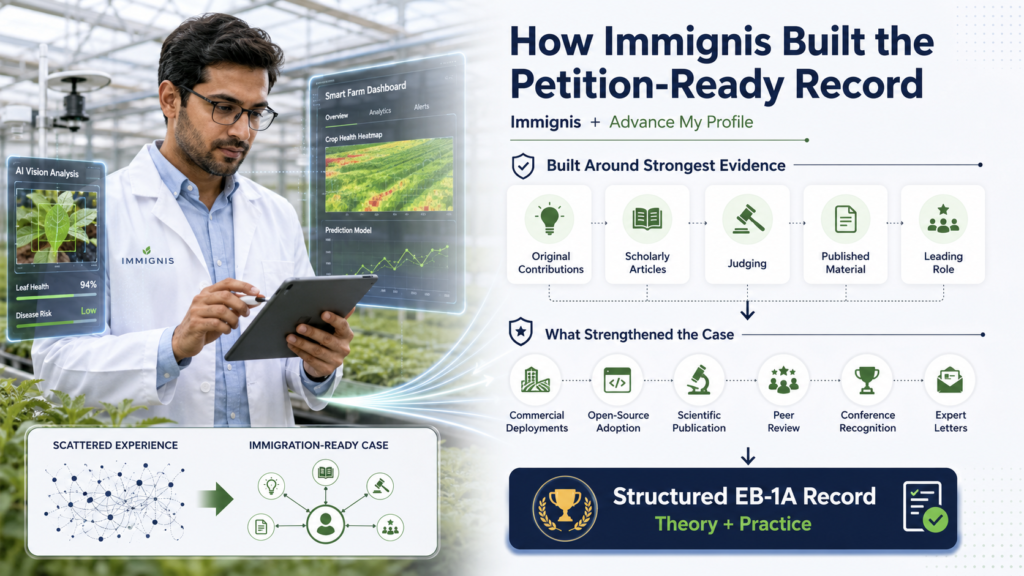
Immignis and Advance My Profile organized the case around the evidence categories most naturally supported by the petitioner’s background: original contributions, scholarly articles, judging, published material, and leading role. The strategy was not to overstate general AI trends. It was to show concrete agricultural significance.
That is an important distinction. Good immigration profile building does not decorate a weak case with generic language. It identifies the strongest truthful evidence, connects it to the legal criteria, and presents it in a way USCIS can evaluate clearly.
The petition emphasized deployment through commercial partners, open-source adoption metrics, scientific publication, peer review, conference recognition, and expert letters from people who could explain the field’s technical demands. Together, these elements translated a scattered professional footprint into a structured EB-1A record.
The result was a profile that showed the petitioner as a scientist whose work mattered both in theory and in practice, even across a politically complicated landscape.
Why this case worked
The case worked because the evidence was concrete, varied, and mutually reinforcing. Commercial deployment showed utility. Open-source adoption showed independent recognition. Publications showed technical legitimacy. Peer review showed trust from other experts. Conference and media visibility showed field presence. Leading-role evidence showed responsibility and distinction.
USCIS did not need to guess whether the petitioner’s work mattered. The petition created several separate pathways to the same conclusion: this was a scientist whose work had moved beyond ordinary professional activity and had become influential in a meaningful technical niche.
The petition also worked because it used a believable narrative. It openly acknowledged the evidence difficulty created by geopolitics and applied-industry work. Then it solved that difficulty by building a paper trail from deployable systems, public technical evidence, and independent expert validation.
This is exactly why ethical profile building matters. It helps convert real but scattered achievement into a legally persuasive immigration record.
Conclusion
The Belarusian agricultural computer-vision scientist’s EB-1A approval shows that applied AI for agriculture can support a strong extraordinary-ability petition when deployment, open-source influence, publications, and peer recognition are documented carefully.
The case succeeded because real farm deployments, commercial partner evidence, scientific publication, peer review, agri-tech visibility, and leading-role documentation were turned into one coherent immigration profile.
The broader lesson is clear: if your work is already being used in the field, the challenge is not inventing impact. The challenge is documenting that impact clearly enough for USCIS to recognize it. That is what profile building is designed to do.
Frequently asked questions
Can an agricultural computer-vision scientist qualify for EB-1A?
Yes. An agricultural computer-vision scientist can qualify for EB-1A when the evidence shows extraordinary ability through original contributions, publications, judging, leading roles, and field recognition tied to real technical impact.
Do software deployments help an EB-1A petition?
Yes. Real deployments can be highly persuasive because they show that the petitioner’s work is used in practice, especially when the record documents the petitioner’s technical role and the importance of the deployed system.
Can open-source adoption metrics help prove extraordinary ability?
Yes. Open-source adoption metrics can help when they are connected to genuine technical influence, such as community use, implementation value, and independent reliance on the petitioner’s methods or code.
Does peer review count as judging in EB-1A cases?
Yes. Reviewing scholarly work, technical papers, or conference submissions can support the judging criterion because it shows that other professionals trust the petitioner to evaluate the work of others in the field.Yes. Reviewing scholarly work, technical papers, or conference submissions can support the judging criterion because it shows that other professionals trust the petitioner to evaluate the work of others in the field.
Can a scientist from a politically complicated region still build a strong EB-1A case?
Yes. A strong case can still be built through borderless evidence such as open-source records, publications, conference roles, independent expert letters, and commercial partner documentation.
Can Immignis and Advance My Profile help AI and agri-tech professionals?
Yes. Immignis and Advance My Profile help scientists, engineers, AI professionals, healthcare experts, and other technical specialists with ethical profile building, evidence development, professional visibility, and petition-ready EB-1A or EB-2 NIW profile-building strategy.
Build an EB-1A record around real deployment, independent recognition, and technical authorship
Many AI and engineering professionals already have strong evidence, but it is often buried in repositories, technical systems, partner deployments, internal reports, conference activity, and client outcomes. Ethical profile building can turn that scattered record into a clear immigration case strategy.