
How an EB-1A Data Journalism Editor from Spain secured approval after shared bylines, investigative methods, policy responses, journalism awards, teaching, professional-service roles, and newsroom leadership were organized into evidence of personal influence in data-driven investigative journalism.
Key facts at a glance
| Petition outcome | Form I-140 approved under EB-1A on August 9, 2024. |
| Professional profile | Spanish data-journalism editor who built and led investigative teams using public records, databases, statistical analysis, visual reporting, and collaborative newsroom methods to produce stories that informed public debate and prompted institutional responses. |
| Field niche | Data-driven investigative journalism. |
| Starting weakness | The strongest investigations carried shared bylines, the editor’s methods were often invisible to readers, and the public impact appeared through later policy, regulatory, or institutional responses rather than through one easily attributable achievement. |
| Profile-building focus | Contribution mapping within collaborative investigations, impact documentation, journalism-award records, methodology publication, journalism-school teaching, industry-award judging, press-association roles, and evidence of editorial leadership. |
| Principal EB-1A evidence areas developed | Awards, judging the work of others, published material about the petitioner, original contributions, and leading or critical role. |
| Central issue | Showing that the petitioner did not merely edit stories produced by a large newsroom, but designed investigative methods, directed teams, shaped publishable findings, and influenced how data journalism was practiced and evaluated. |
| Approval lesson | In collaborative journalism, the byline is only the visible edge of the work. A strong petition reconstructs who designed the investigation, controlled the method, made the editorial decisions, and created influence that continued after publication. |
The investigation had a byline. The method did not.
Major investigations are rarely the work of one person. Reporters obtain records, developers clean datasets, designers build visualizations, editors test the findings, lawyers review risk, and publishers decide when the work is ready. The final article may carry several names, or it may credit a newsroom project rather than explain who built the reporting system behind it.
That collaborative strength created the weakness in this case. The petitioner had helped establish data-led investigative work that produced important stories and public responses, but the personal record was difficult to see. Shared bylines blurred authorship. Internal methodology was not always published. The consequences of an investigation might emerge months later through hearings, audits, revised rules, official statements, or changed institutional practice.
USCIS approved the Form I-140 petition on August 9, 2024. Immignis and Advance My Profile organized the record around contribution attribution. The case showed where the editor designed the investigation, how the method differed from ordinary reporting, why independent journalism bodies recognized the work, and how the petitioner influenced both newsroom practice and the public institutions examined by the reporting.
Why data journalism can hide the person who made the work possible
Data-driven investigations combine journalism with database construction, public-records research, coding, statistical reasoning, source verification, visual explanation, and conventional reporting. The published story may look simple because the difficult work has been compressed into a chart, searchable tool, map, or carefully worded conclusion.
Editors in this field are particularly easy to overlook. They may determine the reporting question, negotiate access to records, decide how data should be cleaned, test whether patterns are real, assign follow-up interviews, challenge weak conclusions, coordinate legal review, and choose the final narrative. Much of that work happens before a reader sees the article.
The petition therefore could not rely only on copies of successful investigations. It needed records showing the petitioner’s authority and identifiable contribution inside each project. The question was not simply whether the newsroom produced influential journalism. It was what this editor personally built, directed, or changed.
The field was defined as data-driven investigative journalism
A broad label such as journalist or editor would have weakened the case. It would have placed the petitioner beside professionals working in daily news, commentary, broadcasting, features, public relations, and many other forms of communication that use different measures of distinction.
Data-driven investigative journalism described the actual professional niche. The work involved acquiring difficult records, structuring large datasets, identifying patterns, testing claims, combining quantitative findings with source reporting, and publishing evidence in a form that the public and decision-makers could understand.
This definition also made the evidence coherent. Awards, impact records, methodology articles, teaching, judging, association roles, and newsroom leadership were not unrelated accomplishments. They all reflected recognition of the petitioner’s ability to turn complex data into accountable public-interest reporting.
Contribution mapping separated one editor from the hundred-name project
The first task was to reconstruct the work behind major investigations. For each project, the record identified the reporting question, the dataset, the petitioner’s editorial responsibilities, the decisions made, the people supervised, and the output that resulted.
Useful evidence included assignment records, project plans, methodology notes, internal role descriptions, newsroom correspondence, data dictionaries, publication credits, presentations, award submissions, colleague statements, and public explanations of the reporting process. Strong letters described what the petitioner decided and why those decisions mattered. They did not merely say that the editor was talented or respected.
This approach respected collaborative authorship. It did not erase reporters, developers, designers, or partner organizations. Instead, it showed where the petitioner supplied leadership that was distinct from the contributions of others. That distinction allowed the petition to present team success without converting every collective achievement into a personal claim.
Investigation-impact documentation made diffuse consequences usable
Investigative journalism often produces impact indirectly. A story may prompt questions in parliament, a regulatory inquiry, an internal audit, public disclosure, litigation, a correction, a resignation, a policy review, or new reporting by other outlets. None of those outcomes automatically proves that one journalist made an original contribution, but together they can show that the work changed what institutions and the public knew or did.
The case connected each claimed consequence to the relevant investigation. Timelines, official responses, hearing records, regulator statements, institutional announcements, follow-up reporting, citations, and independent commentary helped establish sequence and reliance. The petition avoided claiming that every later event had one cause. It focused on responses that expressly referred to, relied on, or closely followed the published work.
This made the influence more credible. The argument was not that publication alone was significant. It was that the petitioner helped create reporting methods and findings that institutions treated seriously enough to answer, investigate, or act upon.
Journalism awards provided a field-specific measure of distinction
The strongest approval hook was unusually direct: journalism is a profession that formally evaluates and ranks its own work. Recognized award programs compare investigations, reporting methods, public-interest value, innovation, and execution. When properly documented, that peer evaluation can provide strong evidence of professional recognition.
The petition examined each award carefully. It identified the awarding body, the competition level, the category, the selection process, the winning work, and the petitioner’s connection to that work. A newsroom award was not automatically described as an individual award. Where the recognition belonged to a team, the record explained the petitioner’s credited and independently documented role.
Awards also helped a non-journalist understand the standing of the investigations. An officer did not need to decide personally whether one database project was more difficult than another. The field had already evaluated the work through established professional processes.
Methodology publication turned invisible newsroom craft into a public contribution
Many data-journalism methods remain inside a newsroom. The public sees the final findings but not the decisions about records, data cleaning, missing values, matching, verification, uncertainty, reproducibility, or visual presentation. That creates a problem when the method itself is one of the petitioner’s strongest contributions.
Methodology articles, technical notes, conference papers, teaching materials, case studies, and public project explanations gave the work a durable record. They showed how the investigation was built and allowed other journalists to test, learn from, or adapt the approach.
This evidence supported originality more persuasively than a vague claim that the petitioner was innovative. It identified a reporting problem, the method created to solve it, the professional audiences that encountered the method, and signs that other practitioners used or discussed it.
Published material had to be about the editor, not merely written by the editor
Journalists often have extensive publication records, but the EB-1A published-material criterion concerns qualifying material about the person and the person’s work. Articles authored by the petitioner can serve other evidentiary purposes, but they should not be mislabeled as independent coverage about the petitioner.
The case therefore separated authored investigations from profiles, interviews, award coverage, industry features, conference introductions, and articles discussing the petitioner’s methods or newsroom leadership. It also distinguished independent editorial coverage from employer biographies, promotional announcements, and copied event listings.
This legal and factual separation improved the record. It allowed the petition to use authored journalism as evidence of the professional work while reserving the published-material argument for sources that actually discussed the petitioner.
Teaching showed that the method could be transferred
Journalism-school teaching and professional training strengthened the record because they showed that the petitioner’s knowledge was useful beyond one newsroom. Courses, workshops, guest lectures, curriculum materials, and training programs documented what the editor was trusted to teach and who selected the petitioner to do it.
The value of teaching depended on context. A single informal talk carried less weight than repeated instruction, a formal appointment, a selective professional program, or a course built around methods the petitioner had developed in practice. The petition explained the institution, audience, subject, and relationship to the defined field.
Teaching also made the contribution easier to understand. The editor was not only applying a private workflow. The petitioner had developed knowledge that could be explained, organized, and passed to the next group of investigative journalists.
Judging proved that journalism institutions trusted the editor to evaluate excellence
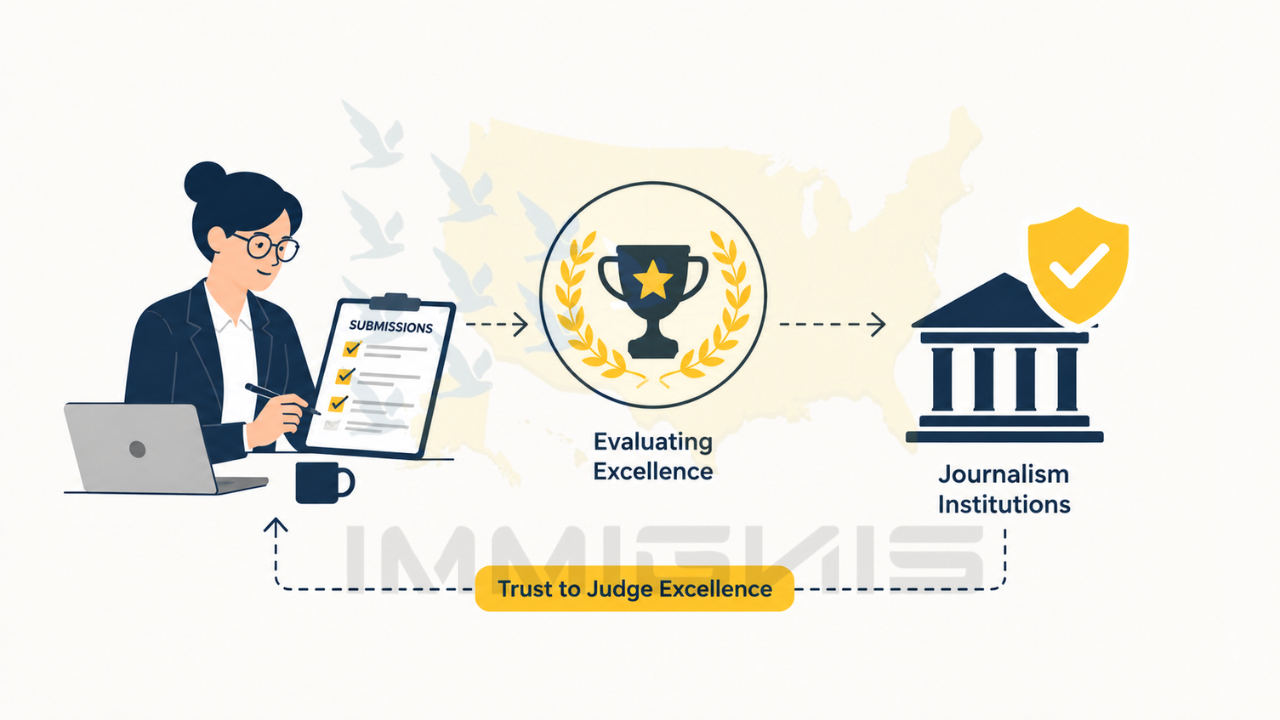
Industry-award judging gave the case a direct form of peer recognition. Journalism competitions, fellowships, grants, and professional programs rely on judges to compare reporting quality, public-interest value, evidence, originality, ethics, and execution.
The record documented completed judging service, not invitations alone. It identified the organizer, the work or applicants evaluated, the petitioner’s responsibilities, and the relationship between the judging activity and data-driven investigative journalism.
This evidence helped separate visibility from authority. The petitioner was not merely invited to speak about successful work. Professional institutions trusted the editor to decide whether the work of others met demanding standards.
Press-association roles and newsroom leadership showed responsibility at field level
Professional-association roles supplied context for the petitioner’s standing outside the employer. Committee service, working groups, standards initiatives, conference roles, and press-freedom or data-journalism programs could show that peers relied on the editor’s judgment in wider professional settings.
Membership alone was not treated as extraordinary. The petition examined whether a role involved selection, substantive responsibility, policy work, program design, review, or leadership. It also avoided assuming that every association met the regulatory membership criterion merely because it was respected.
Inside the newsroom, leading-role evidence focused on authority over consequential work. Editorial responsibility, team creation, investigation approval, methodology control, publication decisions, staff supervision, cross-border coordination, and responsibility for high-impact projects helped establish that the petitioner held a critical function for distinguished organizations or projects.
Why this case worked
The petition did not ask USCIS to treat a long byline as proof of individual distinction. It reconstructed the work. Project records showed what the editor designed. Impact evidence showed what happened after publication. Awards showed how the profession evaluated the investigations. Teaching, judging, and association service showed that the expertise traveled beyond the newsroom.
The field definition also kept the argument disciplined. The case was not built on a general claim that journalism is important to democracy. It showed why this petitioner’s methods, editorial decisions, and professional service were recognized within data-driven investigative journalism.
The approval lesson was simple: collaborative reporting does not prevent an EB-1A case, but the petition must recover the individual signal from the newsroom noise.
What editors and investigative journalists can learn
Keep the methodology record, not only the published link. Save project plans, role assignments, data notes, award submissions, conference materials, teaching records, impact references, and documents showing how decisions were made. Years later, those records may be the clearest proof of personal contribution.
Document impact carefully. An investigation can be influential without causing every event that followed it. Strong evidence identifies direct references, official responses, reliance, timing, and independent confirmation rather than claiming a broad public consequence without support.
Finally, separate three questions that are often mixed together: what the newsroom accomplished, what the petitioner personally did, and how the field independently recognized that work. A strong case answers all three.
Conclusion
The Spanish data-journalism editor secured EB-1A approval after a collaborative newsroom record was reorganized around identifiable personal contribution. The case connected investigative design, data methodology, policy and institutional responses, journalism awards, teaching, judging, association service, and editorial leadership.
Immignis and Advance My Profile did not treat shared bylines as a barrier or claim that the petitioner alone produced team investigations. The work was to attribute accurately, explain the method, document independent recognition, and show why the petitioner’s editorial influence extended beyond one publication or newsroom.
The client’s name, employer, investigations, award programs, partner organizations, and identifying project details are omitted to protect privacy and confidentiality. The professional field, approval date, starting challenge, evidence strategy, and outcome reflect the underlying case record.
Frequently asked questions
Can a journalist qualify for EB-1A?
Yes. A journalist or editor may qualify when the evidence addresses the regulatory requirements and the record as a whole demonstrates the required level of sustained recognition and extraordinary ability in a defined field.
Can shared bylines support an EB-1A case?
They can, but a shared byline does not explain each contributor’s role. Project records, methodology documents, credits, award materials, colleague statements, and leadership evidence should identify what the petitioner personally contributed.
Can journalism awards satisfy the awards criterion?
Potentially. The petition should document the awarding organization, competition level, selection standards, category, recipient, and the petitioner’s connection to the recognized work. Team or newsroom awards should not automatically be described as individual awards.
Can investigative impact prove an original contribution?
Impact evidence may support an original-contribution argument when it shows that the petitioner developed reporting methods or findings of significance to the field. Official responses, professional adoption, methodology use, and independent recognition are generally more useful than a broad claim that a story was important.
Can a policy response to an investigation be used as evidence?
Yes, when the response is documented and connected accurately to the investigation. The record should distinguish direct reliance or express acknowledgment from events that merely occurred later.
Do articles written by a journalist satisfy the published-material criterion?
Not by themselves. Authored articles may support the professional record or other criteria, while the published-material criterion generally concerns qualifying material about the petitioner and the petitioner’s work.
Can data-journalism methodology publication help?
Yes. Methodology articles, project notes, conference papers, and teaching materials can document original methods and show that the petitioner’s contribution was available for professional use beyond one newsroom.
Can journalism-award judging satisfy the judging criterion?
It may when the petitioner actually evaluates the work of others in the same or an allied field. The evidence should identify the organizer, the entries or applicants evaluated, the selection of the petitioner, and completed service.
Can journalism-school teaching support an EB-1A case?
Teaching may strengthen the overall record by showing professional reliance and the transfer of specialized knowledge. Its value depends on the institution, selectivity, repetition, subject matter, and connection to the petitioner’s recognized expertise.
Can press-association membership satisfy the membership criterion?
Ordinary membership usually is not enough. The petition must examine whether admission requires outstanding achievements judged by recognized experts. Leadership or substantive association service may remain relevant under other criteria even when the membership criterion is not met.
How can an editor prove a leading or critical role?
Evidence may show authority over investigative strategy, data methods, team formation, publication decisions, legal and ethical review, staff supervision, partnerships, and high-impact projects for distinguished news organizations or programs.
Does newsroom reputation automatically prove the editor’s extraordinary ability?
No. A distinguished newsroom can provide context, but the petition still needs person-specific evidence showing what the editor did, why the role was important, and how the field recognized the individual.
How does profile building help data journalists?
Ethical profile building identifies where strong collaborative work lacks attribution or public documentation. It can organize impact records, develop methodology authorship, strengthen independent visibility, document judging and teaching, and connect newsroom leadership to the correct EB-1A evidence areas.
Start with the work behind the byline
Data journalists, investigative editors, newsroom leaders, visual-investigation specialists, computational reporters, documentary researchers, and journalism educators may already have useful EB-1A evidence in investigations, award records, policy responses, methodology files, judging, teaching, and professional-service roles. The first step is accurate contribution mapping.