How an EB-1A Desalination Membrane Scientist from Egypt secured approval by documenting anti-fouling membrane performance, publication and citation evidence, patent-linked innovation, pilot and industry validation, international desalination roles, completed peer review, and ethical immigration-specific profile building around a water-security problem.
Key facts at a glance
| Petition outcome | Form I-140 approved under EB-1A on October 25, 2024. |
| Professional profile | Egyptian materials scientist developing membrane treatments intended to reduce fouling, energy demand, cleaning frequency, and maintenance burdens in seawater-desalination systems. |
| Field niche | Anti-fouling membrane science for seawater desalination. |
| Starting weakness | The research addressed a major water-security problem, but much of its influence appeared through laboratory performance, pilot testing, patents, multidisciplinary publications, and industrial collaboration rather than through broad public recognition of the individual scientist. |
| Profile-building focus | Membrane-performance documentation, publication and citation mapping, patent and invention attribution, water-technology conference presentations, international desalination-body roles, completed peer review, pilot or industry validation, expert letters, and careful field definition. |
| Principal EB-1A evidence areas developed | Authorship of scholarly articles, original contributions of major significance, judging the work of others, published material where qualifying coverage existed, and selective membership or professional roles when the admission or selection standard could be documented. |
| Central issue | Showing that a microscopic surface treatment was not merely a laboratory result, but part of a technically significant effort to make desalination systems more reliable, efficient, and usable at practical scale. |
| Approval lesson | Desalination and membrane-science cases become stronger when performance data, adoption, patents, publications, peer trust, and field-level relevance are connected to the individual scientist rather than left dispersed across projects and institutions. |
The case began with a scale problem
The petitioner worked on surfaces measured at a scale invisible to the public. The practical problem, however, was much larger. Seawater-desalination plants depend on membranes that must continue separating water from dissolved salts while operating under demanding chemical, biological, and hydraulic conditions. When those membrane surfaces foul, the consequences can include higher pressure, more cleaning, reduced productivity, shorter service life, and greater operating burden.
The scientific record therefore contained two very different scales. At one end were coatings, surface chemistries, material interactions, filtration behavior, and carefully controlled tests. At the other were water systems serving communities, industrial users, and regions where dependable freshwater supply matters every day. The petition had to connect those scales without exaggerating what a single experiment or scientist could prove.
USCIS approved the Form I-140 petition on October 25, 2024. The case history contained earlier approval and reopening entries, so the final story uses the latest approval decision shown in the record. Immignis and Advance My Profile organized the professional evidence around one central question: could the petitioner show that the membrane work had significance beyond a laboratory result and that the contribution belonged to the petitioner personally?
Why anti-fouling membrane science is difficult to explain in an EB-1A petition
Membrane fouling is not one simple defect. Deposits can arise from biological growth, suspended material, organic compounds, mineral scaling, or combinations of these mechanisms. A treatment that performs well against one type of fouling may behave differently under another feed-water condition, operating pressure, cleaning regime, or membrane configuration.
This makes the field highly interdisciplinary. It can involve materials science, surface chemistry, polymer science, microbiology, fluid behavior, water treatment, process engineering, analytical characterization, and system operations. The petitioner’s record crossed several of these areas, which was scientifically useful but difficult for an immigration officer to interpret without a precise field definition.
The petition therefore defined the niche as anti-fouling membrane science for seawater desalination. The narrower description helped separate the case from general chemistry, generic water treatment, or routine membrane operation. It also created a clearer framework for evaluating publications, patents, pilot testing, peer review, industry letters, and professional roles.
The case did not claim that every improvement in a membrane automatically solved water scarcity. It explained the more defensible connection: fouling resistance and reliable membrane performance are material technical concerns in desalination, and a scientist whose work improves how those concerns are studied, measured, or addressed may contribute meaningfully to the field.
Performance documentation gave the science a usable evidentiary spine
The strongest starting evidence was membrane-performance documentation. Laboratory and pilot records can be persuasive only when they make clear what was measured, what comparison was used, what the petitioner personally developed, and how the result was evaluated.
The profile-building process organized authorized summaries of membrane preparation, surface-treatment methods, fouling tests, flux behavior, rejection performance, cleaning response, durability testing, or related indicators where those records were available. The petition did not rely on unexplained graphs or technical tables. It translated the result into a question a non-specialist could understand: what problem did the treatment address, how was the improvement tested, and why did qualified researchers or industry teams consider it useful?
Attribution was essential. A successful membrane project may include chemists, materials scientists, analytical specialists, process engineers, technicians, supervisors, industrial partners, and institutional laboratories. The evidence therefore distinguished team achievement from the petitioner’s own role in treatment design, experimental strategy, characterization, interpretation, scale-up, or validation.
The performance record did not stand alone. It became stronger when connected to publications, patents, citations, pilot use, repeated reliance, or independent expert explanation. That combination helped show that the work was not merely an isolated laboratory exercise.
Original contribution required more than a promising test result
For EB-1A purposes, originality and major significance are related but separate questions. A membrane treatment can be technically new without yet having broad significance. The petition therefore avoided treating novelty as the conclusion.
The evidence was organized around indicators of consequence. These could include replication, continuation into later studies, citation by other researchers, integration into a pilot program, reliance by an industrial collaborator, use of the method in follow-on work, patent protection, or expert validation explaining why the approach addressed an important technical barrier.
Where the petitioner had developed or refined a surface treatment, the record explained the specific function of that treatment. It did not use generic language such as “revolutionary membrane.” It described the scientific problem, the tested mechanism, the petitioner’s role, and the evidence that others regarded the work as useful.
This distinction mattered because the approval argument was not that desalination is important and therefore every desalination researcher is extraordinary. The argument was that this particular scientist produced identifiable work, and the documentary record showed meaningful professional reliance on that work.
Publications and citations mapped the path from experiment to field knowledge
Scholarly publications were a major part of the case because they placed the petitioner’s research into the technical literature. The record was organized by topic rather than presented as an undifferentiated publication list. Articles connected to surface modification, anti-fouling behavior, membrane characterization, cleaning response, seawater treatment, polymer performance, or related water-technology questions were tied back to the defined field niche.
Citation evidence was used carefully. Raw citation totals can provide context, but the more useful analysis examined who cited the work, what proposition they relied on, whether the method appeared in later research, and how the publication fit within the petitioner’s broader contribution. A modest number of technically meaningful citations can sometimes explain more than a large number with no discussion of substance.
First-author or corresponding-author work helped make personal responsibility easier to see where such authorship existed. Multidisciplinary articles were supported by contribution statements, project records, or expert letters explaining the petitioner’s role. The petition did not assume that appearing on a paper automatically proved leadership or major significance.
The publication strategy also identified gaps. Where strong technical work had remained internal, ethical profile building focused on legitimate, non-confidential publication opportunities rather than manufactured authorship or low-quality outlets. The goal was to create a durable public record of real scientific work.
Patent evidence separated invention from ordinary laboratory participation
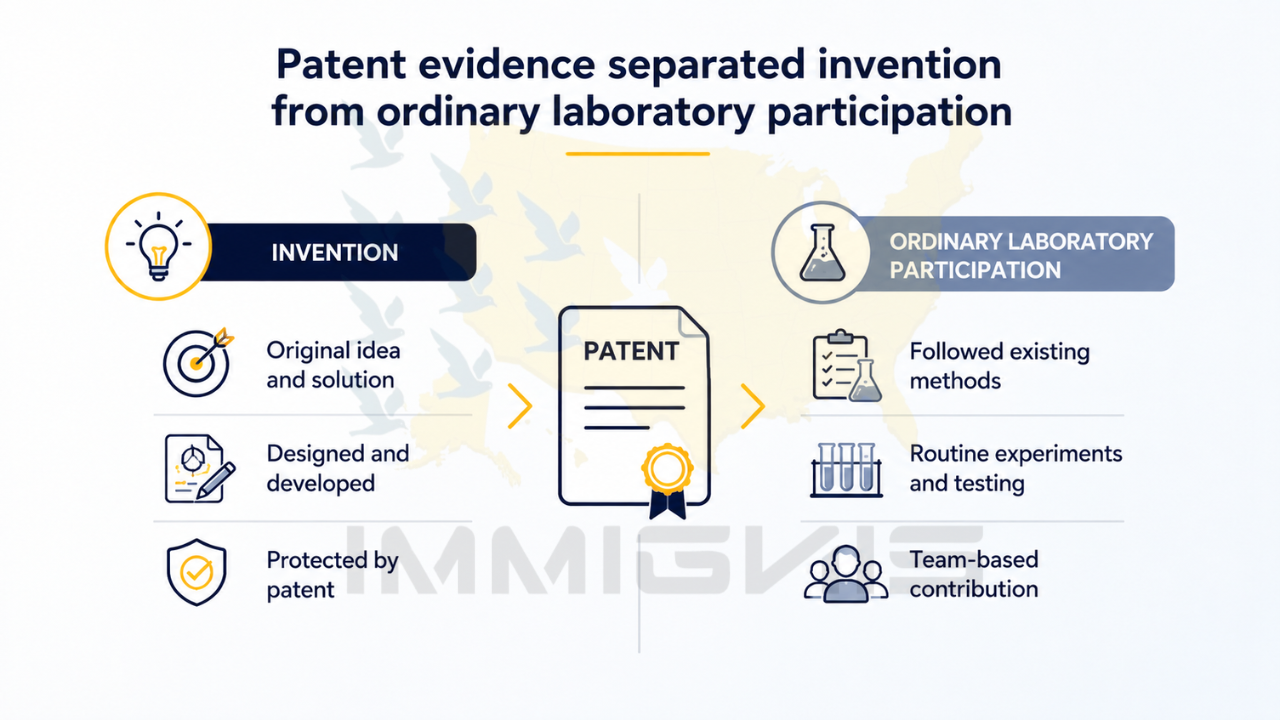
Patent records can be particularly useful in applied materials science because they identify inventors and describe a claimed technical solution. In this case, patent or invention-attribution evidence helped show that the petitioner did more than operate established methods.
The petition explained what technical problem the protected approach addressed, how the petitioner contributed to the inventive concept, and how the patent related to anti-fouling membrane performance. It did not treat the existence of a patent as automatic proof of major significance. Patent evidence was connected to testing, development, licensing interest, pilot activity, commercial evaluation, or expert assessment where the record supported those connections.
This approach prevented two common errors. First, the petition did not confuse an employer’s ownership of intellectual property with the absence of personal inventorship. Second, it did not imply that every named inventor contributed equally. The supporting record identified the petitioner’s actual inventive work.
Pilot testing and industry letters translated laboratory promise into practical relevance
Pilot and industrial collaboration evidence helped bridge the gap between a controlled test and real operating conditions. A membrane treatment that performs well in a laboratory may still face questions about durability, manufacturability, cleaning compatibility, material cost, feed-water variability, and integration into existing systems.
The profile-building strategy therefore documented authorized pilot work, technical evaluation, scale-up discussions, or industry reliance where those records existed. Letters from collaborators were strongest when they explained the problem under evaluation, the petitioner’s specific contribution, the reason the work was selected for further testing, and the professional consequence of the result.
The letters did not claim that a complete desalination plant adopted a technology unless the record proved it. They distinguished laboratory interest, pilot evaluation, process consideration, and full implementation. That precision made the evidence more credible.
Industry validation was useful because it showed that the work was being assessed against practical constraints, not only academic curiosity. It also helped establish why the scientist’s contribution mattered to people responsible for water-treatment performance.
Conference platforms made a technical niche visible outside one laboratory
International water and desalination conferences provided another form of professional visibility. Presentations, invited talks, technical sessions, panels, or accepted research contributions showed that the petitioner’s work had entered broader professional discussion.
The petition documented the nature of the event, the technical subject presented, the selection process where available, and the petitioner’s role. A conference appearance was not treated as extraordinary simply because the event was international. The value came from selection, subject-matter relevance, repeat invitations, presentation responsibility, or a role in shaping the technical program.
Conference records also supported the coherence of the profile. The same core expertise – membrane surface treatment, fouling control, desalination performance, and material reliability – appeared across publications, patents, presentations, and professional service.
Completed peer review supported the judging criterion
The petitioner’s service reviewing journal manuscripts, conference papers, research proposals, or other technical submissions was documented where completed review could be confirmed. The petition explained that reviewers evaluate the work of other professionals and are selected because editors or organizers trust their subject-matter judgment.
Invitations alone were not presented as completed judging. The evidence included reviewer acknowledgments, editorial records, review histories, certificates, or letters confirming actual service. Routine internal review performed as part of ordinary employment was distinguished from independent professional evaluation.
Peer review also helped the final merits analysis. It showed that the field relied on the petitioner not only to produce research, but also to assess the quality, methods, and conclusions of other researchers.
Professional roles and membership were used with care
International desalination organizations, water-technology networks, scientific societies, and technical committees can provide useful evidence, but their significance depends on the actual selection standard and responsibility involved.
The petition did not assume that paying dues or joining an open association satisfied the EB-1A membership criterion. Where a role required nomination, peer selection, documented achievement, technical expertise, committee appointment, or another meaningful threshold, the record explained that process.
Even when a role did not independently satisfy the membership criterion, it could still support final merits, judging, leading role, or original-contribution arguments. Committee participation, standards input, conference organization, or technical working-group responsibility helped show how the petitioner was trusted within the field.
Published material had to be about the scientist, not merely the topic
Published material is frequently confused with authorship. Articles written by the petitioner can support the scholarly-articles criterion. Published material requires qualifying coverage about the petitioner and the petitioner’s work.
Where science media, water-industry outlets, institutional publications, or other independent sources discussed the petitioner’s membrane research, the petition documented the outlet, authorship, circulation or audience, and the substance of the coverage. Passing mentions or institutional announcements were not overstated.
This evidence helped make an otherwise technical profile understandable to a wider audience. It showed that the petitioner’s work could be recognized outside the immediate research team while remaining tied to the actual scientific contribution.
Expert letters connected microscopic mechanisms to system-level relevance
Expert letters were especially useful because membrane science can become difficult for a non-specialist to follow. The strongest letters explained the field problem, the petitioner’s contribution, the evidence of reliance, and why the work mattered to desalination research or operations.
Independent experts provided field context. Collaborators, supervisors, patent colleagues, or pilot partners established personal attribution and technical detail. Each writer’s basis of knowledge was made clear. The letters were supported by publications, patents, performance data, review records, pilot evidence, or professional-role documents rather than left as unsupported praise.
The case avoided broad claims that one membrane treatment secured water for an entire city. Instead, the letters explained the more defensible relationship between improved fouling control, dependable membrane performance, and the long-term challenge of operating desalination systems efficiently.
The final merits analysis treated the record as one scientific career
Meeting at least three evidentiary criteria is only the first stage of the EB-1A analysis. USCIS then considers the evidence together to determine whether the petitioner has sustained national or international acclaim and belongs among the small percentage at the top of the field.
The final presentation therefore connected evidence across time. Publications showed authorship. Citations and follow-on work showed scientific reliance. Patent records showed inventorship. Pilot and industry evidence showed practical evaluation. Peer review showed trust in the petitioner’s judgment. Conferences and professional roles showed recognition outside one laboratory. Performance documentation tied the entire record back to identifiable membrane work.
The case did not ask USCIS to infer extraordinary ability from the importance of water alone. It showed a sustained pattern of contribution, authorship, evaluation, selection, and reliance within a defined technical field.
Why this case worked
The case worked because it gave the officer a clear path from surface science to professional significance. The evidence did not stop at a microscopic coating, a laboratory graph, or a publication title. It explained what the petitioner developed, how the work was tested, who relied on it, how it entered the literature, and why qualified professionals continued to seek the petitioner’s judgment.
It also remained disciplined. The petition did not equate every patent with major significance, every citation with acclaim, every society membership with selective admission, or every pilot test with commercial adoption.
A microscopic membrane surface became persuasive evidence only after the record showed the scientist behind it and the technical chain connecting that work to desalination reliability.
What other desalination and membrane professionals can learn
Scientists and engineers in membranes, water treatment, polymers, coatings, desalination, separation science, process engineering, and related materials fields often possess substantial evidence that is fragmented across laboratories, patents, pilot reports, industrial collaborations, publications, citation databases, conference systems, and review platforms.
A useful profile-building process begins by preserving attribution. Keep authorized invention records, contribution statements, cleared performance summaries, pilot documentation, publication drafts, citation analyses, completed review evidence, committee appointments, conference invitations, and letters from people who directly used or evaluated the work.
The goal is not to convert every technical activity into an immigration criterion. It is to identify the strongest, independently verifiable parts of the record and explain them accurately in the language of the field and the law.
Frequently asked questions
What is EB-1A?
EB-1A is an employment-based immigrant classification for a person of extraordinary ability in the sciences, arts, education, business, or athletics. The petitioner must satisfy the applicable evidentiary framework and demonstrate sustained national or international acclaim in the final assessment.
Can a desalination or membrane scientist qualify for EB-1A?
Potentially. Eligibility depends on the individual record. Publications, original contributions, judging, qualifying published material, leading or critical roles, selective membership, patents, awards, and high remuneration may be relevant when supported by appropriate evidence.
Does research on an important water problem automatically prove extraordinary ability?
No. The importance of desalination or water security provides context, but the petition must establish the petitioner’s own achievements, recognition, and sustained standing in the field.
Can laboratory membrane-performance data support an EB-1A petition?
Yes, when the data is authenticated, understandable, and tied to the petitioner’s personal contribution. It becomes stronger when connected to replication, publications, patents, pilot testing, adoption, or independent reliance.
Does a patent prove an original contribution of major significance?
A patent can show inventorship and novelty, but it does not automatically prove major significance. Evidence of use, testing, licensing, adoption, follow-on development, citation, or expert reliance may help establish significance.
Can citation evidence be used in a membrane-science case?
Yes. Citation totals can provide context, but the substance of the citing work is often important. The petition should explain how other researchers relied on the petitioner’s method, result, or scientific conclusion.
Can pilot testing count as evidence of major significance?
Pilot testing can be persuasive because it shows practical evaluation beyond an initial laboratory experiment. The record should accurately distinguish evaluation, scale-up, process consideration, and full commercial adoption.
Can industrial collaboration be used if the work is confidential?
Yes. Authorized summaries, redacted performance records, cleared project descriptions, patent documents, and detailed letters can show the contribution while protecting proprietary information.
Can peer review satisfy the judging criterion?
Yes, when the petitioner completed reviews of the work of others through journals, conferences, grant programs, or another formal process. Invitations alone are weaker than documented completed service.
Does ordinary membership in a desalination or scientific society satisfy the membership criterion?
Not automatically. The criterion requires evidence that admission demanded outstanding achievements judged by recognized experts. Open or paid membership may still support professional context but generally does not satisfy that requirement by itself.
Can a technical committee role strengthen the petition?
Yes. A committee or working-group role may support judging, leading role, original contributions, or final merits when the selection process and actual responsibility are documented.
What is the difference between scholarly articles and published material?
Scholarly articles are works authored by the petitioner. Published material generally refers to qualifying coverage written about the petitioner and the petitioner’s work. The two categories should not be merged.
How can a scientist prove a leading or critical role?
The record should document the distinguished reputation of the organization or project and show why the petitioner’s responsibility, scientific authority, invention ownership, or technical decisions were important to its work.
Does EB-1A require a permanent U.S. job offer or labor certification?
EB-1A does not require a permanent job offer or labor certification, and an eligible person may self-petition. The record must still show that the person intends to continue work in the area of extraordinary ability in the United States.
How does EB-1A differ from EB-2 NIW for a desalination scientist?
EB-1A focuses on extraordinary ability and sustained acclaim under its own criteria. EB-2 NIW requires EB-2 qualification and a showing that waiving the job-offer and labor-certification requirements is in the national interest. The better fit depends on the individual evidence and proposed U.S. work.
How can ethical profile building help a membrane scientist?
It can organize existing evidence, improve lawful attribution, develop legitimate publications and review service, preserve pilot and invention records, and build professional visibility without inventing adoption, purchasing recognition, or overstating laboratory results.
Turn hidden membrane science into a documented professional record
A strong desalination record may already exist across performance data, publications, patents, pilot files, professional roles, conference programs, review systems, and the testimony of researchers or industry specialists who relied on the work.
Start with a free EB-1A profile assessment to identify which achievements can be documented now, which contributions require clearer attribution, and which ethical profile-building steps may strengthen a desalination or membrane-science case.