
How a U.S.-linked energy record became an EB-1A approval by connecting methane detection, sensor validation, and LNG reliability monitoring
Key facts at a glance
| Outcome | EB-1A approval for a Qatari LNG methane-monitoring engineer connected to U.S.-linked energy projects. |
| Approval date | Approved on January 29, 2026. |
| Field niche | Methane leak detection and LNG reliability monitoring, with a focus on sensor validation, emissions signals, maintenance response, and reliability in LNG operations. |
| Starting problem | The work had environmental value and operational importance, but the initial record did not clearly connect both sides into one field-level authority story. |
| Profile-building path | Focused publications, sensor-validation evidence, a policy paper for LNG and emissions stakeholders, trade-media interviews, an invited talk, peer review, selective membership evidence, and independent expert letters. |
| EB-1A evidence presented | Scholarly articles, original contributions, published material, judging, memberships, and leading or critical role evidence. |
On January 29, 2026, USCIS approved the Form I-140 petition of a Qatari engineer whose strongest work sat in a difficult intersection: methane leak detection, LNG operations, and reliability monitoring.
The approval did not depend on treating him as a general energy professional. It depended on showing a narrower and more defensible record: an engineer who worked on how methane signals are detected, validated, interpreted, and connected to operational decisions in LNG environments.
That distinction made the case stronger. Methane monitoring can easily be described as an environmental compliance task. LNG reliability work can easily be described as plant operations. His EB-1A petition needed to show why the two were connected and why his work belonged to a field of recognized technical importance. This demonstrated the type of expertise seen in EB-1A energy engineers working on advanced energy challenges.
The final record did that by documenting methane-monitoring methods that helped energy teams move from raw sensor data to trustworthy action: confirm the signal, understand uncertainty, locate the likely source, assess the operational context, and decide what response is justified.
The case was not just about finding a leak
A methane alarm is not the same thing as a useful engineering decision.
A reading may reflect an actual leak, sensor drift, background variation, maintenance activity, weather effects, or the position of a detector relative to the source. In a complex LNG setting, the question is rarely just whether a number changed. The more important question is whether the evidence is reliable enough to support inspection, maintenance, shutdown review, repair prioritization, or another operational step.
That became the professional center of the case. His work focused on leak-detection logic, sensor-validation practices, monitoring reliability, emissions data interpretation, and the relationship between methane signals and LNG facility decisions.
Advance My Profile, powered by Immignis, reviewed the record with legal strategists and energy-domain support. The profile was narrowed to methane leak detection and LNG reliability monitoring. That field definition helped prevent the case from becoming a loose collection of energy, emissions, and operations documents.
Why a strong LNG engineering record can still look ordinary
Energy engineers often work inside records that are not designed for immigration evidence. Internal reports, inspection notes, monitoring logs, validation documents, facility procedures, and project summaries may show useful work, but they do not automatically show sustained acclaim or recognized field-level expertise.
The starting record had that problem. It showed involvement in serious LNG and methane-monitoring work. It did not yet explain which technical methods were his, why those methods mattered outside one project setting, or how the work had recognition beyond employer-based operations.
There was also a framing problem. If the case leaned too heavily on climate impact, the record could sound like environmental policy. If it leaned too heavily on LNG operations, it could sound like routine reliability engineering. The petition had to show the bridge between the two: methane monitoring as a technical discipline that supports emissions reduction, safety review, and energy infrastructure reliability.
What USCIS needed to see in this methane-monitoring EB-1A case
The EB-1A green card is a self-petition immigrant classification for individuals who can demonstrate extraordinary ability through sustained national or international acclaim and recognized achievements in their field.
For original contributions, the petition needed to identify the applicant’s own monitoring methods, sensor-validation work, reliability logic, or emissions-analysis framework and explain why the contribution had significance beyond a routine job assignment.
For scholarly articles, the record needed focused authorship in methane detection, LNG monitoring, sensor validation, emissions analytics, or related energy reliability subjects. A scattered publication list would have been weaker than a coherent authorship record tied to the field niche.
Published material required independent coverage about him, his expertise, or his work. General media discussion about methane or LNG would not be enough unless it connected to the applicant’s professional authority.
Judging evidence required actual evaluation of other professionals’ work, such as peer review, technical review, or scoring of energy, emissions, or engineering submissions. Speaking at a conference and judging a submission are different types of evidence.
Membership evidence had to show selective admission or elevation based on achievement. Leading or critical role evidence had to show why important projects relied on his technical judgment, not simply that he worked in a high-value energy environment.
The evidence was rebuilt around a decision chain
The strongest technical story was not a facility name or a project title. It was a decision chain.
What changed in the monitored signal? Was the reading credible? Which sensor or sensor group captured it? Could the pattern be reproduced? What operating condition existed at the time? Did the evidence justify inspection, repair prioritization, or further monitoring? Which response reduced uncertainty without overstating the data?
The petition organized non-confidential evidence around those questions. It described sensor placement logic, validation procedures, data-quality review, false alarm management, leak-source interpretation, maintenance response, and the point where emissions monitoring became part of reliability planning.
Protected facility information, customer data, proprietary operating parameters, and sensitive project details were kept out of the public-facing record. The case did not need to expose them. It needed to show the method at a level independent experts could evaluate.
The papers gave the technical work a public language
The publication strategy was deliberately narrow. It did not ask the engineer to write broadly about climate change, oil and gas, or energy transition. It focused on the technical questions that matched his real work: methane leak detection, sensor validation, LNG monitoring, and reliability decisions based on uncertain signals.
One paper examined why methane detection cannot be judged only by whether a sensor produces an alarm. Reliability depends on how teams validate the signal, handle background variation, and decide whether the reading points to an actionable event.
Another paper addressed the relationship between emissions monitoring and LNG operational continuity. A facility may need to respond to emissions risk without creating unnecessary disruption from unreliable signals. That balance made the work more than a compliance exercise.
The papers helped convert internal engineering experience into public technical authorship. They also gave the petition a clearer way to explain why his work belonged in a specialized field rather than inside a generic energy job description.
Sensor-validation evidence mattered because raw readings can mislead
Sensor evidence is powerful only when the record explains how it was validated.
The petition therefore did not present monitoring outputs as if every signal proved a leak or every detected event proved a system improvement. It focused on the engineering behind interpretation: calibration, drift review, data quality, location context, atmospheric or operational conditions, and the method used to separate a credible methane event from noise.
Where the evidence supported it, the record described how monitoring work influenced inspection or maintenance decisions. Where multiple factors could have contributed to an operational result, the petition did not claim that one monitoring method alone produced the full outcome.
That discipline strengthened the case. It made the record more credible to technical experts and reduced the risk that USCIS would see the petition as an attempt to turn ordinary project participation into extraordinary ability.
The policy paper connected LNG monitoring to two audiences
The policy paper was written for LNG, emissions, and energy-reliability stakeholders. Its value came from joining two conversations that are often separated.
For climate and emissions audiences, the paper explained why methane detection must be reliable, timely, and tied to verifiable response. A detection program that produces data but does not support action has limited practical value.
For LNG reliability audiences, the paper explained why monitoring uncertainty matters. Poorly interpreted signals can create delayed response, unnecessary intervention, or confusion about where engineering attention should move next.
The paper did not claim that any monitoring system can eliminate methane emissions. It explained a more defensible point: validated monitoring can help teams detect, prioritize, and respond to methane risk while supporting the reliability expectations of energy infrastructure.
Trade-media interviews made the issue understandable without overstating it
The media record worked because it did not present him as a general energy commentator. His interviews focused on methane monitoring in LNG settings, sensor uncertainty, leak verification, and the operational steps that follow a credible detection event.
He explained that methane monitoring is useful only when data is connected to decision-making. A sensor reading may start the process, but engineers still need context, validation, response planning, and a way to document what was done.
That public explanation supported published-material evidence and reinforced the case theme. The applicant was not simply associated with a high-profile energy topic. He was being recognized for a specific technical subject within that topic.
Invited talks and peer review expanded the recognition record
Invited speaking helped place the work before audiences that cared about LNG operations, emissions monitoring, and energy infrastructure. The talks used non-confidential examples involving signal validation, leak prioritization, sensor behavior, and response decisions.
The strongest audience questions were not about whether methane matters. They were about detection reliability, false positives, maintenance timing, facility context, and how to make monitoring data useful without treating it as certainty.
Peer review supported the judging criterion where records showed genuine evaluation of work by other specialists. The petition documented the venues, subject areas, and completed review activity. The point was not that he had read papers. The point was that professional venues trusted him to evaluate technical work in the field.
Selective membership and leading-role evidence were handled cautiously
Professional membership evidence can help, but it is not a shortcut. The petition examined the actual admission or elevation rules and used membership evidence only where the record showed a selective process tied to professional achievement.
Leading or critical role evidence was also kept tied to proof. The record explained where U.S.-linked energy projects or significant monitoring work relied on his technical judgment, how his role affected the monitoring process, and why his contribution was more than routine participation.
This approach kept the petition from relying on the prestige of an energy project alone. The case focused on what he contributed and how that contribution was recognized.
Independent letters explained significance across climate and reliability
Independent experts in LNG, emissions monitoring, and energy reliability played an important role. Their letters did not simply say that methane monitoring is important. They explained why the applicant’s methods mattered to the way monitoring data is validated and used.
The best letters addressed attribution. They identified the technical work linked to the applicant and explained why the contribution was not merely routine instrumentation or ordinary facility support.
They also helped explain why the field niche was credible. Methane leak detection has environmental significance, but in LNG operations it also relates to safety review, maintenance decisions, reliability, and the responsible operation of energy infrastructure.
How the EB-1A evidence worked together
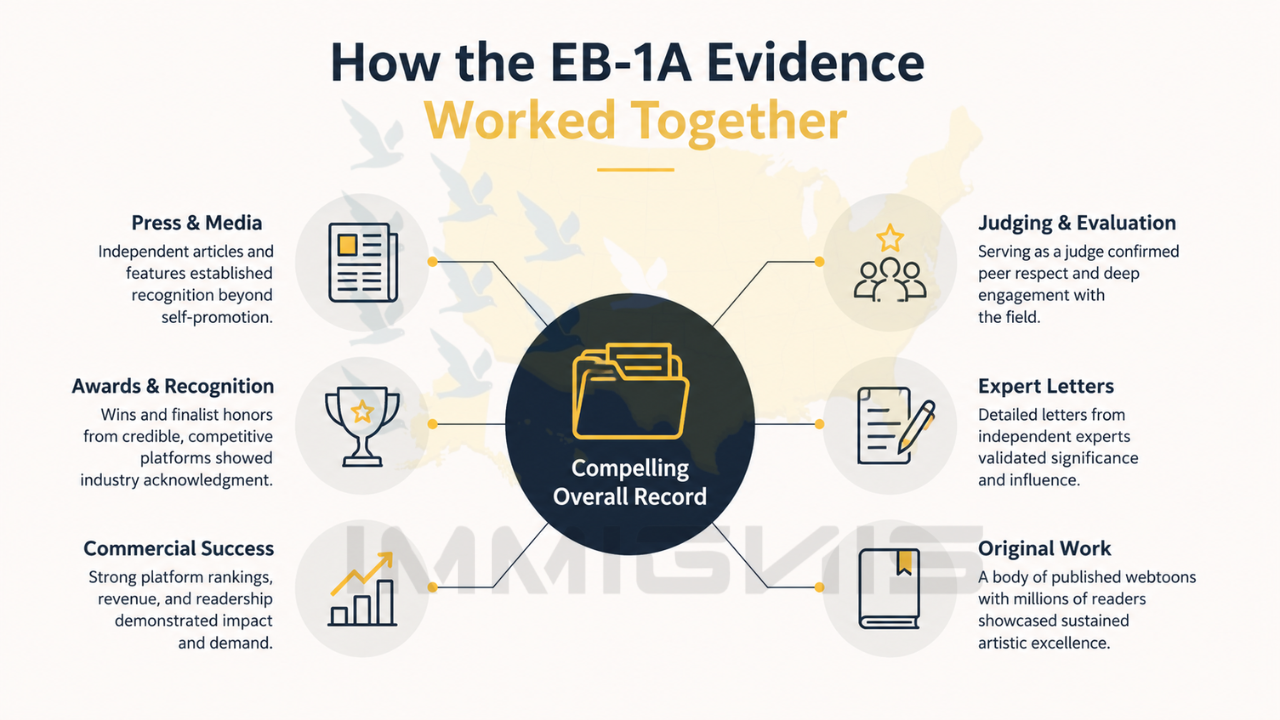
The petition was strongest because the evidence did not sit in isolated boxes.
The scholarly articles showed focused authorship in methane detection, sensor validation, and LNG monitoring. The original-contribution evidence connected that public authorship to documented technical methods. The policy paper and media commentary showed that he could explain the subject to energy and emissions audiences. Peer review and invited activity showed that the field used his judgment beyond the employer setting. Independent letters explained significance and attribution.
No single category carried the case alone. The approval came from a record that made the specialty visible and then supported it through several kinds of evidence pointing to the same professional identity.
Why this case matters for energy and emissions professionals
This case is useful for engineers, data scientists, monitoring specialists, emissions professionals, reliability engineers, and energy-infrastructure leaders whose best work is locked inside project records.
Many professionals assume that working on an important infrastructure problem will be obvious to USCIS. It is not. A petition must show the applicant’s own contribution, how that contribution has been recognized, and why the record as a whole reflects extraordinary ability in a defined field.
The lesson is not to expose confidential facility data or exaggerate climate impact. The lesson is to build a safe, accurate, public record around the professional method: what problem was solved, how the method worked, who relied on the applicant’s judgment, and how the field recognized the contribution.
The result
USCIS approved the Form I-140 petition on January 29, 2026.
The case did not turn on a claim that methane monitoring alone can solve climate risk or guarantee LNG reliability. It succeeded because the petition showed a specialized engineer whose work connected emissions data, sensor validation, and energy-infrastructure decision-making.
For the applicant, the approval recognized more than an energy job title. It recognized a public and verifiable record of expertise in methane leak detection and LNG reliability monitoring.
Lessons for professionals whose work sits inside energy projects
Energy professionals often have work that is important, technical, and difficult to disclose. That does not make EB-1A impossible. It means the case must be built around a method that can be documented without exposing protected information.
For methane-monitoring and LNG professionals, the question is not whether the employer or project matters. The question is whether the record proves individual expertise, sustained recognition, and a contribution that the field can understand.
A strong petition connects the internal evidence to external recognition. Publications, expert letters, peer review, media commentary, selective membership, invited talks, and safe adoption evidence should not feel like separate achievements. They should all explain the same professional story.
Frequently asked questions
Can LNG methane-monitoring work support an EB-1A petition?
Yes, LNG methane-monitoring work can support an EB-1A petition when the applicant can show individual achievements, recognized expertise, and evidence that the work has significance beyond ordinary employment. The petition must identify the specific technical contribution and support it with credible evidence.
Is environmental significance enough for EB-1A?
Not by itself. Environmental importance may help explain why the field matters, but EB-1A still requires evidence of the applicant’s own extraordinary ability, sustained acclaim, and recognized achievements. The case must prove the person, not only the importance of the issue.
Can confidential LNG project evidence be used safely?
Yes. A petition can use non-confidential summaries, role evidence, public technical writing, expert letters, safe examples, and method descriptions. Protected facility details, customer information, proprietary operating data, and sensitive project records should remain confidential.
Do sensor-validation records help prove original contributions?
They can help when they show what the applicant personally developed or improved and why the method mattered. Raw sensor outputs are weaker than evidence explaining validation logic, uncertainty management, decision use, and expert recognition of the method’s significance.
Can peer review and invited talks strengthen an energy EB-1A case?
Yes. Peer review can support the judging criterion when the applicant actually evaluated other specialists’ work. Invited talks can support recognition when they show that relevant professional audiences sought the applicant’s expertise. Each type of evidence should be documented accurately.
Build an EB-1A record around the energy method you can prove
If you work in LNG, methane monitoring, emissions analytics, energy reliability, sensor validation, process safety, or critical infrastructure monitoring, your strongest evidence may be inside confidential project files.
Immignis and Advance My Profile help professionals identify a defensible authority niche, organize non-confidential evidence, develop public recognition, and prepare an EB-1A record around achievements that can be verified and defended.