Key facts at a glance:
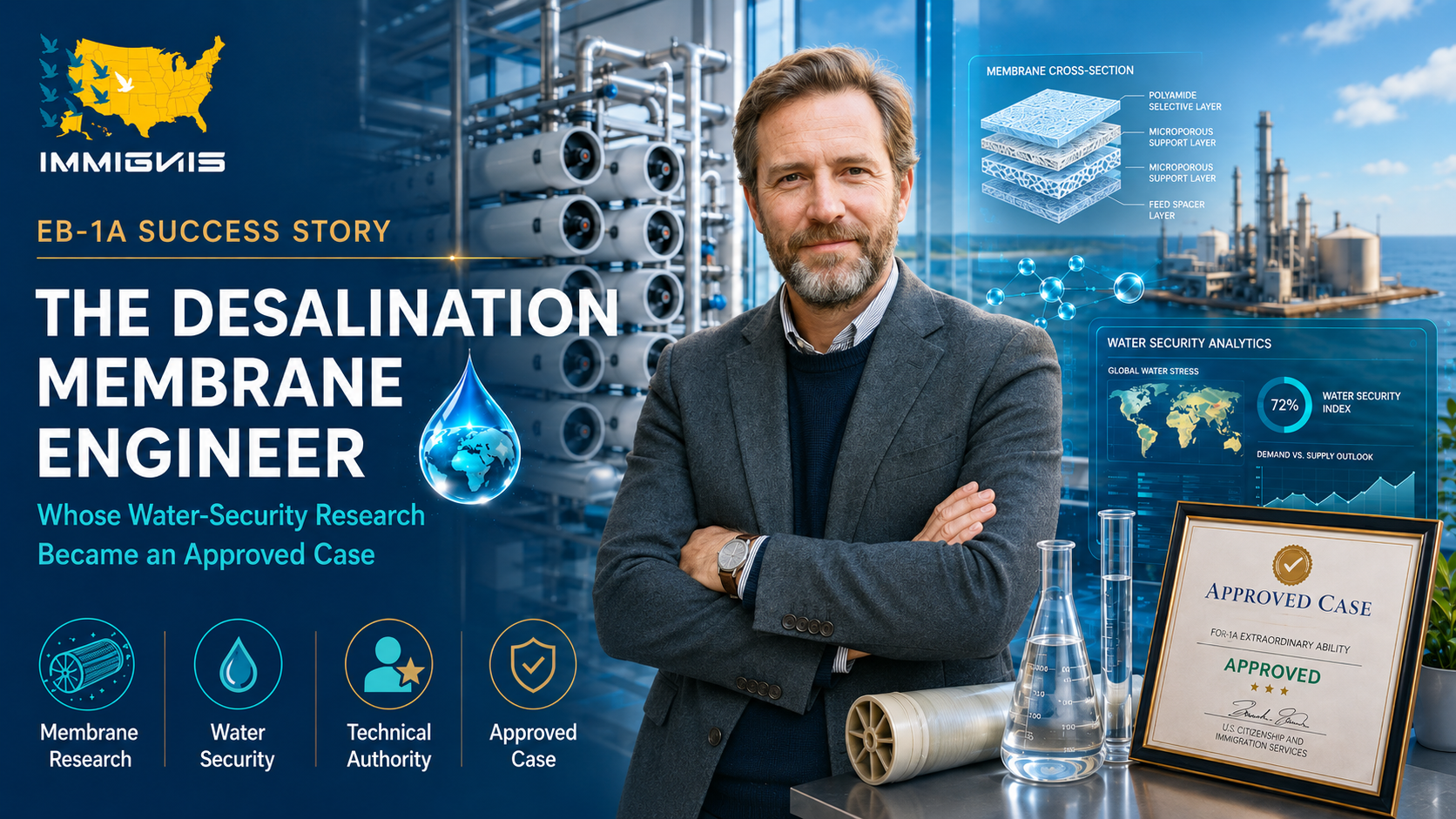
| Outcome | EB-1A approval for a Moroccan desalination membrane engineer working with a France based water tech lab. |
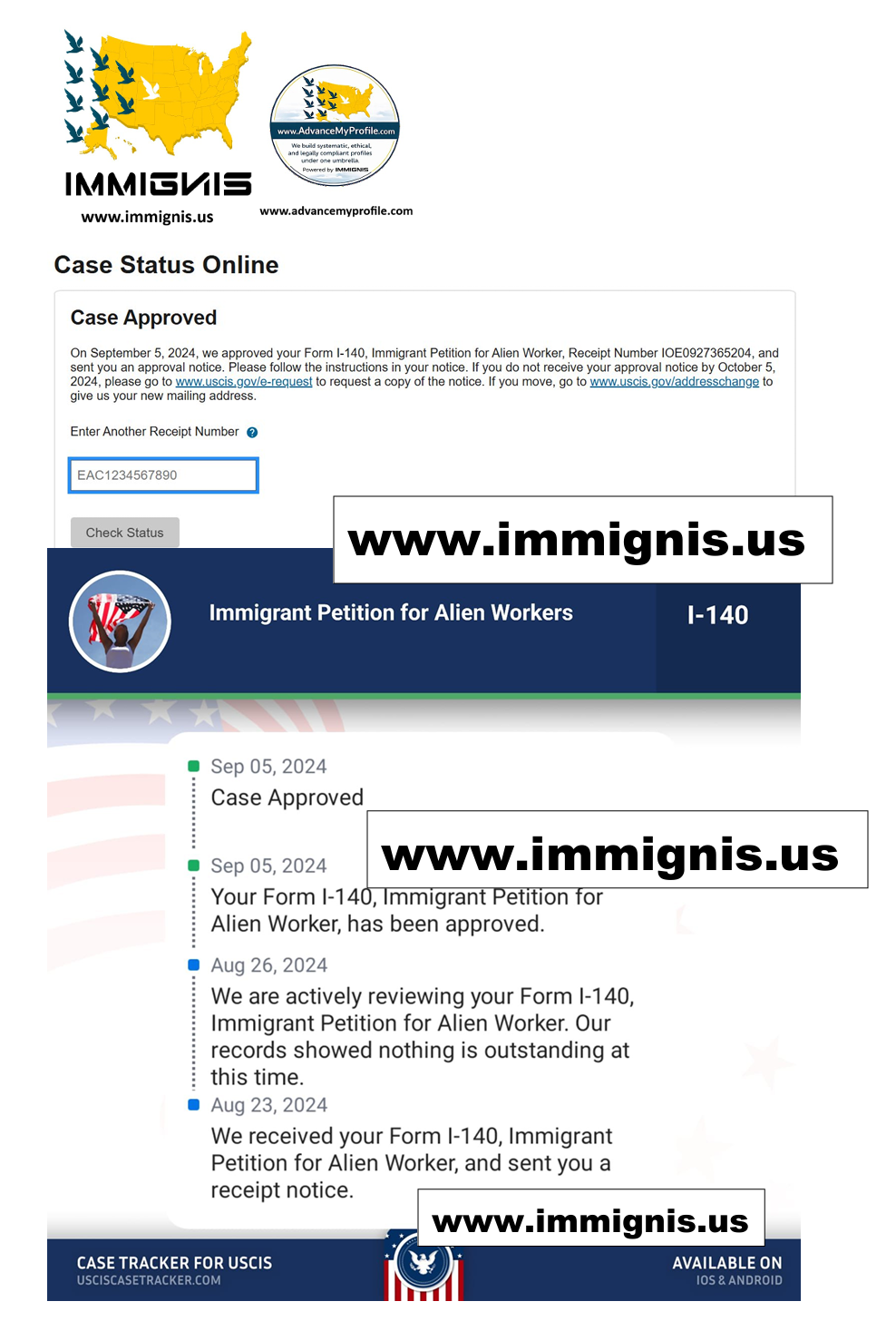
| Approval date | Approved on September 5, 2024. |
| Field niche | Energy efficient desalination membranes for arid regions. |
| Starting problem | Promising research had scientific value, but it lacked broader public visibility, industry recognition, and a clear water-security narrative. |
| Path used | Ethical EB-1A profile building through focused papers, patent filing, a water security white paper, conference presentation, technical media coverage, judging for a water innovation challenge, selective memberships, and independent membrane science expert letters. |
| USCIS EB-1A criteria activated | Scholarly articles, original contributions, patents, published material, judging, and memberships. |
EB-1A engineer profile: desalination research
It started with a question that looked simple only from a distance. How do you make seawater usable without making the energy cost unbearable?
For years, the engineer had been working near that question inside a France-based water-tech lab. His research focused on desalination membranes for arid regions, where every percentage of energy savings can matter and every improvement in membrane performance can affect whether clean water systems are practical, scalable, and trusted.
The science was serious. The public record was not. His publications were promising, but the story around them was quiet. His work had technical originality, yet most people outside membrane science did not understand why it mattered. Industry audiences saw desalination as a water problem. Researchers saw it as a materials problem. Policymakers saw it as a resilience problem. His record did not yet connect those audiences.
He had not built an ordinary research career. He had built one that needed a sharper voice.
Why did a strong desalination profile still look risky for EB-1A?
The risk was not the science. The risk was fragmentation. A membrane engineer can publish promising research and still look incomplete for EB-1A if the record does not show independent recognition, field-level significance, and a clear specialty. In this case, the work moved across chemistry, materials engineering, water treatment, and sustainability. That range made the profile interesting, but it also made the petition vulnerable.
USCIS would not be asked to approve a broad “water researcher.” The case needed to show a top level specialist in energy efficient desalination membranes for arid regions.
The EB-1A green card is a self-petition immigrant category for people who can show extraordinary ability through sustained national or international acclaim and evidence that they are among the small percentage at the top of their field.
That standard made the engineer pause. He had strong research, but not enough public visibility. He had technical credibility, but limited media recognition. He had promising innovation, but the patent and broader water-security significance needed clearer documentation.
His concern was not unusual. Many scientists in water technology, clean energy, materials science, and environmental engineering are deeply skilled but under documented. Their work matters to the field, but their public evidence does not yet prove it.
What did Immignis see that the original record did not show?
Immignis saw a scientist whose case could become stronger if the record stopped trying to be broad.
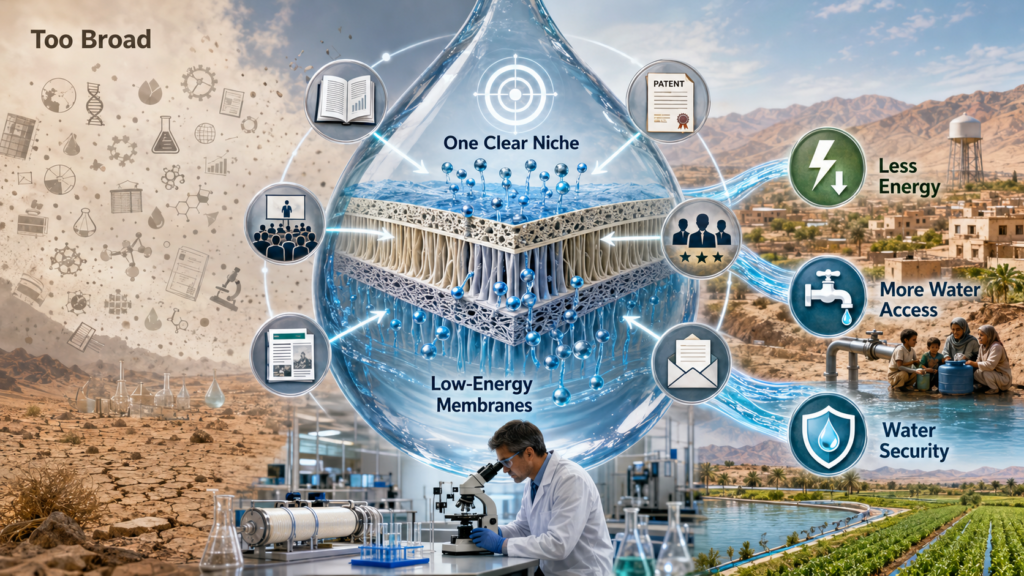
The first assessment identified the central issue: his research had to be framed around one defensible niche. Not water treatment generally. Not sustainability generally. Not membrane science in every possible direction. The EB-1A case needed a single center: low energy desalination membranes for water stressed and arid regions.
That framing changed the build. It allowed every publication, conference presentation, patent document, white paper, media feature, membership, judging activity, and expert letter to point toward one problem: how better desalination membranes can reduce energy burden and improve water access in dry regions.
The case was no longer about a researcher with scattered promise. It became the story of a membrane engineer whose work sat at the intersection of materials innovation and water security.
What did USCIS need to see in this desalination membrane case?
USCIS needed to see that the work was not only a lab improvement. For this case, the officer would need answers to several field specific questions. Did the membrane research show scientific originality? Did the patent filing reflect a real technical contribution? Did independent experts view the work as meaningful for desalination or water-security systems? Did the public record show recognition beyond the lab? Did the profile explain why lower energy desalination matters for arid regions?
The petition also had to avoid a common weakness in research-based EB-1A cases. A publication list alone is not the same as sustained acclaim. A patent filing alone is not proof of major significance. A conference presentation alone is not field recognition. Each item had to be tied to the same water-security narrative.
The final merits issue was practical: could the total record show a researcher whose membrane work had moved from promising science into recognized field contribution? That became the standard for every evidence choice.
How did Advance My Profile build his authority record ethically?
The build began with positioning. Advance My Profile, powered by Immignis, narrowed the profile to energy efficient desalination membranes for arid regions. This was the most important strategic move. It gave the entire case a field identity that an adjudicator, a scientist, a water utility leader, or a policy audience could understand.
Then came focused authorship. With domain support, the engineer’s research was shaped into papers that stayed close to his true expertise: membrane efficiency, water-treatment performance, materials behavior, and desalination challenges in dry regions. The publication plan did not chase unrelated topics. It built depth where the record needed strength.
The patent filing gave the profile another layer. It helped document that the work was not only commentary on known methods. It reflected a claimed technical solution in the desalination membrane space. In the petition, the patent filing was not treated as automatic proof. It was connected to expert letters, technical publications, and the broader water-security problem.
A water-security white paper followed. This was written for water-management stakeholders, research networks, and groups concerned with drought resilience and arid-region infrastructure. It translated the technical work into language that showed why membrane efficiency can matter outside the laboratory.
Conference visibility added public professional review. The engineer was prepared for a technical presentation that placed his work before a relevant water-technology audience. That helped move the record from private research progress into field-facing recognition.
Media coverage was built carefully. Technical media explained the desalination challenge, the energy burden of conventional systems, and the role of membrane research in arid region water planning. The coverage did not exaggerate. It made the science understandable to the public and to industry readers.
Selective memberships were reviewed and pursued where his record matched the eligibility rules. The goal was not to collect logos. The goal was to show that recognized professional communities in membrane science, water technology, or environmental engineering had a credible basis to place him inside their expert circles.
Judging evidence then strengthened the record. He was positioned to evaluate work in a water innovation challenge. That mattered because EB-1A values the movement from being evaluated to evaluating others. In a technical field, judging signals that the professional is trusted to assess new ideas, not only produce them.
Independent letters completed the outside voice. Immignis worked with the client to develop detailed letters from membrane science experts who could explain the value of his work in desalination, materials engineering, and water resilience. The letters did not rely on praise alone. They explained the technical problem, the contribution, and why the field should care.
The case was built by legal strategists, domain reviewers, content professionals, media specialists, and an evidence team working under one rule: the record had to be real, relevant, and verifiable.
Why did ethical profile building matter in water technology?
Water technology is too serious for decorative evidence. A desalination researcher cannot build long-term authority with weak journals, fake awards, irrelevant memberships, or paid visibility dressed up as recognition. Those tactics may create a louder file, but they do not create a stronger professional.
For this engineer, the profile had to be something he could continue using after approval. A patent filing he could explain. A white paper he could share with water stakeholders. Publications that fit his specialty. Media coverage that described the science correctly. Judging that matched his field. Letters that came from people qualified to evaluate the work.
That is the difference between profile building and profile decoration. Profile decoration tries to impress once. Profile building creates evidence a professional can carry for life.
Could your own EB-1A profile be stronger than it looks?
If your work sits inside a lab, a prototype program, a technical team, or a narrow scientific community, your issue may be visibility. Immignis offers a free profile assessment for professionals who want to understand whether their record may support an EB-1A green card, EB-2 NIW, O-1, or another merit-based pathway. The assessment looks at your true niche, evidence gaps, recognition potential, and honest path forward.
Which USCIS EB-1A criteria did the final petition activate?
The final Form I-140 petition activated six USCIS EB-1A criteria and tied them into a finalmerits narrative.
Scholarly articles: Focused papers showed authorship in desalination membrane science and energy efficient water treatment.
Original contributions: The patent filing, technical evidence, white paper, and independent letters explained how the work contributed to low-energy desalination and arid region water resilience.
Patents: The filing supported the originality of the membrane related technical work and strengthened the contribution narrative.
Published material: Technical media coverage placed his expertise in public view and connected his name with desalination innovation and water security.
Judging the work of others: Judging for a water innovation challenge showed that he was trusted to evaluate emerging technologies and ideas in his field.
Memberships: Selective professional memberships helped show recognition within relevant scientific and water technology communities.
The final-merits argument connected these activities to one precise specialty. The record did not present him as a general sustainability researcher. It presented him as a membrane engineer whose work helped address the technical and energy barriers that shape desalination in arid regions.
What did EB-1A approval mean for him?
The EB-1A approval gave the engineer a self-petition green card path and a stronger professional identity.
Approved on September 5, 2024, the case showed how a promising but under-visible research profile could become a recognized authority record. It also showed that technical work does not need to be loud at the beginning to become credible evidence.
After profile building, his record carried more than papers. It included a focused niche, patent evidence, a water security white paper, conference visibility, technical media coverage, judging activity, selective memberships, and independent expert validation. The approval was the immigration result. The water security authority record was the long-term asset.
If this sounds like you:
You may be a membrane scientist, water engineer, materials researcher, climate resilience specialist, or clean tech founder whose work is real but under recognized.
That does not mean your record is weak. It may mean your record is not yet organized around the right problem. The safest path is to build recognition that your real work deserves: focused authorship, patent or IP evidence where appropriate, public technical explanation, selective memberships, judging, white papers, and independent expert letters.
Do not build evidence you will need to hide later. Build an EB-1A profile that supports your immigration future and strengthens your professional name.
Can a desalination membrane engineer qualify for an EB-1A green card?
Yes. A desalination membrane engineer may qualify for an EB-1A green card if the record shows extraordinary ability through sustained acclaim and evidence under the USCIS EB-1A criteria. In this field, strong evidence may include focused publications, patent filings, technical media coverage, judging, selective memberships, water security white papers, and expert letters from membrane science leaders.
How can desalination research be framed for EB-1A without sounding too broad?
The strongest framing usually identifies a narrow specialty. In this case, the profile was not framed as general water treatment or sustainability. It was framed around energy efficient desalination membranes for arid regions, which made the evidence easier to connect and stronger for final merits.
Does a patent filing help an EB-1A membrane-science petition?
A patent filing can help when it is real, relevant, and connected to the applicant’s technical contribution. It should not be treated as automatic proof of extraordinary ability. The petition should explain how the patent relates to the field problem, why the contribution matters, and how independent experts view the work.
Why are white papers useful in a water security EB-1A profile?
A white paper can translate technical research into a form that water management stakeholders, policy networks, and industry groups can understand. For desalination and arid region resilience, this matters because USCIS must see not only that the science exists, but why it has field or practical significance.
What creates RFE risk in a desalination or membrane engineering EB-1A case?
RFE risk can increase when the petition shows publications but does not explain why the work is important outside the lab. USCIS may also question whether a patent filing has significance, whether media coverage is credible, or whether memberships are selective. A strong petition connects each document to one coherent specialty.
Do I need industry recognition if I already have academic papers?
Academic papers are valuable, but they may not be enough if the record lacks broader recognition. In applied fields such as desalination, industry visibility, conference presentations, stakeholder white papers, judging activity, and independent expert letters can help show that the work has relevance beyond publication alone.
Build an EB-1A success story around evidence you can trust:
If you work in desalination membranes, water technology, clean tech materials, arid region infrastructure, or environmental engineering, your strongest achievements may already exist. They may simply be too technical, scattered, or under visible to support a strong petition without a strategy.
Immignis helps professionals build EB-1A profiles through ethical evidence development, field specific positioning, reputable visibility, independent validation, and petition ready storytelling.