Key facts at a glance
| Outcome | EB-1A approval for an Egyptian film editor whose work on acclaimed Arabic-language feature films had been recognized through film projects, creative credits, and later field-specific evidence. |
| Approval date | Approved on August 19, 2025. |
| Field niche | Narrative feature editing in Arab cinema, with a focus on story rhythm, scene structure, emotional pacing, and the final shape of feature-length dramatic films. |
| Starting problem | The films had acclaim, but the editor had almost no personal press. Directors, actors, and producers received most public attention, while her creative contribution remained buried in credits. |
| Profile-building path | Immignis and Advance My Profile built the record through editing-specific award evidence, cinema-press interviews focused on craft, editors-guild membership, festival jury service, and director letters explaining her creative authorship. |
| EB-1A evidence presented | Awards or award-linked evidence where supported, selective membership, judging, leading or critical role, published material, and independent evidence explaining the editor’s original creative contribution. |
| Approval hook | The case made the invisible art visible: the cut was presented as authorship, not as routine post-production labor. |
EB-1A Film Editor: USCIS approved the Form I-140 petition on August 19, 2025.
The approval was not built on broad claims that editing is important. It was built on proof that this particular editor shaped acclaimed Arabic-language feature films in ways that directors, festival records, critics, guild evidence, and industry peers could recognize.
She was an Egyptian film editor working in narrative feature editing in Arab cinema. The films in her record had traveled, screened, and received attention. The problem was that the public record usually stopped at the director’s name. Her work was visible on screen, but her individual authorship was not yet visible on paper.
That is a common problem for film editors. A director may give interviews. A producer may accept the award. Actors appear in the promotional material. The editor helps determine what the audience finally sees, but the evidence may remain trapped in the end credits.
The film had recognition. The editor did not.
The original record contained serious film work. It had feature credits, festival materials, project histories, and evidence that the films themselves had artistic value. What it did not yet show was why the editor should be evaluated as an individual of extraordinary ability.
For EB-1A, a film’s success can help. But a film’s success is not automatically the editor’s success. USCIS still needs to see the person’s own role, recognition, and standing in the field.
That distinction shaped the case. The petition could not simply argue that the films were acclaimed. It had to explain what editing contributed to those films and then document that the contribution was recognized by people outside the editing room.
The starting weakness was sharp: the editor worked on acclaimed Arabic-language features, but almost no press discussed her personally. The directors had the visible narrative. The editor had the cut.
The niche was narrative feature editing in Arab cinema
The profile was narrowed to narrative feature editing in Arab cinema. That focus mattered because it prevented the case from becoming a generic film-industry profile. She was not presented as a general post-production professional, a video editor, or a technician who assembled footage after others had made the creative decisions.
Narrative feature editing is a creative discipline. Editors shape pace, tension, continuity, emotional reveal, performance selection, transitions, silence, rhythm, and the order in which the audience understands a story. In Arab cinema, where social context, dialogue cadence, family dynamics, political undertone, and emotional restraint may carry major narrative weight, editing can determine whether a film feels merely assembled or fully authored.
The petition explained this without exaggerating. It did not claim that the editor alone created the films. It showed how her work contributed to the final storytelling, how directors relied on her judgment, and how the record could separate her individual contribution from the collaborative nature of filmmaking.
That framing gave USCIS a practical way to evaluate her record. The question became: did the evidence show a recognized film editor whose creative judgment had contributed to distinguished work in a specific cinematic field?
What USCIS needed to see in a film-editor EB-1A case
A film editor’s EB-1A case often turns on attribution. The field is collaborative, so the petition must show what the editor did, how others evaluated that work, and why her role was leading, critical, or artistically significant.
The evidence had to do more than list film credits. It needed to show the weight of those credits, the importance of the films, the editor’s actual role in the creative process, and the way her work had been recognized by the film community.
For leading or critical role, the petition needed contracts, credits, director letters, production records, festival materials, or other evidence showing that the films depended on her editorial judgment. For published material, the record needed coverage about her, her editing work, or her craft perspective, not only reviews of the films. For judging, it needed genuine jury or adjudication roles where she evaluated the work of other filmmakers or editors.
For awards, the petition had to be careful. Editing-specific awards, nominations, or credited award connections can be strong when documented. Award submissions alone were not treated as award wins. Where the evidence concerned a film award received by the project rather than a personal editing award, the petition explained the relationship honestly and used supporting evidence to show her role.
At final merits, USCIS could still ask whether the full record showed sustained acclaim and top-level expertise. That meant the evidence needed to tell one coherent story: not only that the films mattered, but that her editing was a recognized reason they worked.
Director letters turned invisible labor into attributable authorship
The most important internal evidence came from directors. Their letters did not merely say that she was talented or hardworking. They described the editorial decisions that changed a film.
Strong letters explained how she handled performance selection, pacing, structural compression, scene order, emotional transition, rhythm, or silence. They identified specific projects and described the difference between footage as captured and the film as finally experienced.
This was not about flattery. It was about attribution. A director can explain when an editor solved a story problem, reshaped a character arc, changed the emotional weight of a sequence, or preserved narrative tension where the footage contained several possible versions of the film.
That evidence helped separate personal artistic contribution from team credit. USCIS was not asked to guess what the editor did. The petition gave the officer a record showing how filmmakers who had worked with her understood her role.
Editing-specific awards and festival records were handled with discipline
The case included award-related evidence, but the strategy was careful. Film awards are complicated because awards may belong to the film, the director, the producer, the cast, or a specific craft category. A festival laurel on a poster does not automatically prove that every credited crew member received an award.
The petition separated the evidence. Where an award, nomination, or recognized selection specifically related to editing or craft work, it was documented as direct evidence. Where an award belonged to the film as a whole, it was used to show the significance of the project, while director letters and credits explained the editor’s role in that project.
Award submissions also had to be described accurately. A submitted film or submitted editing category was not called an award unless the record supported that. This discipline protected the credibility of the petition.
The result was stronger than inflated language. USCIS could see a truthful award record, a serious film record, and a separate attribution record showing why the editor’s work mattered within those films.
Cinema-press interviews gave her a public voice
The initial file had almost no personal press. That created a published-material problem and also made the editor look less visible than the directors she worked with.
Immignis and Advance My Profile helped build a public record around the craft of editing. Cinema-press interviews focused on how she approaches narrative structure, rhythm, performance selection, the handling of silence, and the particular demands of Arabic-language feature storytelling.
This press did not need to turn her into a celebrity. It needed to show that people in the film community had reason to discuss her expertise. That is different from promotional publicity. The strongest coverage treated editing as a creative discipline and addressed her work, process, and field-specific judgment.
Published material became more useful when it did not simply announce a screening or repeat a film synopsis. It gave USCIS independent evidence that her professional identity existed outside the credit roll.
Editors-guild membership helped because it connected her to a professional standard
Membership evidence can be weak when the organization accepts anyone who pays dues. The petition therefore analyzed the editors-guild membership carefully. It identified the guild or professional body, the admission or recognition standard, and the relevance of the membership to film editing as a field.
Where the membership involved professional review, credit requirements, achievement standards, or recognition by peers, it supported the EB-1A record. Where membership was open or purely administrative, it was not overstated.
This was particularly important for an editor whose public record was initially thin. A serious professional membership helped show that her standing was not limited to one director’s private opinion. It placed her within a recognized professional community of film editors.
Festival jury service showed that others trusted her judgment
Judging evidence was built through festival jury service and related adjudication roles. This evidence mattered because USCIS recognizes judging the work of others as a regulatory criterion when the person actually evaluates the work of other professionals in the field.
The petition documented the festival or competition, the role, the category, the selection process, and the kind of work she evaluated. It also distinguished genuine jury service from ordinary attendance, panel participation, or promotional appearances.
For a film editor, judging can be especially persuasive when the role requires evaluation of storytelling, craft, structure, editing, or overall cinematic execution. It shows that the field is not only accepting the person’s work. It is asking the person to evaluate the work of others.
This helped answer the sustained-recognition question. Her judgment was no longer only used inside editing rooms. It was being used in a public professional setting.
Leading role was proved through records, not adjectives
One of the core EB-1A arguments was leading or critical role. This criterion can become weak if the petition only says that the person was essential. The evidence must show why the role was leading or critical for a distinguished organization, production, project, or entity.
The petition used credits, production records, director letters, festival histories, and film materials to show her role on feature films with recognized standing. It explained how editing entered the creative process and why her decisions affected the final work.
This was not a claim that she outranked the director or controlled the whole production. It was a claim that her editorial role was critical to the finished films, and that the films themselves were distinguished enough for the role to matter.
That distinction made the argument credible. In a film case, leading or critical role should not be a hierarchy contest. It should show how the beneficiary’s role affected a significant creative project.
The cut was presented as creative authorship
The phrase “the cut as authorship” became the case’s central idea. Editing is not simply a technical step after filming. In narrative features, the edit can decide the order of revelation, the weight of a glance, the duration of discomfort, the rhythm of a conversation, and the moment when a viewer understands what a character cannot say directly.
That idea was important because the editor’s strongest work was visible in the finished films, but the records did not initially tell USCIS how to read that work. The petition translated screen craft into evidence.
Director letters explained authorship. Press interviews made the craft public. Jury service showed peer trust. Guild membership placed her inside a professional standard. Award and festival evidence showed that the projects mattered. Together, these records made the edit legible as a creative contribution.
How the EB-1A evidence came together
The approved petition did not depend on one piece of evidence. It worked because the evidence reinforced one narrow profile: a narrative feature editor in Arab cinema whose work had moved from private creative labor into documented professional recognition.
• Leading or critical role: Credits, production records, festival materials, and director letters showed her editorial role in significant Arabic-language feature films.
• Published material: Cinema-press interviews and craft-focused coverage discussed her editing work, creative process, and contribution to narrative filmmaking.
• Judging: Festival jury service documented her evaluation of other filmmakers’ work and showed that the field trusted her professional judgment.
• Membership: Editors-guild evidence supported the record where membership standards showed professional recognition or achievement-based admission.
• Awards and award-linked evidence: Editing-specific awards, nominations, or project laurels were documented carefully and tied to her role where the record supported attribution.
• Final merits: The full record showed a consistent creative professional whose work was not merely employment, but recognized artistic contribution within a defined film-editing field.
That final-merits story mattered. USCIS was not reviewing a list of film credits. It was reviewing evidence that the editor’s creative judgment had been recognized through films, directors, press, peers, and professional institutions.
Why this approval matters for film editors
This case is useful for film editors, sound designers, cinematographers, production designers, costume designers, and other screen professionals whose work is central to the finished film but often hidden behind the director’s public identity.
A collaborative field does not prevent EB-1A approval. It does require better attribution. The petition must show what the person did, how the work affected the final production, and how the field recognized that contribution.
For editors, the strongest evidence often comes from a combination of credits, director testimony, festival records, craft-specific press, jury roles, guild recognition, and award documentation. The record must be organized so the officer can see personal authorship inside a team medium.
That was the lesson of this approval. The editor did not need to become the public face of the films. She needed the evidence to show that her creative decisions were part of why the films worked.
The result
USCIS approved the Form I-140 on August 19, 2025.
The final petition showed an Egyptian film editor whose contribution to narrative feature editing in Arab cinema could be documented through editing-specific evidence, director letters, cinema press, festival jury service, professional membership, and carefully explained award records.
The approval turned an invisible craft problem into an evidentiary story. The films already existed. The work was already on screen. The petition made the authorship visible.
Lessons for film editors and screen professionals considering EB-1A
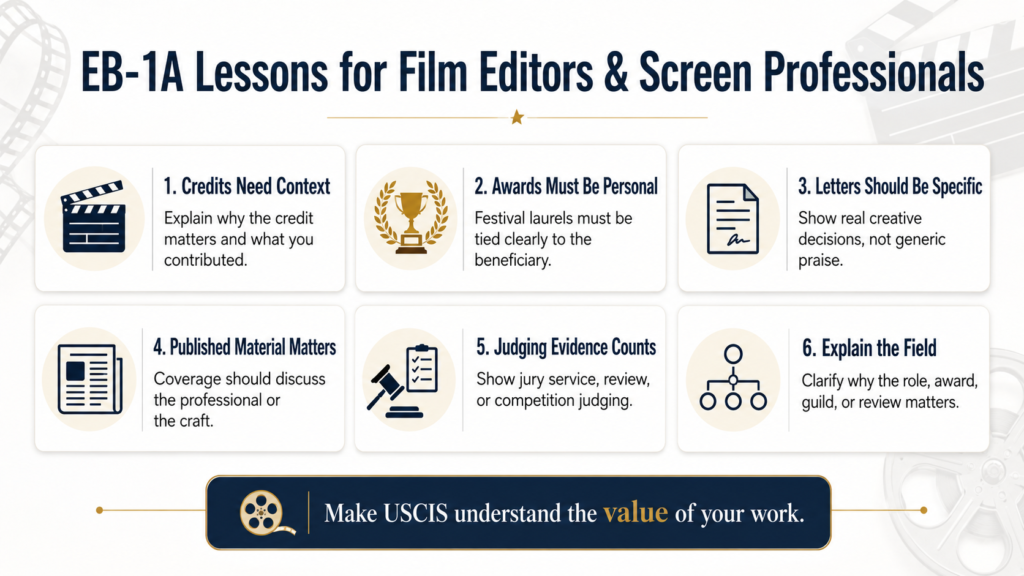
• Film credits are not enough unless the petition explains the importance of the credit and the person’s specific contribution.
• Festival laurels should be tied carefully to the beneficiary. A film award is not always a personal award for every crew member.
• Director and producer letters are strongest when they describe actual creative decisions, not just praise the person’s talent or reliability.
• Published material should discuss the professional or the craft, not only the film’s plot or the director’s vision.
• Judging evidence must show real evaluation of others’ work, such as jury service, selection review, competition judging, or festival adjudication.
• A strong EB-1A film case explains the hierarchy of the field so USCIS can understand why a role, festival, guild, credit, award, or review matters.
Frequently asked questions
Can film editors qualify for EB-1A?
Yes. Film editors can qualify for EB-1A when the record shows extraordinary ability in the arts through evidence such as leading or critical roles, published material, judging, awards, membership, commercial success, or other relevant evidence. The key is proving the editor’s individual contribution and recognition, not only the success of the films.
Are film credits enough for an EB-1A petition?
Credits are important, but they are usually not enough by themselves. The petition should explain the importance of the project, the editor’s role, and the way the field recognized the editor’s work.
Can a film’s festival award help the editor?
Yes, but it must be handled carefully. A festival award can show the distinction of the film, and it may support the editor’s role when additional evidence connects the editor’s contribution to the awarded work. It should not be presented as a personal editing award unless the record supports that claim.
What kind of letters help a film editor’s EB-1A case?
Letters from directors, producers, artistic directors, editors, festival programmers, and film scholars can help when they identify specific projects, explain the editor’s creative decisions, and describe why the work mattered in the field.
Can jury service at film festivals count as judging?
Yes. Festival jury service or adjudication can support the judging criterion when the person actually evaluates films, submissions, or creative work by others in the field. The evidence should document the role, the organization, the category, and the nature of the evaluation.