How an Indian digital-payments security leader converted confidential banking work into an EB-1A approval
Key facts at a glance
| Outcome | EB-1A approval for an Indian fintech cybersecurity architect working with a UAE based banking group. |
| Approval date | Approved on January 21, 2025. |
| Field niche | Zero-trust architecture for digital payment platforms, with a focus on identity, access boundaries, service-to-service trust, fraud exposure, and secure transaction workflows. |
| Starting weakness | His corporate cybersecurity work was serious and high value, but much of it lived inside banking products, internal security programs, and confidential payment-platform records. The public record did not yet show enough independent recognition under EB-1A criteria. |
| Profile-building path | The record was developed through technical articles, a zero-trust white paper, media commentary on payment fraud, fintech award judging, peer review, senior professional membership evidence, critical-role documentation, salary comparison, and independent expert letters. |
| EB-1A criteria supported in the petition | Original contributions, published material, judging the work of others, memberships, leading or critical role, and high salary. |
| Approval theme | USCIS approved the petition after the record connected corporate security leadership to field-level fintech cybersecurity expertise. |
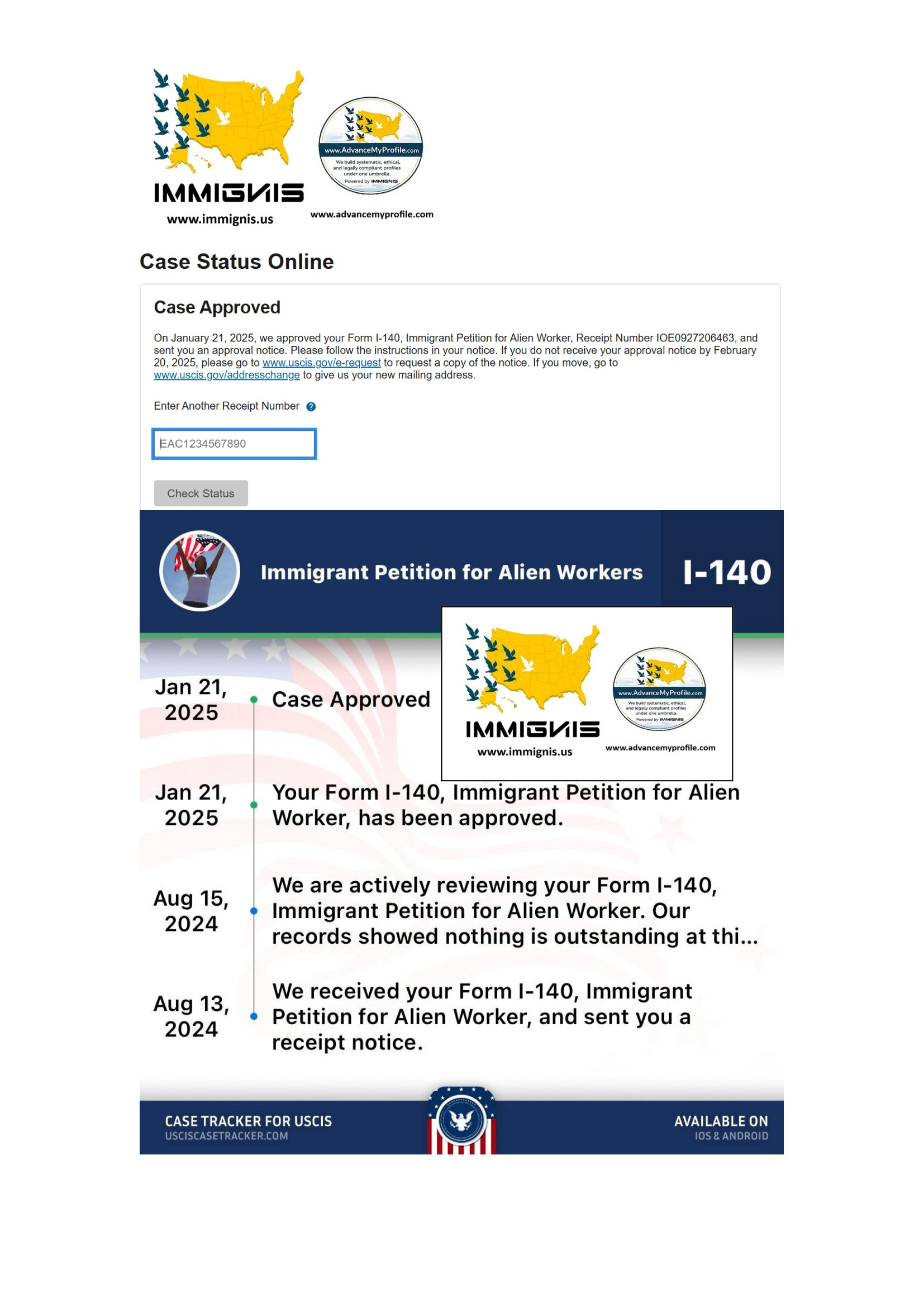
On January 21, 2025, USCIS approved the Form I-140 petition of an Indian EB-1A Fintech Cybersecurity Architect working with a UAE-based banking group.
At first glance, his case looked like many strong but difficult EB-1A profiles in cybersecurity. He had worked on digital payment security, fraud exposure, access controls, and architecture decisions that mattered to banking operations. Yet the most important evidence was hidden where cybersecurity evidence is often hidden: inside corporate systems that were designed not to be visible.
That was the central problem. His work helped protect payment platforms, but the record initially read like a corporate security resume. EB-1A required something different. The petition had to show that his expertise had moved beyond internal responsibility and could be recognized as original, significant, and trusted by others in the fintech security field.
The case was not about a job title. It was about trust inside a payment system
Digital payments need speed. Cybersecurity asks a harder question: should this user, device, service, application, or transaction be trusted at this moment?
The architect’s work focused on zero-trust architecture for digital payment platforms. In practical terms, that meant reducing assumptions. A user login was not enough by itself. A network location was not enough. A service calling another service still needed boundaries. Privileged actions required stronger checks. Transaction data, authentication signals, fraud alerts, device behavior, and access records all had to move through systems without creating unnecessary exposure.
This was not general IT security. His field sat at the intersection of banking architecture, digital payments, identity and access management, fraud risk, service design, and platform reliability. A control that blocks too much can disrupt legitimate payment activity. A control that trusts too easily can leave the platform exposed. The petition framed his niche around that balance.
Why corporate cybersecurity work can look weak in an EB-1A record
Cybersecurity professionals often have a strange evidence problem. The better their work is, the less visible it may be.
Banks do not publish detailed maps of their payment architecture. They do not disclose authentication logic, privileged-access models, fraud-monitoring thresholds, payment gateway weaknesses, incident patterns, or controls that protect specific systems. A cybersecurity architect can spend years solving difficult technical problems and still have a public record that says little more than “security leadership,” “platform protection,” or “risk management.”
For EB-1A, that is not enough. USCIS does not approve a case because an applicant worked in an important industry or held a senior corporate role. The record must identify the person’s own contribution, show why it mattered, and demonstrate recognition that is not limited to the employer.
In this case, the work had to be rebuilt around evidence that could be verified without exposing confidential banking systems.
What USCIS needed to see in a fintech cybersecurity EB-1A case
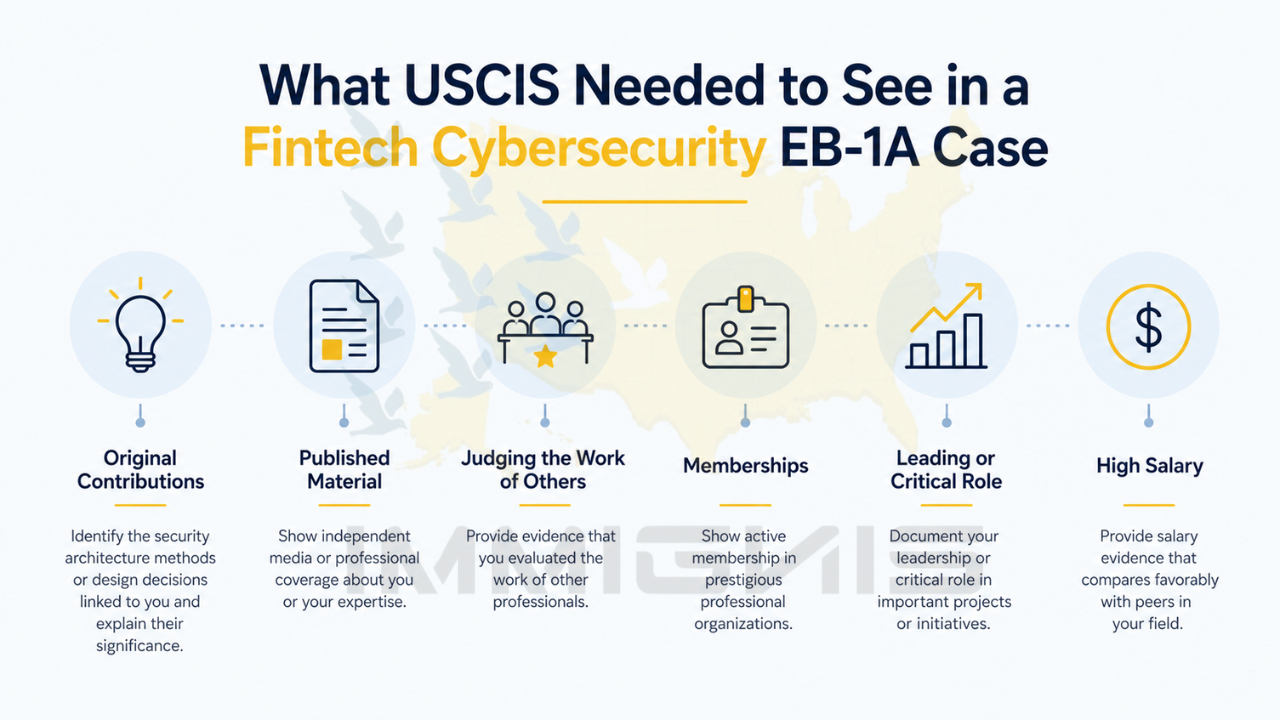
The petition had to answer several questions that are easy to overlook in technology cases.
For original contributions, the record needed more than a statement that he improved cybersecurity. It had to identify the security architecture methods, zero-trust design decisions, payment-platform controls, or fraud-risk structures linked to him and explain why those contributions had significance beyond routine employment.
For published material, the case needed independent media or professional coverage about him or his expertise. Articles written by the applicant can be useful, but they do not by themselves satisfy the published material criterion because that criterion concerns material about the person or the person’s work.
For judging, the evidence had to show that he evaluated the work of others. Judging fintech awards, reviewing cybersecurity or fintech submissions, or peer reviewing technical work can qualify when the record documents the assignment, subject matter, and actual evaluation activity.
For memberships, the file had to show selective admission or advancement standards based on professional achievement. Ordinary paid membership was kept separate from the EB-1A argument.
For leading or critical role, the employer evidence had to explain why significant digital payment security work depended on his judgment. The record also had to distinguish ordinary participation in a security team from responsibility for architecture, controls, implementation decisions, or program-level protection.
For high salary, the comparison had to fit the field, geography, and level of work. A cybersecurity salary cannot be evaluated intelligently against a broad technology category if the real role is fintech payment-platform architecture within banking.
The record was rebuilt around architectural decisions
Advance My Profile and Immignis organized the non-confidential record around the decisions that a zero-trust payment architect actually makes.
Which identity should be trusted? Which system should receive access to transaction data? Which service may call another service? What should happen when a risk signal changes? Which payment action requires stronger authentication? How should privileged access be limited, logged, and reviewed? What information is needed for fraud detection, and what information should not be unnecessarily exposed?
The case did not publish bank diagrams, account data, customer information, fraud rules, protected technical configurations, or live security controls. Instead, it documented the logic of his work: identity boundaries, access segmentation, service trust, authentication layers, privileged-action controls, monitoring, incident-response connections, and the use of risk signals in payment workflows.
That framing changed the petition. The story was no longer “he worked in corporate cybersecurity.” The story became “he developed and led security architecture methods for digital payment platforms where trust decisions affect both fraud exposure and transaction reliability.”
Original contributions came from method, not secrecy
A common mistake in cybersecurity EB-1A cases is to assume that confidential work cannot support an original-contribution argument. Confidential work can be relevant, but it must be presented carefully.
Here, the petition identified non-confidential methods and architecture decisions tied to the applicant. The evidence addressed how zero-trust principles were adapted to payment workflows, how access boundaries were designed around transaction functions, how risk signals informed security decisions, and how authentication and authorization logic could be strengthened without turning the payment platform into an unusable system.
Independent experts then explained why these methods mattered in fintech cybersecurity. Their letters did not simply praise him. They discussed the technical problem: digital payment platforms involve fast transaction flows, multiple services, external integrations, identity risk, account-takeover exposure, fraud attempts, privileged access, and operational pressure to keep payments moving. In that environment, zero trust is not a slogan. It is an architecture problem.
The petition avoided unsupported claims. It did not say that one architect eliminated fraud, secured an entire banking system, or created a universal solution for payment security. It showed a narrower and more defensible point: his work contributed to the way digital-payment trust, access, and risk controls were structured in a banking environment.
Technical articles gave the architecture a public language
The applicant’s technical articles were used to explain what could not be shown through internal records alone.
The articles discussed zero-trust design for payment platforms, identity boundaries, service-to-service access, privileged actions, fraud exposure, and the challenge of enforcing security controls without damaging payment experience. They helped move the record away from generic cybersecurity language and toward a field-specific body of work.
The strongest writing did not claim that zero trust is new. It addressed the fintech question: how should trust be limited and continuously examined when payment systems must interact with users, merchants, APIs, banking services, fraud tools, and internal teams?
That distinction mattered. EB-1A does not reward a person for repeating common industry ideas. The petition had to show how his work applied, refined, or operationalized those ideas in a specialized payment-platform setting.
The zero-trust white paper made the case useful to the field
The white paper was written for cybersecurity, banking, and fintech readers. It organized payment security around practical architecture questions: identity verification, least privilege, network and service segmentation, privileged-access review, device and session risk, API trust, transaction monitoring, and response when risk changes during a payment workflow.
It also dealt with a problem that many executives understand but few can solve with a slogan. Digital payments must remain available. Security controls that introduce too much friction can create business and customer-service problems. Weak controls can invite fraud, account takeover, data exposure, and operational disruption.
The white paper did not reveal protected banking information. Its value was that it turned internal expertise into a public explanation other professionals could evaluate, discuss, and use as part of a broader fintech security conversation.
Media commentary connected his expertise to payment fraud
The published-material record was built around media and professional commentary on fraud and digital-payment security.
He explained why payment fraud is not only a consumer-behavior problem. It can also reflect trust assumptions in the platform: how accounts are accessed, how sessions are evaluated, how payment actions are authorized, how suspicious behavior is escalated, and how systems share risk signals.
This commentary helped the public record in two ways. First, it gave independent outlets a reason to identify him as a fintech cybersecurity expert. Second, it translated a complex architecture subject into language that business, technology, and financial readers could understand.
The article coverage was not treated as a substitute for technical evidence. It supported recognition. The original-contribution argument still depended on architecture records, expert analysis, and evidence connecting the methods to him.
Judging evidence showed that others trusted his security judgment
Judging was an important part of the case because cybersecurity authority is often demonstrated through trust. Other organizations must be willing to rely on the person’s judgment to evaluate technical work, products, submissions, or professional claims.
The record documented his role judging fintech award submissions and reviewing work connected to digital payments, cybersecurity, fraud prevention, or financial technology. Where peer review was included, the evidence showed that he assessed methods, claims, security assumptions, implementation logic, and whether conclusions followed from the submitted material.
The petition did not blur attendance, nomination, mentorship, and judging. Only actual evaluation of others’ work was used for the judging criterion. That discipline made the evidence cleaner and easier to defend.
Senior membership was evaluated by the admission standard
The membership evidence was not treated as a trophy. The petition examined the actual standard for the senior professional membership used in the case.
USCIS generally looks for membership in associations that require outstanding achievement, as judged by recognized experts in the field. A membership that anyone can buy is weak. A senior grade or selective category can be stronger when the rules show professional achievement, experience, peer review, or expert assessment.
For this applicant, the file documented the membership category, the advancement requirements, the evidence submitted for admission or elevation, and the relationship between the membership and his fintech cybersecurity field.
The critical-role evidence had to separate responsibility from importance
A banking group can be important. A payment platform can be important. That does not automatically make every cybersecurity employee critical for EB-1A purposes.
The petition therefore focused on his individual role within significant security work. Employer and project evidence showed the payment-platform context, the architecture decisions connected to him, the teams or systems affected, and why his judgment mattered to the security program.
The strongest critical-role evidence explained function, not hierarchy alone. It showed where his work entered zero-trust architecture, digital-payment controls, fraud-risk review, privileged access, and secure platform operation. Titles helped provide context, but the case did not depend on title alone.
The high-salary argument used the right comparison group
High salary can support an EB-1A petition when the comparison is reliable. The wrong comparison can weaken an otherwise strong record.
For this case, the petition compared compensation against relevant cybersecurity, fintech, banking-technology, and architecture roles in the appropriate market. It also considered seniority and the specialized nature of zero-trust work for digital payment systems.
The argument was not that any well-paid cybersecurity professional qualifies for EB-1A. The salary evidence supported the broader point that the applicant was compensated at a level consistent with specialized expertise and senior responsibility in a high-stakes financial technology environment.
The evidence became stronger because it pointed to the same professional identity
The final record worked because the different categories did not feel disconnected.
The technical articles explained the architecture. The white paper gave the method a public form. Media commentary connected him to fraud and payment security. Judging and peer review showed that others used his judgment. Senior membership supported professional recognition. Critical-role evidence showed that his work mattered inside the banking group. Salary evidence showed market recognition for specialized expertise. Independent letters tied the technical record together and explained field significance.
That coherence mattered at final merits. EB-1A is not only a checklist. After reviewing individual criteria, USCIS can examine the record as a whole to decide whether the evidence shows sustained acclaim and the level of expertise required for extraordinary ability.
In this case, the petition presented a cybersecurity architect whose work, recognition, and professional judgment all pointed toward the same niche: zero-trust architecture for digital payment platforms.
Why this approval matters for fintech cybersecurity professionals
Many cybersecurity professionals assume their work cannot support EB-1A because it is confidential. That is not always true. The challenge is to separate protected operational details from the professional method that can be documented safely.
A fintech cybersecurity architect does not need to disclose live controls, client vulnerabilities, or internal payment data to build a credible record. The petition can often use non-confidential architecture descriptions, role evidence, technical writing, independent commentary, judging records, selective membership evidence, expert letters, and salary comparisons.
The work must still be real. Profile building cannot replace expertise. It can, however, help a professional explain expertise that was previously trapped inside corporate systems.
What similar applicants should learn from this case
If you work in fintech cybersecurity, digital banking, payment fraud, identity architecture, cloud security, zero trust, API security, or transaction-risk systems, the first question is not whether your company is important. The first question is what professional problem your work is known for solving.
For one person, that problem may be account-takeover prevention. For another, it may be API trust across payment services, identity-risk scoring, privileged-access controls, transaction-monitoring architecture, or secure cloud migration for banking systems. A narrow field is usually stronger than a broad claim of “cybersecurity leadership.”
The second question is evidence. Can your work be traced to you? Can it be explained without exposing protected systems? Have other professionals relied on your judgment? Is there independent recognition beyond your employer? Are salary, membership, judging, published material, and expert letters all pointing to the same authority niche?
This case was approved because the petition answered those questions with a coherent record.
Frequently asked questions
Can corporate cybersecurity work support EB-1A?
Yes, but corporate responsibility alone is usually not enough. The petition must identify the applicant’s own contribution, document why it mattered, and show recognition beyond ordinary employment. Confidential details should be protected, but non-confidential methods and role evidence can often be used.
Can zero-trust architecture qualify as an original contribution?
It can support an original-contribution argument when the record shows a specific method, implementation approach, architecture decision framework, or security contribution linked to the applicant and explains why it had significance in the field. Simply saying “zero trust” is not enough.
Can judging fintech awards count for EB-1A?
Judging can count when the applicant actually evaluated the work of others and the record documents the judging assignment, subject matter, selection process, and completed evaluation. Merely attending an event, being nominated, or mentoring informally is different.
Does high salary help a cybersecurity EB-1A case?
High salary can help when the comparison is reliable and specific to the role, geography, seniority, and field. For a fintech cybersecurity architect, the comparison should focus on relevant cybersecurity, fintech, digital banking, and security-architecture compensation evidence rather than a broad technology average.
Do cybersecurity architects need public writing for EB-1A?
Public writing is not mandatory in every case, but it can help when corporate work is under-documented. Technical articles, white papers, and professional commentary can make a specialized method visible, provided the writing is accurate and connected to the applicant’s real expertise.
Build an EB-1A record around the security problem you are trusted to solve
If your strongest cybersecurity work is hidden inside banking platforms, payment systems, fraud programs, cloud architecture, or confidential product records, your EB-1A case may need more than a strong resume.
Immignis and Advance My Profile help identify a defensible authority niche, document individual contributions, build credible recognition, and prepare an EB-1A record around evidence you can verify and defend professionally.