How a Mauritian financial-crime compliance architect secured EB-1A approval by turning confidential AML framework work into a public, verifiable record built on regulator-cleared documentation, FATF-process contributions, compliance-press commentary, industry-training leadership, and certification-body roles.
Key facts at a glance
| Petition outcome | Form I-140 approved under EB-1A on May 1, 2026. |
| Professional profile | Mauritian compliance architect who rebuilt AML frameworks for an international financial center under regulatory pressure. |
| Field niche | Anti-money-laundering frameworks for offshore financial centers. |
| Starting weakness | The better the work, the less anyone could say about it because the strongest proof was confidential, regulator-facing, or institutionally sensitive. |
| Profile-building focus | Regulator-cleared framework documentation, FATF-process contributions, compliance-press commentary, industry-training leadership, certification-body roles, and expert letters. |
| EB-1A criteria supported | Original contributions, leading role, published material, judging, and membership. |
| Central issue | Proving field-level financial-crime compliance expertise without exposing protected regulatory, institutional, or client-sensitive information. |
| Approval lesson | Standard-setting participation can become public proof of confidential excellence when AML framework work is documented safely and independently. |
The approval
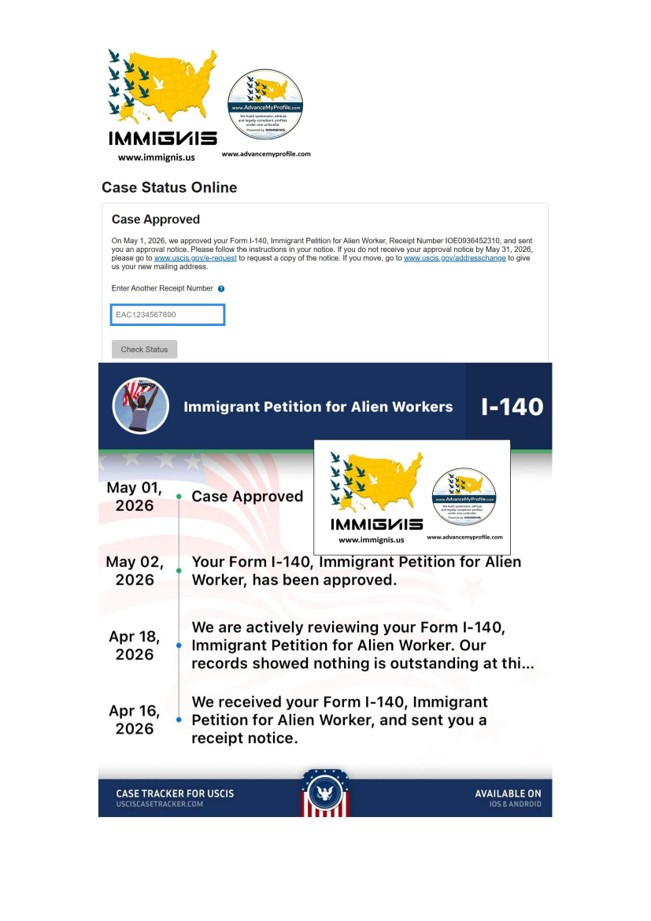
On May 1, 2026, USCIS approved the Form I-140 petition of an EB-1A for AML Compliance Experts case involving a Mauritian financial-crime compliance expert whose work helped strengthen anti-money-laundering frameworks for an international financial center under regulatory pressure.
Inside the compliance and financial-services environment, the petitioner was already trusted. Regulators, institutions, internal committees, and risk teams relied on the petitioner's ability to translate legal expectations into practical controls, governance systems, monitoring architecture, and training standards.
For EB-1A, however, that created a difficult evidence problem. The most valuable work in financial-crime compliance is often the least visible. Strong AML systems prevent failures, reduce risk, and help institutions satisfy regulatory expectations, but the details are usually protected by confidentiality, supervisory sensitivity, or client privilege.
That became the central challenge of the case: proving extraordinary ability in a confidential financial-crime compliance field without exposing sensitive regulatory or institutional information.
The evidence problem in financial-crime compliance cases
Financial-crime compliance is difficult to document because the best evidence often sits inside internal risk assessments, suspicious-activity monitoring programs, regulator communications, audit remediation files, board reports, and confidential policy frameworks. Those materials may prove serious impact, but they cannot always be filed openly or quoted freely.
The petitioner's starting weakness was not lack of achievement. The weakness was that the strongest achievements were designed to be quiet. In AML work, success often means preventing enforcement problems, closing control gaps, improving institutional behavior, and creating frameworks that regulators can trust.
The case therefore needed a precise field definition. It was not framed as ordinary legal compliance, bank administration, or risk-management employment. It was framed as anti-money-laundering framework design for offshore financial centers, with emphasis on financial-crime controls, institutional remediation, and standard-setting participation.
That field definition gave the petition a practical measuring stick. The question was not simply whether the petitioner worked in compliance. The question was whether the AML framework work had recognized importance in a specialized financial-crime field where public proof must be built carefully and ethically.
Why confidentiality could not become an excuse for weak evidence
Many compliance professionals assume that confidentiality makes EB-1A impossible. That is understandable, but not correct. A strong petition does not need to reveal protected investigations, client files, or supervisory communications. It needs to show field-level distinction through documents that can be safely disclosed and independently understood.
The petition therefore avoided two mistakes. It did not expose confidential regulatory information, and it did not rely on vague claims such as "sensitive work" or "important compliance duties." Instead, it separated protected details from disclosure-safe evidence that demonstrated the petitioner's role, expertise, and recognition.
That approach included regulator-cleared framework summaries, FATF-process contributions, compliance-press commentary, industry-training leadership, certification-body service, membership evidence, and letters from senior compliance and financial-crime experts.
This made the case stronger. It showed USCIS that confidentiality had been handled responsibly while still giving the officer enough public and independent evidence to evaluate the petitioner's standing in the field.
Original contributions through AML framework design
The strongest part of the case was the petitioner's contribution to AML framework design. In financial-crime compliance, original contribution does not always look like an invention or academic discovery. It may appear through governance models, risk-based control architecture, transaction-monitoring improvements, institutional remediation frameworks, and training systems that help financial institutions meet higher compliance standards.
The petition documented how the petitioner helped rebuild AML systems in a way that responded to regulatory pressure and improved institutional readiness. The evidence focused on what changed because of the work: clearer control structures, better accountability, improved policy implementation, and stronger alignment with international expectations.
Importantly, the petition did not overclaim. It did not say that one professional alone transformed an entire financial center. It showed that, within a specialized compliance environment, the petitioner's framework work contributed to measurable and recognized improvements in AML practice.
That evidence gave USCIS a concrete way to understand original contribution in a field where the most important work is often preventative, technical, and confidential.
Standard-setting participation made confidential excellence visible
The approval hook of the case was standard-setting participation. In AML and financial-crime compliance, public proof often comes from participation in recognized processes, working groups, certification bodies, training programs, and industry frameworks rather than from product launches or media publicity.
The petition used this evidence to show that the petitioner was not only applying rules internally. The petitioner was contributing to the professional infrastructure through which the field defines, teaches, and improves AML practice.
FATF-process contributions and certification-body roles were especially important because they showed that the petitioner's knowledge was relevant beyond one employer. They connected the work to broader international expectations for financial-crime prevention and regulatory alignment.
That type of evidence is powerful in confidential fields. It proves expertise without exposing protected files. It shows that the field recognizes the petitioner through participation in the systems that shape compliance standards themselves.
Leading-role evidence had to show responsibility for institutional change
A senior compliance title does not automatically prove a leading role. For EB-1A, the record had to show that the petitioner carried responsibility that was important to institutions, programs, or recognized bodies in the field.
The petition documented the petitioner's role in AML framework redesign, compliance governance, policy implementation, training leadership, remediation planning, and cross-functional coordination with senior stakeholders. The emphasis was on authority, decision-making, and accountability, not job title alone.
This helped distinguish the petitioner from ordinary compliance staff. The petitioner was presented as a compliance architect whose work shaped how institutions identified, monitored, escalated, and reduced financial-crime risk.
For business and compliance professionals, this distinction matters. EB-1A evidence must connect the individual to the outcome. It is not enough to show that a bank, fund, or jurisdiction improved; the petition must show the petitioner's specific role in that improvement.
Published material and compliance commentary
Public visibility in AML work can be limited because serious compliance professionals do not usually publicize sensitive details. Still, professional commentary, compliance-press interviews, articles, training materials, conference panels, and industry publications can show that the petitioner has recognized knowledge in the field.
The petition used compliance-press commentary carefully. The most useful material connected the petitioner by name to AML frameworks, financial-crime controls, offshore financial-center standards, sanctions-risk management, regulatory readiness, or professional training.
This evidence helped solve a visibility problem. It showed that the petitioner's expertise existed outside confidential institutional records and had become part of the professional conversation in financial-crime compliance.
Judging and certification roles showed peer trust
Judging evidence can be difficult in compliance fields, but equivalent peer-evaluation roles often exist. Certification-body work, assessment roles, training leadership, curriculum input, professional review service, and participation in expert panels may show that the field trusts the petitioner to evaluate knowledge, standards, or professional quality.
The petition framed those roles as evidence of peer trust. The petitioner was not simply attending training sessions; the petitioner was helping shape, review, teach, or validate the professional standards used by others.
That mattered because EB-1A requires more than private employer approval. It requires evidence that peers or institutions in the field recognize the petitioner's expertise. Certification-body roles helped make that recognition visible.
Membership and professional standing in financial-crime compliance
Membership evidence can support EB-1A when it is more than a routine paid subscription. In this case, the petition focused on roles connected to professional standards, financial-crime prevention, AML training, certification, and industry governance.
The record showed that the petitioner's professional standing was not limited to one employer or one confidential project. The expertise was connected to organizations and processes that help define the wider compliance field.
This was important because financial-crime compliance is highly credentialed. Meaningful association roles, certification-body involvement, and standards participation can show that the petitioner is recognized within the professional architecture of the field.
Why the petition worked
The success of the case came from disciplined evidence selection. Instead of presenting a vague confidential career, the petition built a public, verifiable record around safe evidence that demonstrated the petitioner's standing in AML framework design.
It showed that the petitioner was not merely following compliance rules. The record showed a professional helping build and improve the systems through which institutions identify risk, satisfy regulatory expectations, and prevent financial-crime exposure.
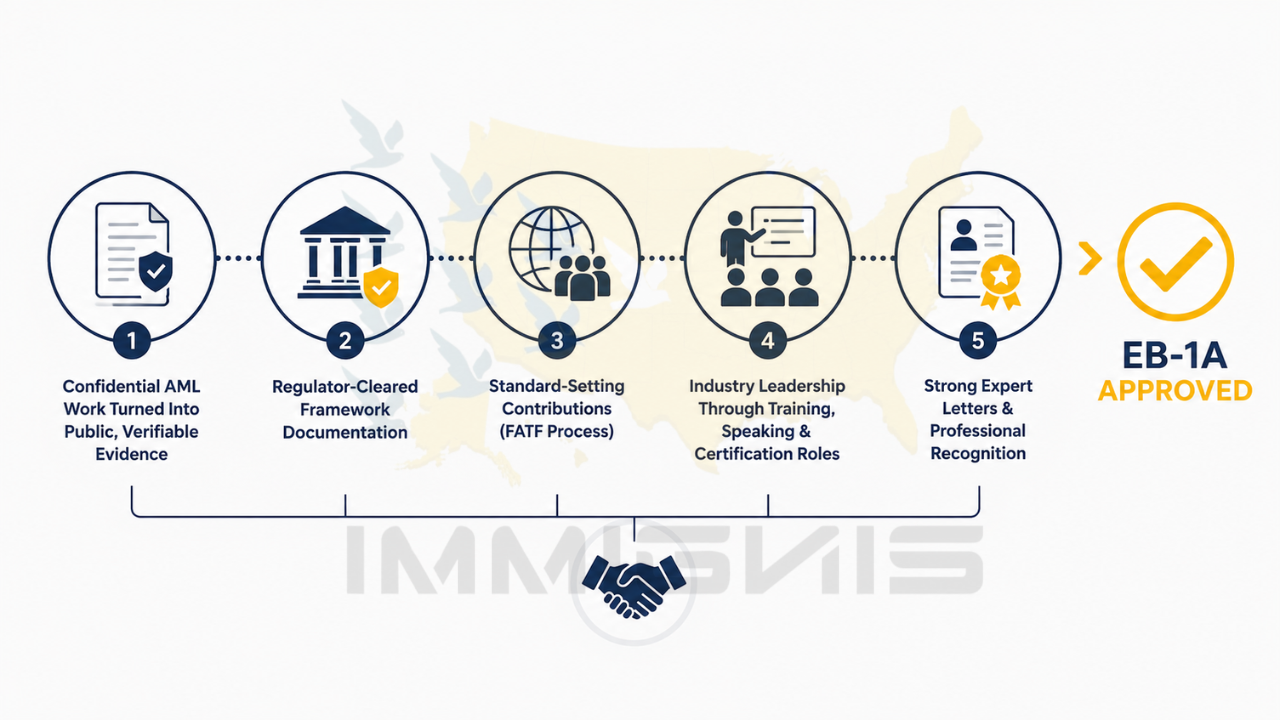
The evidence worked together. Framework documentation showed contribution. FATF-process and standard-setting evidence showed field relevance. Published commentary showed public visibility. Certification-body roles showed peer trust. Leading-role materials showed institutional importance.
Why the approval mattered
The approval mattered because it showed how a financial-crime compliance professional can qualify for EB-1A without exposing protected regulatory or institutional information.
For this Mauritian financial-crime compliance expert, the petition did not rely on secrecy as a substitute for proof. It showed external recognition, professional trust, leading responsibility, and original contribution through safe, structured evidence.
Most importantly, the petition translated confidential excellence into adjudicator-readable proof. It did not ask USCIS to trust hidden claims. It gave the officer a record that could be evaluated without compromising sensitive compliance information.
The broader lesson for compliance, AML, and risk professionals
This case offers a useful roadmap for AML experts, sanctions specialists, financial-crime compliance leaders, regulatory remediation professionals, risk-control architects, and compliance executives working in banks, funds, offshore financial centers, fintechs, or advisory firms.
Many such professionals make critical contributions, but their work is not designed for public recognition. The key is to identify evidence that proves distinction without violating confidentiality. That usually requires careful framing, document clearance, and a strong explanation of how the field measures authority.
For many compliance professionals, useful evidence may include regulator-cleared summaries, professional articles, conference training, certification-body roles, industry association leadership, expert letters, framework authorship, and evidence of participation in recognized standard-setting processes.
The approval confirmed the central lesson of the case: in AML and financial-crime compliance, standard-setting participation can become the public fingerprint of confidential excellence.
Lessons for AML, sanctions, compliance, and risk professionals
This case is useful for financial-crime compliance professionals, AML officers, sanctions specialists, risk leaders, regulatory remediation advisors, and compliance architects whose best work is often confidential, preventive, or institutionally sensitive.
A strong EB-1A case in this space usually depends on identifying evidence that translates confidential institutional value into public and peer-recognized achievement. That means moving beyond internal files and showing how the field itself has recognized the petitioner.
It also helps to define the field precisely. "Compliance" sounds too broad. "Anti-money-laundering framework design for offshore financial centers" gives USCIS a narrower and more meaningful way to evaluate the petitioner's work.
Questions to ask before building the record
For these professionals, the evidence should be built around disclosure-safe proof rather than unsupported claims about sensitive work.
A strong record usually begins with the following questions:
- Can regulator-cleared materials describe the petitioner's framework contributions without exposing protected information?
- Can standard-setting, FATF-related, training, or certification-body evidence show that the petitioner's expertise matters beyond one employer?
- Do compliance publications, conferences, or industry bodies recognize the petitioner by name?
- Can leading-role evidence connect the petitioner personally to institutional improvements, governance changes, or AML remediation outcomes?
- Can expert letters explain why the petitioner's work is significant, including the importance of prevented harm, improved controls, and regulatory readiness?
When those questions are answered with documents, a confidential compliance career becomes much easier for USCIS to evaluate. That is often the difference between important internal work and a successful EB-1A record.
Frequently asked questions
Can an AML or financial-crime compliance expert qualify for EB-1A?
Yes. An AML or financial-crime compliance expert may qualify for EB-1A if the evidence shows extraordinary ability in a defined field through original contributions, leading roles, published material, judging or certification roles, memberships, or other recognized indicators of distinction.
Can confidential compliance work be used in an EB-1A petition?
Yes. Confidential work can support EB-1A when it is presented through disclosure-safe summaries, cleared documentation, expert letters, public training materials, standard-setting roles, and other evidence that does not reveal protected information.
Can FATF-related work help an EB-1A compliance case?
Yes. FATF-related contributions or participation in processes connected to international AML standards can help show field relevance, especially when the petition explains the petitioner's role clearly and supports it with independent evidence.
Do certification-body roles help prove extraordinary ability?
Yes. Certification-body roles, professional assessment work, training leadership, or standards participation can help show peer trust and professional standing in financial-crime compliance.
Can published compliance commentary support EB-1A?
Yes. Compliance-press commentary, professional articles, conference materials, and industry publications can show public recognition and subject-matter authority when they connect the petitioner by name to the field.
Can Immignis and Advance My Profile help compliance professionals build EB-1A evidence?
Immignis and Advance My Profile help AML experts, compliance architects, sanctions specialists, risk leaders, and financial-crime professionals define a credible niche, document confidential work safely, improve visibility, and build a petition-ready EB-1A evidence record.
Build an EB-1A record around AML expertise, standard-setting work, and disclosure-safe proof
Many financial-crime compliance professionals create real institutional and public-interest value, but their strongest proof stays inside confidential frameworks, regulator-facing files, and internal risk systems.