EB-1A for Chefs explains how a Thai chef secured approval after restaurant rankings, culinary awards, regional-menu authorship, press profiles, festival appearances, collaboration dinners, competition judging, television work, and cookbook authorship were organized into a personal record of culinary influence.
Key facts at a glance
| Petition outcome | Form I-140 approved under EB-1A on February 1, 2024. |
| Professional profile | Thai chef and culinary ambassador who elevated regional Thai cooking beyond familiar stereotypes and presented it through disciplined fine-dining menus, public events, media appearances, and international collaborations. |
| Field niche | Regional Thai haute cuisine. |
| Starting weakness | The restaurant carried the rankings, awards, and reviews, while the chef’s personal record was scattered across menus, kitchen leadership, event programs, press articles, television appearances, and collaborative dining projects. |
| Profile-building focus | Personal attribution for restaurant honors, culinary-press profiles, festival and collaboration-dinner records, competition judging, television and media appearances, cookbook authorship, and documentation of menu and concept leadership. |
| Principal EB-1A evidence areas developed | Awards, published material about the petitioner, judging the work of others, leading or critical role, original contributions, and commercial-impact evidence presented as comparable evidence where appropriate. |
| Central issue | Showing that the petitioner did more than cook at a successful restaurant: the chef personally shaped how regional Thai cuisine was interpreted, presented, discussed, and valued by international diners and culinary professionals. |
| Approval lesson | A chef’s EB-1A case becomes stronger when restaurant recognition is connected to personal authorship, culinary decisions, peer trust, press attention, and influence that continues outside one dining room. |
The menu was famous. The authorship was not.
A diner can remember a restaurant name long after forgetting who designed the menu. Rankings and awards often intensify that imbalance. They celebrate the venue, the service, the room, and the overall experience, while the chef whose decisions created the food may appear only in a short biography or a photograph near the reservation page.
That was the difficulty in this case. The petitioner had helped move regional Thai cuisine into a fine-dining setting without stripping away its local identity. The work appeared in tasting menus, ingredient choices, cooking methods, collaborations, festivals, television segments, and press coverage. Yet the evidence did not initially read as one chef’s professional record.
USCIS approved the Form I-140 petition on February 1, 2024. Immignis and Advance My Profile built the case around personal attribution. The record connected restaurant recognition to the chef’s role, documented a distinct culinary point of view, and showed that peers, journalists, organizers, and audiences recognized the petitioner beyond a single establishment.
Why successful chefs disappear behind restaurant brands
Fine dining is collaborative by design. A strong service depends on cooks, pastry teams, beverage professionals, farmers, fishers, suppliers, front-of-house staff, managers, owners, and investors. That collaboration makes a restaurant possible, but it also makes immigration attribution difficult.
A restaurant may receive a ranking or award without explaining who conceived the menu, trained the kitchen, selected regional ingredients, refined the techniques, or maintained consistency. A review may praise a dish without naming its author. A television appearance may create public visibility but say little about the chef’s professional standing unless the context is documented.
The case therefore did not treat every success attached to the restaurant as the petitioner’s personal achievement. It separated collective recognition from individual contribution and used records that showed where the chef exercised creative and operational authority.
The field was regional Thai haute cuisine
The petition needed a field definition narrower than chef or hospitality professional. Those labels would have mixed the petitioner with an enormous range of culinary work and would not have explained what made the record distinctive.
Regional Thai haute cuisine described the actual professional niche. The petitioner worked with regional flavor structures, ingredients, preservation practices, local histories, and cooking techniques, then translated them into a fine-dining format with controlled execution and international presentation.
This definition also prevented the case from relying on vague national-cuisine prestige. The argument was person-specific: the chef had developed a recognizable way of presenting regional Thai food, and that approach was visible through menus, media, invitations, judging, authorship, and the restaurant’s documented performance.
Restaurant rankings and awards required personal attribution
The restaurant’s honors were useful, but they could not simply be copied into the petition as though every distinction belonged automatically to the chef. The evidence had to explain the award or ranking, the period it covered, the petitioner’s role at that time, and the culinary work for which the venue was recognized.
Role records, employment documents, ownership or leadership information, menu-development files, press interviews, event biographies, internal responsibilities, and letters from people with direct knowledge helped connect the honors to the petitioner. The strongest letters described decisions, not compliments.
This distinction mattered. The petition did not say the chef personally won every restaurant award. It showed that the petitioner held the culinary authority behind the food program during the recognized period and was publicly or independently associated with the work being praised.
The original contribution was a new reading of regional Thai cuisine
The heart of the case was not a claim that the petitioner invented Thai food. It was that the chef developed an identifiable interpretation of regional cuisine and helped change how that cuisine was received in fine-dining spaces.
The evidence explained the chef’s method. Regional dishes were researched, ingredients were sourced with attention to place, techniques were refined for consistency, and menus were designed to preserve flavor logic rather than reduce the food to familiar shorthand. Presentation changed, but the cuisine was not treated as decoration.
Adoption and response supplied the significance. Other chefs sought collaboration, organizers invited the petitioner to represent Thai cuisine, journalists discussed the approach, diners traveled for the menu, and culinary professionals treated the chef as someone with a point of view worth examining. Together, those records made the contribution more concrete than a general claim of creativity.
Culinary press made the chef visible outside the reservation page
Published material was one of the clearest ways to separate the petitioner from the restaurant brand. Profiles, interviews, reviews centered on the chef, features about regional ingredients, and articles discussing the petitioner’s culinary approach created a public record of personal recognition.
The evidence was reviewed carefully. A restaurant listing, menu repost, event calendar, or short promotional announcement did not carry the same weight as a substantive article about the chef and the chef’s work. The petition identified what each publication actually said and why the outlet mattered in the culinary field.
This press record also helped a non-culinary reader understand the work. It explained why a dish, ingredient, or regional method mattered without asking the immigration officer to judge taste.
Festivals and collaboration dinners showed demand beyond one venue
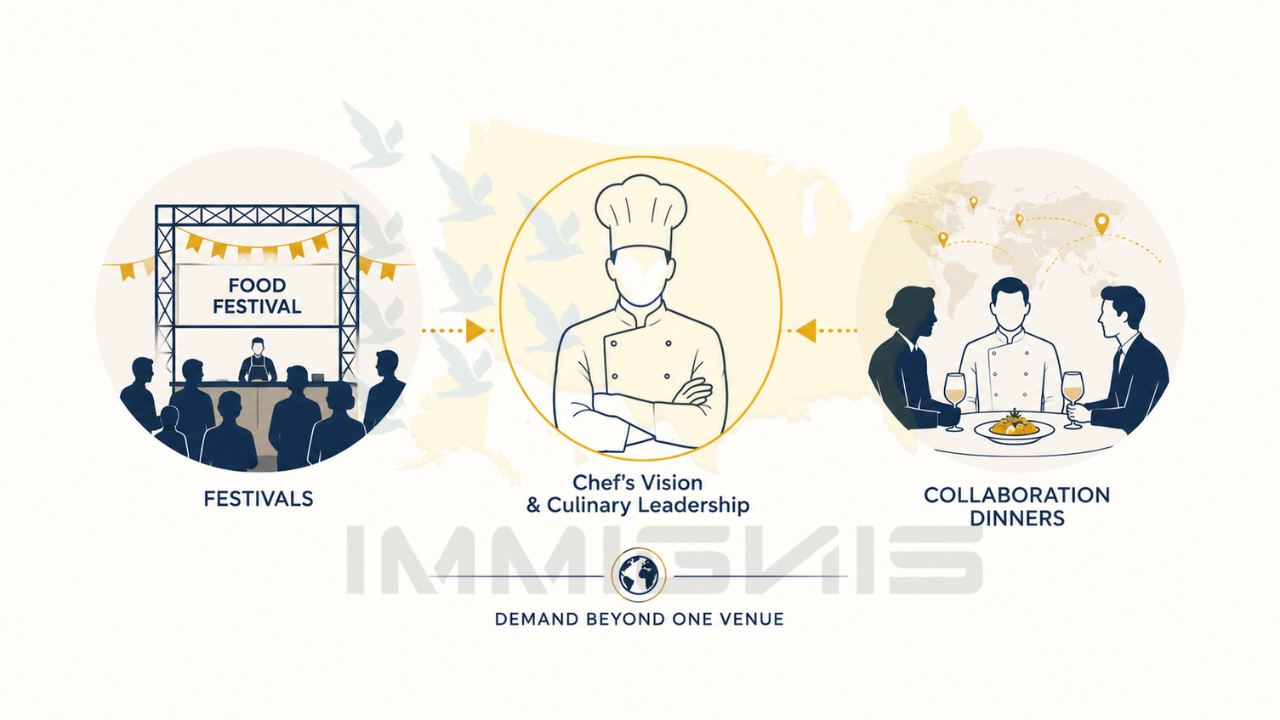
A chef can be successful inside one restaurant and still have limited recognition outside it. Festival invitations and collaboration dinners helped answer that concern because they showed that other institutions and chefs wanted the petitioner’s participation under the petitioner’s own name.
The record included event programs, invitations, menus, billing, photographs, organizer descriptions, partner-chef statements, and media coverage where available. It explained whether the petitioner appeared as a featured chef, guest collaborator, culinary representative, speaker, or program leader.
These events were not counted mechanically. A private dinner arranged by friends did not prove the same thing as a selective festival or an independently organized collaboration. Context, selection, audience, and professional purpose determined the value of the evidence.
Judging demonstrated trust in the chef’s palate and standards
Competition judging gave the case a direct form of peer recognition. When an organization asks a chef to evaluate the work of other culinary professionals, it is relying on that person’s judgment about technique, flavor, execution, originality, presentation, or professional readiness.
The petition documented completed service rather than invitations alone. It identified the competition or assessment, the people or work evaluated, the petitioner’s role, and the standing of the organizing body. Where the event involved students or emerging chefs, the record explained why the judging still related to the same or an allied field.
Judging also supported the wider narrative. The petitioner was no longer simply producing food for diners. The culinary community trusted the chef to decide whether the work of others met professional standards.
Television and media appearances needed substance, not screen time
Television can create visibility quickly, but visibility is not automatically acclaim. The case distinguished between appearances that merely promoted a restaurant and programs that invited the petitioner because of culinary knowledge, regional expertise, or professional standing.
Useful records included episode descriptions, interview topics, broadcast materials, clips, transcripts, host introductions, and evidence of the program’s reach. The petition focused on what the chef was asked to explain or demonstrate and how the appearance connected to the defined field.
This kept the evidence grounded. The point was not that the petitioner had been on camera. The point was that media producers selected the chef to speak for a cuisine, method, region, or professional question.
Cookbook authorship gave the cuisine a durable record
Menus disappear. Dishes change with seasons, suppliers, and creative direction. Cookbook or substantial recipe authorship gave the petitioner a record that could be attributed, preserved, and examined beyond a restaurant service.
The strongest authorship evidence did more than reproduce recipes. It explained regional context, ingredient choice, technique, adaptation, and the thinking behind the food. Publication records, contracts, contributor credits, editorial correspondence, sales information where available, and independent reviews helped establish the nature and reach of the work.
Authorship also reinforced the chef’s identity as a culinary communicator. The petitioner was documenting a method and helping readers understand regional Thai cuisine rather than leaving the entire professional record inside the kitchen.
Leading role and commercial results had to remain separate
The leading-role evidence focused on authority: menu direction, kitchen leadership, team training, quality control, sourcing strategy, collaboration decisions, and responsibility for the restaurant’s culinary identity. The standing of the establishment was documented separately through independent recognition and market evidence.
Commercial records could add context. Reservations, revenue trends, waiting lists, repeat collaborations, demand for special events, publishing performance, or other measurable results may show that the culinary concept reached an audience. Those records were used carefully and, where appropriate, as comparable evidence rather than mislabeled as a standard criterion that automatically applies to chefs.
The result was a balanced argument. The petition did not equate popularity with extraordinary ability, and it did not ignore commercial response. It showed how professional recognition, authorship, peer trust, and audience demand converged around the petitioner’s work.
Why this case worked
Every part of the record answered the same attribution question from a different direction. Restaurant honors showed the standing of the venue. Role documentation connected the chef to the food program. Press profiles named the petitioner. Collaboration dinners and festivals showed outside demand. Judging established peer trust. Television appearances documented public expertise. Cookbook authorship preserved the culinary method.
The case also gave USCIS a usable way to understand originality in cuisine. It did not depend on extravagant language about artistry. It showed a defined regional focus, identifiable decisions, independent response, and a body of work that influenced how others encountered Thai food.
The approval lesson was straightforward: the restaurant can open the door, but the petition must still prove the chef.
What chefs and culinary professionals can learn
Keep records while recognition is happening. Save full reviews, event programs, menu credits, contracts, judging confirmations, broadcast details, collaboration correspondence, award rules, ranking methodology, and documents showing who controlled the culinary program.
Build a record around a real culinary identity. A long list of unrelated appearances is weaker than a coherent body of work that explains what the chef does, where that work comes from, and why other professionals pay attention to it.
Most importantly, separate the restaurant’s reputation from personal evidence. A famous venue can provide context, but the case becomes persuasive when independent records show the chef’s own authorship, authority, recognition, and influence.
Conclusion
The Thai chef and culinary ambassador secured EB-1A approval after a restaurant-centered record was reorganized around personal contribution. The case connected awards and rankings to culinary leadership, documented a distinct regional approach, and showed recognition through press, festivals, collaborations, judging, television, and authorship.
Immignis and Advance My Profile did not treat the restaurant’s success as a substitute for the chef’s evidence. The work was to identify where the petitioner’s decisions could be proven and where outside recognition followed the individual beyond the brand.
The client’s name, restaurant identity, and identifying culinary projects are omitted to protect privacy and confidentiality. The professional field, approval date, starting challenge, and evidence strategy reflect the underlying case record.
Frequently asked questions
Can a chef qualify for EB-1A?
Yes. A chef may qualify when the evidence addresses the regulatory framework and the record, considered as a whole, shows the required level of sustained recognition and extraordinary ability. Restaurant success by itself is not enough.
Can restaurant awards be used in a chef’s EB-1A petition?
They may be relevant, but the petition must show what the award recognized and how the chef was personally connected to the honored culinary work. A restaurant award should not automatically be described as an individual award.
Can a restaurant ranking prove extraordinary ability?
A ranking can help establish the standing of the restaurant and the market response to its work. Its value depends on the ranking method, the petitioner’s role during the relevant period, and evidence linking the recognized food program to the chef.
What can count as an original contribution for a chef?
Evidence may concern a distinctive culinary method, menu concept, use of regional ingredients, preservation or reinterpretation of food traditions, adopted techniques, or influence on other professionals. The contribution must be attributable and its significance must be documented.
Can culinary press satisfy the published-material criterion?
Potentially, when qualifying material is about the chef and the chef’s work rather than only about the restaurant, a dish, or an event. The nature and reach of the publication should also be documented.
Can cooking-competition judging satisfy the judging criterion?
It may when the chef actually evaluates the work of others in the same or an allied field. The record should identify the organizer, participants, work judged, selection of the petitioner, and completed service.
Do television appearances help an EB-1A chef case?
They can help when the chef is featured because of culinary expertise or professional recognition. Promotional screen time alone is usually weaker than a substantive interview, demonstration, or expert role.
Can guest-chef dinners and food festivals support the case?
Yes, depending on the selectivity, organizer, billing, professional purpose, and evidence that the chef was invited under the chef’s own name. Routine private events carry less weight than selective professional platforms.
Does cookbook authorship satisfy the scholarly-articles criterion?
A cookbook does not automatically satisfy that criterion. It may still provide relevant authorship, original-contribution, commercial-impact, or comparable evidence depending on its content, publication context, and reception.
Can commercial success be used for a chef?
Commercial results may be relevant, but the regulatory commercial-success criterion is written for the performing arts. In a chef case, carefully documented commercial impact may be presented as comparable evidence when appropriate rather than automatically labeled as a standard criterion.
How can a chef prove a leading or critical role?
Useful evidence may show authority over menu development, kitchen operations, team training, sourcing, quality standards, collaborations, and the culinary identity of a distinguished restaurant or organization.
Can a chef rely on a restaurant’s Michelin stars or similar recognition?
The recognition can provide important context, but the petition still needs personal attribution. It should explain the chef’s role during the recognized period and avoid implying that an institutional distinction was personally awarded when it was not.
How does profile building help culinary professionals?
Ethical profile building identifies where strong culinary work lacks attribution, public documentation, or independent visibility. It may organize award records, strengthen press and authorship, document judging and collaborations, and clarify a chef’s professional niche without inventing achievements.
Start with the evidence behind the menu
Chefs, restaurateurs, culinary directors, pastry professionals, food researchers, cookbook authors, and culinary ambassadors may already have useful EB-1A evidence in award records, menus, reviews, leadership documents, event programs, television archives, judging service, publishing contracts, collaboration records, and professional correspondence.