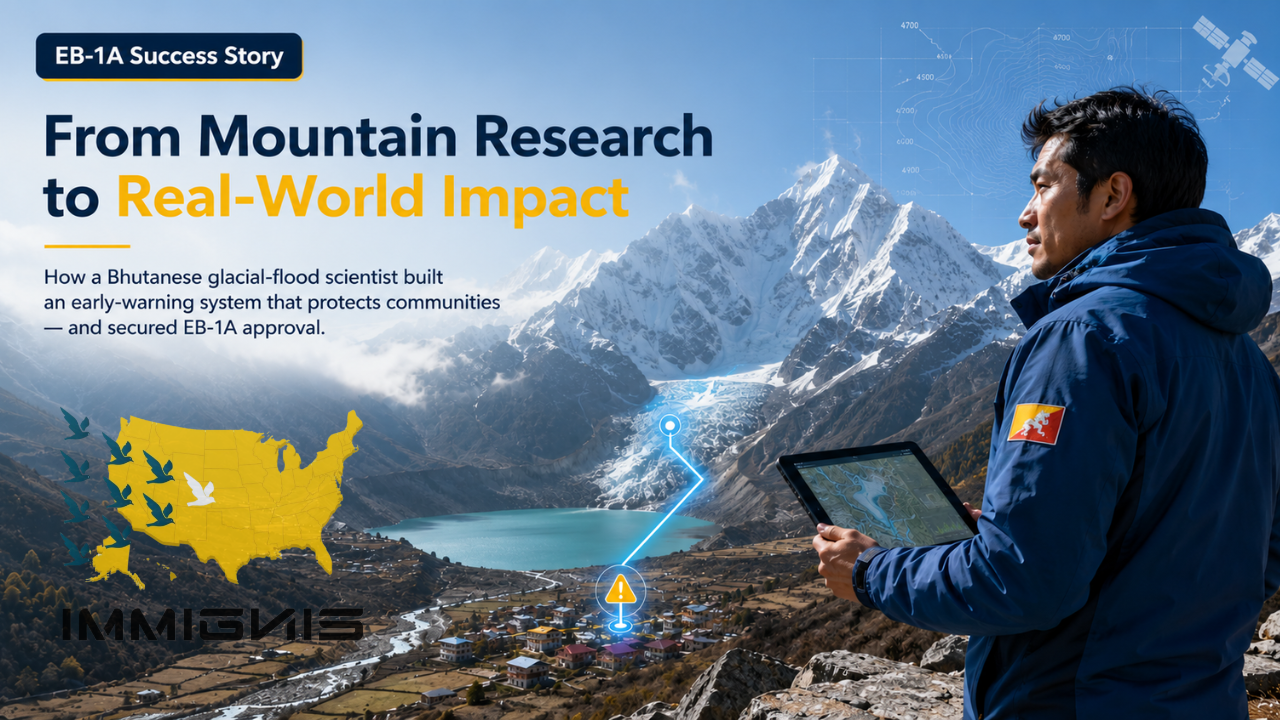
EB-1A for Climate Scientists explains how a Bhutanese researcher secured approval by documenting his role in glacial-lake outburst flood risk assessment, early-warning design, scholarly publication, international mountain-research networks, UN climate-adaptation work, media coverage, and immigration-specific profile building.
Key facts at a glance
| Petition outcome | Form I-140 approved under EB-1A on October 24, 2024. |
| Professional profile | Bhutanese glacial-flood scientist researching glacial-lake outburst floods that threaten Himalayan valleys and downstream communities. |
| Field niche | Glacial-lake outburst flood risk assessment and early-warning systems. |
| Starting weakness | The work had direct public-safety value, but it came from a small national institution and much of the visible credit sat with larger international programs and partner organizations. |
| Profile-building focus | Early-warning-system attribution, publication development, international mountain-research network roles, UN climate-adaptation documentation, media coverage, expert letters, and immigration-specific evidence organization. |
| Principal EB-1A evidence areas developed | Original contributions, scholarly articles, leading role, qualifying membership evidence, and published material. |
| Central issue | Showing that a scientist from a small institution had personally shaped risk knowledge and warning systems used for communities facing a hazard with relevance far beyond Bhutan. |
| Approval lesson | A local warning system can become strong EB-1A evidence when the record identifies who developed the risk method, how the system was used, and why other professionals relied on it. |
The approval
On October 24, 2024, USCIS approved the Form I-140 petition of a Bhutanese scientist whose work focused on glacial-lake outburst flood risk assessment and early-warning systems for Himalayan valleys.
EB-1A is the first-preference immigrant classification for people who can demonstrate extraordinary ability in the sciences, arts, education, business, or athletics through sustained national or international acclaim.
The institution behind the work was small. The hazard was not. A glacial-lake outburst flood can send water, sediment, ice, and debris through narrow valleys with little time for people downstream to react. The petitioner had helped turn field observations and flood modeling into warning information tied to actual communities. Yet the public record explained the project more clearly than it explained his personal contribution.
Immignis and Advance My Profile built the case around attribution. The central question was no longer whether Bhutan faced a serious glacial-flood risk. The question was who produced the risk knowledge, warning logic, and technical record that allowed villages and agencies to act.
The system named the villages. The petition named the scientist.
One feature made the evidence unusually concrete. The warning system was connected to downstream settlements by name. Risk maps, communication routes, thresholds, and response planning were designed for places where people would need clear instructions, not an abstract climate forecast.
That same level of identification was missing from the petitioner’s professional profile. Reports could describe the lake, the valley, the sensors, the flood path, and the communities at risk while leaving individual technical authorship difficult to find. The work had a public identity. The scientist behind it did not yet have an immigration-ready one.
The case therefore treated attribution as an evidence project of its own. It traced the petitioner’s role through technical records, project correspondence, methodology documents, implementation histories, presentations, institutional letters, and independent explanations from professionals familiar with the system.
What glacial-lake outburst flood assessment actually requires
A glacial-lake outburst flood, commonly called a GLOF, occurs when water stored in or near a glacier is released suddenly. The trigger may involve failure of a moraine or ice dam, a slope collapse, an avalanche entering the lake, rapid lake expansion, or another destabilizing event.
Risk assessment is therefore more than identifying a lake on a map. It can require lake monitoring, terrain analysis, remote sensing, field surveys, breach scenarios, flood-routing models, exposure mapping, community knowledge, and repeated review as mountain conditions change.
An early-warning system adds another layer. The science must be converted into thresholds, detection methods, communication procedures, evacuation time, maintenance responsibilities, and messages that people can understand under pressure. A technically impressive model has limited value if the warning does not reach the right valley in time.
This explanation helped USCIS understand the field niche. The petitioner was not presented as a general climate researcher. He was presented as a specialist working where glaciology, hydrology, hazard modeling, disaster preparedness, and community warning meet.
Early-warning-system attribution became the center of original contribution
The strongest evidence connected the petitioner personally to the warning system. The record identified which scientific and technical decisions he made, what parts of the risk assessment he authored or directed, and how his work entered the operational system used by institutions and downstream communities.
The evidence addressed questions that are often left unanswered in collaborative projects. Who selected or interpreted the hazard inputs? Who developed the flood scenarios? Who connected modeled arrival times with warning thresholds? Who translated technical findings into a system that local authorities could use?
This supported the original-contributions argument because the case did not rely on the general value of early warning. It showed a specific contribution, linked it to the petitioner, and documented reliance on the resulting work. Letters and project records were most useful when they explained the method and the consequence of getting it wrong.
The approach stayed narrow. It did not claim that one scientist created an entire national warning system alone. It showed the part he owned, why that part required unusual expertise, and how the wider system depended on it.
Publication development gave the methods a public home
The petitioner’s starting publication record did not fully match the importance of the fieldwork. Work produced inside small institutions or international adaptation programs often appears first in reports, technical annexes, shared datasets, and implementation documents. Academic authorship may come later, and the most visible byline may belong to a foreign principal investigator.
The profile-building plan strengthened the petitioner’s own publication record around GLOF hazard assessment, early-warning design, flood modeling, mountain hydrology, and lessons from community implementation. The purpose was not to turn a practitioner into a different kind of scientist. It was to place his existing technical knowledge into publications where authorship and method could be reviewed directly.
Those articles supported the scholarly-articles criterion and helped with final merits. They gave the officer a clearer research identity and showed continuity between field responsibility, written analysis, and professional recognition.
Mountain-research networks showed recognition outside one institution
International mountain-research and cryosphere networks helped move the record beyond a single Bhutanese employer. Technical groups, regional research platforms, specialist workshops, and cross-border hazard initiatives placed the petitioner among professionals dealing with similar risks across the Himalaya and other mountain regions.
The value of these roles depended on the details. Open enrollment in a general association would not prove the EB-1A membership criterion. The petition focused on appointments, invitations, or memberships where the selection standard, technical responsibility, or evidence of achievement could be documented.
Network participation also produced independent evidence. When specialists from outside the home institution invited the petitioner to contribute, relied on his assessment, or asked him to share methods, the record showed professional trust that did not depend on a local job title.
UN climate-adaptation records connected local work to wider practice
UN-linked climate-adaptation documentation became useful because it placed the technical work inside a recognized disaster-risk and adaptation framework. The record gathered project documents, technical materials, participation records, and implementation evidence that described or relied on the petitioner’s work.
This did not mean that the reputation of an international organization automatically transferred to the petitioner. The evidence still had to identify his role. The stronger documents explained what he produced, why the project needed it, and how the work informed early warning, preparedness, or risk reduction.
For a scientist from a small country, this type of documentation can correct a scale problem. The professional may work through a modest institution, but the methods can be relevant to mountain communities, adaptation programs, and hazard specialists in many countries.
Media coverage made the warning understandable without overselling it
GLOF modeling is difficult to explain to a general reader. Media coverage helped translate the science into a question people immediately understand: how much warning time does a valley have, and what should residents do with it?
The published-material evidence was strongest when coverage discussed the petitioner or his work rather than mentioning the broader project in passing. Articles, interviews, and expert commentary connected his technical role with the communities, infrastructure, and public agencies that depended on the warning information.
The case avoided dramatic language that the evidence could not support. It did not claim that every warning would prevent every loss. It showed that the petitioner helped make risk visible earlier and response planning more informed.
A leading role can exist inside a small national institution
A small institution does not make a role insignificant. What matters is the institution’s reputation and the person’s responsibility within the relevant work. The petition documented the organization’s public mandate, technical function, partnerships, and reliance on the petitioner in GLOF assessment and warning activity.
The leading-role argument focused on decisions that could not be reduced to routine employment. The petitioner held responsibility for technical outputs, coordination, interpretation, or implementation that affected whether the warning system could function as intended.
This section was especially important because the case could otherwise be misread as a capable employee participating in a well-funded international project. The evidence showed why the project and institution depended on his judgment, local knowledge, and continuity.
How Immignis and Advance My Profile built the record
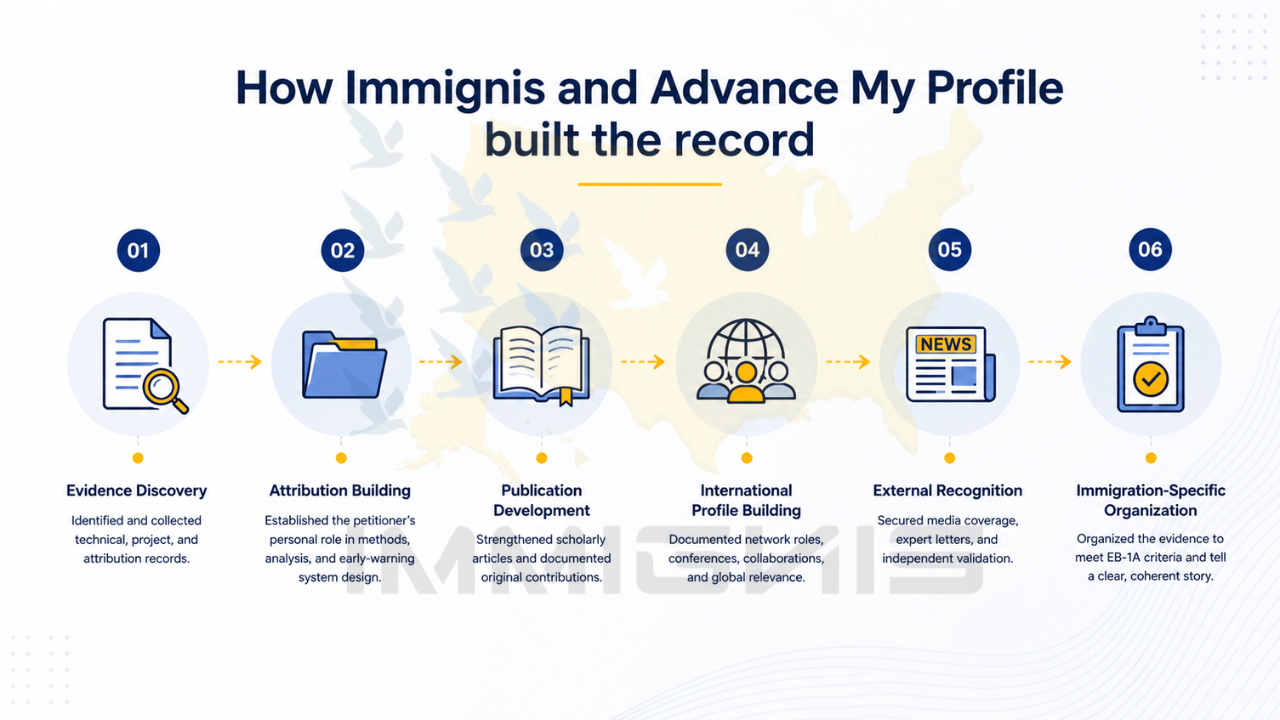
Before profile building, the career could be summarized too simply: a Bhutanese scientist worked on glacial lakes, contributed to an early-warning project, and joined international climate activities. That summary left the most persuasive facts hidden.
Immignis and Advance My Profile reorganized the record around ownership and use. The work included early-warning-system attribution, publication development, mountain-research network roles, UN climate-adaptation documentation, media positioning, expert letters, and evidence mapping to the EB-1A criteria addressed in the petition.
The process did not manufacture a public-safety contribution. It documented one that already existed. The villages were already on the warning map. The profile-building work made the scientist’s authorship, responsibility, and professional recognition visible beside them.
Why this case worked
The evidence told one consistent story. Technical records identified the petitioner’s part in the warning system. Publications gave the methods clear authorship. International networks showed external professional trust. UN-linked documents placed the work inside real adaptation and disaster-risk activity. Media coverage helped a non-specialist understand why the science mattered.
The field definition was equally important. The petition did not rely on the broad importance of climate change or the Himalaya. It explained the narrow specialty of GLOF risk assessment and early-warning systems, then measured the petitioner’s achievements within that specialty.
Most of all, the case moved from institutional importance to personal evidence. Bhutan’s exposure to glacial floods explained the setting. The approval record depended on proving what this scientist personally contributed and why others trusted that contribution.
What other hazard scientists can learn
Researchers in flood forecasting, landslide monitoring, wildfire detection, earthquake engineering, public-health surveillance, drought planning, and other warning fields often face the same problem. Their work may influence a system, while the public sees only the agency, dashboard, project, or alert.
A useful evidence review begins with the chain between science and action. Who built the model? Who set the threshold? Who validated the inputs? Who connected the technical result with a warning protocol? Who trained the people responsible for using it?
No single answer guarantees EB-1A eligibility. The record must still show sustained acclaim and satisfy the overall legal standard. But clear attribution can reveal professional distinction that a project logo, institutional report, or shared publication list has concealed.
Conclusion
The Bhutanese glacial-flood scientist’s approval shows how locally rooted hazard work can become a personal EB-1A record. The case did not depend on institution size or general statements about climate risk. It depended on documented authorship, operational use, professional trust, and a precise field niche.
The approval hook was tangible. A warning system carried the names of villages that needed time to act. The petition finally carried the name and contribution of the scientist whose work helped make that warning possible.
The client’s name and identifying details are omitted to protect privacy. The professional field, approval date, and evidence strategy reflect the underlying case record.
Frequently asked questions
Can a scientist working on glacial-lake outburst floods qualify for EB-1A?
Yes. The field is not a barrier. The petition must demonstrate sustained recognition through qualifying evidence such as original scientific contributions, scholarly authorship, leading or critical roles, qualifying memberships, and published material about the scientist or the scientist’s work.
Can an early-warning system support the original-contributions criterion?
It can when the evidence identifies the applicant’s original technical contribution, shows that the system or method was used, and explains its significance through independent records or expert testimony. General participation in a warning project is not enough.
Does working for a small institution weaken an EB-1A case?
Institution size alone does not decide the issue. The record should document the institution’s distinguished reputation in the relevant area and show why the applicant’s role was leading or critical within its work.
Can UN or international-project documents be used as EB-1A evidence?
Yes, when they genuinely document the applicant’s role, work, authorship, or professional reliance. The name of an international organization does not replace personal attribution, but its project records can be useful supporting evidence.
Does ordinary membership in a scientific association satisfy the EB-1A membership criterion?
Usually not. The membership criterion requires evidence that admission is based on outstanding achievement judged by recognized experts. Invitations, expert appointments, or selective network roles may be useful when the selection requirements are documented.
How can Immignis and Advance My Profile help hazard and climate scientists?
Immignis and Advance My Profile help define the field niche, trace personal authorship, organize system-adoption evidence, strengthen publications and professional visibility, document selective roles, and prepare an immigration-focused evidence record without inventing achievements.
Build an immigration record around the warning work people rely on
Many climate and hazard scientists already have meaningful work, but their names are hidden inside agency systems, international projects, technical reports, shared datasets, and implementation records.
Start with a free EB-1A profile assessment to evaluate whether your glaciology, flood modeling, early-warning work, climate adaptation, disaster-risk research, publications, professional roles, and documented impact can support a stronger immigration profile.