How a coach from the Cuban school of amateur boxing built an EB-1A record around champion development, judging, methodology, and documented leadership.
Key facts at a glance
| Petition outcome | Form I-140 approved under EB-1A on May 07, 2026. |
| Professional profile | Cuban boxing coach trained in the Cuban amateur boxing tradition, with a record of developing champions across two continents. |
| Field niche | Cuban-method amateur boxing development and high-performance coaching. |
| Starting weakness | The Cuban boxing system was famous, but the petitioner's own role was not documented clearly enough for immigration evidence. |
| Profile-building focus | Champion-development attribution, federation roles, boxing-press profiles, international coaching invitations, judging at sanctioned events, and a methodology publication. |
| EB-1A criteria supported | Leading role, original contributions, judging, published material, and high remuneration. |
| Central issue | Showing that athlete success did not happen around him by coincidence, but was connected to his identifiable coaching method and leadership. |
| Approval lesson | A sports coach can have an extraordinary record even when the medals hang around other people's necks, but only if the evidence proves individual contribution. |
The approval
On May 07, 2026, USCIS approved the Form I-140 petition of an EB-1A for Cuban Boxing Coaches whose work sat inside one of the most respected amateur boxing traditions in the world. The case was not built around the general reputation of Cuban boxing. It was built around one harder question: what evidence showed that this coach, as an individual, had risen to the top of his field?
That distinction mattered. In sports cases, reputation often travels through athletes, teams, clubs, federations, and national systems. The coach may be the person shaping the result every day, but the public record usually records the boxer, the bout, the medal, or the national program. The coach remains visible to insiders and almost invisible to adjudicators.
This EB-1A case succeeded because the record did not ask USCIS to admire Cuban boxing as an institution. It showed how the petitioner had applied, refined, and taught a recognizable coaching methodology that helped produce competitive results, informed athlete development, and earned recognition from people who understood the sport.
The problem: the system was famous, the individual was not
The petitioner came from the Cuban school of amateur boxing, a tradition known for technical discipline, footwork, defense, timing, conditioning, and tactical intelligence. Inside boxing circles, that background carried weight. Outside those circles, it created a documentation problem.
A famous system does not automatically prove the extraordinary ability of every coach trained within it. USCIS still needs evidence that identifies the person, explains the role, and shows why the person's work stands apart from routine coaching. Without that bridge, even a respected coach can look like one more member of a successful program.
The starting record had fragments of strength: champions he had helped develop, federation relationships, invitations, and a strong professional reputation. But too much of the proof existed in informal spaces: phone calls, gym reputation, athlete loyalty, and tournament memory. The case risk was simple. The officer could see boxing success, but not enough individual evidence connecting that success to the petitioner.
For EB-1A, that is not a small problem. The category requires more than talent or hard work. It requires a record showing sustained acclaim and a level of expertise indicating that the person is among the small percentage who have risen to the very top of the field. For a coach, that means the petition must prove the coaching contribution itself.
Why coaching cases are different from athlete cases
Athletes usually have a cleaner evidence trail. They have rankings, medals, fight records, championships, statistics, and media coverage naming them directly. Coaches often have to prove their value through the performance of others. That creates three common risks.
- The athlete receives the public acclaim, while the coach receives private gratitude.
- The team or federation is credited, while the individual coach's role is reduced to a job title.
- The method is understood by the sport community, but never explained in terms an immigration officer can evaluate.
The petitioner's case had all three risks. His athletes and teams could point to results. His colleagues could describe his influence. But the record needed to show more than proximity to success. It needed to prove attribution.
The strategy therefore focused on a narrow field: Cuban-method amateur boxing development. That framing was important. It did not describe him broadly as a sports trainer, fitness coach, boxing instructor, or former athlete. It placed him in the specific technical and developmental niche where his evidence made sense.
What had to be documented
The evidence-building work focused on turning reputation into records that could be reviewed independently. Immignis and Advance My Profile did not treat the case as a simple list of tournaments or testimonials. The file had to answer specific adjudication questions:
- Which athletes, programs, or competitive outcomes could be connected to his coaching work?
- What was distinctive about his coaching method, beyond ordinary training support?
- Did recognized boxing organizations, federations, or event bodies rely on him in a meaningful role?
- Was his expertise recognized outside his immediate gym or employer?
- Could judging, media, remuneration, and methodology evidence show broader field recognition?
The goal was not to exaggerate a coaching record into something it was not. It was to document what insiders already knew in a form USCIS could assess.
Champion-development attribution
The first major evidence problem was attribution. In boxing, results are public, but coaching influence is often private. A boxer wins a national title, qualifies internationally, or reaches a podium. The official result may show the athlete, the country, and the event, but not the training decisions that helped produce the performance.
The petition therefore needed letters and supporting records from athletes, federation officials, gym leaders, and boxing professionals who could explain the petitioner's actual role. Strong letters did not simply say he was respected or hardworking. They identified what he did: technical correction, fight preparation, tactical planning, conditioning structure, sparring selection, development of amateur prospects, and transition planning for higher-level competition.
This distinction was important. Athlete success by itself cannot be lifted and used as the coach's award. But athlete development can support original contribution, leading role, and field impact when credible evidence shows the coach's specific involvement. The petition treated the athletes' results as corroboration, not as a substitute for personal acclaim.
Federation roles and institutional trust
The second part of the record focused on federation and program-level trust. A coach who is chosen for important development roles, selection responsibilities, sanctioned events, or international coaching assignments can show recognition that goes beyond ordinary private instruction.
The case documented roles with boxing organizations and programs that relied on the petitioner's expertise. These records mattered because they showed that recognized institutions in the sport trusted him with more than routine supervision. They trusted him with athlete development, competitive preparation, and technical judgment.
For the leading role criterion, adjectives were not enough. The record needed programs, titles, responsibilities, team structures, event documents, invitations, and letters from organizational leaders. The strongest evidence showed not merely that he worked for a boxing program, but that the program depended on his expertise for competitive development.
Judging and sanctioned-event recognition
Judging can be valuable in EB-1A cases when it reflects a genuine request to evaluate the work, skill, or performance of others in the field. For a boxing coach, this can include service at sanctioned competitions, athlete selection panels, technical evaluations, coaching assessments, or related roles where the person is trusted to judge competitive ability.
The petition documented judging-related credentials and event participation in a way that separated real evaluative responsibility from ordinary attendance. The point was not that the petitioner had been present at competitions. The point was that event bodies and boxing stakeholders trusted him to assess athletes, performance, or competitive readiness.
This helped the record in two ways. First, it supported the formal judging criterion. Second, it reinforced final merits by showing that his expertise was recognized by others who had authority in the sport.
Methodology publication: explaining the Cuban system through his own work
The most interesting part of this case was the methodology evidence. Many coaches are effective because they carry knowledge that was taught orally, refined in gyms, and tested through competition. That kind of knowledge is real, but it can be difficult to prove in a petition if it is never written down.
The profile-building work helped convert coaching knowledge into a methodology publication. This did not mean inventing a theory after the fact. It meant organizing the petitioner's existing approach in a way that could be read, evaluated, and attributed to him.
The methodology evidence explained how he used the Cuban amateur boxing tradition in athlete development: technical habits, tactical drills, defensive structure, rhythm control, conditioning phases, competition readiness, and individualized corrections based on style and opponent profile. By putting that system into a documented professional format, the petition showed original contribution more clearly.
This was especially important because USCIS officers may not understand the internal hierarchy of boxing coaching. A clear methodology gave the officer a measuring stick. It showed what the coach actually contributed, why that contribution was not generic, and how it connected to athlete outcomes.
Published material and boxing-press visibility
The petitioner also needed public recognition outside private boxing circles. For many coaches, the public record is thin because sports media tends to cover fighters, not the development infrastructure behind them. The profile-building process addressed this by developing boxing-press coverage focused on the petitioner's coaching method, athlete-development role, and place within the Cuban boxing tradition.
Published material is strongest when it is about the person and the person's work, not merely a passing mention. In this case, the goal was coverage that helped readers understand why his coaching record mattered. Articles, interviews, and profiles connected his work to competitive preparation and champion development. They also helped show that his recognition was not limited to those who already worked with him.
The media evidence did not carry the case alone. It worked together with federation documentation, letters, judging evidence, and methodology proof. That combination made the record more credible than a collection of promotional articles standing by themselves.
High remuneration in a coaching field
High remuneration can be difficult in sports coaching because compensation varies by country, organization, athlete level, and whether the coach works privately, through a federation, or through a club. A raw income number is rarely enough. The petition needed a comparison context.
The record therefore presented remuneration evidence in relation to the relevant coaching market. The goal was to show that the petitioner's earnings or compensation terms reflected a level of demand and recognition above ordinary coaching services in the field. Where appropriate, contracts, payment records, seminar fees, consulting income, and comparable compensation data helped support the analysis.
This evidence was handled carefully. High remuneration was not presented as proof that he was a celebrity. It was presented as one more indicator that boxing stakeholders valued his expertise at a level consistent with an accomplished coach.
How the EB-1A criteria came together
This case was not won by one document. It was won by making several kinds of evidence reinforce the same central point: the petitioner was not merely part of a famous system; he was an identifiable coach whose work had been relied upon, recognized, and applied at a high level.
The record supported several EB-1A criteria:
- Leading role: Documentation showed that boxing programs, teams, or training environments relied on him for important athlete-development responsibilities.
- Original contributions: Methodology evidence and champion-development attribution explained how his coaching approach contributed to athlete performance and technical development.
- Judging: Sanctioned-event roles and evaluation responsibilities showed that the field trusted his judgment of other athletes or competitors.
- Published material: Boxing-press coverage and professional profiles discussed his work, method, and standing in the sport.
- High remuneration: Compensation evidence helped show that his services were valued beyond ordinary coaching levels in the relevant market.
Together, these criteria created a record that was both technical and human. It showed the coach in the gym, the coach in competition preparation, the coach as evaluator, the coach as teacher, and the coach as a recognized specialist in a specific boxing tradition.
The final-merits argument
Meeting individual criteria is only part of an EB-1A case. USCIS also considers whether the full record shows sustained acclaim and whether the petitioner is among the small percentage at the top of the field. For this coach, the final-merits issue was attribution.
The petition had to avoid two weak arguments. First, it could not argue that Cuban boxing is famous, therefore every coach from that system is extraordinary. Second, it could not argue that successful athletes automatically prove extraordinary coaching. Instead, the final-merits section connected each piece of evidence back to the petitioner's personal role.
The strongest theme was simple: the system was famous, but this petition proved the individual. Federation trust, athlete-development evidence, sanctioned judging, media recognition, methodology documentation, and remuneration records all pointed in the same direction. They showed a coach whose work was recognized by people inside the sport and significant enough to be explained outside it.
Why the approval mattered
The approval showed that EB-1A can work for coaches whose careers do not look like a traditional athlete resume. A coach may not have a neat list of personal medals from the current phase of his career. He may not have mainstream press. He may not have a public profile equal to the athletes he trains. But if the evidence proves his individual contribution, recognition, and standing in the field, the record can become strong.
This case also shows why sports petitions should not rely on reputation alone. Everyone in a gym may know who built a champion. USCIS does not adjudicate gym reputation. It adjudicates evidence. The work of profile building is to make the invisible visible without overstating it.
For this Cuban boxing coach, that meant turning champion-development knowledge, sanctioned-event trust, coaching methodology, and professional recognition into a coherent EB-1A record. On May 07, 2026, USCIS approved the petition.
Lessons for coaches, trainers, and sports-development professionals
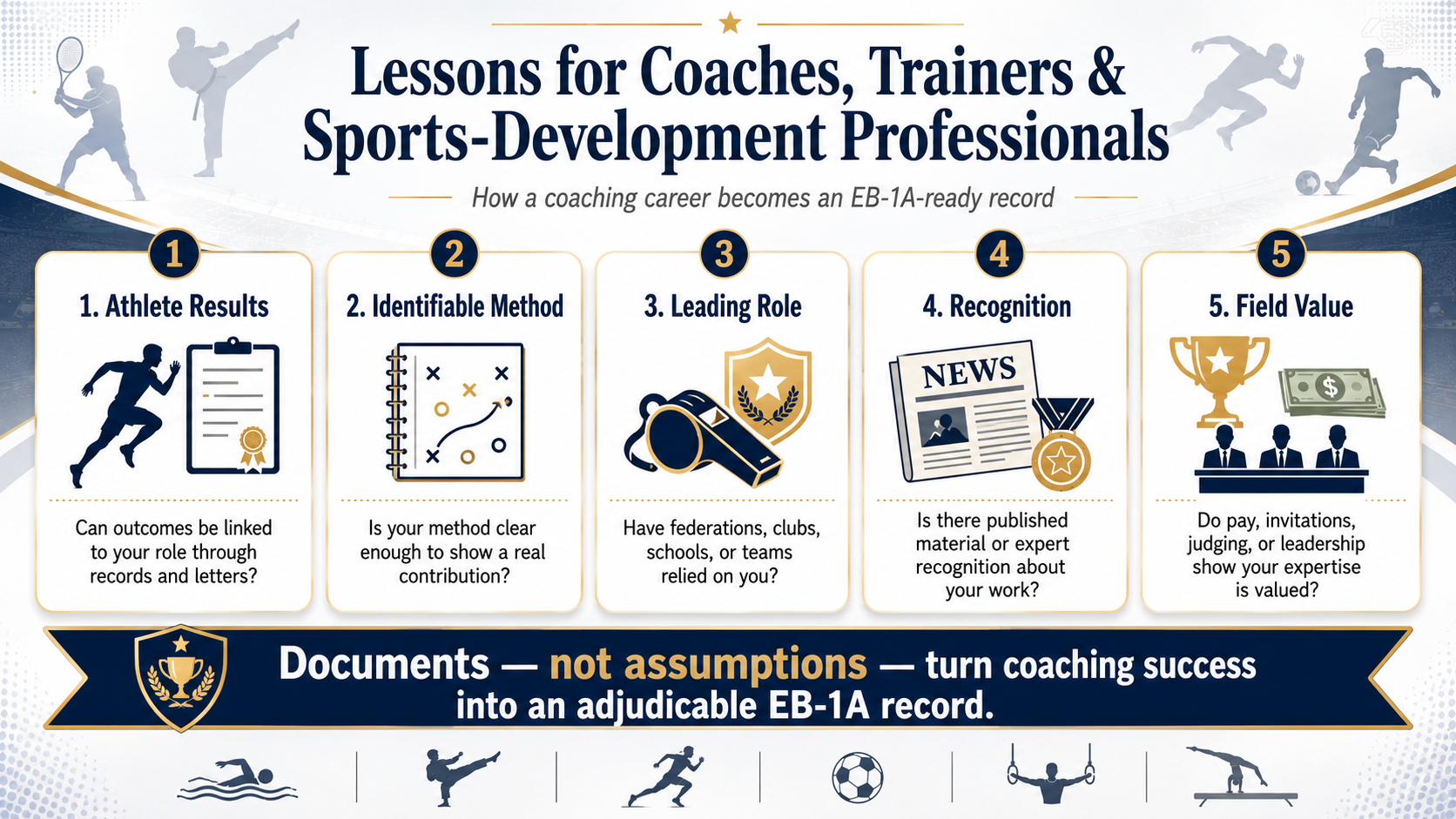
This success story is useful for professionals far beyond boxing. Coaches in tennis, martial arts, track and field, football, swimming, gymnastics, and other sports often face the same issue. Their work creates results, but the public record belongs to the athlete.
A strong EB-1A strategy for coaches usually starts with five questions:
- Can athlete outcomes be connected to your specific role through credible records and letters?
- Is your method identifiable enough to be explained as a contribution, not just experience?
- Have federations, competitions, schools, clubs, or teams relied on you in a leading or evaluative role?
- Is there published material or expert recognition about your work, not merely about athletes or teams?
- Can compensation, invitations, judging, or leadership evidence show that the field values your expertise?
When those questions are answered with documents, not assumptions, a coaching career can become an adjudicable EB-1A record.
Frequently asked questions
Can a boxing coach qualify for EB-1A?
Yes. A boxing coach may qualify if the evidence shows sustained acclaim and extraordinary ability in the coaching field. The petition must document the coach's own role, recognition, and contribution, not only the success of athletes or the reputation of a national boxing system.
Can athlete medals support a coach's EB-1A case?
They can help, but they are not automatically the coach's awards. Athlete medals are most useful when credible evidence connects the results to the coach's training method, preparation role, technical guidance, or leadership. The petition should prove attribution rather than simply list athlete achievements.
What kind of evidence is useful for a sports coach?
Useful evidence may include coaching contracts, federation roles, athlete-development letters, tournament records, media coverage, judging credentials, conference presentations, methodology publications, seminar invitations, compensation records, and letters from recognized sports authorities.
Why does a methodology publication matter?
A methodology publication helps explain the coach's technical contribution. It can show that the coach has a recognizable approach to athlete development rather than only general experience. For coaches from oral or traditional training systems, this can be especially important.
Does USCIS understand sports traditions like Cuban boxing?
USCIS officers may not know the internal hierarchy of every sport. A strong petition should explain the field, the relevant standards of prestige, and why the petitioner's role is recognized as important by qualified people in that field.
Can Immignis and Advance My Profile help sports professionals build EB-1A evidence?
Immignis and Advance My Profile help coaches, athletes, trainers, and sports-development professionals identify a defensible field niche, organize attribution evidence, document recognition, and build a professional record that can be presented clearly in an EB-1A petition.
Build an EB-1A record around the results you helped create
Many coaches are known by athletes, federations, and insiders, but not by public evidence. That gap can become the main weakness in an EB-1A case. Immignis and Advance My Profile help turn coaching reputation, athlete results, methodology, judging roles, and institutional trust into a clearer authority record.