Key facts at a glance
| Outcome | EB-1A approval for a South Korean EV battery safety engineer working at a U.S. based automotive supplier. |
| Approval date | Approved on July 30, 2024. |
| Field niche | Thermal runaway prevention and propagation risk reduction in electric vehicle battery packs. |
| Starting problem | His strongest battery safety work was internal. The record showed tests, design reviews, and supplier programs, but little independent recognition of his own safety methods. |
| Path used | Ethical EB-1A profile building through focused battery safety papers, patent filing, non-confidential failure mode and validation evidence, an EV safety white paper, technical media commentary, a conference panel, peer review, selective membership elevation, and independent automotive safety letters. |
| USCIS EB-1A criteria activated | Original contributions, scholarly articles, published material, judging, and memberships. Patent evidence strengthened the original-contribution record. |
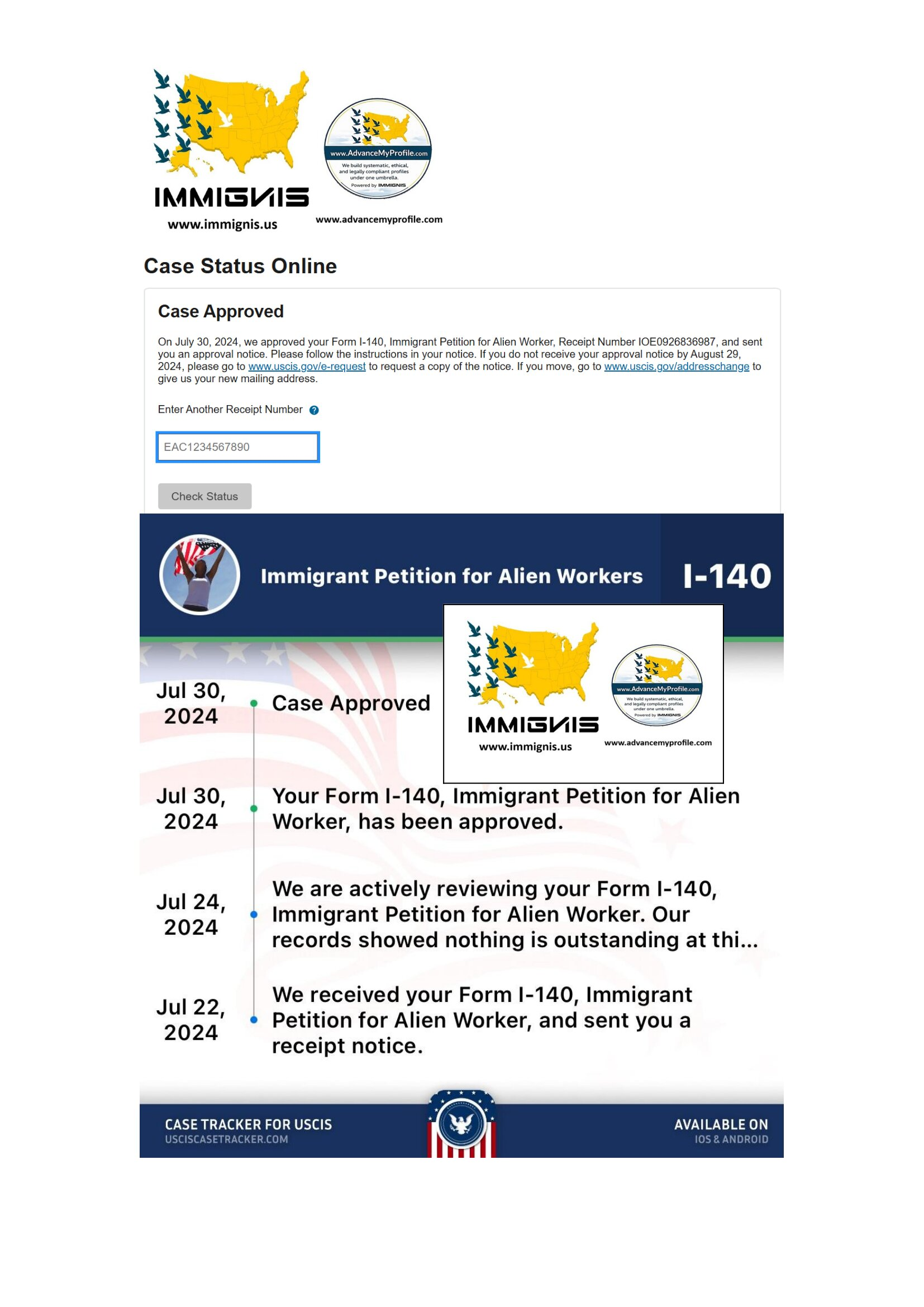
USCIS approved his Form I-140 on July 30, 2024.
Months before filing, one battery test trace had become the simplest way to explain his career. The first temperature line climbed. Then the next sensor moved.
That second line mattered. EB-1A for EV Battery Engineers: He was a South Korean battery safety engineer working for a U.S. based automotive supplier. His work focused on what happens when a lithium-ion cell enters thermal runaway and how pack design, sensing, isolation, thermal pathways, and validation methods can reduce the chance that one failing cell becomes a larger battery event. Inside the company, this was serious engineering. Outside the company, almost nobody could see his name beside the methods.
The battery pack was visible. The safety engineer was not.
EV battery programs produce enormous records. Test reports, design reviews, supplier meetings, simulation results, failure analyses, and corrective-action documents can fill years of work.
His original profile described safety projects and battery pack responsibilities. It said little about the recurring technical decisions that belonged to him: how he read propagation behavior, how he separated trigger conditions from pack-level consequences, and how he used validation evidence to challenge a safety assumption.
The EB-1A green card is a self-petition immigrant classification for people who can demonstrate extraordinary ability through sustained national or international acclaim and recognized achievements in the field.
Advance My Profile, powered by Immignis, reviewed the non-confidential record with legal strategists and battery safety specialists and narrowed the field to thermal runaway prevention and propagation risk reduction in EV battery packs.
His niche began at the moment a cell failure could become a pack problem
Thermal runaway is a self-accelerating temperature rise in a battery cell that can lead to venting, fire, and severe heat release. For an EV battery pack, teams also study how heat, gas, electrical faults, mechanical damage, and pack architecture may affect neighboring cells and modules after an initiating cell event.
The evidence was organized around failure mode analysis, temperature and sensor behavior, barriers between cells or modules, pack-level thermal pathways, detection logic, and validation of safety concepts.
The case did not claim that one engineering method can eliminate thermal runaway. The record showed a specialist whose work addressed how risk is identified, tested, and reduced within an EV battery safety program.
What did USCIS need to see in an EV battery safety EB-1A case?
Under the two step framework often associated with Kazarian, USCIS first considers whether evidence fits the regulatory criteria and then evaluates the record as a whole in final merits. Meeting criterion labels without showing sustained acclaim and top level expertise is not enough.
For original contributions, the petition had to identify his methods, safety concepts, validation approaches, or technical work and explain why they had major significance in the field. Confidential test reports alone could not answer every part of that argument.
Scholarly articles needed a clear battery safety subject. Published material required independent coverage about him or his expertise. Peer review supported judging when he actually evaluated the work of other researchers.
The memberships criterion required more than paying dues. The elevation used in the case had to be tied to standards that recognized achievement and involved expert assessment.
Patent evidence was useful for tracing inventorship and a technical concept. It supported the original-contribution record; patents are not a separate EB-1A regulatory criterion.
The internal safety record was reorganized by failure mode, method, and use
Advance My Profile worked through non-confidential project summaries, role records, validation documents, and invention materials. The evidence was grouped around technical questions instead of programs.
What condition was being investigated? Which data did he review? What safety assumption was under challenge? What method or design concept was linked to him? What happened to the program after the analysis?
One evidence stream concerned propagation behavior and thermal pathways. Another concerned early warning and sensor interpretation. A third concerned validation logic and how test results were converted into engineering decisions.
Customer identities, protected pack details, and proprietary parameter values remained outside the public story.
The technical papers gave his safety methods a public language
With domain support, he developed papers on thermal runaway behavior, propagation risk, sensing and warning signals, pack level safety analysis, and the interpretation of validation data.
The papers did not recreate an employer test program. They addressed open engineering questions using non-confidential scientific and technical material.
One paper examined why a single temperature threshold may be insufficient across failure scenarios. Another discussed combining thermal, electrical, or gas-related signals in safety analysis without disclosing a company algorithm.
Battery engineers often have years of serious safety work hidden inside validation programs, supplier records, and confidential design reviews. A free EB-1A profile assessment can identify which methods are attributable to you and where public authorship, judging, membership, or independent recognition still needs development.
A patent filing helped trace the technical concept to him
Where the filing identified him as an inventor, the public record connected him to a battery safety concept. Technical evidence and independent analysis explained the problem the concept addressed.
The filing itself was not treated as proof that the contribution had major significance. Significance came from the wider record: the safety problem, his documented work, the concept’s relationship to pack-level risk, and expert explanations from EV battery specialists.
The EV safety white paper was written for people who make pack-level decisions
Its audience included battery engineers, automotive safety professionals, technical suppliers, and program leaders responsible for pack level decisions.
The paper organized the problem around detection, thermal pathways, isolation, validation, and failure test evidence. It also examined the limits of treating one successful test as proof that every pack condition has been understood.
The document did not prescribe a proprietary battery design. Its value was in the safety questions it asked and the way it linked test evidence to engineering decisions.
Media commentary moved past the question, ‘Are EV batteries safe?’
His commentary explained the difference between an initiating cell event and propagation through a larger pack, why thermal pathways matter, and why detection systems must be considered against the failure modes they are intended to identify.
The interviews stayed away from confidential customer programs and current product incidents that he had not personally investigated.
The conference panel showed a safety specialist who could defend the method in public
His conference panel contribution centered on propagation risk and validation: the initiating failure, the route heat or fault effects can take through the pack, and assumptions built into a test method.
Panel questions pushed the subject into practical language: what a sensor really shows, how much testing supports a conclusion, and when a safety team should revisit a threshold or barrier concept. The panel was documented as invited speaking and professional recognition, not judging. The judging criterion came from peer review, where he evaluated research submitted by other specialists.
Peer review and membership elevation created recognition outside the automotive supplier
Journals and technical venues asked him to review work in battery safety, thermal management, failure analysis, and related energy storage subjects. The file documented genuine review assignments and completed activity where available. The reviewed work was tied to his field or an allied technical area.
Advance My Profile documented the association’s advancement requirements, the achievements considered, and the expert review involved in the elevated grade used for the petition.
Independent automotive safety experts explained why propagation work matters
The strongest letters began with the engineering problem. A severe cell failure can create heat and other effects at module and pack level, and limiting propagation presents a different technical problem from identifying the initial trigger.
Independent experts discussed his papers, patent evidence, non-confidential safety methods, and validation work. They explained why his focus on propagation pathways, detection evidence, and pack level validation had value in EV safety engineering.
How the USCIS EB-1A criteria came together in this battery safety case
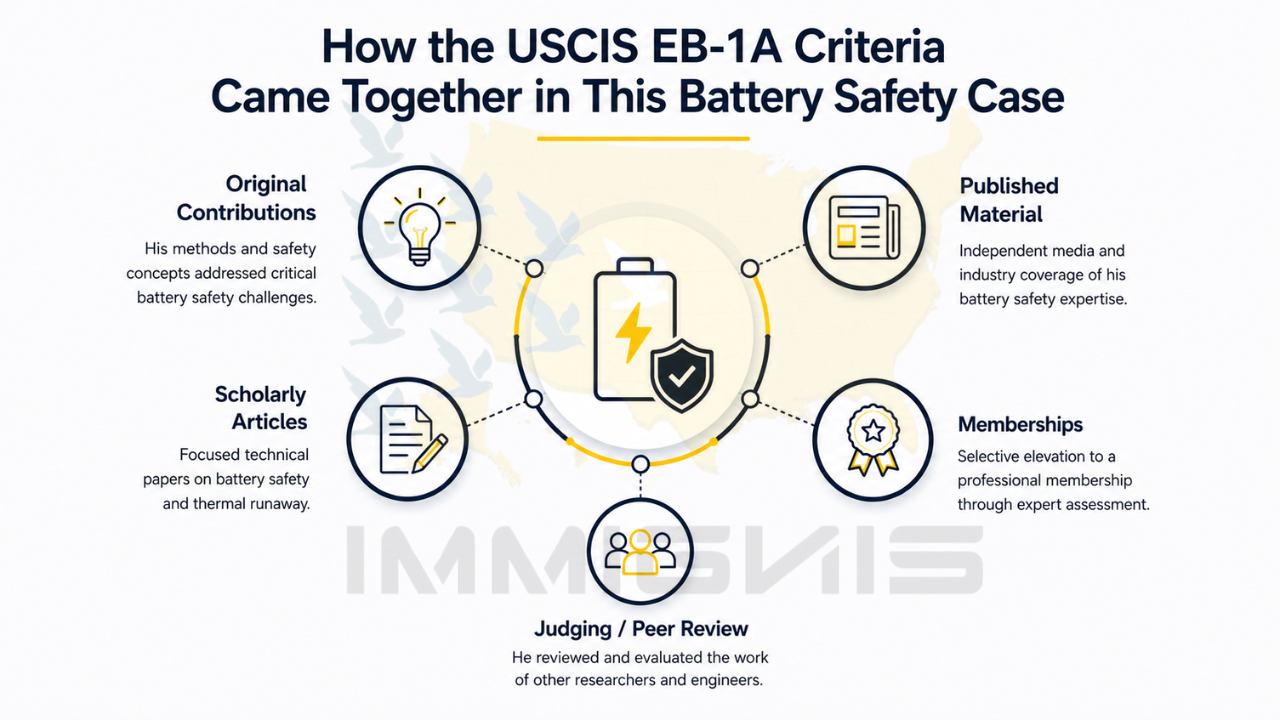
Original contributions: Non-confidential safety method evidence, validation records, patent documentation, technical papers, and independent automotive safety letters explained his individual contribution to thermal runaway prevention and propagation-risk reduction.
Scholarly articles: Focused papers connected his authorship to thermal runaway behavior, propagation risk, sensing, validation, and EV battery pack safety.
Published material: Independent automotive and battery industry coverage discussed him or his expertise in thermal runaway prevention and EV battery safety.
Judging the work of others: Peer-review records documented genuine evaluation of research by other specialists in battery safety, thermal management, failure analysis, and allied fields.
Memberships: The membership-elevation evidence included the relevant advancement standards, the achievements considered, and documentation of expert assessment for the elevated professional grade.
The papers made the technical questions public. The white paper organized the safety methodology for EV stakeholders. Patent evidence traced a technical concept. Peer review and membership elevation showed outside assessment. Media, the conference panel, and independent letters carried the same specialty beyond the company.
Approval came on July 30, 2024
The approved EB-1A petition gave him a self-petition immigration path without employer sponsorship or labor certification. The filing established a priority date for the immigrant petition, while later permanent-residence timing can depend on visa availability and the applicant’s next immigration step.
If your EV safety work is locked inside test reports and design reviews
A battery program may involve cell, thermal, mechanical, electrical, software, manufacturing, supplier, and vehicle safety teams. Your record has to show where your analysis or method enters that system.
Document non-confidential failure modes, validation logic, methods, and decisions attributable to you. Publish around open engineering questions. Use patents according to their status. Build judging through genuine evaluation work and rely on membership only when the admission or elevation standard supports the criterion.
Do not build a safety profile from fake awards, paid citations, junk publications, or technical claims you would be uncomfortable defending to another battery engineer. A weak shortcut can create an immigration problem and a professional record you may spend years trying to explain.
FAQs
What is thermal runaway in an EV battery?
Thermal runaway is a self accelerating rise in cell temperature caused by heat generating reactions inside the battery. A severe event can involve venting, fire, and intense heat. EV battery safety engineering also studies whether the effects of one cell failure can spread to neighboring cells, modules, or other parts of the pack.
Can internal battery-safety work support an EB-1A original-contribution claim?
Yes, when the applicant’s individual method or technical contribution can be identified and the evidence shows major significance in the field. Non-confidential validation records, patent evidence, technical papers, documented use, and independent expert analysis can help explain the work without publishing protected pack details.
Does an EV battery patent count as its own EB-1A criterion?
No. Patents are not a separate EB-1A regulatory criterion. Patent evidence may help document inventorship and support an original-contribution argument, while the petition still needs evidence explaining the significance of the underlying contribution.
Can peer review count as judging for a battery engineer?
Genuine peer review can support the judging criterion when the engineer actually evaluates research by other specialists in the same or an allied field. The record should document the invitation and the review activity, and the subject of the reviewed work should fit the applicant’s technical expertise.
Can a senior professional membership help an EB-1A battery-safety case?
It may support the memberships criterion when the association requires outstanding achievements for membership or elevation and those achievements are judged by recognized experts in the field. An open dues-based membership normally does not establish that criterion by itself. The petition should include the actual admission or advancement standards.
Do I need a PhD to pursue EB-1A as an EV battery safety engineer?
No specific PhD is required for EB-1A extraordinary ability. A battery engineer may rely on applicable evidence such as original contributions, scholarly authorship, judging, published material, qualifying memberships, and sustained independent recognition. USCIS evaluates the full extraordinary-ability record.
Build an EB-1A success story around the safety method behind your battery program
If you work in EV batteries, thermal runaway, battery-pack validation, energy storage safety, thermal management, or automotive failure analysis, your strongest contribution may still be trapped inside internal program records.
Immignis and Advance My Profile help identify a defensible technical niche, document individual safety methods, build credible field recognition, and prepare an EB-1A record around evidence you can verify and defend professionally.