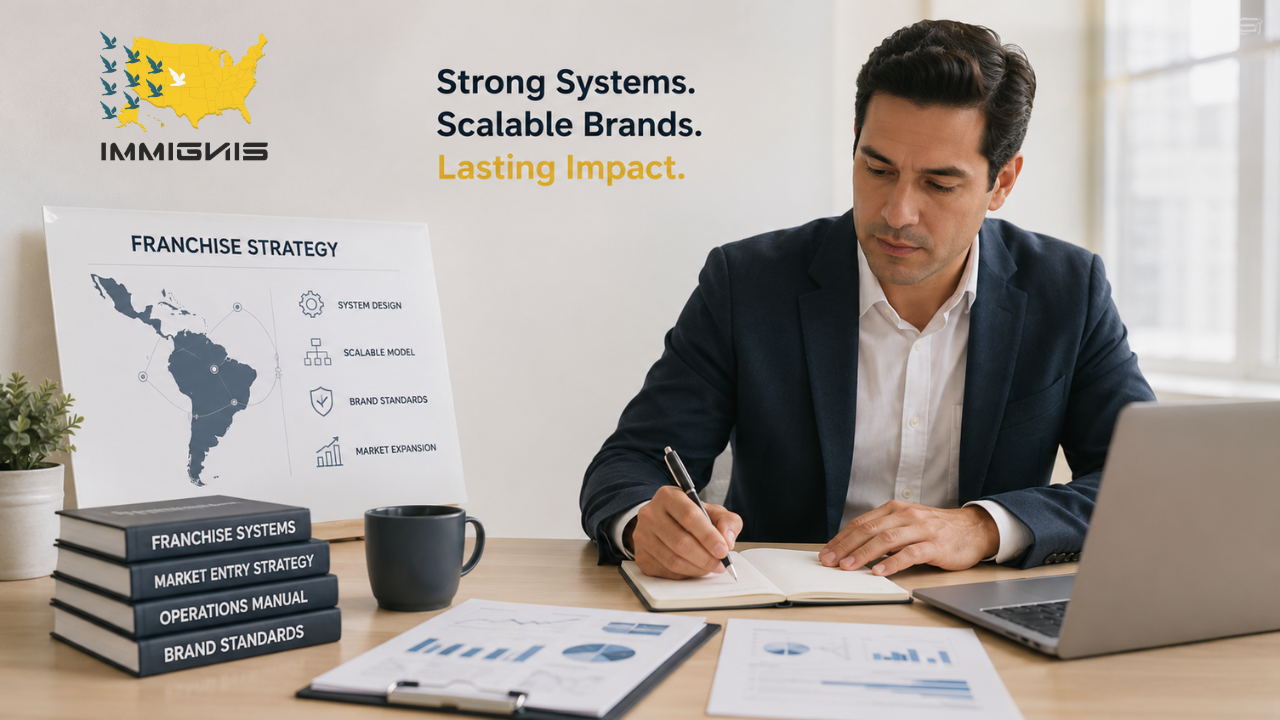
How a Mexican franchise-systems strategist secured EB-1A approval by turning client-cleared case documentation, franchise-association roles, trade-press bylines, franchise-expo keynotes, judging for franchise awards, and fee benchmarking into a petition-ready record.
Key facts at a glance
| Petition outcome | Form I-140 approved under EB-1A on May 4, 2026. |
| Professional profile | Mexican consultant who designed franchise architectures that helped food brands scale across Latin America. |
| Field niche | Franchise-system design for emerging markets. |
| Starting weakness | Client success appeared under client logos, while the strategist's own role was hidden behind confidential consulting work and word-of-mouth reputation. |
| Profile-building focus | Client-cleared case documentation, franchise-association roles, trade-press bylines, franchise-expo keynotes, judging for franchise awards, and fee benchmarking. |
| EB-1A criteria supported | Original contributions, leading role, published material, judging, and high remuneration. |
| Central issue | Proving that the petitioner personally designed scalable franchise systems, rather than simply being associated with successful client brands. |
| Approval lesson | The consultant's paradox can be reversed ethically when client-branded success is supported by clear attribution, public visibility, judging roles, and market-valuation evidence. |
The approval
On May 4, 2026, USCIS approved the Form I-140 petition of an EB-1A for Franchise Consultants whose work helped food brands scale across Latin America through stronger franchise architecture, market-entry planning, operating systems, and brand-standard controls.
Inside the franchise sector, his influence was already understood by owners, operators, and expansion teams. Restaurant and food-service brands grew because he helped turn successful local concepts into repeatable franchise systems capable of entering new cities and markets.
For EB-1A, however, the case carried a familiar problem for consultants: the most visible success belonged to the client. The restaurants, brand names, unit growth, and market expansion all appeared under client logos, while the strategist who designed the system remained largely behind the scenes.
That became the central challenge of the case: reversing the consultant's invisibility in an ethical, disclosure-safe way and proving that his franchise-system design work represented extraordinary ability in a defined business field.
The evidence problem in franchise-system strategy cases
Franchise strategy work is often private. The strongest documents may include expansion plans, franchise manuals, unit-economics models, brand-standard systems, market-entry analysis, operating procedures, training frameworks, and investor or franchisee materials. Those records can show serious impact, but they are usually client-owned and not fully public.
The petitioner's starting weakness was not lack of value. The weakness was attribution. Every client success wore the client's logo. New locations opened under the brand name. Trade attention went to the restaurant group. Financial gains appeared in the client's books, not in the consultant's public profile.
The case therefore needed a precise field definition. It was not framed as general business consulting, restaurant marketing, or ordinary expansion support. It was framed as franchise-system design for emerging markets, with emphasis on scalable operating architecture, market replication, brand governance, franchisee readiness, and cross-market expansion strategy.
That field definition gave the petition a practical measuring stick. The question was not whether the petitioner helped businesses grow. The question was whether his franchise architectures were recognized as important, repeatable, and valuable within the franchise and food-service expansion field.
The consultant's paradox: invisible by design
Many strong franchise consultants are invisible because their work is supposed to make the client look seamless. A good system allows the brand to expand smoothly, keep standards consistent, train operators, attract franchisees, and protect customer experience across locations. When the work succeeds, the public sees the brand, not the architect behind it.
That invisibility can be dangerous in an EB-1A petition. USCIS cannot approve a case based on reputation alone, and it cannot assume that a consultant caused a client's expansion without evidence. The petition had to identify documents and third-party materials that could connect the petitioner to the results without exaggeration or breach of confidentiality.
The case reversed the paradox through attribution. Client-cleared summaries, owner letters, franchise documentation, public brand-growth evidence, conference roles, bylines, judging invitations, and fee records helped show that the petitioner was not merely near successful companies. He was the strategist whose systems helped those companies scale.
That approach made the case stronger. Instead of claiming credit for every restaurant milestone, the petition focused on the petitioner's specific design contributions: the systems, manuals, structures, market logic, and governance tools that made expansion possible.
Client-cleared case documentation became the backbone of the record
In a franchise case, client-cleared documentation can be more valuable than broad promotional language. The record focused on documents that explained the client problem, the petitioner's intervention, the system he designed, the markets affected, and the measurable outcomes that followed.
The petition used those materials carefully. Confidential sales, franchise-fee, investor, or operating data did not need to be exposed in full. Disclosure-safe summaries and authorized letters were enough to show scale, responsibility, and significance while protecting client information.
The best evidence answered practical questions. What expansion barrier existed before his involvement? What franchise architecture did he create? How did the system change store replication, franchisee onboarding, brand consistency, or market entry? Why did the client rely on his judgment rather than treat him as an ordinary vendor?
Those materials helped convert client-branded growth into officer-readable proof of individual expertise. They also showed that the petitioner's work was not generic consulting, but specialized franchise-system design that affected business replication across emerging markets.
Leading-role evidence had to show strategic control, not support work
Consultants often struggle with the leading-role criterion because they are outside the client organization. The petition therefore had to show that the petitioner held a critical role in the design and execution of franchise architecture, even if he was not the owner of the brand.
The record documented his authority over franchise-system planning, brand-standard structures, expansion-roadmap design, operating-model development, market-entry strategy, and franchisee-facing implementation tools. It showed that clients depended on his judgment for decisions that affected whether expansion could be replicated successfully.
This was important because the petitioner was not presented as a general advisor giving occasional suggestions. The case showed that his work shaped the systems clients used to expand, train, control quality, and maintain brand value across markets.
For consultants, this distinction is essential. A client may become successful, but EB-1A requires proof that the petitioner personally held a central role in the success, not merely that he was connected to a successful brand.
Original contribution in franchise-system design
Original contribution in business strategy does not always look like a patent or academic theory. In franchising, originality may appear through a practical operating architecture, a market-entry model, a franchisee-readiness framework, a brand-standard system, or a repeatable method for converting a local concept into a scalable multi-market franchise.
For this petitioner, the original-contribution argument was built around applied franchise architectures that helped food brands move from informal growth to structured expansion. The case showed how his methods improved replication, clarified operational standards, strengthened franchise governance, and made cross-market growth more realistic.
That mattered because USCIS looks for contributions of significance, not routine job performance. The petition therefore avoided vague claims about business growth and focused on the petitioner's specific frameworks, their adoption by clients, and the independent validation that showed the field valued his expertise.
The petition did not claim that he created franchising in Latin America or single-handedly built every client brand. It made a narrower and stronger point: within franchise-system design for emerging markets, his methods created measurable value and were recognized by clients, industry platforms, and peers.
Trade-press bylines made the expertise visible
The original profile had limited public authorship because consultants often work behind client brands. Trade-press bylines helped correct that weakness by attaching the petitioner's name to franchise strategy, brand expansion, food-service scaling, and emerging-market growth issues.
Those publications mattered because they showed that he was not merely executing private client work. He was contributing to public professional discussion about franchise design and advising the field through explainable strategy, market observations, and practical frameworks.
The petition treated published material as support for the broader record. The most useful pieces were not generic publicity. They connected his name to the exact niche claimed in the petition: franchise-system design, food-brand scaling, and emerging-market expansion.
Franchise-association roles strengthened independent validation
Association roles can be important when they show that the field recognizes a professional beyond client relationships. In this case, franchise-association participation and leadership helped demonstrate that the petitioner was trusted in the broader franchise ecosystem, not only by paying clients.
The petition used those roles to show peer recognition. Participation in franchise organizations, working groups, educational programs, or industry initiatives helped establish that his expertise was relevant to standards, training, and professional practice in the field.
That evidence also supported the final-merits argument. It showed that the petitioner's standing did not depend solely on private consulting claims. Other actors in the franchise industry were willing to place him in visible, field-facing roles.
Franchise-expo keynotes showed field-level demand for his knowledge
Speaking invitations can be persuasive when they are tied to respected industry platforms and the petitioner's specialized expertise. Franchise expos, restaurant-growth events, and regional business forums gave the petitioner a public stage to explain franchise-system design to owners, investors, and operators.
The petition did not treat speaking as event attendance. It treated keynotes and panels as evidence that organizers considered his knowledge valuable to the field. The topics also mattered because they matched the claimed niche: franchise architecture, market replication, emerging-market expansion, and operational standardization.
This helped make a private consulting career more publicly legible. The officer could see not only that clients used his systems, but that the franchise field invited him to teach and explain those systems to others.
Judging roles showed peer trust in his franchise expertise
Judging evidence can be especially useful in consultant cases because it shows that the field trusts the petitioner to evaluate the work of others. For a franchise strategist, judging franchise awards, food-service growth competitions, or entrepreneur-selection programs can show recognized expertise beyond private client work.
The petition placed that evidence in context. It showed that the petitioner was not simply attending award events, but was asked to help assess franchise models, growth concepts, business readiness, or operational excellence.
That mattered because judging turns expertise into peer validation. It shows that industry institutions believed his standards and judgment were strong enough to measure the work of other professionals and companies.
Fee benchmarking supported high-remuneration evidence
High remuneration can support EB-1A when the numbers are compared against the correct market. For consultants, this often means showing that fees, retainers, project rates, or advisory compensation were high relative to comparable consulting services in the region and field.
In this case, fee benchmarking helped show that the market paid a premium for the petitioner's franchise-system expertise. The evidence did not rely on unsupported claims that he was highly valued. It compared his compensation to relevant consulting benchmarks and explained why clients paid for his specialized judgment.
That evidence worked best because it was paired with the rest of the record. When client-cleared impact, bylines, association roles, keynotes, and judging are already present, fee benchmarking helps confirm that the market recognizes the petitioner as more than an ordinary business advisor.
Why the petition worked
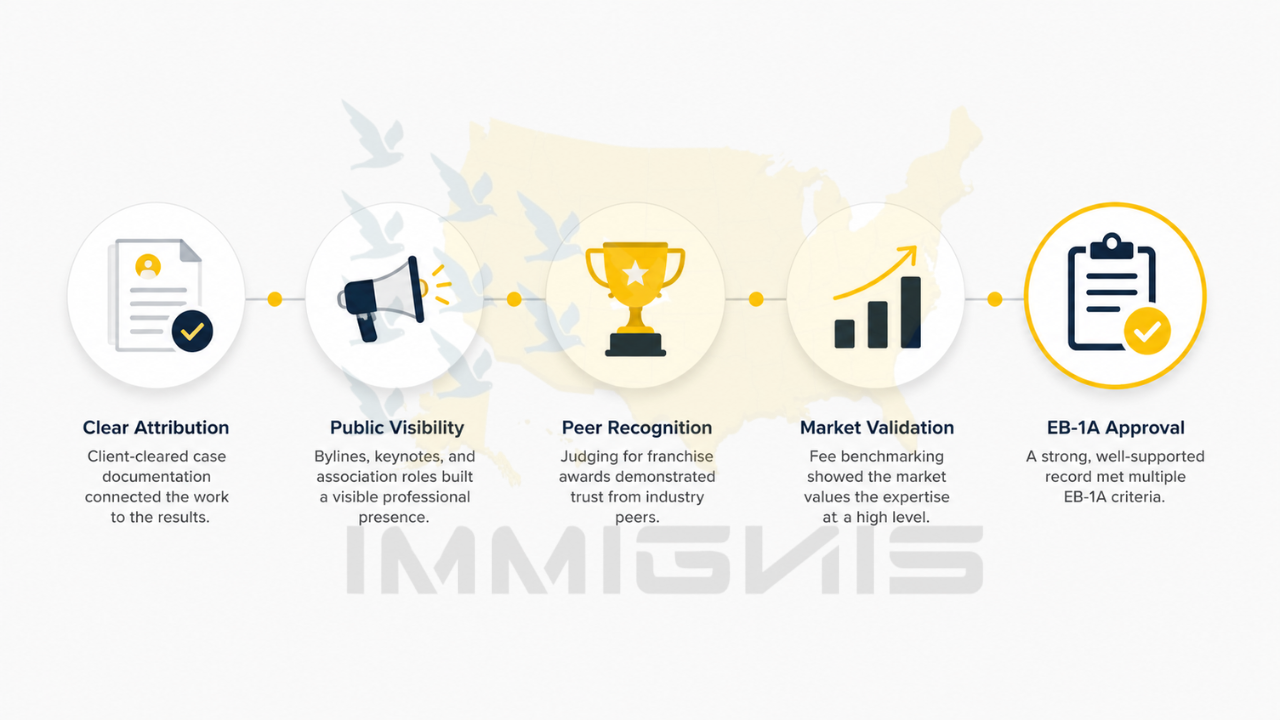
The success of the case came from disciplined framing. Instead of presenting a broad story about restaurant growth, the petition defined a specific field and then connected the petitioner to evidence that the field could understand: systems, replication, governance, market entry, and client-attributed results.
It showed that the petitioner was not an invisible helper behind famous brands. He was a franchise-system strategist whose methods gave food brands the structure needed to expand while preserving standards and commercial viability.
That framing allowed the EB-1A criteria to work together. Leading-role evidence showed strategic authority. Original-contribution evidence showed applied franchise architecture. Published material showed public visibility. Judging showed peer trust. High remuneration showed market valuation.
Most importantly, the petition did not ask USCIS to believe word-of-mouth reputation. It converted that reputation into signed attribution, public-facing evidence, and disclosure-safe documentation of real business impact.
Why the approval mattered
The approval mattered because it showed how a consultant can qualify for EB-1A even when the visible business success belongs to clients. The petition proved that invisibility by design can be reversed ethically when the evidence identifies the petitioner's specific role and contribution.
For this Mexican franchise-systems strategist, the petition did not overclaim client achievements or expose confidential information. It organized the right evidence: client-cleared case documents, owner letters, trade bylines, franchise-association roles, expo keynotes, judging service, and fee benchmarking.
The approval confirmed the central lesson of the case: in consulting fields, the client's logo does not have to erase the strategist's contribution when the petition documents attribution, impact, and independent validation clearly.
Lessons for franchise consultants, brand strategists, and business advisors
This case is useful for franchise consultants, restaurant-growth strategists, brand-system designers, expansion advisors, operations consultants, and business architects whose strongest work is often credited publicly to their clients.
A strong record usually begins with the following questions:
- Can client-cleared summaries explain the petitioner's specific role in designing franchise systems or expansion architecture?
- Can owner, executive, or franchisee letters connect client growth to the petitioner's methods without overstating confidential results?
- Do trade-press bylines, interviews, or conference invitations show the petitioner's visibility in the franchise field?
- Can franchise-association roles, awards judging, or expo keynotes show independent validation beyond private client work?
- Can fee benchmarking show that the market pays a premium for the petitioner's specialized franchise-system expertise?
When those questions are answered with documents, a behind-the-scenes consulting career becomes much easier for USCIS to evaluate. That is often the difference between client success and an extraordinary-ability record.
Frequently asked questions
Can a franchise consultant qualify for EB-1A?
Yes. A franchise consultant may qualify for EB-1A if the evidence shows sustained acclaim and extraordinary ability in a defined field such as franchise-system design, brand expansion strategy, or emerging-market franchise architecture.
How can a consultant prove impact when client brands get the credit?
A consultant can prove impact through client-cleared case documentation, owner or executive letters, public growth evidence, trade publications, speaking invitations, judging roles, and fee benchmarking that connect the petitioner personally to the work.
Can confidential franchise or client work be used in an EB-1A petition?
Yes, when it is documented safely. Cleared summaries, redacted materials, authorized letters, non-confidential case studies, and public-facing evidence can show impact without exposing sensitive client information.
Do franchise-expo keynotes and trade-press bylines help EB-1A?
Yes. Keynotes, panels, interviews, and bylines can help show that the petitioner is recognized outside private client engagements and trusted to contribute to professional discussion in the field.
Can judging franchise awards support EB-1A?
Yes. Judging can support EB-1A because it shows that industry institutions trusted the petitioner to evaluate the work, models, or achievements of others in the franchise field.
Can Immignis and Advance My Profile help franchise consultants build EB-1A evidence?
Immignis and Advance My Profile help franchise consultants, brand strategists, restaurant-growth advisors, and business professionals define a credible field niche, document impact, improve visibility, and build a petition-ready EB-1A evidence record.
Turn behind-the-scenes franchise strategy into petition-ready evidence
Many franchise consultants create the systems that make client brands scalable, but the public record often credits only the client. EB-1A success depends on documenting the strategist's own role through attribution, industry recognition, and disclosure-safe proof of impact.