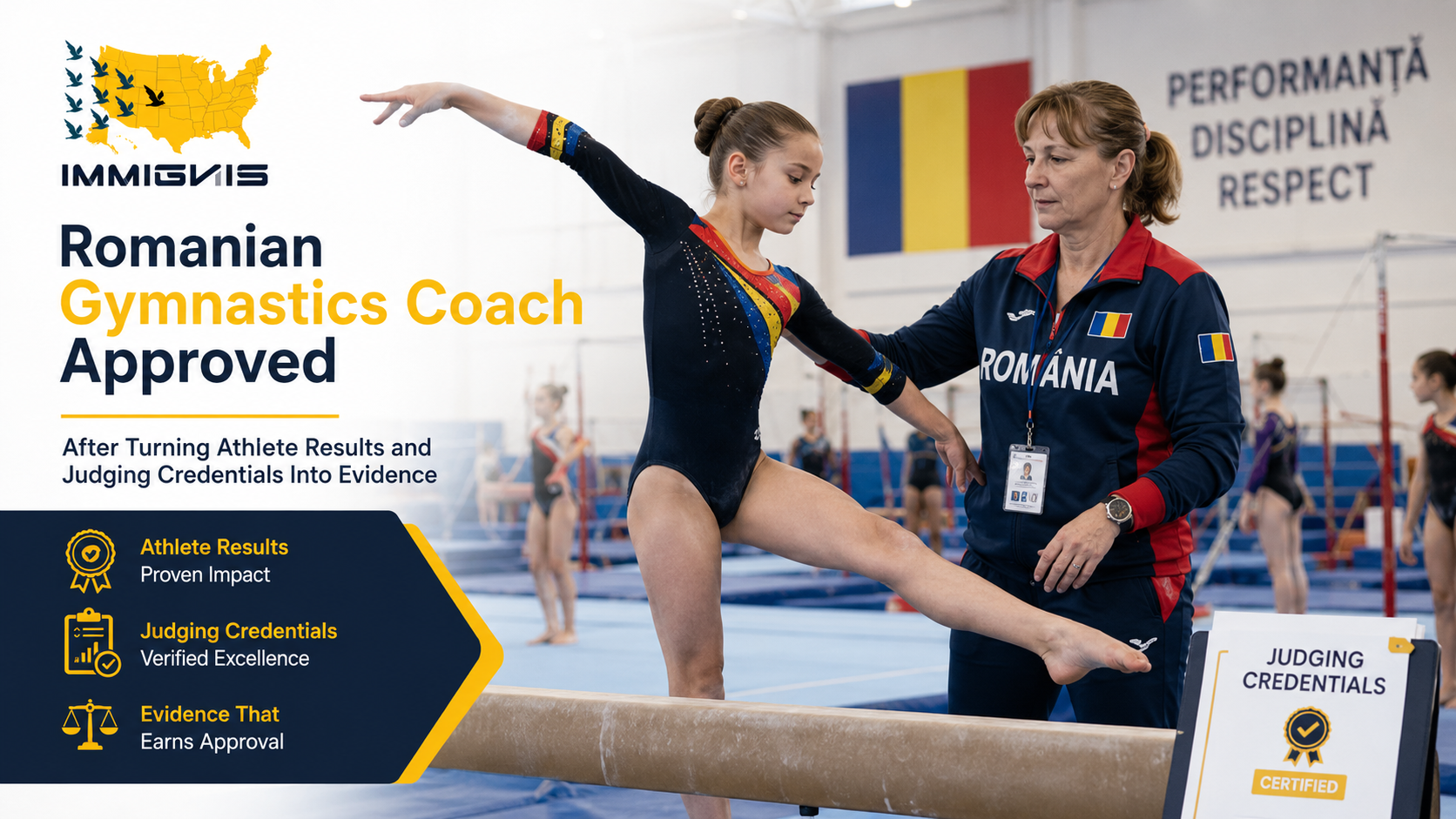
How a former elite gymnast built a stronger EB-1A record around women's artistic gymnastics development coaching, athlete attribution, judging credentials, and federation recognition.
Key facts at a glance
| Petition outcome | Form I-140 approved under EB-1A on June 9, 2026. |
| Professional profile | Romanian former elite gymnast coaching junior athletes to international finals. |
| Field niche | Women's artistic gymnastics development coaching. |
| Starting weakness | Federation records named the athletes, but the coach's role in their development was not documented clearly enough. |
| Profile-building focus | Meet-result attribution, federation coaching licenses, judging credentials, coaching-education lecturing, sports-media coverage, and athlete and federation letters. |
| EB-1A criteria supported | Judging, leading role, original contributions, published material, and membership. |
| Central issue | Proving that the coach had an identifiable role in athlete development, not merely association with talented gymnasts. |
| Approval lesson | In sports coaching cases, the evidence must move the coach from the background of athlete results into a documented position of field-level authority. |
The approval
On June 9, 2026, USCIS approved the Form I-140 petition of an EB-1A for Gymnastics Coaches whose career did not fit the simplest EB-1A story. She was not filing as the gymnast who stood on the podium. She was filing as the coach whose work helped younger gymnasts reach international finals and whose judgment was trusted inside a demanding, highly technical sport.
That difference shaped the entire case. Gymnastics is a sport where the public record usually follows the athlete. Scores, rankings, medals, and competition results name the gymnast. Broadcasts focus on the routine. Federation databases preserve the final placement. The coach may be the person rebuilding the skill, correcting body position, planning difficulty, managing training load, and preparing the athlete mentally for the floor, vault, bars, or beam, but those details rarely appear in the official result sheet.
The petition therefore had to answer a practical question: how do you prove extraordinary ability when your best work is reflected in another person's performance?
The answer was not to claim credit for every athlete achievement. It was to document the coach's own role with discipline: licenses, judging credentials, meet-result attribution, federation letters, athlete statements, lectures, media coverage, and evidence that her technical judgment was relied upon beyond routine instruction.
The coaching record behind the athlete record
The petitioner had a background many sports professionals would respect immediately. She came from an elite gymnastics environment, transitioned into coaching, and worked with junior athletes who competed at levels serious enough to be noticed by federations and international programs. Within gymnastics circles, that background meant something. For EB-1A, however, reputation inside a gym is not enough.
The starting record had a familiar weakness. The athletes had results. The coach had knowledge. But the paper trail did not yet show why her coaching work should be treated as extraordinary. Competition pages did not explain who designed training progressions. Federation materials did not automatically identify the person responsible for technical development. Parents, athletes, and fellow coaches knew her role, but USCIS needed documents that could be read, compared, and evaluated.
This is where the case needed careful reconstruction. The goal was not to turn coaching into marketing language. It was to show, through evidence, that her contribution was real, specific, and recognized by qualified people in the sport.
Why gymnastics coaching is difficult to prove in EB-1A cases
Gymnastics coaching is both visible and invisible. The results are public. The coaching process is not. A routine may last less than two minutes, but the work behind it can involve years of technical correction, fear management, strength development, injury prevention, difficulty selection, and timing. A small coaching decision can change whether a skill is safe, whether a routine scores competitively, or whether an athlete can progress to the next level.
That kind of work matters, but EB-1A does not approve people because their work is important in a general sense. The record has to show that the person has achieved sustained acclaim and is among the small percentage who have risen to the top of the field. For a coach, the petition must prove individual standing in the coaching field, not only association with successful athletes.
Three risks had to be addressed in this case:
- Athlete results could look impressive but still fail to prove the coach's personal role.
- Federation records could confirm competitions and licenses but not explain the coach's distinctive methodology.
- Judging credentials could be overlooked unless the petition explained why they represented field trust and expert evaluation of other athletes.
The strongest strategy was to define the field narrowly: women's artistic gymnastics development coaching. That phrase gave the petition a real measuring stick. It was not about general fitness, youth sports, or recreational instruction. It was about developing competitive female gymnasts through a technical progression recognized by the sport.
The judging brevet became more than a credential
One of the most useful parts of the case was her judging record. In many EB-1A petitions, the judging criterion must be built from peer review, award evaluation, conference selection, or professional panels. In gymnastics, the field itself gives certain experts formal authority to evaluate performance. A judging credential, often called a brevet or formal judging qualification depending on the system, can be unusually important because it shows that the sport entrusted the person to evaluate the work of other competitors.
The petition did not simply list the credential. It explained what it meant. A gymnastics judge must understand the code of points, execution deductions, difficulty, composition, body shape, landing control, apparatus-specific rules, and the difference between a routine that looks impressive to a casual viewer and a routine that meets the technical standard. Judging requires trained eyes and accepted authority.
That made the judging evidence powerful. It showed that the petitioner was not only a coach producing athletes; she was also trusted to assess athletes in a formal competitive setting. The record connected her judging role to the EB-1A criterion for judging the work of others and to the broader final-merits point that the field recognized her expertise.
Attribution: connecting athlete results to coaching work
The next issue was attribution. A gymnast's success belongs first to the gymnast. EB-1A evidence for a coach must be careful not to take that away. The petition instead showed where the coach's work could be documented without exaggeration.
Immignis and Advance My Profile organized records showing which athletes trained under her, which competitions and finals were relevant, and what her role was in their development. Letters from athletes, parents, federation officials, and sports leaders explained her responsibilities in plain terms. They did not rely on empty praise. They described training design, technical correction, skill progression, competition preparation, and the way her coaching decisions affected athlete readiness.
This type of evidence is especially important in junior-to-international development. Young gymnasts do not reach higher competitive levels through talent alone. The coach is often responsible for building technical foundations early enough that advanced skills can be added safely and consistently. The petition explained that developmental work as a professional contribution, not a background task.
Licenses, federation standing, and membership evidence
Sports cases often include membership or licensing evidence, but not every certificate carries EB-1A weight. A basic registration may only show that a person is allowed to coach. A stronger record explains what the credential required, who issued it, whether it involved testing or merit-based advancement, and why it signals professional standing in the field.
For this petitioner, federation coaching licenses and judging credentials helped show that her authority was not self-declared. The petition explained the standards behind those records. Where membership evidence was used, it was tied to professional achievement, field recognition, or selective participation rather than mere enrollment.
This prevented the membership evidence from feeling like decoration. It became part of a larger picture: a coach whose expertise had been reviewed, licensed, trusted, and used by recognized sports bodies.
Coaching education as original contribution evidence
The record also needed to show more than personal coaching success. To support the original-contributions argument, the petition focused on how the petitioner's methods were shared with others through coaching-education lectures and documented training guidance. That mattered because an original contribution does not always have to be a product, patent, or academic article. In sports coaching, it may be a technical system, a development method, a safety-minded progression, or a training approach that other coaches and athletes rely on.
The petition framed her contribution around development coaching for women's artistic gymnastics: how young athletes move from foundational technique to competitive routines, how risk is managed, and how technical precision is built before difficulty is increased. This gave the officer something concrete to evaluate. The case was no longer simply that she was a good coach. The argument became that she had a recognizable method valued by athletes, federations, and other coaches.
Lecturing evidence helped because it showed that her knowledge was not confined to her own training group. When a coach is invited to educate others, explain technique, or participate in development programs, that can support the idea that her expertise is recognized and useful beyond her immediate workplace.
Published material and sports-media coverage
The petitioner did not begin with a strong media record. That is common in gymnastics coaching. Journalists tend to write about athletes, medals, injuries, and comeback stories. Coaches appear briefly, if at all. The profile-building work therefore focused on coverage that discussed the petitioner, her coaching method, and her role in athlete development.
Strong published material must be more than a passing mention. The petition used sports-media coverage to show that her work had become visible outside private training rooms and internal federation circles. The coverage helped explain her technical approach and why her role mattered in the development pipeline.
Media evidence alone would not have carried the case. But combined with licenses, judging credentials, athlete-result attribution, federation letters, and lecturing records, it helped show a pattern of recognition.
Leading role in athlete-development environments
The leading-role evidence was built around responsibility, not job title. A coach can be called a head coach, development coach, technical coach, academy coach, or national-program instructor. The title matters less than the proof of what the person actually did.
The petition documented her role in developing junior athletes, guiding training decisions, preparing gymnasts for competitive environments, and contributing to programs with a recognized position in the sport. Letters and institutional records were used to show that the organizations were distinguished enough for the role to matter and that the petitioner's work was important within those organizations.
This was important because USCIS is often skeptical of broad claims that someone played a critical or leading role. The record needed to show the specific responsibilities that made her role significant. It did that by connecting her coaching responsibilities to athlete progression, competition preparation, and institutional trust.
How the EB-1A criteria worked together
This case was not built around one dramatic document. It was built around a pattern. Each category of evidence answered a different part of the same question: why should USCIS see this Romanian gymnastics coach as an authority in her field?
- Judging: Formal judging credentials and sanctioned-event responsibilities showed that the field trusted her to evaluate the work of other gymnasts.
- Leading role: Coaching records and letters showed important responsibility in athlete-development settings, not merely routine instruction.
- Original contributions: Methodology evidence and coaching-education lectures explained her specific approach to developing competitive gymnasts.
- Published material: Sports-media coverage discussed her work, method, and role in gymnastics development.
- Membership and professional standing: Federation licensing, credentials, and selective professional recognition helped show that her standing was confirmed by the sport's own institutions.
The key was consistency. The record did not wander across unrelated sports, childhood biography, and general mentorship. It stayed focused on the field niche: women's artistic gymnastics development coaching. That focus helped every document point toward the same conclusion.
The final-merits argument
In the final-merits analysis, the petition had to show that the full record was stronger than a checklist. The central theme was field trust. Gymnastics had trusted her as a coach, as a judge, as an educator, and as a development specialist. Athlete results gave the case visibility, but the strongest argument came from the documents explaining her role behind those results.
The petition avoided a weak claim that all athlete success should be credited to the coach. Instead, it showed that her coaching contribution was identifiable and repeatedly recognized. The judging credential showed technical authority. Federation records showed professional standing. Letters connected her work to athlete progression. Lectures showed that others relied on her knowledge. Media coverage made her expertise visible to a broader audience.
Together, those records answered the question that usually decides coaching cases: is this person simply associated with successful athletes, or has the field recognized her own expertise? In this case, the evidence supported the second answer.
Why the approval mattered
The approval on June 9, 2026, mattered because it showed how a coaching career can be documented without pretending it is the same as an athlete career. The petitioner did not need to become the public face of every athlete she trained. She needed a record that proved her own standing in the coaching field.
For sports professionals, that lesson is important. A coach may work behind the scenes for years. The athlete may receive the medal, the interview, and the headline. But if the coach has formal judging authority, recognized coaching credentials, documented influence on athlete development, professional letters, and evidence of field trust, the record can be strong.
This Romanian gymnastics case succeeded because the petition brought the coach out of the athlete's shadow and showed USCIS the technical hierarchy of the sport. It explained what mattered in gymnastics and why this coach's role met that standard.
Lessons for coaches in technical sports
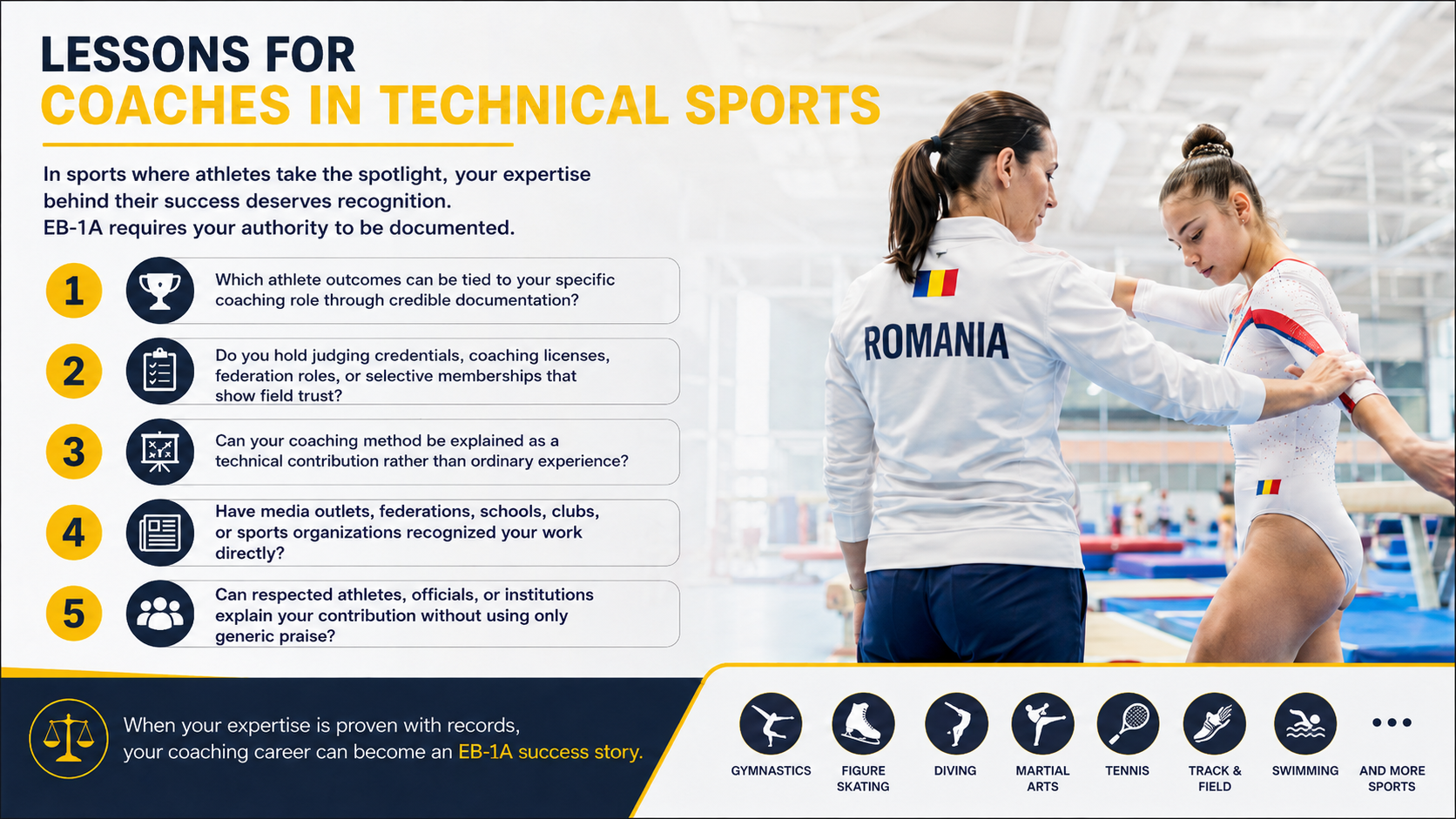
This success story is useful for coaches in gymnastics, figure skating, diving, martial arts, tennis, track and field, swimming, and other sports where the athlete is usually the visible performer. In those fields, the coach's authority often lives in results, credentials, invitations, and insider recognition. EB-1A requires that authority to be documented.
A strong sports-coaching profile usually begins with five questions:
- Which athlete outcomes can be tied to your specific coaching role through credible documentation?
- Do you hold judging credentials, coaching licenses, federation roles, or selective memberships that show field trust?
- Can your coaching method be explained as a technical contribution rather than ordinary experience?
- Have media outlets, federations, schools, clubs, or sports organizations recognized your work directly?
- Can respected athletes, officials, or institutions explain your contribution without using only generic praise?
When those questions are answered with records, not assumptions, a coaching background can become an EB-1A record that an officer can understand.
Frequently asked questions
Can a gymnastics coach qualify for EB-1A?
Yes. A gymnastics coach may qualify if the evidence shows sustained acclaim and extraordinary ability in the coaching field. The petition must document the coach's own role, recognition, and contribution, not only the success of athletes trained by the coach.
Can athlete results support a coach's EB-1A petition?
They can support the case when there is credible evidence connecting the results to the coach's role. Athlete medals, rankings, and international finals are useful only if the petition explains what the coach did and includes documentation from athletes, federations, clubs, or other qualified sources.
Why are judging credentials important in gymnastics EB-1A cases?
Judging credentials can be especially helpful because they show that the sport formally trusted the person to evaluate other athletes. In gymnastics, judging requires technical knowledge of execution, difficulty, apparatus standards, and scoring rules. That can directly support the EB-1A judging criterion when properly documented.
What evidence helps a sports coach show original contributions?
Helpful evidence may include coaching methodology publications, training manuals, education lectures, athlete-development systems, documented protocol adoption, letters from recognized coaches or federations, and results showing that the method was applied in serious competitive settings.
Does a federation coaching license automatically prove EB-1A membership?
Not automatically. A license or membership is strongest when the petition explains the admission or advancement requirements and shows that the credential reflects professional achievement, field trust, or selective recognition rather than simple registration.
Can Immignis and Advance My Profile help coaches build EB-1A evidence?
Immignis and Advance My Profile help coaches, athletes, trainers, and sports-development professionals identify a focused field niche, organize attribution evidence, document recognition, and build a professional record that can be presented clearly in an EB-1A petition.
Build an EB-1A record around the athletes you helped develop
Many coaches are respected by athletes and federations but under-documented in public evidence. That gap can become the central weakness in an EB-1A case. Immignis and Advance My Profile help turn coaching credentials, athlete results, judging authority, development methodology, and institutional recognition into a clearer authority record.