How a Lebanese hospitality concept and brand strategist secured EB-1A approval by turning owner attribution letters, hospitality-press features, concept-portfolio documentation, award submissions, guest lectures, judging service, and remuneration evidence into a petition-ready record.
Key facts at a glance
| Petition outcome | Form I-140 approved under EB-1A on September 4, 2024. |
| Professional profile | Lebanese strategist behind restaurant and hotel concepts that became recognized regional landmarks. |
| Field niche | Hospitality concept development and brand strategy. |
| Starting weakness | The venues were famous, but the strategist behind the concepts was known mostly through word of mouth and private owner relationships. |
| Profile-building focus | Owner attribution letters, hospitality-press features, concept-portfolio documentation, industry-award submissions, hospitality-school guest lectures, judging for F&B awards, and remuneration evidence. |
| EB-1A criteria supported | Leading role, published material, original contributions, judging, and high remuneration. |
| Central issue | Proving that the petitioner personally shaped recognized hospitality concepts rather than relying on the fame of venues alone. |
| Approval lesson | Owner letters and field-facing evidence can convert a hidden hospitality reputation into signed, USCIS-readable proof of extraordinary ability. |
The approval
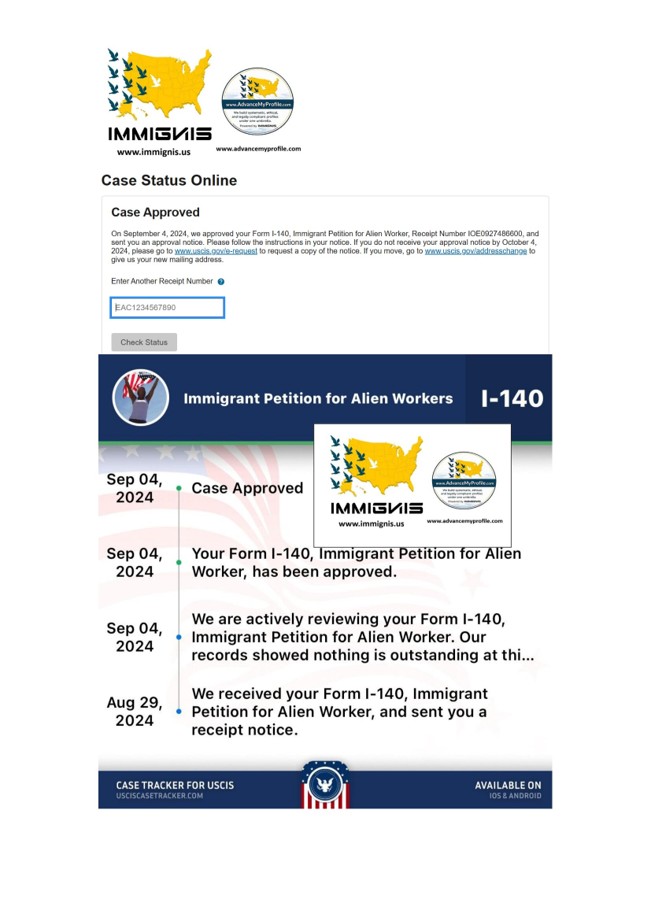
On September 4, 2024, USCIS approved the Form I-140 petition of a Lebanese EB-1A for Hospitality Strategists whose work helped shape restaurant and hotel concepts that became recognized regional destinations.
Inside the hospitality market, his reputation was already meaningful. Owners trusted his concept judgment. Operators relied on his positioning work. Guests knew the venues, even when they did not know the professional who helped build the identity behind them.
For EB-1A, however, venue popularity was not enough by itself. The petition had to show that the petitioner, not only the restaurants or hotels, had earned recognition in a defined field of expertise.
That became the central challenge of the case: converting a word-of-mouth hospitality reputation into signed, officer-readable proof of field-level brand-strategy expertise.
The evidence problem in hospitality brand strategy cases
Hospitality concept work is difficult to document because the strongest proof often appears through the venue itself. A restaurant becomes a landmark. A hotel concept becomes known in the region. A brand identity shapes guest demand. Yet the strategist behind that work may remain invisible behind the owner, chef, operator, or property brand.
The petitioner’s starting weakness was not lack of impact. The problem was attribution. The venues were known, but the paper trail did not clearly show who developed the concept, positioned the brand, shaped the customer experience, or influenced the commercial identity that made the property distinctive.
The case therefore needed a precise field definition. It was not framed as general marketing, ordinary restaurant consulting, or hotel management. It was framed as hospitality concept development and brand strategy, with emphasis on venue identity, market positioning, guest-experience architecture, and launch strategy.
That field definition mattered because it gave USCIS a way to measure the work. The question was not whether a venue was popular. The question was whether the petitioner had become a recognized professional in the specialized field that creates and positions hospitality concepts.
Why famous venues had to become personal evidence
Many hospitality professionals face the same problem. The public remembers the restaurant name, the hotel name, the chef, the investor, or the neighborhood. The strategist who shaped the concept often remains known only inside owner conversations and project meetings.
The petition therefore treated venue fame as a starting point, not as the final argument. It had to connect the success of those venues to the petitioner’s personal work in concept development, brand positioning, market differentiation, and hospitality identity.
This conversion was important because USCIS does not approve a case based on rumors of influence. The record had to show signed attribution, documented project responsibility, and independent recognition that explained why the petitioner’s role mattered.
That shift made the case stronger. Instead of asking USCIS to believe that he was the hidden force behind respected venues, the petition gave the officer direct evidence from owners, project records, media materials, and industry sources.
Owner attribution letters became the backbone of the case
In hospitality concept work, owner letters can be powerful when they are specific, credible, and tied to real projects. A strong letter does not merely praise the strategist. It explains what he was asked to do, what concept problem he solved, how his work shaped the venue, and why the result mattered commercially or culturally.
The petition used owner letters carefully. They identified the venues, described the petitioner’s role, explained the concept and brand decisions, and connected those decisions to the venue’s standing in the market.
The best evidence answered practical questions. What was the original concept challenge? What brand position did the petitioner create? How did his work influence the venue’s identity, guest experience, or market reception? Why did the owner consider his role central rather than peripheral?
Those materials helped convert word-of-mouth reputation into signed testimony. They also solved the main attribution problem by showing that the petitioner’s contribution was not a vague advisory presence, but a real strategic role behind recognizable hospitality concepts.
Leading-role evidence had to show concept authority, not general involvement
Hospitality projects involve many people: owners, chefs, architects, designers, operators, investors, and marketing teams. Because of that, a petition must show the petitioner’s specific role with care. It is not enough to say he was involved in successful venues.
The record documented his authority over concept positioning, brand narrative, market identity, customer-experience direction, launch strategy, and strategic differentiation. It showed that he was trusted to help define what the venue would become, not just to support ordinary promotion after the concept already existed.
That evidence helped establish a leading or critical role within distinguished hospitality projects. It also showed why his work mattered within the wider hospitality market, where concept clarity and brand identity can determine whether a venue becomes memorable or disappears into a crowded field.
For hospitality professionals, this distinction is essential. A venue may become famous. EB-1A requires proof that the petitioner’s own role helped make that reputation possible.
Original contribution in hospitality concept development
Original contribution in hospitality does not always look like a patent, scientific paper, or technical invention. In this field, originality may appear through a distinctive concept, a market-shaping brand approach, a guest-experience model, or a repeatable strategy for turning venues into destination brands.
For this petitioner, the original-contribution argument was built around concept work that owners and industry observers recognized as meaningful. The case showed that his approach helped create hospitality identities that stood out in competitive markets and influenced how venues were perceived by guests, press, and the industry.
That mattered because USCIS looks for contributions of significance, not ordinary job performance. The petition therefore avoided generic claims about creativity and focused on documented project outcomes, industry recognition, and third-party explanation.
The petition did not claim that he personally created every success factor behind each venue. It made a narrower and stronger point: within hospitality concept development and brand strategy, his work was trusted by serious owners and contributed to concepts that gained regional recognition.
Hospitality press made the record visible beyond private projects
The original profile had limited public documentation because hospitality strategy work often happens privately. The venue receives coverage, while the strategist stays behind the brand. Hospitality-press features helped correct that weakness by connecting the petitioner’s name to the concepts, trends, and brand decisions he helped shape.
This evidence was valuable because it translated private project influence into public recognition. Press coverage helped show that his work was not only known by owners, but also visible within the hospitality field.
The petition treated press evidence as support for the broader record. The most useful materials connected him to concept creation, hospitality branding, restaurant and hotel positioning, or recognized venues rather than simply mentioning him in passing.
Concept-portfolio documentation organized the invisible work
A hospitality strategist’s work can be visually and commercially obvious, but legally and professionally undocumented. A concept portfolio helped organize the evidence in a way the officer could understand: venue by venue, concept by concept, and contribution by contribution.
The portfolio did not replace independent evidence. It worked as a roadmap. It showed the pattern of the petitioner’s work across multiple projects and helped tie owner letters, press features, award materials, and public-facing venue records into one coherent narrative.
That structure was important because a single successful restaurant or hotel can be dismissed as one project. A documented portfolio showed sustained work across a niche, making it easier to argue that the petitioner had built recognized expertise in hospitality concept development.
Judging and guest lectures showed peer trust
Judging for food-and-beverage awards, hospitality competitions, or industry recognition programs can be valuable because it shows that the field trusts the petitioner to evaluate the work of others. That is different from self-promotion or employer praise.
Hospitality-school guest lectures also helped when presented properly. They showed that institutions valued the petitioner’s practical expertise enough to place him before students, professionals, or emerging operators as someone who could teach concept strategy and brand thinking.
Together, judging and guest-lecture evidence helped show that the petitioner was not only executing projects privately. He was also recognized as a knowledgeable professional whose expertise had value to the wider hospitality field.
How the EB-1A criteria worked together
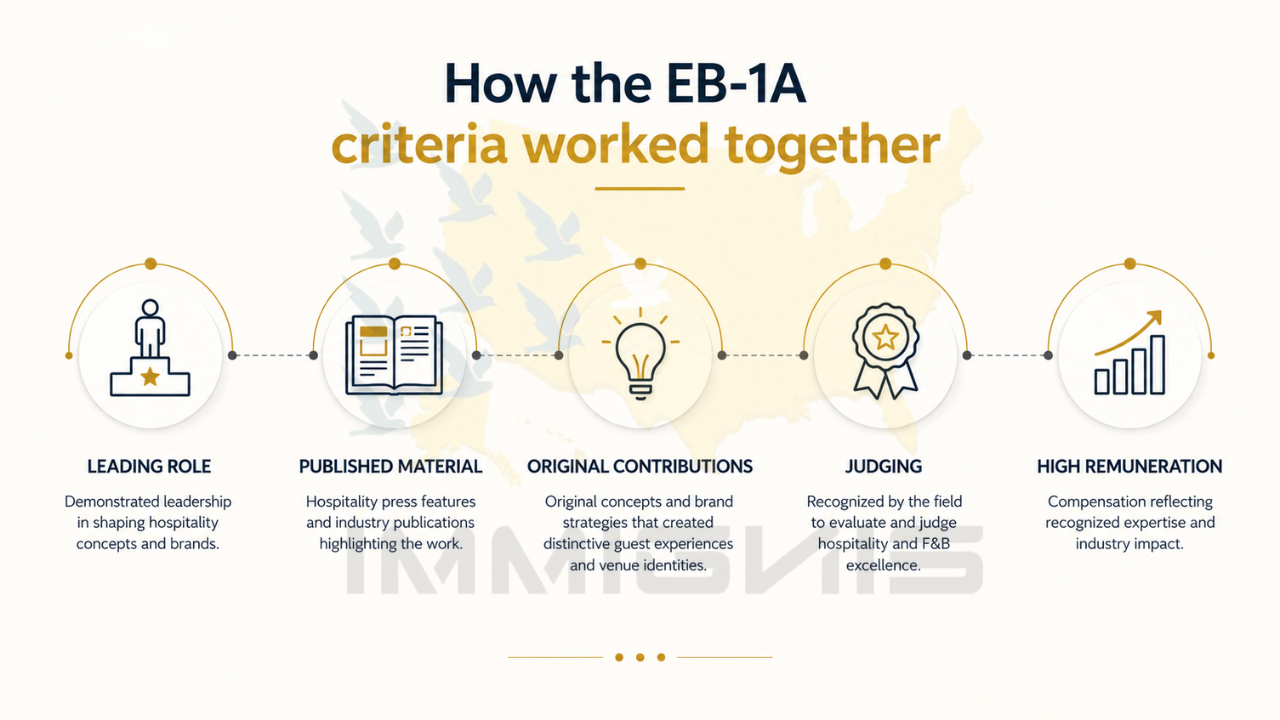
The petition did not depend on one perfect exhibit. It worked because several forms of evidence pointed to the same conclusion: the petitioner had become a recognized hospitality concept and brand-strategy professional whose work was valued beyond ordinary consulting.
- Leading role: Owner letters and project records showed that the petitioner held central concept and brand-strategy responsibility in recognized restaurant and hotel projects.
- Original contributions: Concept-portfolio documentation and professional explanations showed that his work helped create distinctive hospitality identities and destination-level venues.
- Published material: Hospitality-press features made his role visible beyond private owner relationships and helped show recognition in the field.
- Judging: Service for food-and-beverage or hospitality awards showed peer trust and professional standing.
- High remuneration: Compensation and fee evidence supported the claim that the market valued his specialized hospitality-strategy expertise at a high level.
The strongest part of the record was attribution. The case did not rely on the general fame of venues alone. It showed how that fame connected back to the petitioner’s specific role and expertise.
The final-merits argument
At the final-merits stage, the petition had to show that the evidence as a whole established sustained acclaim and extraordinary ability in hospitality concept development and brand strategy.
The argument focused on recognition within the field rather than general public celebrity. The petitioner was not presented as a public-facing restaurant owner or hotelier. He was presented as the strategist whose work helped shape concepts that owners, press, hospitality institutions, and award platforms recognized as meaningful.
The final record showed that his reputation was not merely private gossip. It was supported through signed owner testimony, portfolio documentation, hospitality-press visibility, judging service, guest lectures, award submissions, and remuneration evidence.
That is why the petition became stronger than a standard business or marketing case. It did not simply say he helped famous venues. It proved how his specific concept and brand-strategy work became visible, credited, and valued in the hospitality field.
Why the approval mattered
The approval mattered because it showed how a hospitality strategist can qualify for EB-1A even when the public mainly knows the venues, not the professional behind them. In fields built around experience, atmosphere, and reputation, the evidence must make authorship visible.
For this Lebanese hospitality brand strategist, the petition did not try to manufacture fame. It identified the real proof that already existed and organized it into a record USCIS could evaluate.
The approval confirmed the central lesson of the case: when a professional is known through word of mouth, the petition must convert that reputation into signed attribution, public recognition, and field-level validation.
Lessons for hospitality strategists, brand consultants, and concept developers
This case is useful for hospitality brand strategists, restaurant consultants, hotel concept developers, food-and-beverage advisors, experience-design professionals, and creative business consultants whose work is visible through venues but not always credited publicly.
A strong record usually begins with the following questions:
- Can owners or operators give specific letters explaining the petitioner’s concept and brand-strategy role?
- Can the venue portfolio be documented in a disclosure-safe way with project scope, responsibilities, and outcomes?
- Do hospitality-press features, awards materials, or public records connect the petitioner to recognized concepts?
- Can judging roles, guest lectures, or industry panels show peer trust and field-level credibility?
- Can remuneration or consulting-fee evidence show that the market values the petitioner’s specialized expertise?
When those questions are answered with documents, a behind-the-scenes hospitality career becomes much easier for USCIS to understand. That is often the difference between being rumored as influential and being proven as extraordinary.
Frequently asked questions
Can a hospitality brand strategist qualify for EB-1A?
Yes. A hospitality brand strategist may qualify for EB-1A if the evidence shows sustained acclaim and extraordinary ability in a defined field such as hospitality concept development, restaurant brand strategy, hotel positioning, or guest-experience design.
Can famous restaurant or hotel projects support an EB-1A petition?
Yes, but the petition must connect the success of those venues to the petitioner’s own work. Useful evidence may include owner letters, project records, concept portfolios, press features, award materials, and independent expert letters.
Are owner attribution letters useful in EB-1A hospitality cases?
Yes. Owner letters can be very useful when they are specific, credible, and explain the petitioner’s actual role, the importance of the project, and how the petitioner’s work shaped the venue’s concept, brand, or market success.
Does hospitality-press coverage help prove extraordinary ability?
Yes. Hospitality-press features, industry commentary, and venue coverage can help when they connect the petitioner to recognized concepts and show that his work is visible within the field.
Can judging food-and-beverage awards support EB-1A?
Yes. Judging or evaluating food-and-beverage, restaurant, hotel, or hospitality awards can support EB-1A because it shows that the field trusts the petitioner to assess the work of others.
Can Immignis and Advance My Profile help hospitality professionals build EB-1A evidence?
Immignis and Advance My Profile help hospitality strategists, brand consultants, concept developers, and creative business professionals define a credible field niche, document attribution, improve visibility, and build a petition-ready EB-1A evidence record.
Turn hospitality reputation into signed, petition-ready evidence
Many hospitality professionals shape famous venues while remaining invisible behind owners, chefs, hotel brands, and restaurant groups. EB-1A success depends on making that contribution visible, documented, and independently validated.