EB-1A for Maritime Engineers explains how a Panamanian maritime-logistics engineer secured approval by turning canal transit scheduling, water-management optimization, drought-response engineering, and binational trade infrastructure work into a petition-ready immigration profile built through ethical profile building, operations-innovation documentation, maritime-engineering publication, shipping-forum visibility, trade-press commentary, professional-society roles, and immigration-specific profile building.
Key facts at a glance
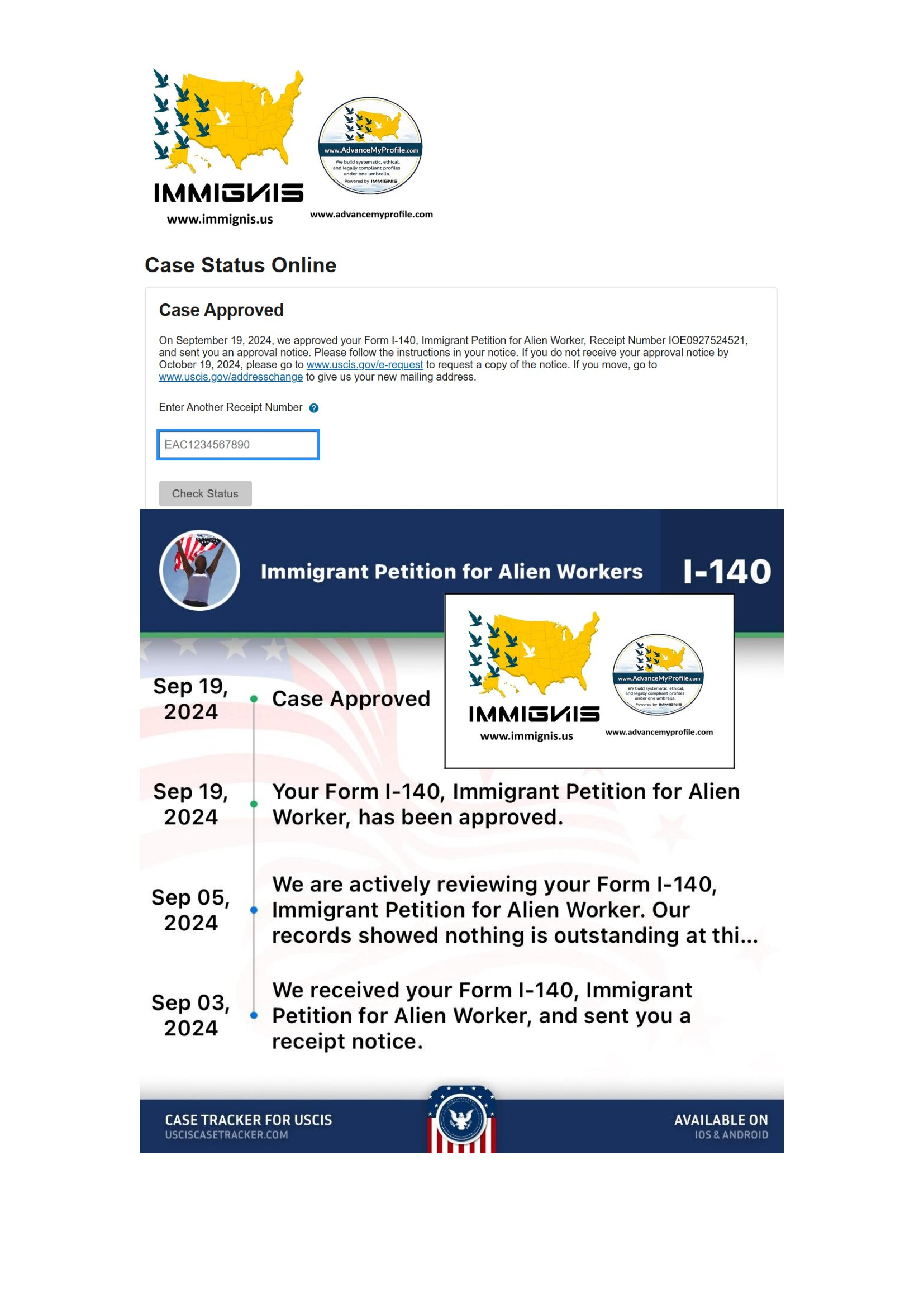
| Petition outcome | Form I-140 approved under EB-1A on September 19, 2024. |
| Professional profile | Panamanian maritime-logistics engineer optimizing transit scheduling and water management for interoceanic canal operations. |
| Field niche | Canal operations engineering under climate-driven water constraints. |
| Starting weakness | The canal was globally famous, but the engineers behind transit reliability, water allocation, and operations optimization were treated as internal staff and rarely named publicly. |
| Profile-building focus | Operations-innovation documentation, maritime-engineering publication, international shipping-forum talks, trade-press commentary on drought response, professional-society roles, expert letters, and immigration-specific profile building. |
| EB-1A criteria supported | Leading role, original contributions, published material, scholarly articles, and membership. |
| Central issue | Showing that the petitioner was not just a staff engineer inside a famous canal system, but a specialist whose optimization work helped protect a globally significant shipping corridor under climate-driven water stress. |
| Approval lesson | Infrastructure engineers can build strong EB-1A profiles when internal operational impact is converted into person-centered, verifiable evidence through profile building, publication, expert validation, and field-specific documentation. |
The approval
On September 19, 2024, USCIS approved the Form I-140 petition of a Panamanian maritime-logistics engineer whose work focused on canal operations engineering under climate-driven water constraints.
The approval was significant because the petitioner worked in one of the most globally visible infrastructure systems in the world, yet the individual engineering record was not naturally visible. The canal was famous. The commercial disruption was newsworthy. The drought response affected global shipping. But the engineer behind scheduling logic, transit optimization, and water-management improvements could easily disappear inside institutional credit.
That made the case a strong example of EB-1A profile building and immigration profile building. The petitioner already had meaningful work, but the record had to be rebuilt so USCIS could see the person behind the operations system, not only the institution that employed him.
Immignis and Advance My Profile helped convert the petitioner's internal engineering impact into a petition-ready EB-1A profile. The strategy focused on operations-innovation documentation, maritime-engineering publication, international shipping-forum talks, trade-press commentary on drought response, professional-society roles, expert letters, and immigration-specific profile building that connected the evidence to the correct EB-1A criteria.
The evidence problem in canal operations engineering
Canal operations engineering is a highly specialized field because it sits at the intersection of hydrology, shipping logistics, infrastructure reliability, transit scheduling, climate adaptation, and international trade. When water levels decline or traffic patterns change, the consequences can reach ports, manufacturers, shipping lines, commodity markets, and national economies far beyond the country where the canal is located.
Yet the individual engineer's role can be hard to document. Operations improvements are usually internal. Scheduling models may be proprietary. Water-allocation decisions may be tied to government or authority-level communications. Media coverage often names the canal, the authority, or the crisis, but not the engineer who helped build the technical response.
That was the petitioner's starting weakness. The work mattered, but the paper trail did not naturally identify him. He was classified as staff inside a famous system. Without careful profile improvement, the case could have looked like ordinary employment at an important organization rather than extraordinary ability in a defined engineering niche.
The petition therefore defined the field precisely as canal operations engineering under climate-driven water constraints. It did not present the case as general civil engineering, generic logistics, or routine infrastructure management. It framed the petitioner as a maritime-logistics engineer working on the operational survival of a critical trade corridor during climate-related water stress.
That field definition gave USCIS a measuring stick. It explained why transit scheduling, water management, drought-response commentary, shipping-forum participation, and operations-innovation documentation were not scattered work duties, but evidence of field-level expertise.
Why the canal's fame had to be separated from the engineer's achievement
A famous institution can help an EB-1A case, but it can also create a problem. USCIS may understand that the canal is important, but still ask why the petitioner personally qualifies. The petition therefore had to separate the institution's reputation from the engineer's individual contribution.
The case did this by identifying the petitioner's role in transit scheduling, water-use optimization, operations planning, and drought-response engineering. It linked specific operational challenges to specific professional input, showing how his work helped keep transit systems functional under constraints that affected global shipping.
This person-centered approach was essential. It moved the case away from a general statement that the petitioner worked for a famous canal system and toward a detailed record showing what he did, why it mattered, and how his work fit into a narrow technical field.
As part of immigration-specific profile building, this was the turning point. The petition turned institutional prestige into individualized evidence. The canal was the stage, but the petitioner's engineering work became the story.
Operations-innovation documentation made internal impact visible
Operations-innovation documentation became one of the strongest pillars of the case. Canal engineering achievements are often not public in the way academic discoveries or consumer products are public. The evidence therefore had to show internal innovation through cleared records, technical summaries, project descriptions, performance indicators, and expert-supported explanations.
The petition organized the evidence around practical operational questions: how transit scheduling was optimized, how water use was managed, how drought-related constraints were addressed, how vessel movement was stabilized, and how engineering decisions affected reliability for shippers and canal users.
This documentation supported original contributions because it showed that the petitioner's work was not routine maintenance. It involved solving technical problems in a globally important system where small improvements can affect shipping capacity, delay reduction, resource efficiency, and confidence in trade-route reliability.
For professionals searching for profile building, EB-1A profile building, EB-2 NIW profile building, infrastructure profile building, engineering profile improvement, or USCIS evidence building, this case shows why internal technical achievements must be translated into clear, attribution-based evidence rather than left buried in employer records.
Maritime-engineering publication gave the work a public technical record
Publication evidence helped convert the petitioner's practical operations experience into a public professional record. In infrastructure engineering cases, publication does not always need to look like a long academic citation record. It can include maritime-engineering articles, technical papers, industry white papers, conference proceedings, or professional commentary that explains methods and lessons from the work.
The petition used maritime-engineering publication to show that the petitioner's expertise was not trapped entirely inside the canal authority. His technical knowledge could be expressed, shared, and evaluated by a broader professional audience.
This evidence supported scholarly-articles and published-material arguments while also strengthening the original-contributions discussion. It showed that the petitioner was not only applying known methods, but helping develop and communicate knowledge about canal operations, water constraints, and maritime logistics under climate stress.
As part of publication profile building and professional profile building for immigration, this step gave the case a more visible technical identity. It made the petitioner searchable, citeable, and easier for USCIS to place inside a field.
Shipping-forum talks and trade-press commentary created field visibility
International shipping-forum talks helped show that the petitioner's expertise had value beyond his employer. Forums in shipping, port operations, maritime logistics, canal resilience, and climate adaptation are places where professionals exchange solutions to industry-wide problems.
The petition used these talks to show recognition. The petitioner was not merely executing internal tasks. He was invited to explain operational lessons, drought-response challenges, canal-capacity issues, and water-management strategies to audiences connected to global shipping and maritime infrastructure.
Trade-press commentary added another layer of public visibility. During canal drought events, the shipping world looks for explanations of transit delays, draft limits, scheduling changes, and long-term resilience. Commentary connected to those issues helped show that the petitioner's expertise was relevant to the broader industry conversation.
This was valuable profile building. It converted a staff engineer's specialized internal knowledge into professional visibility without overstating the record. The evidence showed that the field needed his perspective because the climate-vs-canal problem had become a global logistics issue.
Professional-society roles helped place the petitioner inside the field's hierarchy
Professional-society roles helped show that the petitioner belonged to the recognized technical community of maritime engineers, logistics specialists, infrastructure professionals, or water-management experts. In engineering cases, membership evidence becomes stronger when the organization is selective, specialized, or tied to meaningful professional activity rather than simple fee-based enrollment.
The petition used professional-society roles to show engagement with the field beyond employment. Participation in technical committees, working groups, conference panels, professional associations, or standards discussions can help demonstrate that the petitioner's expertise was taken seriously by peers.
This evidence supported the membership and leading-role discussions while reinforcing the final merits analysis. It showed that the petitioner's work was not isolated inside one employer but connected to professional networks concerned with shipping reliability, canal operations, climate resilience, and maritime engineering.
For engineering profile building and immigration profile building, these roles are important because they show professional identity. They help USCIS see not only what the petitioner did, but where he stood within the broader technical ecosystem.
Expert letters explained why climate-driven canal work mattered globally
Expert letters helped translate the technical and economic significance of the work for a non-specialist immigration audience. A USCIS officer may understand that a canal is important, but may not immediately understand how scheduling algorithms, water-management models, or transit-planning decisions can affect global trade.
The strongest letters explained the petitioner's role in practical terms. They described the relationship between drought, water availability, vessel movement, transit capacity, delay management, and supply-chain reliability. They also clarified why the petitioner's work reflected specialized expertise rather than routine staff participation.
These letters were especially useful because they connected the petitioner's work to the global conversation around climate adaptation in infrastructure. Canal operations are no longer only a local engineering issue. They are part of the world's changing logistics map.
As part of ethical profile building, the expert letters did not exaggerate the petitioner into the sole reason the canal functioned. Instead, they showed his individual contribution inside a complex system and explained why that contribution was significant in the field.
How profile building changed the case
The case changed once the evidence was organized around the petitioner rather than around the canal alone. The canal's importance was already obvious. The missing piece was attribution.
Immignis and Advance My Profile helped build that attribution. The profile-building process connected internal operations documentation, publication, shipping-forum visibility, trade-press commentary, professional-society roles, and expert letters into one coherent EB-1A record.
This was not artificial publicity. It was profile improvement, evidence development, and immigration-specific profile building. The goal was to make real engineering expertise visible in a field where staff engineers are often hidden behind institutional systems.
For professionals searching online for profile building, immigration profile building, EB-1A profile building, EB-2 NIW profile building, professional profile building for engineers, or help improving a technical immigration profile, this case shows how internal infrastructure work can be converted into a legally readable extraordinary-ability record.
Why this case worked
The case worked because it avoided a vague infrastructure story. It did not say only that the petitioner worked for a famous canal or helped with important operations. It defined a narrow field, documented individual contribution, and connected each piece of evidence to the EB-1A criteria.
Operations-innovation documentation showed original contribution. Maritime-engineering publication gave the work a public technical record. Shipping-forum talks and trade-press commentary showed professional visibility. Professional-society roles supported membership and field engagement. Expert letters explained why the work mattered globally.
Most importantly, the petition solved the staff-engineer problem. It showed that the petitioner's work was not lost inside the canal's name. His technical decisions, operational knowledge, and climate-response expertise could be identified, documented, and evaluated.
That is why the approval hook was so strong: climate-vs-canal drama gave a staff engineer a global stage, but the petition still had to prove the engineer belonged on that stage.
Conclusion
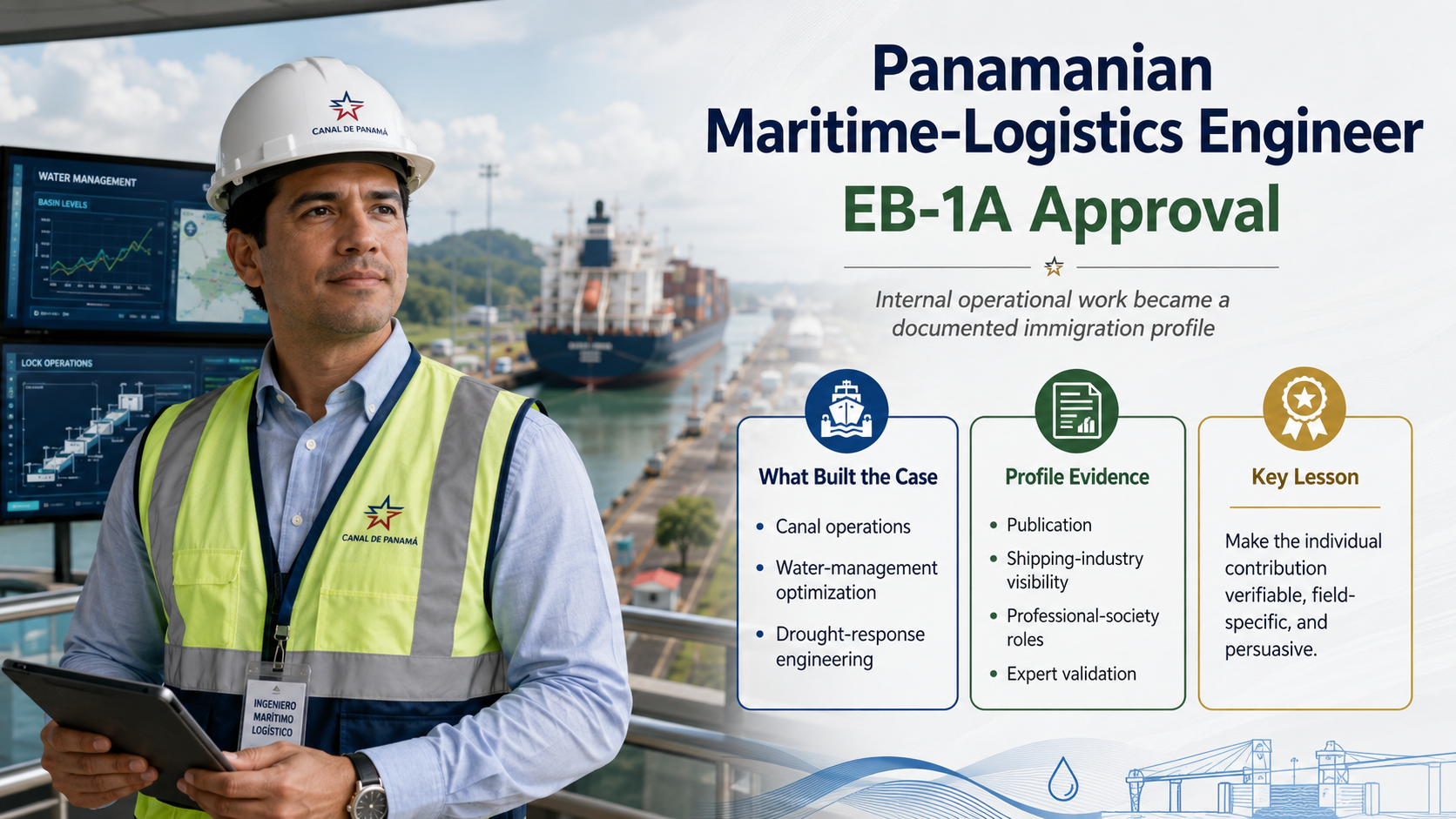
The Panamanian maritime-logistics engineer's EB-1A approval shows that infrastructure professionals can build strong extraordinary-ability cases even when their achievements are internal, operational, and attached to a famous public asset.
The petition succeeded because it used ethical profile building to connect canal operations, water-management optimization, drought-response engineering, publication, shipping-industry visibility, professional-society roles, and expert validation into a person-centered immigration profile.
The broader lesson is clear: when a megaproject is famous but the engineer is invisible, a strong EB-1A strategy must extract the individual contribution from the institution and make it verifiable, field-specific, and legally persuasive.
Frequently asked questions
Can a maritime-logistics engineer qualify for EB-1A?
Yes. A maritime-logistics engineer may qualify for EB-1A when the record shows extraordinary ability through original contributions, leading roles, published material, scholarly or technical publication, professional membership, and strong final-merits evidence.
Can canal operations or infrastructure engineering support an EB-1A petition?
Yes. Canal operations, port systems, maritime logistics, water-management engineering, and climate-resilience infrastructure can support EB-1A when the petition defines the niche clearly and documents the petitioner's individual contribution.
How can internal engineering work be used for EB-1A evidence?
Internal engineering work can be useful when it is supported by cleared documentation, attribution letters, project summaries, technical publications, conference presentations, expert letters, and other evidence that connects the work to the petitioner personally.
Do trade-press interviews help an engineering EB-1A case?
Yes. Trade-press commentary can support published material and professional visibility when it shows that the petitioner's expertise is relevant to industry conversations and not merely self-promotion.
Can climate-related infrastructure work strengthen an EB-1A profile?
Yes. Climate-driven infrastructure challenges can strengthen a case when the petitioner's work addresses nationally or globally significant technical problems and the record includes strong evidence of impact and recognition.
Can Immignis and Advance My Profile help engineers build EB-1A evidence?
Yes. Immignis and Advance My Profile help engineers, maritime professionals, infrastructure specialists, and technical leaders define a precise field niche, document achievements, improve visibility, and build petition-ready EB-1A or EB-2 NIW profiles through ethical profile building and immigration-specific evidence development.
Build an EB-1A record around infrastructure engineering, maritime logistics, and climate-resilience expertise
Many engineers already have high-impact work, but the evidence is often locked inside employer systems, project documents, technical committees, conference records, or industry communications.